What Is Teamwork? Definition, Importance, Skills & Practical Examples
What Is Teamwork? Definition, Importance, Skills & Practical Examples
Teamwork is one of the most important skills people can develop for education, careers and professional life. Almost every modern workplace requires people to work with others in some form. Employees collaborate with colleagues, managers, customers, clients, vendors, partners and teams from different departments.
However, teamwork is much more than simply working alongside other people.
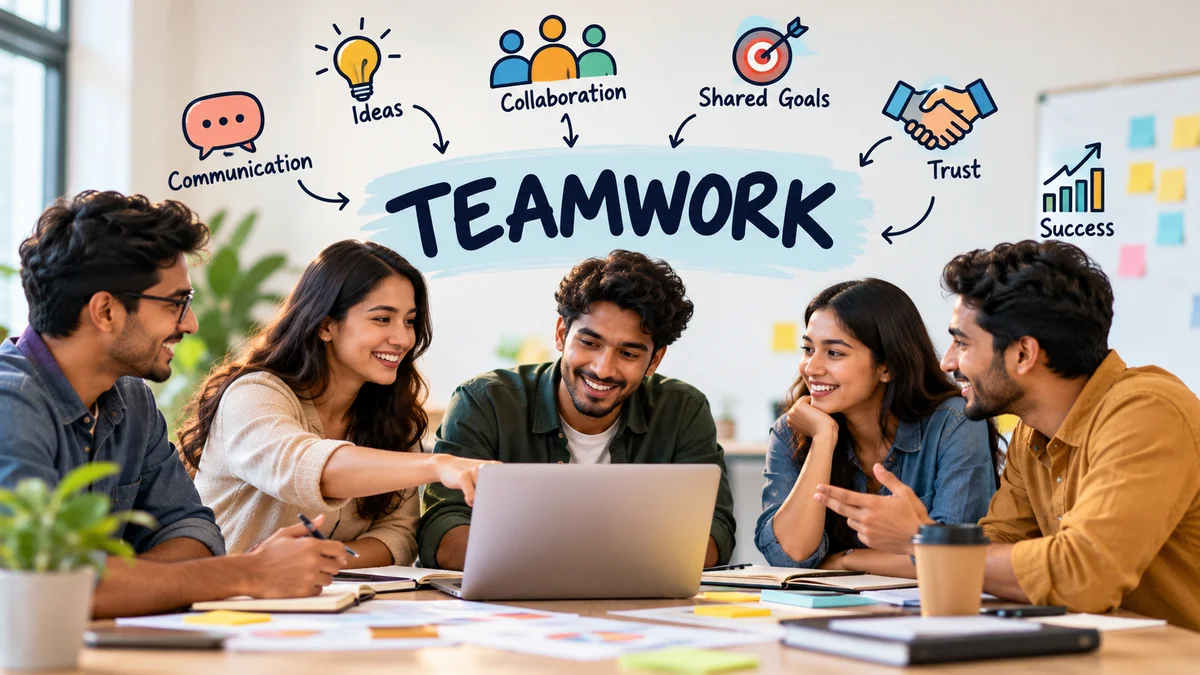
True teamwork means combining individual skills, knowledge, responsibilities and effort to achieve a shared objective. It involves communication, cooperation, trust, accountability, respect, problem solving, adaptability and a willingness to support the overall success of the team.
A team can contain highly talented individuals and still fail if those individuals do not communicate properly, misunderstand responsibilities, hide problems, miss deadlines or refuse to consider other perspectives.
On the other hand, a team made up of people with different levels of experience can achieve excellent results when members communicate clearly, understand their responsibilities, support one another and remain focused on a common goal.
This guide explains what teamwork means, why it is important, how effective teamwork works, the most important teamwork skills, common challenges teams face, practical workplace examples, teamwork for students and freshers, teamwork interview questions and practical ways to become a stronger team member.
---
1. What Is Teamwork?
Teamwork is the process of people working together toward a common goal by combining their skills, knowledge, effort and responsibilities.
A simple definition is:
Teamwork is the ability of individuals to cooperate and coordinate their efforts to achieve a shared objective.
The important part of this definition is the idea of a shared objective.
Imagine five employees sitting in the same office and working on five completely unrelated tasks. They are part of the same organization, but they are not necessarily demonstrating teamwork.
Now imagine five employees working together to launch a new product.
One person manages the project.
Another develops the product.
Another creates the design.
Another prepares the marketing campaign.
Another analyzes customer data.
Each person has a different responsibility, but all of them are working toward the same outcome.
That is teamwork.
Teamwork does not require everyone to perform the same task.
In fact, effective teams often work precisely because people have different skills and responsibilities.
The goal is to coordinate those differences effectively.
---
2. Teamwork vs Working in a Group
The words “group” and “team” are often used interchangeably, but there is an important difference.
A group is simply a collection of people.
A team is a group of people who coordinate their efforts around a shared objective.
For example, ten employees may belong to the same department. They are a group.
If those employees are working together on a specific project, sharing information, dividing responsibilities and coordinating their work, they are functioning as a team.
A team normally includes:
• A common objective
• Defined responsibilities
• Communication
• Coordination
• Interdependence
• Accountability
• Cooperation
The difference becomes particularly important in professional environments.
Simply placing people together does not automatically create an effective team.
The people must also understand how their individual work contributes to the overall objective.
---
3. Why Is Teamwork Important?
Teamwork is important because modern work is often too complex for one person to manage effectively.
Consider a company launching a new digital product.
The project may require:
• Product planning
• Market research
• Design
• Software development
• Data analysis
• Marketing
• Sales
• Customer support
• Finance
• Legal review
• Project management
One person is unlikely to be an expert in all these areas.
A team allows specialists to contribute their knowledge while coordinating toward the same outcome.
Teamwork can help organizations:
• Solve complex problems
• Complete projects
• Share knowledge
• Improve productivity
• Reduce duplicated work
• Generate new ideas
• Make better decisions
• Support customers
• Respond to challenges
• Develop employees
Good teamwork also allows organizations to make better use of different people's strengths.
---
4. The Main Purpose of Teamwork
The purpose of teamwork is not simply to make people work together.
The purpose is to make collective effort more effective.
A team should ideally accomplish something that would be more difficult, slower or less effective if every person worked independently.
For example, a product development team combines:
• Technical expertise
• Business knowledge
• Design skills
• Customer understanding
• Project management
The collective result can be stronger than the contribution of any one person.
This is sometimes described as the value of combining complementary skills.
---
5. The Key Elements of Effective Teamwork
Effective teamwork usually depends on several important elements.
These include:
1. A clear shared goal
2. Defined responsibilities
3. Effective communication
4. Active listening
5. Trust
6. Accountability
7. Respect
8. Cooperation
9. Problem solving
10. Adaptability
11. Constructive feedback
12. Reliability
13. Good leadership
14. Appropriate decision making
15. Shared responsibility
Not every team will have all these characteristics at the same level.
However, the stronger these elements are, the more likely the team is to work effectively.
---
6. Clear Goals
A team needs a clear understanding of what it is trying to achieve.
A vague goal can create confusion.
For example:
“Improve our marketing.”
This does not tell the team exactly what success means.
A clearer objective might be:
“Increase qualified website leads by 20% over the next quarter while maintaining the agreed acquisition cost.”
Now the team has a clearer direction.
Team members can understand:
• What they are trying to accomplish
• How success will be measured
• What timeframe applies
• Which activities matter
Clear goals reduce unnecessary effort and help teams prioritize.
---
7. Shared Understanding
Having a goal is not enough.
Everyone needs to understand the goal in a reasonably consistent way.
Imagine a manager says:
“Complete the project as soon as possible.”
One employee may think this means tomorrow.
Another may think it means next week.
Another may focus on completing quickly even if quality is reduced.
A better approach is to clarify:
• The deadline
• Expected deliverables
• Quality standards
• Responsibilities
• Review process
• Dependencies
The more important the project, the more valuable this clarity becomes.
---
8. Defined Roles and Responsibilities
Every team member should understand what they are responsible for.
A simple question can help:
“Who owns this task?”
For example:
Project Manager:
Responsible for overall coordination.
Designer:
Responsible for visual design.
Developer:
Responsible for implementation.
Content Specialist:
Responsible for written content.
QA Specialist:
Responsible for testing.
Marketing Specialist:
Responsible for promotion.
Without clear ownership, tasks can easily be duplicated or ignored.
Someone may assume another person is handling an activity while that person assumes someone else is responsible.
Clear roles reduce this problem.
---
9. Communication
Communication is one of the foundations of teamwork.
Team members need to communicate:
• What they are working on
• What has been completed
• What is delayed
• What has changed
• What they need from others
• What risks have appeared
• What decisions have been made
Good communication is not about constantly sending messages.
It is about providing relevant information at the right time.
Too little communication creates uncertainty.
Too much unnecessary communication can create noise.
Effective teams find a useful balance.
---
10. Active Listening
Teamwork requires both speaking and listening.
A person may communicate clearly but still be a poor team member if they never listen to others.
Active listening involves:
• Paying attention
• Understanding the speaker
• Asking clarifying questions
• Avoiding unnecessary interruption
• Confirming understanding
• Considering the other person's perspective
For example, instead of immediately responding to a colleague's idea, you could say:
“So, if I understand correctly, you're suggesting that we change the process before the next campaign. Is that right?”
This confirms understanding before discussion continues.
---
11. Asking Questions
Asking questions is an important teamwork skill.
Some people avoid asking questions because they worry that others will think they do not understand.
In reality, asking an appropriate question early can prevent a much larger mistake later.
Useful questions include:
“What is the final deadline?”
“Which version should I use?”
“Who needs to approve this?”
“Should I prioritize this task over the other task?”
“What happens if this dependency is delayed?”
“Can you clarify what success looks like?”
Good questions improve clarity.
---
12. Trust
Trust allows team members to rely on each other.
If an employee says:
“I will complete the report by Thursday,”
the rest of the team should be able to plan around that commitment.
Trust develops through repeated behavior.
People build trust when they:
• Keep commitments
• Communicate honestly
• Admit mistakes
• Share relevant information
• Meet deadlines
• Support colleagues
• Take responsibility
Trust can be damaged when people repeatedly hide problems, miss commitments without explanation or blame others.
---
13. Accountability
Accountability means accepting responsibility for your work, decisions and commitments.
Suppose an employee discovers that they made an error in a report.
A weak response might be:
“The data was confusing.”
A stronger response might be:
“I found an error in the report. I corrected it and reviewed the remaining figures to make sure there are no similar issues.”
The second response demonstrates accountability.
Accountability does not mean accepting blame for everything.
It means being honest about your own contribution and taking appropriate action.
---
14. Respect
Teams contain people with different:
• Experiences
• Skills
• Opinions
• Personalities
• Communication styles
• Working preferences
Respect means treating other people professionally even when you disagree.
Respect does not require agreement.
You can disagree strongly with an idea while still treating the person who proposed it respectfully.
For example:
“I understand the reasoning behind that approach, but I have concerns about the implementation time. Could we compare it with another option?”
This is more constructive than:
“That idea is terrible.”
---
15. Cooperation
Cooperation means being willing to work with others toward the shared objective.
Cooperation can involve:
• Sharing information
• Helping colleagues
• Reviewing work
• Coordinating schedules
• Providing feedback
• Offering assistance when appropriate
Cooperation does not mean doing everyone else's work.
It means recognizing when another person's success depends on coordination with you.
---
16. Collaboration
Collaboration goes beyond simply working next to another person.
It involves jointly contributing to a result.
For example, a marketing specialist and sales specialist may collaborate to improve lead quality.
The marketing team may analyze campaign data.
The sales team may provide feedback about lead quality.
Together they may adjust targeting and messaging.
That is collaboration.
---
17. Reliability
Reliable team members are predictable in a positive way.
If they make a commitment, others can generally depend on them.
Reliability means:
• Meeting agreed deadlines
• Completing assigned work
• Communicating changes
• Following through
• Raising problems early
Reliability is particularly important when tasks are dependent on one another.
One person's delay can create delays for several other people.
---
18. Adaptability
Teams operate in changing environments.
Requirements may change.
Customers may change their expectations.
Budgets may change.
Technology may change.
Deadlines may change.
Team members may change.
An effective team adapts to new circumstances.
For example, if a client changes a major requirement halfway through a project, the team may need to determine:
• What changed?
• What work is affected?
• What needs to be removed?
• What needs to be added?
• Does the deadline change?
• Who needs to be informed?
Adaptability helps teams respond without losing focus.
---
19. Problem Solving
Teams regularly encounter problems.
A useful problem-solving process is:
1. Define the problem.
2. Gather information.
3. Identify possible causes.
4. Generate potential solutions.
5. Compare the options.
6. Select an approach.
7. Implement it.
8. Review the result.
Teamwork makes problem solving stronger when people contribute different perspectives.
One person may identify a technical problem.
Another may identify a process problem.
Another may identify a customer issue.
Together they may discover the root cause.
---
20. Constructive Feedback
Feedback helps teams improve.
Good feedback should be:
• Specific
• Relevant
• Respectful
• Timely
• Actionable
Instead of saying:
“This presentation is bad.”
A better statement would be:
“The presentation contains useful information, but the main findings are difficult to identify. We could make the first slide more concise and move the supporting details to later slides.”
This gives the person something practical to improve.
---
21. Receiving Feedback
Teamwork also requires the ability to receive feedback.
When someone gives constructive feedback:
• Listen
• Ask questions
• Avoid immediately becoming defensive
• Consider whether the feedback is valid
• Decide what action is appropriate
A professional response might be:
“Thanks for pointing that out. I hadn't noticed the issue. I'll review it and make the changes.”
Receiving feedback does not mean accepting every opinion as correct.
It means being willing to evaluate feedback objectively.
---
22. Empathy
Empathy means trying to understand another person's perspective.
Suppose a colleague misses a deadline.
You could immediately conclude:
“They are careless.”
Or you could ask:
“Is something blocking the task?”
You may discover:
• A technical issue
• An unclear requirement
• A dependency
• An unrealistic deadline
• An excessive workload
• An unexpected problem
Empathy does not eliminate accountability.
It simply encourages people to understand the situation before reacting.
---
23. Emotional Intelligence and Teamwork
Emotional intelligence can support effective teamwork.
Important abilities include:
• Self-awareness
• Emotional control
• Empathy
• Social awareness
• Relationship management
Imagine a meeting becoming increasingly tense.
An emotionally aware team member might recognize that the discussion is becoming personal and redirect the conversation toward the actual problem.
This can prevent unnecessary conflict.
---
24. Teamwork and Leadership
Leadership and teamwork are closely connected.
A leader needs teamwork skills because leadership involves working with people.
At the same time, teamwork is not limited to managers.
Any employee can demonstrate leadership by:
• Taking ownership
• Helping others
• Solving problems
• Communicating clearly
• Supporting colleagues
• Making responsible decisions
• Encouraging constructive discussion
You can demonstrate leadership without having a leadership title.
---
25. Teamwork Does Not Mean Everyone Does Everything Together
A common misunderstanding is that teamwork means every person must participate in every task.
That is not efficient.
Good teams allow people to work independently where appropriate while coordinating when their responsibilities intersect.
For example:
A developer may spend several hours coding independently.
A designer may work independently on a visual layout.
A tester may independently prepare test cases.
They still need to coordinate where their work depends on one another.
Effective teamwork combines independence and collaboration.
---
26. Teamwork Does Not Mean Agreeing With Everyone
A strong team should be able to disagree.
Healthy disagreement can improve decisions.
For example:
“I understand the proposed approach, but I am concerned about the long-term maintenance cost. Could we compare it with another option?”
This challenges the idea without attacking the person.
Teams should not confuse harmony with effectiveness.
Sometimes the best teamwork involves respectful disagreement.
---
27. Teamwork Does Not Mean Avoiding Responsibility
Teamwork does not mean:
“Everyone is responsible, so nobody is responsible.”
Strong teams combine individual accountability with shared responsibility.
Each person owns their work.
At the same time, everyone cares about the overall outcome.
This balance is important.
---
28. Benefits of Teamwork
Effective teamwork can provide several benefits.
### Better Problem Solving
Different perspectives can help identify problems and solutions.
### Better Knowledge Sharing
Team members can teach one another.
### Greater Efficiency
Responsibilities can be distributed appropriately.
### Improved Decision Making
Different viewpoints can reveal risks and opportunities.
### Professional Development
People can learn from colleagues.
### Stronger Relationships
Effective cooperation can build trust.
### Greater Resilience
Teams can respond to challenges more effectively when people support one another.
---
29. Teamwork Improves Knowledge Sharing
A team should not depend entirely on one person knowing everything.
Knowledge sharing can include:
• Processes
• Tools
• Industry information
• Customer insights
• Technical knowledge
• Lessons learned
• Best practices
For example, when an experienced employee teaches a new employee how a process works, the organization becomes less dependent on one person's individual knowledge.
Documentation can make this knowledge easier to retain.
---
30. Teamwork Supports Learning
Working with other people exposes you to different approaches.
You may discover:
• A better way to solve a problem
• A new tool
• A different communication method
• A more efficient process
• A new industry perspective
This makes teamwork valuable for professional development.
You are not only contributing to the team.
You are also learning from it.
---
31. Teamwork and Productivity
Teamwork can improve productivity when work is properly coordinated.
Suppose four people work on a project.
Without coordination, two people may accidentally complete the same task while another important task is ignored.
With clear responsibilities, work can be divided.
For example:
Person A:
Research
Person B:
Analysis
Person C:
Implementation
Person D:
Quality review
This can reduce duplicated effort.
However, task division alone does not create teamwork.
The team still needs communication and coordination.
---
32. Teamwork and Time Management
Time management affects the entire team.
Imagine the following sequence:
The designer needs three days to complete a design.
The developer needs the design before beginning development.
The tester needs the completed development before testing.
If the designer is delayed by three days, the entire schedule may be affected.
This is why team members should understand dependencies.
If you know that your delay will affect someone else, communicate it early.
---
33. Teamwork and Decision Making
Teams often have to make decisions.
A useful decision-making process is:
1. Define the decision.
2. Gather relevant information.
3. Identify alternatives.
4. Discuss advantages and disadvantages.
5. Consider risks.
6. Select an option.
7. Assign responsibility.
8. Review the result.
Not every decision needs a long meeting.
Simple decisions can be handled quickly.
Complex decisions require more analysis.
---
34. Teamwork and Meetings
Meetings can support teamwork, but meetings should have a purpose.
Before a meeting, ask:
Why are we meeting?
What needs to be decided?
Who needs to attend?
What information is required?
After a meeting, the team should ideally know:
• What was decided
• Who owns each action
• What the deadline is
• What happens next
A meeting without clear outcomes can create more confusion rather than less.
---
35. Teamwork and Documentation
Documentation is especially valuable for large and remote teams.
Useful documentation may include:
• Project plans
• Meeting decisions
• Process documents
• Task ownership
• Requirements
• Technical notes
• Reports
• Guidelines
• Checklists
Documentation reduces dependence on memory and helps people who were not present during a conversation understand what happened.
---
36. Common Teamwork Challenges
Even strong teams experience difficulties.
Common challenges include:
• Poor communication
• Unclear responsibilities
• Lack of trust
• Conflicting priorities
• Unequal workload
• Missed deadlines
• Personality conflicts
• Poor leadership
• Information silos
• Lack of accountability
• Resistance to feedback
• Groupthink
• Micromanagement
The objective is not to create a team that never experiences problems.
The objective is to build a team that can identify and solve problems effectively.
---
37. Poor Communication
Poor communication can create:
• Misunderstandings
• Delays
• Rework
• Incorrect assumptions
• Conflict
For example, suppose a project requirement changes.
If only one team member receives the update, other team members may continue working on the old requirement.
The solution is not necessarily more meetings.
The solution is clear and timely communication.
---
38. Unclear Responsibilities
If nobody knows who owns a task, the task may not be completed.
For important work, clarify:
Who is responsible?
Who contributes?
Who reviews?
Who approves?
Who needs to be informed?
Clear ownership reduces confusion.
---
39. Unequal Workload
Sometimes one employee ends up doing significantly more work than others.
This can cause:
• Stress
• Frustration
• Resentment
• Burnout
• Lower morale
Teams should periodically review workload.
If someone is overloaded, the team can discuss:
• Reprioritization
• Redistribution
• Additional support
• Deadline changes
Workload conversations should focus on solving the problem rather than blaming individuals.
---
40. Conflict Between Team Members
Conflict can happen because of:
• Different opinions
• Miscommunication
• Workload
• Personality differences
• Competing priorities
• Different working styles
• Leadership decisions
Conflict is not always harmful.
A disagreement can sometimes reveal an important problem.
The key is managing disagreement professionally.
A practical process is:
1. Understand the issue.
2. Listen to each perspective.
3. Focus on facts.
4. Identify the shared objective.
5. Discuss possible solutions.
6. Agree on the next step.
7. Follow up.
---
41. Avoiding Blame
When something goes wrong, teams sometimes immediately search for someone to blame.
This can discourage people from reporting problems.
Instead, ask:
What happened?
Why did it happen?
What information was missing?
What process failed?
How can we fix it?
How can we prevent it from happening again?
This approach supports learning while still maintaining accountability.
---
42. Micromanagement
Micromanagement occurs when someone controls too many details of another person's work unnecessarily.
Excessive micromanagement can reduce:
• Confidence
• Ownership
• Initiative
• Motivation
• Independence
Effective management should provide the appropriate amount of direction and oversight.
The right level depends on:
• Experience
• Risk
• Complexity
• Urgency
• Skill level
A new employee may need more guidance than an experienced specialist.
---
43. Information Silos
An information silo occurs when important information remains within one person or department instead of being shared appropriately.
For example, the customer support team may notice a recurring customer complaint while the product team knows nothing about it.
Sharing the information with the relevant team can help the organization respond more effectively.
Knowledge bases, documentation and cross-functional communication can reduce information silos.
---
44. Groupthink
Groupthink can occur when people prioritize agreement over critical thinking.
Imagine a team discussing a major decision.
Everyone agrees quickly because nobody wants to challenge the proposal.
The team may feel productive, but it may be missing important risks.
Healthy teams encourage questions such as:
“What could go wrong?”
“What assumptions are we making?”
“Is there another option?”
“What evidence supports this decision?”
Respectful disagreement can improve decision quality.
---
45. Dominant Team Members
Sometimes one person dominates discussions.
This can prevent others from contributing.
A facilitator can create space by asking:
“What do others think?”
“Does anyone have a different perspective?”
“Would someone from another area like to add something?”
This helps create a more balanced discussion.
---
46. Quiet Team Members
A quiet person is not necessarily disengaged.
Some people prefer to think before speaking.
Others communicate better through writing.
A strong team can provide multiple ways to contribute:
• Meetings
• Written updates
• Documents
• One-to-one conversations
• Feedback channels
The objective is effective contribution, not forcing everyone to communicate in exactly the same way.
---
47. Psychological Safety
Psychological safety means people feel able to ask questions, raise concerns and acknowledge mistakes without unreasonable fear of embarrassment or punishment.
For example, a new employee should be able to say:
“I don't understand this process.”
without feeling that asking the question makes them incompetent.
Teams benefit when people can identify problems early.
---
48. How to Become a Better Team Member
You do not need a management position to improve your teamwork skills.
Start with simple behaviors.
Understand the goal.
Know your responsibilities.
Communicate progress.
Raise problems early.
Meet your commitments.
Listen to others.
Ask questions.
Give constructive feedback.
Accept feedback.
Help colleagues when appropriate.
Take responsibility for mistakes.
These behaviors are simple, but consistency matters.
---
49. Communicate Progress Proactively
Do not always wait for someone to ask:
“How is the task going?”
Instead, provide useful updates.
For example:
“I've completed the data collection and analysis. I'm now working on the recommendations section. I expect to have the first version ready tomorrow afternoon.”
This gives the rest of the team visibility.
---
50. Raise Risks Early
Suppose you realize that you will not meet a deadline.
Do not wait until the deadline passes.
Communicate early.
For example:
“I've identified an issue with the data source that may delay the report by one day. I'm checking an alternative source and will update you by 3 PM.”
Early communication gives the team time to adjust.
---
51. Keep Commitments Realistic
Avoid making unrealistic promises.
If you know a task will take three hours, do not promise to finish it in thirty minutes simply to appear helpful.
Instead say:
“I can complete the initial version today, but I'll need until tomorrow for the full review.”
Reliable expectations are better than unrealistic commitments.
---
52. Help Without Taking Over
Helping colleagues is valuable.
However, you do not need to take over every problem.
You can help by:
• Explaining a process
• Sharing a resource
• Reviewing work
• Troubleshooting
• Answering a question
• Suggesting an approach
The objective is to support the team while allowing appropriate ownership to remain with the person responsible.
---
53. Share Credit
When a project succeeds, recognize the people who contributed.
Instead of:
“I completed the project.”
You could say:
“Our team completed the project. I was responsible for the reporting and analysis component.”
This communicates your contribution while recognizing the team's effort.
---
54. Take Responsibility for Mistakes
Mistakes happen.
The important question is how you respond.
A useful structure is:
What happened?
What was my contribution?
What did I correct?
What will I change?
For example:
“I used an outdated file in the first version of the report. I corrected the report and added a version-check step to my process.”
This shows accountability and learning.
---
55. Help New Team Members
New employees often need time to understand:
• Processes
• Tools
• Team structure
• Documentation
• Workflows
• Expectations
Experienced team members can make onboarding easier by sharing practical knowledge.
Even small acts of guidance can help new employees become productive faster.
---
56. Teamwork in the Workplace
Almost every department can involve teamwork.
Marketing teams coordinate campaigns.
Sales teams coordinate customer opportunities.
Technology teams coordinate development.
Finance teams coordinate reporting.
HR teams coordinate recruitment and employee processes.
Operations teams coordinate execution.
Customer support teams coordinate issue resolution.
The specific tasks differ, but the principles of teamwork remain similar.
---
57. Teamwork in Marketing
A marketing campaign may involve:
• Marketing managers
• Performance marketers
• Designers
• Content writers
• Analytics specialists
• Sales teams
• Product teams
The campaign may require coordination around:
• Target audience
• Creative assets
• Landing pages
• Tracking
• Budget
• Campaign setup
• Reporting
• Lead handling
If one component is delayed, other parts of the campaign may also be affected.
---
58. Teamwork in Software Development
Software projects often involve:
• Product managers
• UX designers
• Developers
• QA specialists
• Data specialists
• Security specialists
• Project managers
A developer may build the application, but the final product depends on contributions from several roles.
Good teamwork helps ensure requirements are understood, designs are practical, software is tested and problems are communicated.
---
59. Teamwork in Sales
Sales professionals may work with:
• Marketing
• Product
• Finance
• Customer support
• Operations
For example, marketing may generate leads while sales qualifies them.
Sales may then provide feedback about lead quality.
Marketing can use that feedback to improve campaigns.
This creates a feedback loop.
---
60. Teamwork in Customer Support
Customer support often depends on collaboration.
A support employee may receive a customer complaint that requires assistance from:
• Technical teams
• Product teams
• Finance
• Operations
The support employee needs to communicate the issue accurately and keep the customer informed.
Poor internal communication can directly affect customer experience.
---
61. Cross-Functional Teamwork
Cross-functional teams include people from different departments.
For example:
Marketing
Sales
Product
Technology
Finance
Customer Support
They may work together on a product launch.
Cross-functional teams can provide broad expertise.
However, different departments may have different priorities.
Marketing may want speed.
Finance may focus on cost.
Technology may focus on stability.
Sales may focus on customer demand.
Effective teamwork requires a shared objective that connects these priorities.
---
62. Remote Teamwork
Remote work requires deliberate communication.
Remote teams can face:
• Communication delays
• Information gaps
• Time-zone differences
• Misunderstandings
• Lack of visibility
Useful practices include:
• Clear written communication
• Regular updates
• Shared documents
• Documented decisions
• Clear deadlines
• Defined ownership
Remote teamwork does not mean having meetings all day.
Good documentation can reduce unnecessary meetings.
---
63. Hybrid Teamwork
Hybrid teams combine remote and office-based work.
A common challenge is that people in the office may have informal conversations that remote colleagues do not hear.
Important decisions should therefore be documented and shared with relevant team members.
The objective is to make important information accessible regardless of where someone works.
---
64. Teamwork Across Different Skill Levels
A team may include:
• Interns
• Freshers
• Junior employees
• Experienced professionals
• Specialists
• Managers
Everyone can contribute differently.
Experienced employees may provide knowledge.
Junior employees may provide fresh perspectives.
Specialists may provide technical expertise.
Managers may provide direction and remove obstacles.
A good team does not assume that only senior people have valuable ideas.
---
65. Teamwork and Diversity
Teams can include people with different experiences, skills, perspectives and working styles.
Different perspectives can improve problem solving.
However, diversity alone does not guarantee good teamwork.
People must also feel respected and included.
Effective teams create an environment where people can contribute ideas and challenge assumptions professionally.
---
66. Teamwork for Students
Teamwork is not only a workplace skill.
Students develop teamwork through:
• Group assignments
• Presentations
• Research projects
• Competitions
• Clubs
• Events
• Volunteer activities
Students can practise:
• Dividing responsibilities
• Meeting deadlines
• Communicating
• Giving feedback
• Resolving disagreements
• Presenting together
These experiences can later become useful examples during interviews.
---
67. Teamwork for Freshers
Freshers may not have extensive professional experience, but they can still demonstrate teamwork.
Examples include:
• College projects
• Internships
• Group presentations
• Student organizations
• Competitions
• Volunteer activities
• Academic research
A fresher should focus on explaining what they personally contributed.
Do not simply say:
“We worked as a team.”
Explain:
What was the goal?
What was your responsibility?
How did you coordinate?
What challenge occurred?
What did you do?
What was the result?
---
68. How to Demonstrate Teamwork in an Interview
A common interview question is:
“Tell me about a time you worked in a team.”
A strong answer can follow the STAR method.
Situation:
Explain the context.
Task:
Explain your responsibility.
Action:
Explain what you personally did.
Result:
Explain what happened.
Example:
“During my final-year project, our team had to prepare a presentation within two weeks. I was responsible for research and coordinating the content from different team members. I created a shared structure, consolidated the research and worked with the presentation team to remove duplicate information. We completed the presentation before the deadline and received positive feedback from the faculty.”
This demonstrates teamwork with evidence.
---
69. Common Teamwork Interview Questions
Interviewers may ask:
• Are you a team player?
• Tell me about a time you worked in a team.
• What role do you normally take in a team?
• How do you handle disagreements?
• Tell me about a conflict with a teammate.
• What would you do if a teammate missed a deadline?
• How do you respond to criticism?
• How do you handle different opinions?
• Have you ever led a team?
• How do you deal with a difficult team member?
• What makes a good team?
Prepare real examples rather than memorizing generic statements.
---
70. How to Answer “Are You a Team Player?”
Avoid answering only:
“Yes, I am a team player.”
Provide evidence.
For example:
“Yes. I enjoy collaborative work because different people can contribute different strengths. During a college project, I worked with several classmates to divide the research, prepare the presentation and coordinate the final submission. I was responsible for consolidating the research and making sure the content was consistent.”
The example makes the answer more credible.
---
71. How to Answer “Tell Me About a Team Conflict”
Do not blame the other person.
Focus on:
• The situation
• The disagreement
• Your response
• The resolution
• What you learned
For example:
“During a group presentation, two members had different opinions about the presentation structure. Instead of choosing one approach immediately, I suggested that we compare both options against the assignment requirements and available time. We combined the strongest parts of both approaches and completed the presentation on time.”
This demonstrates conflict resolution.
---
72. How to Answer “What Role Do You Play in a Team?”
Avoid saying:
“I always lead.”
or:
“I simply follow instructions.”
A balanced answer might be:
“I focus on understanding the objective and completing my responsibilities reliably. Depending on the project, I am comfortable taking ownership of specific tasks and helping coordinate with other members when needed.”
This demonstrates flexibility.
---
73. How to Answer “What If Your Teammate Makes a Mistake?”
A professional answer could be:
“I would first understand what happened and discuss the issue with the teammate. If I can help correct the problem, I would do so. If the mistake affects an important deadline or deliverable, I would make sure the appropriate person is informed so that the team can respond quickly.”
This demonstrates teamwork and accountability.
---
74. How to Handle a Team Member Who Is Not Contributing
Do not immediately attack the person.
First ask whether something is blocking their work.
For example:
“Is anything preventing you from completing this part?”
There may be a genuine issue.
If the lack of contribution continues, the situation may need to be addressed through the appropriate manager or project process.
Teamwork does not mean silently doing another person's responsibilities indefinitely.
---
75. How to Handle a Dominant Team Member
If one person dominates every discussion, you can respectfully encourage wider participation.
For example:
“That is useful. I'd also like to hear what others think before we finalize the decision.”
This keeps the discussion professional while creating space for other perspectives.
---
76. How to Handle a Team Member Who Rejects Feedback
Make feedback specific.
Instead of:
“You never listen.”
Try:
“The same formatting issue appeared in the last two versions. Could we agree on a checklist to prevent it in the next version?”
Specific feedback focuses on behavior and improvement.
---
77. How to Resolve Workplace Disagreements
A practical process is:
1. Stay calm.
2. Listen.
3. Clarify the issue.
4. Separate the person from the problem.
5. Focus on evidence.
6. Explain your reasoning.
7. Consider alternatives.
8. Agree on the next step.
If the disagreement cannot be resolved directly, involve the appropriate manager or organizational process.
---
78. Teamwork and Professional Growth
Teamwork skills can contribute to career development.
People who consistently collaborate effectively may eventually be trusted with:
• Larger projects
• Cross-functional responsibilities
• Client relationships
• Mentoring
• Leadership responsibilities
Technical skills can help you perform a role.
The ability to work effectively with people can help you take on broader responsibilities.
---
79. Teamwork and Career Development
Career growth is not only about acquiring technical knowledge.
Professionals also need to develop:
• Communication
• Collaboration
• Problem solving
• Leadership
• Decision making
• Time management
• Conflict management
These skills become increasingly important as responsibilities grow.
---
80. Teamwork and Leadership Development
Many leadership skills begin with teamwork.
If you learn to:
• Communicate clearly
• Take responsibility
• Support colleagues
• Resolve disagreements
• Give feedback
• Build trust
• Make decisions
you are developing capabilities that can later support leadership.
Leadership is not simply giving instructions.
It is helping people work effectively toward a shared objective.
---
81. Teamwork and Workplace Culture
Organizational culture influences teamwork.
A workplace that encourages:
• Respect
• Transparency
• Knowledge sharing
• Feedback
• Accountability
• Collaboration
can create better conditions for teamwork.
However, individual behavior also matters.
Even when an organization has challenges, employees can still choose to communicate professionally, support colleagues and take responsibility.
---
82. Teamwork and Customer Experience
Customer experience often depends on multiple teams.
For example:
Marketing attracts a customer.
Sales communicates the offering.
Operations fulfills the order.
Finance manages billing.
Customer support handles questions.
If these teams do not communicate, the customer may receive inconsistent information.
Good internal teamwork can therefore contribute to better customer experiences.
---
83. Teamwork and Innovation
Innovation can benefit from multiple perspectives.
A developer may focus on technical feasibility.
A designer may focus on usability.
A marketer may focus on customer demand.
A finance professional may focus on cost.
A customer support representative may focus on recurring customer problems.
Combining these perspectives can help the team evaluate an idea more completely.
---
84. Teamwork and Creativity
Creative ideas often improve when people can build on one another's thinking.
One person may suggest an initial idea.
Another may identify an improvement.
Another may identify a risk.
Another may suggest a different application.
The final idea may be stronger than the original.
However, creativity requires an environment where people feel comfortable contributing.
---
85. Teamwork and Technology
Modern teams use many technologies to collaborate.
Examples include:
• Project management platforms
• Team messaging tools
• Video conferencing
• Shared documents
• Cloud storage
• Version control
• Knowledge bases
• Task management systems
• Analytics dashboards
Technology can support teamwork.
But technology cannot replace good teamwork practices.
A team can have many tools and still communicate poorly.
The process is more important than the number of tools.
---
86. Teamwork in the Age of Artificial Intelligence
Artificial intelligence is changing how people work.
AI tools can help teams with:
• Research
• Writing
• Summarization
• Brainstorming
• Data analysis
• Coding
• Documentation
• Meeting notes
• Content creation
However, AI does not eliminate the need for human teamwork.
Teams still need people to:
• Define goals
• Evaluate information
• Make decisions
• Understand context
• Communicate
• Manage relationships
• Take responsibility
AI can support teamwork, but humans remain responsible for important decisions and outcomes.
---
87. How AI Can Support Team Collaboration
A team may use AI to:
• Summarize meeting notes
• Create a first draft of documentation
• Generate brainstorming ideas
• Analyze information
• Create checklists
• Draft project updates
• Help explain complex topics
However, AI-generated output should be reviewed.
AI systems can produce inaccurate or incomplete information.
Human judgment remains important.
---
88. Teamwork in the Future Workplace
Work is becoming increasingly distributed and technology-driven.
Professionals may work with people:
• In different cities
• In different countries
• Across different time zones
• From different departments
• From different organizations
This makes communication and coordination increasingly important.
People who can work effectively with others are likely to remain valuable across many industries.
---
89. Ten Essential Teamwork Skills
If you want a simple list of the most important teamwork skills, remember these ten:
1. Communication
2. Active listening
3. Accountability
4. Reliability
5. Cooperation
6. Problem solving
7. Adaptability
8. Respect
9. Conflict resolution
10. Giving and receiving feedback
These skills can be developed through practice.
---
90. Five Habits of Strong Team Members
### Habit 1: Communicate Early
Do not hide problems until the deadline.
### Habit 2: Keep Commitments
Do what you say you will do.
### Habit 3: Ask Questions
Clarify uncertainty instead of guessing.
### Habit 4: Help Others
Support colleagues when appropriate.
### Habit 5: Take Responsibility
Own your contribution and learn from mistakes.
These habits may seem simple, but consistency makes them powerful.
---
91. Daily Teamwork Checklist
At the beginning of the day, ask:
□ What is my most important task?
□ Does anyone depend on my work?
□ Are there deadlines I need to communicate?
During the day, ask:
□ Am I keeping others informed?
□ Do I need clarification?
□ Has anything changed?
Before finishing, ask:
□ Did I complete my commitments?
□ Does anyone need an update?
□ Are there risks I should communicate?
This simple routine can improve coordination.
---
92. Weekly Teamwork Review
At the end of each week, ask yourself:
What did I contribute?
Did I meet my commitments?
Did I communicate clearly?
Did I help someone?
Did I ask for help when necessary?
Did I handle disagreement professionally?
Did I receive feedback?
What could I improve next week?
Regular reflection helps turn teamwork from a concept into a practical skill.
---
93. Teamwork Checklist for Students
Before submitting a group assignment, ask:
□ Does everyone understand the objective?
□ Has each person completed their part?
□ Have we reviewed the full project together?
□ Are the sections consistent?
□ Have we checked the information?
□ Is the formatting consistent?
□ Is the presentation ready?
□ Does everyone know their speaking role?
□ Have we allowed enough time for final changes?
---
94. Teamwork Checklist for Professionals
Before completing a project:
□ Are responsibilities clear?
□ Are deadlines agreed?
□ Are dependencies identified?
□ Are progress updates being shared?
□ Are risks communicated?
□ Are important decisions documented?
□ Has the work been reviewed?
□ Are stakeholders aligned?
□ Does everyone know the next step?
---
95. Teamwork Checklist for Managers
Managers can ask:
□ Does the team understand the objective?
□ Does everyone know their role?
□ Is the workload reasonable?
□ Are blockers being addressed?
□ Are people communicating?
□ Are disagreements handled constructively?
□ Are contributions recognized?
□ Is useful feedback being provided?
□ Are decisions clear?
□ Does the team have the resources required?
---
96. How to Build a Teamwork Mindset
A teamwork mindset means thinking beyond:
“What do I need to finish?”
and also asking:
“What does the team need to succeed?”
Suppose your task is complete, but another employee is waiting for information that you have.
Sharing that information may help the entire team.
The goal is not to ignore your own responsibilities.
It is to understand how your work connects with the work of others.
---
97. Individual Success vs Team Success
A team can fail even when individual people perform well.
For example:
A developer may write excellent code.
A designer may create excellent visuals.
A marketer may create a strong campaign.
But if the product launches at the wrong time, the overall project may still fail.
This demonstrates why coordination matters.
Individual excellence is valuable.
Team alignment is equally important.
---
98. Practical Example: Launching a Product
Imagine a company launching a new product.
The product team defines the offering.
The design team creates visual assets.
Technology ensures the product works.
Marketing prepares campaigns.
Sales prepares customer communication.
Customer support prepares answers to common questions.
Finance reviews pricing and financial requirements.
The launch requires all these groups to coordinate.
Suppose marketing launches an advertisement before the final product release date has been confirmed.
Customers may receive incorrect information.
This is a teamwork and coordination problem.
The problem is not necessarily the quality of the marketing campaign.
The problem is that the teams were not aligned.
---
99. Practical Example: Handling a Customer Complaint
Imagine a major customer reports a technical problem.
Customer support receives the complaint.
The support team communicates the issue to technology.
Technology investigates.
Product evaluates whether the problem affects other customers.
Account management communicates with the customer.
Leadership may become involved if the issue is serious.
Good teamwork helps everyone understand:
• What happened
• Who is responsible for each action
• What the customer has been told
• What the next step is
After the issue is resolved, the team can identify how to prevent similar problems.
---
100. Practical Example: Student Group Presentation
Imagine four students preparing a presentation.
Student A conducts research.
Student B organizes the information.
Student C creates the slides.
Student D prepares the presentation delivery.
A few days before submission, the team reviews everything together.
They discover that two sections contain conflicting information.
Because they reviewed the complete project together, they can correct the problem before the presentation.
This illustrates an important principle:
Individual responsibilities are important, but shared review is also important.
---
101. Practical Example: Software Incident
Imagine an organization's website becomes unavailable.
The engineering team investigates the application.
The infrastructure team checks the environment.
The security team evaluates possible security risks.
Customer support communicates with affected users.
The incident manager coordinates the response.
Good teamwork allows the organization to respond quickly while reducing duplicated effort.
After the issue is resolved, the team can conduct a post-incident review.
---
102. Teamwork During a Crisis
During urgent situations, teamwork becomes especially important.
Teams may need to:
• Share information quickly
• Prioritize tasks
• Make decisions
• Assign ownership
• Communicate changes
• Manage uncertainty
Crisis teamwork requires calm communication.
People should avoid creating unnecessary confusion.
The team should focus on:
What do we know?
What do we not know?
What needs to happen immediately?
Who owns each action?
When will we review the situation again?
---
103. Teamwork During Tight Deadlines
Tight deadlines can create pressure.
Under pressure, teams may experience:
• Shorter communication
• Increased mistakes
• Conflict
• Poor prioritization
A strong team responds by becoming more organized rather than simply working harder.
It may need to identify:
• Critical tasks
• Non-critical tasks
• Dependencies
• Risks
• Decision owners
Not everything can always be completed at the same level of priority.
---
104. Teamwork When Requirements Change
Changing requirements are common.
When requirements change, the team should avoid immediately starting new work without understanding the impact.
Ask:
What changed?
Why did it change?
What existing work is affected?
What new work is required?
What should be deprioritized?
Does the timeline need to change?
Who needs to approve the change?
This creates controlled adaptation.
---
105. Teamwork and Accountability in Remote Work
Remote environments can sometimes make accountability less visible.
A good remote team can address this through:
• Clear ownership
• Written updates
• Shared task boards
• Documented decisions
• Agreed deadlines
• Regular check-ins
Accountability should focus on outcomes and commitments rather than unnecessary monitoring.
---
106. Teamwork and Workload Management
Good teamwork requires awareness of workload.
If one employee has ten urgent tasks while another has two low-priority tasks, the team may need to redistribute work.
However, workload redistribution should consider:
• Skills
• Deadlines
• Capacity
• Dependencies
• Importance
The goal is not always equal workload.
The goal is an appropriate and sustainable distribution of work.
---
107. Teamwork and Recognition
Recognition can strengthen team morale.
Recognition does not always require financial rewards.
It can be as simple as:
“Thank you for helping us complete the report on time.”
or:
“I appreciate the way you handled the customer issue.”
Specific recognition is often more meaningful than generic praise.
---
108. Teamwork and Motivation
Team motivation can be affected by:
• Clear goals
• Recognition
• Fair workload
• Trust
• Autonomy
• Good communication
• Opportunities to learn
Teamwork becomes difficult when people feel that their contribution does not matter.
Leaders and team members can help by connecting individual work to the broader objective.
---
109. Teamwork and Professional Communication
Professional communication means being clear, respectful and appropriate for the situation.
For example, instead of writing:
“Why haven't you finished this?”
you could write:
“Could you share an update on this task? We need the final version before the review at 4 PM.”
The second message provides context and keeps the communication professional.
---
110. Teamwork Through Email
Email can be useful when information needs to be documented.
Good professional emails should make it easy to understand:
• Why you are writing
• What action is needed
• Who is responsible
• When it is needed
• Any relevant context
Avoid unnecessarily long messages when a short message will communicate the point.
---
111. Teamwork Through Chat
Team messaging can be useful for quick coordination.
However, important decisions should not disappear inside long message threads.
For important decisions, consider documenting:
Decision
Reason
Owner
Deadline
Next step
This makes information easier to find later.
---
112. Teamwork and Shared Documents
Shared documents allow teams to work from the same information.
They can be useful for:
• Project plans
• Research
• Meeting notes
• Reports
• Requirements
• Content
• Checklists
The team should establish basic rules for ownership and version control where necessary.
---
113. Teamwork and Knowledge Management
Organizations lose valuable knowledge when important information exists only in individual employees' memories.
Knowledge management can include:
• Documentation
• Internal guides
• FAQs
• Training materials
• Process documents
• Knowledge bases
Good knowledge sharing improves continuity when employees change roles or leave the organization.
---
114. Teamwork and Onboarding
New employees need to understand:
• What the team does
• Who is responsible for what
• Which tools are used
• Which processes matter
• How communication works
• Where documentation is stored
A strong onboarding process helps new employees become effective team members faster.
---
115. Teamwork and Mentoring
Experienced employees can support newer employees through mentoring.
Mentoring may include:
• Explaining processes
• Reviewing work
• Sharing lessons
• Discussing career development
• Helping solve problems
Mentoring benefits both people.
The learner gains knowledge.
The mentor develops communication and leadership skills.
---
116. Teamwork and Learning From Mistakes
Mistakes can become learning opportunities.
After a significant problem, a team can ask:
What happened?
What went well?
What did not go well?
What caused the issue?
What could we change?
What should we document?
The objective is not to create fear.
The objective is to improve the system.
---
117. Teamwork and Continuous Improvement
Effective teams regularly look for ways to improve.
They may ask:
Can we simplify this process?
Can we reduce unnecessary steps?
Can we automate part of the work?
Can we improve communication?
Can we reduce repeated errors?
Can we document this better?
Continuous improvement turns teamwork into an ongoing practice rather than a one-time activity.
---
118. Teamwork and Problem Ownership
When a problem appears, someone should own the next step.
For example:
“Someone needs to fix this.”
is vague.
A stronger approach is:
“Rahul will investigate the issue and provide an update by 2 PM.”
Ownership creates clarity.
The person does not necessarily have to solve the entire problem alone.
They own the next action.
---
119. Teamwork and Delegation
Delegation means assigning responsibility to another person while providing the necessary context and authority.
Good delegation considers:
• Skill
• Capacity
• Deadline
• Importance
• Required support
Delegation should not simply mean giving someone work.
The person should understand:
What needs to be done.
Why it matters.
When it is needed.
What quality is expected.
Where to ask for help.
---
120. Teamwork and Decision Ownership
Teams can become slow when nobody knows who makes the final decision.
For important decisions, clarify:
Who provides input?
Who recommends?
Who decides?
Who executes?
Who needs to be informed?
This can prevent endless discussions.
---
121. Teamwork and Responsibility Matrix
For complex projects, teams can use a responsibility matrix.
A simple model may identify:
Responsible:
Who performs the work?
Accountable:
Who owns the outcome?
Consulted:
Who provides input?
Informed:
Who needs to know?
This type of structure can be useful when many departments are involved.
---
122. Teamwork and Goal Alignment
Individual goals should ideally connect to team goals.
For example:
Company goal:
Improve customer retention.
Team goal:
Reduce customer response time.
Individual goal:
Resolve assigned customer requests within the agreed service level.
When these goals connect, people can see how their work contributes to the larger objective.
---
123. Teamwork and Strategic Thinking
Team members should understand not only what they are doing but why it matters.
For example, a person preparing a report should understand how the report will be used.
This context can improve decision making.
Instead of simply following instructions, employees can make better choices when they understand the purpose behind the work.
---
124. Teamwork and Initiative
Initiative means taking appropriate action without always waiting for someone to provide every instruction.
For example, if you notice that the team repeatedly makes the same reporting error, you might create a simple checklist.
That demonstrates initiative.
However, initiative should still respect ownership and organizational processes.
---
125. Teamwork and Boundaries
Good teamwork also requires professional boundaries.
You cannot always say yes to every request.
If you are already handling critical work, you may need to say:
“I can help with this, but I currently have two priority tasks. Which should I move?”
This is better than accepting everything and missing multiple deadlines.
---
126. Teamwork and Saying No Professionally
Saying no does not automatically mean being uncooperative.
A professional response can be:
“I don't have capacity to complete this by Friday without delaying the current project. If this is the higher priority, I can move the other task to next week.”
This gives the team information needed to make a decision.
---
127. Teamwork and Workplace Respect
Respect includes respecting:
• Time
• Expertise
• Responsibilities
• Opinions
• Communication preferences
• Professional boundaries
Respect does not mean avoiding difficult conversations.
It means handling them professionally.
---
128. Teamwork and Accountability vs Blame
Accountability asks:
“What happened and what should we do next?”
Blame asks:
“Whose fault is this?”
Accountability is usually more useful for improving performance.
A team can identify responsibility without creating a culture of fear.
---
129. Teamwork and Transparency
Transparency means providing relevant information openly to the people who need it.
For example, if a deadline is at risk, the team should know.
If a major requirement changes, relevant people should know.
If a decision changes project scope, the impact should be communicated.
Transparency allows people to make better decisions.
---
130. Teamwork and Trust Building
Trust is built through repeated small actions.
You build trust when you:
• Do what you say
• Communicate honestly
• Admit mistakes
• Respect confidentiality where appropriate
• Share information
• Support colleagues
• Avoid unnecessary blame
Trust is rarely created through one large action.
It is usually built over time.
---
131. How to Improve Teamwork Skills Every Day
You can improve teamwork through small daily practices.
Before starting work:
Understand your priorities.
During work:
Communicate relevant updates.
When blocked:
Ask for help.
When someone else is blocked:
Offer appropriate support.
When you make a mistake:
Acknowledge and correct it.
At the end of the day:
Review commitments and communicate anything important.
These behaviors gradually build stronger teamwork habits.
---
132. A 30-Day Teamwork Improvement Plan
Week 1:
Focus on communication.
Practise giving clear updates and asking questions.
Week 2:
Focus on reliability.
Track your commitments and deadlines.
Week 3:
Focus on collaboration.
Help colleagues, share knowledge and request feedback.
Week 4:
Focus on reflection.
Review what improved and what still needs attention.
At the end of 30 days, identify two or three habits to continue.
---
133. Teamwork Self-Assessment
Rate yourself from 1 to 5 on:
Communication
Listening
Reliability
Accountability
Cooperation
Conflict resolution
Adaptability
Problem solving
Feedback
Respect
Then ask:
Which area has the lowest score?
What evidence supports that score?
What behavior can I change?
What would improvement look like?
Self-assessment is useful when it leads to specific action.
---
134. Questions to Ask Yourself About Teamwork
Do I communicate delays early?
Do I keep my commitments?
Do I ask questions when something is unclear?
Do I listen to other people's ideas?
Can I disagree without becoming personal?
Do I accept useful feedback?
Do I give constructive feedback?
Do I help colleagues when appropriate?
Do I take responsibility for mistakes?
Do I understand how my work affects others?
These questions can reveal areas for improvement.
---
135. Common Mistakes People Make in Teams
Some common mistakes include:
• Assuming instead of asking
• Keeping information to themselves
• Agreeing to unrealistic deadlines
• Avoiding difficult conversations
• Blaming others
• Taking too much work
• Refusing help
• Ignoring feedback
• Dominating discussions
• Remaining silent about risks
Recognizing these patterns is the first step toward improving them.
---
136. How to Avoid Misunderstandings
When something is important, confirm it.
For example:
“Just to confirm, you need the final version by 5 PM today and the report should include the three campaign metrics we discussed. Is that correct?”
This may take a few seconds.
It can prevent hours of rework.
---
137. How to Build Better Team Relationships
Strong professional relationships are built through:
• Reliability
• Respect
• Communication
• Support
• Honesty
• Consistency
You do not need to become close friends with every colleague.
Professional trust and respect are enough to create effective working relationships.
---
138. Teamwork and Professionalism
Professionalism means behaving responsibly and respectfully in a work environment.
Teamwork is one part of professionalism.
A professional team member:
• Communicates appropriately
• Respects others
• Meets commitments
• Handles disagreements constructively
• Protects confidential information
• Accepts responsibility
These behaviors build professional credibility.
---
139. Why Teamwork Is a Career Skill
Many technical skills are specific to particular jobs.
Teamwork is transferable.
You can use teamwork in:
• Marketing
• Technology
• Finance
• Sales
• Education
• Operations
• Healthcare
• Customer service
• Management
• Entrepreneurship
That makes teamwork a valuable career skill regardless of industry.
---
140. Teamwork for Entrepreneurs
Entrepreneurs also need teamwork.
A business owner may work with:
• Employees
• Freelancers
• Vendors
• Customers
• Investors
• Partners
• Consultants
Even if the founder makes the final decisions, the business depends on other people.
Entrepreneurial success therefore requires both independent decision making and effective collaboration.
---
141. Teamwork in Small Businesses
Small businesses may have fewer employees, which can make teamwork even more important.
One employee may handle multiple responsibilities.
For example:
A small business may have one person handling marketing, another handling sales and another handling operations.
Because resources are limited, communication must be clear.
Small misunderstandings can have a larger impact when there are fewer people to absorb the problem.
---
142. Teamwork in Large Organizations
Large organizations often have many teams.
This creates additional coordination challenges.
A project may involve:
• Multiple departments
• Multiple managers
• Different locations
• Different systems
• Different priorities
Large teams therefore benefit from clear processes, documentation and ownership.
---
143. Teamwork and Organizational Goals
Employees should understand how their work contributes to organizational goals.
For example:
A customer support employee may help improve customer retention.
A marketing employee may generate demand.
A sales employee may convert opportunities.
A product employee may improve customer value.
A finance employee may maintain financial control.
Different contributions can support the same organization.
---
144. Teamwork and Performance
Good teamwork does not automatically guarantee success.
External factors can affect outcomes.
However, strong teamwork can improve the team's ability to respond to those factors.
A team that communicates well can identify problems faster.
A team that shares information can make better decisions.
A team that trusts each other can respond more quickly.
---
145. What Good Teamwork Looks Like
Good teamwork often looks like this:
Everyone understands the goal.
Everyone knows their responsibility.
People communicate progress.
Problems are raised early.
Team members listen.
Disagreements focus on ideas.
People keep commitments.
Feedback is constructive.
Credit is shared.
Mistakes are addressed honestly.
The team adapts when circumstances change.
---
146. What Poor Teamwork Looks Like
Poor teamwork may involve:
Nobody knows who owns tasks.
Information is withheld.
Deadlines are missed without warning.
Meetings have no clear purpose.
People blame each other.
One person dominates decisions.
Others are afraid to speak.
Problems are hidden.
Work is duplicated.
People focus only on individual success.
This environment can make even talented employees less effective.
---
147. A Simple Formula for Effective Teamwork
A useful way to remember teamwork is:
Clear Goal
+
Clear Roles
+
Communication
+
Trust
+
Accountability
+
Cooperation
+
Problem Solving
=
Stronger Teamwork
No formula guarantees success, but these elements create a strong foundation.
---
148. The Most Important Teamwork Lesson
The most important lesson is that teamwork is not about being perfect.
Teams will experience:
• Mistakes
• Disagreements
• Delays
• Changing priorities
• Misunderstandings
• Unexpected problems
What matters is how the team responds.
Strong teams communicate.
They clarify.
They adapt.
They solve problems.
They learn.
They improve.
---
149. Final Takeaways
Teamwork is the ability to work with others toward a shared objective.
It requires more than simply being part of a group.
Effective teamwork involves:
• Clear goals
• Defined responsibilities
• Communication
• Listening
• Trust
• Accountability
• Respect
• Cooperation
• Problem solving
• Adaptability
• Feedback
For students, teamwork can be developed through group projects, presentations, competitions and activities.
For freshers, teamwork can be demonstrated through academic projects, internships and collaborative experiences.
For professionals, teamwork becomes increasingly important as responsibilities become more complex and involve multiple departments.
You do not have to be the loudest person in the room.
You do not have to lead every project.
You do not have to agree with everyone.
You need to contribute responsibly, communicate clearly, listen to others, respect different perspectives and remain focused on the shared objective.
The best team members understand both sides of teamwork:
They can work independently when necessary.
They can collaborate effectively when needed.
They know when to ask for help.
They know when to offer help.
They communicate problems early.
They take responsibility for their work.
They recognize the contributions of others.
They learn from mistakes.
They accept constructive feedback.
They help the team move forward.
---
150. Final Checklist: Are You a Strong Team Member?
Use this checklist to evaluate yourself.
□ I understand the team's objective.
□ I understand my responsibilities.
□ I know how my work affects others.
□ I communicate clearly.
□ I listen to other people.
□ I ask questions when something is unclear.
□ I communicate delays early.
□ I keep my commitments.
□ I take responsibility for mistakes.
□ I accept constructive feedback.
□ I provide useful feedback to others.
□ I respect different opinions.
□ I can disagree professionally.
□ I help colleagues when appropriate.
□ I share useful information.
□ I avoid unnecessary blame.
□ I adapt when priorities change.
□ I contribute to problem solving.
□ I recognize other people's contributions.
□ I focus on the team's overall objective.
If you can consistently practise these behaviors, you are developing a strong foundation in teamwork.
---
Conclusion
Teamwork is not simply the act of putting several people together and assigning them tasks.
It is the ability to combine different people, skills, knowledge and perspectives in a coordinated way to achieve a shared objective.
Effective teamwork requires communication, trust, accountability, cooperation and respect.
It also requires people to understand their responsibilities while recognizing how their work connects with everyone else's work.
For students, teamwork can help build confidence and prepare them for professional environments.
For freshers, it can demonstrate that they are capable of learning, communicating and contributing even when they have limited professional experience.
For experienced professionals, strong teamwork can support larger responsibilities, cross-functional projects and leadership opportunities.
For organizations, teamwork can improve problem solving, knowledge sharing, productivity, innovation and the ability to respond to challenges.
The strongest teams are not teams where everyone thinks the same way.
They are teams where people can bring different perspectives, challenge ideas respectfully, communicate openly and work toward a common outcome.
A strong team does not avoid problems.
It knows how to handle them.
A strong team does not require everyone to do everything.
It gives people clear ownership while coordinating their efforts.
A strong team does not eliminate disagreement.
It creates a professional way to manage disagreement.
And a strong team does not depend on one person.
It builds an environment where knowledge, responsibility and contribution are shared.
Ultimately, teamwork is a skill that can be developed.
Start with small habits.
Communicate clearly.
Listen carefully.
Keep your commitments.
Ask questions.
Raise problems early.
Help others.
Accept feedback.
Take responsibility.
Respect different perspectives.
Focus on the shared goal.
Over time, these behaviors can make you a more effective student, colleague, professional, leader and team member.
Learn. Prepare. Grow.