What Is Programmatic Advertising? A Beginner’s Guide
What Is Programmatic Advertising? A Beginner’s Guide
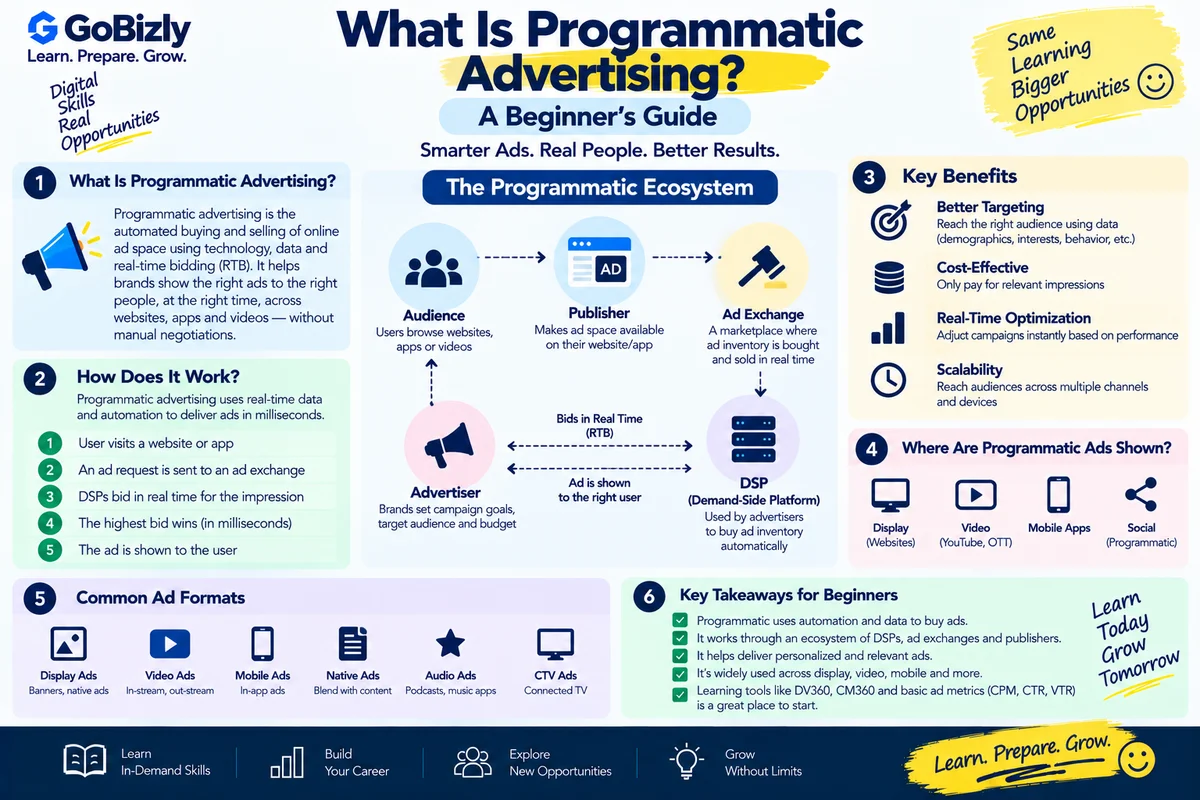
Programmatic advertising is a technology-driven approach to buying and selling digital advertising inventory.
Instead of manually negotiating every individual ad placement, programmatic systems can automate parts of the buying and selling process.
The ecosystem can include:
Advertisers
Agencies
DSPs
SSPs
Ad exchanges
Publishers
Ad servers
Data and measurement providers
Understanding how these components interact is essential for anyone entering AdTech or digital advertising.
1. What Is Programmatic Advertising?
Programmatic advertising uses automated technology to facilitate the buying and selling of digital advertising inventory.
The process can happen very quickly.
When a user visits a digital property with an available ad opportunity, an automated auction or transaction may determine which advertisement is displayed.
2. What Is a DSP?
DSP = Demand-Side Platform
A DSP is used by advertisers or agencies to manage programmatic media buying.
Depending on the platform, advertisers can use a DSP to:
Select audiences
Define targeting
Set bids
Manage budgets
Control frequency
Optimize campaigns
Analyze performance
Examples include platforms such as DV360 and other demand-side technologies.
3. What Is an SSP?
SSP = Supply-Side Platform
An SSP helps publishers manage and sell available advertising inventory.
It can connect publisher inventory with buyers through programmatic marketplaces.
4. What Is an Ad Exchange?
An ad exchange is a digital marketplace where advertising inventory can be bought and sold.
It can facilitate transactions between demand and supply.
The exact architecture varies across the ecosystem.
5. What Is RTB?
RTB = Real-Time Bidding
RTB is a process where advertising inventory can be auctioned in real time.
A simplified flow is:
User visits page
↓
Ad opportunity becomes available
↓
Bid requests are sent
↓
Eligible buyers evaluate the opportunity
↓
Bids are submitted
↓
Auction determines the winning bid
↓
Ad is served
This process can happen within milliseconds.
6. What Is a Bid?
A bid represents the amount a buyer is willing to pay for an advertising opportunity according to the applicable pricing model.
The bid doesn't automatically guarantee a win.
The auction and platform rules determine the outcome.
7. Why Can a DSP Lose a Bid?
A campaign may lose an auction for several reasons.
Examples include:
Bid too low
Targeting mismatch
Budget constraints
Frequency limitations
Inventory restrictions
Deal conditions
Creative issues
Auction rules
Troubleshooting requires examining the specific campaign and platform data.
8. What Is Targeting?
Programmatic campaigns can use different targeting methods.
Depending on the platform, these may include:
Demographics
Geography
Context
Device
Audience segments
First-party data
Remarketing
Publisher inventory
Keywords or content signals
Targeting should support the campaign objective.
9. What Is a Frequency Cap?
A frequency cap limits how often an individual user may be exposed to an advertisement within a specified period.
For example:
3 impressions per user per day
Frequency management can help control excessive exposure.
10. What Is a Deal ID?
A Deal ID is a unique identifier used to represent certain programmatic transactions, particularly private marketplace or other negotiated deals.
A deal may include conditions such as:
Inventory
Pricing
Audience
Buyers
Sellers
The exact deal structure depends on the transaction.
11. Open Auction vs Private Deals
Open Auction
Inventory can be available to eligible buyers through an open marketplace.
Private Marketplace
A publisher may make inventory available to selected buyers under defined conditions.
Private deals can provide buyers with access to specific inventory or negotiated terms.
12. What Is an Ad Server?
An ad server helps manage and serve digital advertisements.
For example, Campaign Manager 360 is commonly used for campaign management, trafficking, measurement and ad serving within the Google Marketing Platform ecosystem.
An ad server and DSP have different roles, although they can integrate with each other.
13. What Is Viewability?
Viewability measures whether an advertisement had the opportunity to be seen according to a defined measurement standard.
It is different from simply counting impressions.
Advertisers may use third-party measurement providers such as:
IAS
DoubleVerify
Measurement definitions should always be checked for the specific reporting setup.
14. What Is CTR?
CTR = Click-Through Rate
A common formula is:
CTR = Clicks ÷ Impressions × 100
For example:
If an ad receives 50 clicks from 5,000 impressions:
CTR = 50 ÷ 5,000 × 100 = 1%
15. What Is CPM?
CPM = Cost per Thousand Impressions
A common formula is:
CPM = Cost ÷ Impressions × 1,000
CPM is widely used in display and programmatic advertising.
16. What Is VTR?
VTR = View-Through Rate
The exact definition can vary by platform and video measurement methodology.
It generally describes the proportion of video impressions that reached a defined viewing threshold.
Always check the platform's reporting definition.
17. Programmatic Campaign Workflow
A simplified workflow is:
Campaign Objective
↓
Audience & Targeting
↓
Media Planning
↓
Line Item Setup
↓
Creative Setup
↓
Bid & Budget
↓
Launch
↓
Monitor
↓
Optimize
↓
Report
18. Common Programmatic Troubleshooting Areas
If a campaign isn't delivering as expected, review:
Campaign status
Insertion order
Line item
Targeting
Audience availability
Creative approval
Inventory
Bid
Budget
Pacing
Frequency caps
Deal configuration
Tracking
Integrations
Don't change multiple variables blindly.
Identify where delivery dropped first.
19. Programmatic vs Traditional Media Buying
Traditional digital media buying may involve more manual negotiation and placement management.
Programmatic introduces automated systems that can evaluate and transact on inventory at scale.
However, programmatic still involves planning, strategy, relationships, creative management and measurement.
Automation doesn't remove the need for human decision-making.
20. How Beginners Can Learn Programmatic
A useful learning sequence is:
Digital Advertising Basics
↓
Programmatic Ecosystem
↓
DSP / SSP Concepts
↓
RTB & Auctions
↓
Targeting
↓
Campaign Structure
↓
Creative & Tracking
↓
Reporting
↓
Troubleshooting
↓
Optimization
Build practical knowledge through realistic campaign scenarios.
Programmatic Advertising Checklist
☐ Understand programmatic advertising
☐ Learn DSPs
☐ Learn SSPs
☐ Understand ad exchanges
☐ Understand RTB
☐ Learn bidding
☐ Understand targeting
☐ Learn frequency capping
☐ Understand Deal IDs
☐ Learn open auctions
☐ Learn private deals
☐ Understand ad servers
☐ Learn viewability
☐ Know core KPIs
☐ Practice troubleshooting
Conclusion
Programmatic advertising can appear complicated because several technologies work together.
Start with the ecosystem.
Understand the roles of DSPs, SSPs, exchanges and ad servers.
Then learn bidding, targeting, measurement and troubleshooting.
Once the workflow becomes clear, individual platforms become easier to understand.
Understand the ecosystem first. Then learn the platform.
Learn. Prepare. Grow.