What Is Performance Marketing? A Beginner’s Guide
What Is Performance Marketing? A Beginner’s Guide
Digital marketing can involve many different activities, from building brand awareness to generating leads and selling products online.
But how do you know whether your marketing is actually producing results?
This is where performance marketing becomes important.
Performance marketing is an approach to digital marketing where campaigns are planned, measured and optimized based on specific business outcomes.
These outcomes could include:
Website visits
Leads
App installs
Purchases
Sign-ups
Sales
Revenue
Other measurable conversions
Instead of looking only at how many people saw an advertisement, performance marketing focuses heavily on what happened after the marketing activity.
In this guide, we'll explain:
What performance marketing means
How performance marketing works
Common performance marketing channels
Important KPIs
Conversion tracking
Attribution
Bidding and optimization
Performance marketing vs digital marketing
Performance marketing vs brand marketing
Practical examples
Common mistakes
Frequently asked questions
What Is Performance Marketing?
Performance marketing is a data-driven approach to marketing where campaigns are measured and optimized against defined performance goals.
In simple terms:
Performance marketing focuses on measurable actions and business outcomes rather than exposure alone.
For example, imagine an online store spends ₹50,000 on advertising.
The business might track:
How many people clicked the ads
How many visited the website
How many added products to their cart
How many completed purchases
How much revenue was generated
How much it cost to generate each purchase
This allows marketers to evaluate campaign performance using measurable data.
How Does Performance Marketing Work?
A typical performance marketing process looks like this:
Business goal → Campaign strategy → Audience → Ad → Landing page → Conversion → Measurement → Optimization
Let's break this down.
1. Define the business goal
The first step is determining what the campaign is supposed to achieve.
For example:
Generate leads
Increase sales
Generate app installs
Increase subscriptions
Drive registrations
The marketing strategy should be connected to the business objective.
2. Define the target audience
Marketers determine who they want to reach.
Depending on the platform, targeting can involve:
Demographics
Location
Interests
Search intent
Keywords
Website behavior
Customer lists
Context
First-party data
Similar or modeled audiences
The available targeting options depend on the advertising platform and campaign type.
3. Select marketing channels
The marketer chooses the platforms that can help achieve the objective.
Examples include:
Google Ads
Meta Ads
LinkedIn Ads
Programmatic advertising
Affiliate marketing
Search advertising
Display advertising
Paid social
Email marketing
The appropriate channel depends on the audience, objective, budget and business model.
4. Create the campaign
The campaign is then configured.
This can involve:
Audience targeting
Keywords
Ad creatives
Landing pages
Budgets
Bidding
Conversion tracking
Geographic targeting
Device targeting
Frequency controls
5. Measure conversions
The campaign needs measurement to determine whether users are completing the desired action.
Examples include:
Lead generation
A visitor submits a form.
E-commerce
A customer completes a purchase.
App marketing
A user installs an app.
SaaS
A visitor starts a trial or subscription.
6. Analyze the results
Marketers analyze campaign data to understand:
What is working
What isn't working
Which audiences perform better
Which ads generate results
Which channels generate conversions
How much each conversion costs
7. Optimize
Based on the data, marketers can make changes.
For example:
Adjust bids
Change targeting
Pause underperforming ads
Test new creatives
Improve landing pages
Adjust budgets
Change keywords
Improve conversion tracking
The process then continues.
Launch → Measure → Learn → Optimize → Measure again
Performance Marketing Channels
Performance marketing can use multiple digital channels.
1. Search Advertising
Search advertising allows businesses to show ads when users search for relevant terms.
A common example is Google Ads Search campaigns.
For example, someone searches:
"digital marketing course"
A relevant advertiser may show an ad for its course.
Search advertising can be particularly useful when users already demonstrate an active search intent.
2. Paid Social
Paid social advertising allows businesses to promote content, products or services on social platforms.
Examples include:
Meta Ads
LinkedIn Ads
Other social advertising platforms
Campaign objectives can include:
Awareness
Traffic
Leads
Engagement
Sales
App-related actions
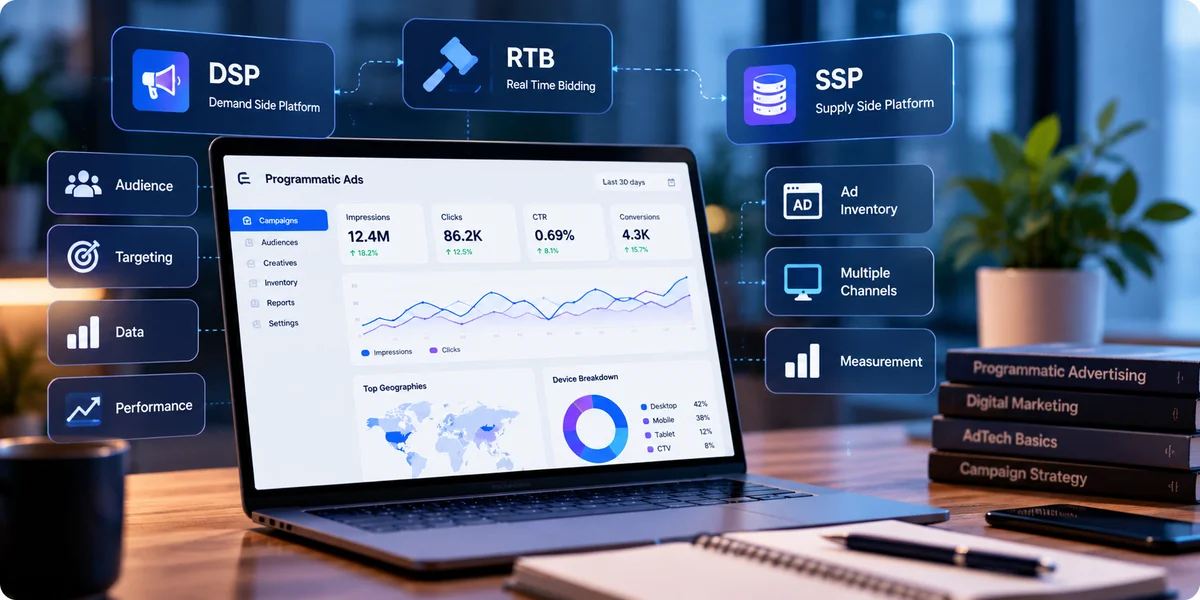
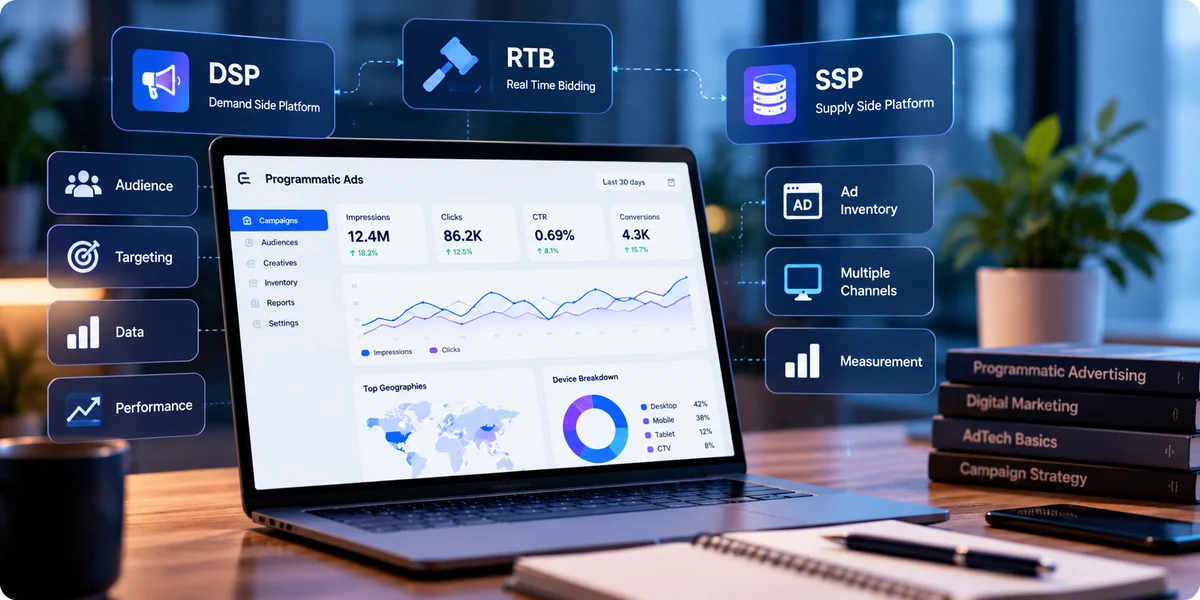
3. Programmatic Advertising
Programmatic advertising uses technology and automated buying processes to purchase digital advertising inventory.
It can involve:
DSPs
SSPs
Ad exchanges
Real-time bidding
Private marketplaces
Programmatic guaranteed deals
Programmatic campaigns can be used for objectives ranging from awareness to measurable conversions, depending on the campaign strategy and measurement setup.
4. Display Advertising
Display advertising uses visual advertisements across websites, apps and other digital environments.
Common formats include:
Banner ads
Responsive display ads
Native formats
Rich media
Display campaigns can be measured using metrics such as:
Impressions
Clicks
CTR
Conversions
CPA
Viewability
Conversion value
5. Affiliate Marketing
Affiliate marketing involves third parties promoting a company's products or services.
The affiliate may receive a commission based on an agreed action.
For example:
Affiliate → Customer → Purchase → Commission
The exact payment structure depends on the affiliate program.
6. Email Marketing
Email marketing can also support performance-focused campaigns.
Examples include:
Product promotions
Lead nurturing
Abandoned-cart emails
Customer onboarding
Re-engagement campaigns
Performance can be measured using metrics such as:
Open rate
Click rate
Conversion rate
Revenue
Unsubscribe rate
Important Performance Marketing KPIs
Performance marketing relies heavily on measurement.
Here are some important metrics.
KPI | Meaning |
|---|---|
Impressions | Number of times an ad was shown |
Clicks | Number of clicks |
CTR | Click-through rate |
CPC | Cost per click |
Conversions | Desired actions completed |
Conversion Rate | Percentage of relevant users who convert |
CPA | Cost per acquisition/action |
CPL | Cost per lead |
ROAS | Return on ad spend |
Revenue | Revenue attributed to the measured activity |
CTR
CTR = Clicks ÷ Impressions × 100
For example:
10,000 impressions
200 clicks
CTR:
200 ÷ 10,000 × 100 = 2%
CTR helps indicate how frequently users clicked after seeing an ad.
However, a high CTR does not automatically mean a campaign is profitable.
CPC
CPC = Advertising Cost ÷ Clicks
For example:
Advertising cost = ₹10,000
Clicks = 2,000
CPC:
₹10,000 ÷ 2,000 = ₹5
Conversion Rate
A simplified conversion rate formula is:
Conversion Rate = Conversions ÷ Relevant Visits/Clicks × 100
For example:
1,000 visits
50 conversions
Conversion rate:
50 ÷ 1,000 × 100 = 5%
The exact denominator used should match the measurement definition being applied.
CPA
CPA means Cost Per Acquisition or Cost Per Action, depending on the context.
A simple formula is:
CPA = Advertising Cost ÷ Conversions
For example:
₹20,000 advertising cost
100 conversions
CPA:
₹20,000 ÷ 100 = ₹200
ROAS
ROAS means Return on Ad Spend.
A common formula is:
ROAS = Attributed Revenue ÷ Advertising Cost
For example:
Advertising cost = ₹50,000
Attributed revenue = ₹200,000
ROAS:
₹200,000 ÷ ₹50,000 = 4
This is commonly expressed as 4× ROAS.
ROAS should be interpreted carefully because revenue isn't the same as profit, and attribution methods can affect the reported revenue.
Why Conversion Tracking Matters
Performance marketing depends on reliable measurement.
If conversions aren't tracked correctly, marketers may make decisions based on incomplete or incorrect information.
Conversion tracking can help answer questions such as:
Which campaigns generate conversions?
Which ads perform well?
Which audiences convert?
Which keywords generate leads?
Which products generate revenue?
What does each conversion cost?
Depending on the platform, measurement may involve:
Website tags
Analytics platforms
Conversion APIs
Offline conversion imports
CRM integrations
Server-side measurement
Platform conversion tracking
What Is Attribution?
Attribution is the process of assigning credit for a conversion to one or more marketing interactions.
Imagine someone:
Sees a display advertisement
Searches for the company
Clicks a search ad
Visits the website
Returns later through an email
Makes a purchase
Which marketing activity gets credit?
That's an attribution question.
Different attribution approaches can produce different results.
Therefore, marketers should understand the attribution methodology behind the numbers they use.
Performance Marketing vs Digital Marketing
These terms are closely related but aren't identical.
Digital marketing
Digital marketing is the broader category.
It can include:
SEO
Content marketing
Social media
Email
Paid advertising
Analytics
Influencer marketing
Digital PR
Performance marketing
Performance marketing emphasizes measurable outcomes and optimization.
For example:
Digital marketing:
Publish useful SEO content to build organic visibility.
Performance marketing:
Run paid campaigns and measure leads, conversions, acquisition costs and revenue.
There can be significant overlap between the two.
Performance Marketing vs Brand Marketing
The two approaches can have different primary objectives.
Brand marketing
Often focuses on:
Awareness
Recognition
Perception
Long-term brand building
Performance marketing
Often focuses on measurable actions such as:
Leads
Sales
Sign-ups
Purchases
App installs
This doesn't mean performance marketing has no effect on brand outcomes or that brand marketing cannot be measured.
In practice, businesses often use both approaches as part of a broader marketing strategy.
A Practical Performance Marketing Example
Imagine an online company selling professional courses.
The business wants to generate course purchases.
Goal
Generate paid course enrollments.
Campaigns
The company runs:
Google Search campaigns
Meta campaigns
Display campaigns
Budget
Suppose the total advertising budget is ₹100,000.
Measurement
The business tracks:
Clicks
Cost
Leads
Course purchases
Revenue
CPA
ROAS
After several weeks, the team analyzes the data.
They might discover that:
One campaign generates many clicks but few purchases.
Another campaign generates fewer clicks but more purchases.
One audience generates leads at a lower cost.
One landing page produces a higher conversion rate.
The marketer can then use those observations to inform future campaign decisions.
This is the basic principle of performance marketing:
Measure → Understand → Optimize
Landing Pages and Performance Marketing
Advertising doesn't operate independently from the website.
A user might click a highly relevant advertisement but leave the website because the landing page is confusing.
Important landing-page considerations include:
Relevance
Clear messaging
Strong call to action
Mobile usability
Page speed
Trust signals
Simple navigation
Easy forms
Consistency between advertisement and landing page
Improving the landing-page experience can affect campaign performance, although the impact varies by situation.
The Role of Creative
Creative is another important part of performance marketing.
Depending on the channel, creative can include:
Images
Videos
Headlines
Descriptions
Calls to action
Product demonstrations
Social content
Marketers can test different creative approaches to understand which messages resonate with the intended audience.
For example:
Creative A: Focuses on price.
Creative B: Focuses on convenience.
Creative C: Focuses on a specific customer problem.
The results can provide useful insights into audience response.
How Performance Marketing Is Optimized
Optimization can happen at several levels.
Campaign level
Review:
Budget
Objective
Overall performance
Audience level
Review:
Audience segments
Demographics
Locations
Behavioral signals
Creative level
Review:
Headlines
Images
Videos
Messages
Calls to action
Keyword level
For search campaigns:
Search terms
Match types
Negative keywords
Keyword performance
Landing-page level
Review:
Conversion rate
User experience
Page speed
Form completion
Measurement level
Review:
Conversion tracking
Attribution
Data quality
CRM integration
Common Performance Marketing Mistakes
1. Optimizing only for clicks
Clicks are useful, but clicks aren't necessarily the final business goal.
A campaign can generate many clicks without generating meaningful conversions.
2. Ignoring conversion tracking
Without reliable conversion data, optimization becomes much harder.
3. Focusing only on cheap conversions
A low CPA isn't automatically valuable if the resulting customers have low value.
The quality and value of conversions matter.
4. Changing campaigns too frequently
Frequent changes can make it difficult to understand the impact of individual adjustments.
Campaign-specific platform behavior also varies, so optimization should be based on appropriate evidence rather than assumptions.
5. Ignoring landing pages
Advertising and landing-page experience are connected.
A campaign cannot always compensate for a poor post-click experience.
6. Looking at only one KPI
A campaign should generally be evaluated using multiple relevant metrics.
For example:
CTR → CPC → Conversion Rate → CPA → Revenue/ROAS
The appropriate metrics depend on the campaign objective.
A Simple Performance Marketing Framework
You can remember performance marketing using this framework:
1. Objective
What are you trying to achieve?
2. Audience
Who are you trying to reach?
3. Offer
What are you asking people to do?
4. Channel
Where will you reach them?
5. Creative
What message will you show?
6. Measurement
How will you measure success?
7. Optimization
What will you improve based on the data?
Frequently Asked Questions
Is performance marketing the same as paid advertising?
Not exactly.
Paid advertising is an important part of performance marketing, but performance-oriented marketing can involve other channels and activities as well.
Is Google Ads performance marketing?
It can be.
Google Ads campaigns can be managed around measurable outcomes such as leads, sales or conversions.
Is SEO performance marketing?
SEO is generally considered part of digital marketing rather than exclusively performance marketing. However, SEO performance can certainly be measured using outcomes such as organic traffic, leads and revenue.
Is programmatic advertising performance marketing?
Programmatic advertising can be used for performance-focused campaigns, although programmatic is also widely used for awareness and other objectives.
What is the most important performance marketing KPI?
There isn't one universally correct KPI.
The appropriate KPI depends on the business objective.
For example:
Lead generation → CPL/CPA and lead quality
E-commerce → revenue, ROAS and profitability-related metrics
Traffic → qualified traffic and engagement
App campaigns → installs and downstream actions
Can small businesses use performance marketing?
Yes.
Small businesses can use performance-focused digital campaigns, but the appropriate channel, budget, tracking setup and objectives depend on the business.
Conclusion
Performance marketing is a measurable, data-driven approach to digital marketing that focuses on defined outcomes.
It connects:
Business objectives → Audiences → Campaigns → Conversions → Measurement → Optimization
Its strength comes from the ability to measure campaign activity and use the resulting data to make informed decisions.
However, performance marketing isn't simply about getting cheap clicks or conversions.
Effective measurement requires understanding:
Business goals
Conversion quality
Tracking
Attribution
Customer value
Campaign economics
When these elements work together, marketers can make better-informed decisions about where to allocate attention and budget.
The core idea is simple: don't just launch campaigns—measure what happens, learn from the data and continuously improve.