What Is Digital Marketing? A Complete Beginner’s Guide
What Is Digital Marketing? A Complete Beginner’s Guide
Businesses have always needed ways to reach customers.
What has changed is where people spend their time, how they discover products and how businesses communicate with them.
Today, people may discover a company through:
Google Search
YouTube
Instagram
Facebook
LinkedIn
Websites
Email
Online marketplaces
Mobile apps
The marketing activities used across these digital environments are broadly referred to as digital marketing.
Digital marketing includes much more than online advertising.
It can involve:
Search engine optimization
Paid advertising
Social media
Content marketing
Email marketing
Analytics
Influencer marketing
Affiliate marketing
Marketing automation
Conversion optimization
In this guide, we'll explain the fundamentals of digital marketing and how its different components work together.
What Is Digital Marketing?
Digital marketing is the use of digital channels, platforms and technologies to promote products, services, brands or ideas and communicate with audiences.
In simple terms:
Digital marketing is marketing that uses digital environments to reach, engage and convert audiences.
For example, a business might:
Publish an article.
Appear in Google Search.
Run Google Ads.
Promote content on Instagram.
Capture leads through its website.
Follow up using email.
Measure conversions using analytics.
All of these activities can be part of a broader digital marketing strategy.
How Does Digital Marketing Work?
A simplified digital marketing journey looks like this:
Awareness → Interest → Consideration → Conversion → Retention
Let's look at each stage.
Awareness
People first discover the brand.
Possible channels:
Social media
YouTube
Display advertising
Search
Content
Influencers
Interest
The person becomes interested and wants to learn more.
They might:
Visit the website
Read an article
Watch a video
Follow the brand
Download a resource
Consideration
The person evaluates whether the product or service is right for them.
They may:
Compare products
Read reviews
Check pricing
Request information
Speak to sales
Conversion
The person completes the desired action.
Examples:
Purchase
Lead submission
Registration
App installation
Subscription
Retention
The business attempts to maintain the customer relationship.
This can involve:
Email
Customer support
Loyalty programs
Content
Offers
Product communication
Not every customer journey follows exactly the same sequence.
Major Digital Marketing Channels
Digital marketing contains multiple channels.
Let's understand the major ones.
1. Search Engine Optimization
SEO is the process of improving a website's visibility in organic search results.
For example, imagine someone searches:
"how to learn digital marketing"
A website may appear in the organic results if its content is relevant and meets search-engine requirements.
SEO can involve:
Keyword research
Search intent
Content creation
On-page optimization
Technical SEO
Internal linking
Digital PR
Relevant backlinks
SEO generally focuses on earning organic visibility rather than directly paying for each click.
2. Search Engine Marketing and Google Ads
Paid search allows businesses to advertise on search engines.
Google Ads is one of the most widely used advertising platforms.
For example, a company selling web-development services might advertise when users search for relevant terms.
Paid search can help businesses reach users who are actively searching for particular products or services.
Common metrics include:
Impressions
Clicks
CTR
CPC
Conversions
CPA
Conversion value
ROAS
3. Social Media Marketing
Social media marketing involves using social platforms to communicate with audiences.
It can include both organic and paid activities.
Organic social
Examples:
Posts
Reels
Stories
Videos
Community engagement
Paid social
Examples:
Meta Ads
LinkedIn Ads
Other social advertising platforms
Social media can support objectives such as:
Awareness
Engagement
Traffic
Lead generation
Sales
4. Content Marketing
Content marketing involves creating and distributing useful content for a target audience.
Examples include:
Blog articles
Guides
Videos
Podcasts
Case studies
Infographics
Newsletters
Checklists
E-books
For example, a digital marketing company could publish:
"How to Set Up Conversion Tracking"
That article can educate potential customers while also helping the company demonstrate expertise.
5. Email Marketing
Email marketing allows businesses to communicate directly with people who have opted into relevant communications.
Common uses include:
Newsletters
Product announcements
Educational content
Promotions
Lead nurturing
Customer onboarding
Re-engagement
Important metrics can include:
Delivery rate
Open rate
Click rate
Conversion rate
Unsubscribe rate
Email performance should be evaluated according to the campaign objective.
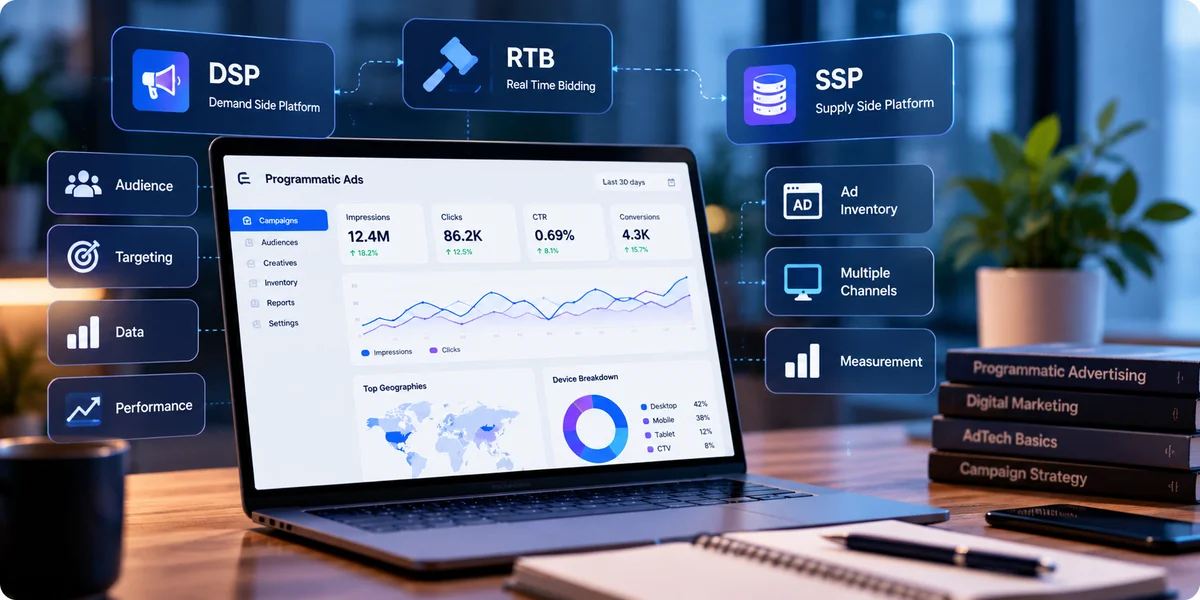
6. Programmatic Advertising
Programmatic advertising uses technology to automate or facilitate the buying and selling of digital advertising inventory.
It can involve:
DSPs
SSPs
Ad exchanges
RTB
Private marketplaces
Programmatic guaranteed deals
Programmatic can be used for different objectives, including awareness, consideration and performance-focused campaigns.
7. Affiliate Marketing
Affiliate marketing involves partners promoting a company's products or services.
The affiliate may receive compensation based on an agreed action.
For example:
Affiliate → Visitor → Website → Purchase → Commission
Affiliate marketing can be useful when businesses want to expand their reach through external partners.
8. Influencer Marketing
Influencer marketing involves collaborating with individuals who have an audience on digital platforms.
An influencer might promote:
Products
Services
Apps
Events
Content
Brands
Businesses should consider factors such as audience relevance, authenticity, campaign objectives and measurement when evaluating influencer partnerships.
9. Mobile Marketing
Mobile marketing focuses on reaching users through mobile devices.
Examples include:
Mobile advertising
SMS marketing
Push notifications
Mobile apps
In-app advertising
Because many users access digital services through smartphones, mobile experience is an important part of digital marketing.
10. Marketing Analytics
Analytics allows marketers to understand what users are doing and how campaigns perform.
Questions analytics can help answer include:
Where are visitors coming from?
Which campaigns generate traffic?
Which pages receive attention?
Which campaigns generate leads?
Which products generate revenue?
Where are users dropping off?
Without reliable measurement, marketing decisions can become heavily dependent on assumptions.
The Digital Marketing Funnel
A common way to visualize customer journeys is through a funnel.
Top of Funnel — Awareness
People discover the brand.
Examples:
Display
Video
Social media
SEO content
Middle of Funnel — Consideration
People explore the product or service.
Examples:
Website visits
Product research
Guides
Reviews
Remarketing
Bottom of Funnel — Conversion
People are ready to take action.
Examples:
Purchase
Lead
Registration
Booking
After Conversion — Retention
The business works to maintain the relationship.
Examples:
Email
Customer support
Loyalty
Educational content
The funnel is a useful framework, but real customer journeys are often less linear.
Paid vs Organic Digital Marketing
One important distinction is between paid and organic marketing.
Organic Marketing
Businesses attempt to earn visibility without directly paying for each exposure or click.
Examples:
SEO
Organic social content
Content marketing
Community building
Paid Marketing
Businesses pay platforms or partners to distribute marketing messages.
Examples:
Google Ads
Meta Ads
Programmatic advertising
LinkedIn Ads
Sponsored content
Many businesses use both.
What Is Performance Marketing?
Performance marketing focuses heavily on measurable outcomes.
Examples include:
Leads
Sales
Sign-ups
App installs
Purchases
A performance marketing campaign may track:
Spend → Clicks → Conversions → Revenue
The focus is on understanding the relationship between marketing activity and measurable results.
What Is Brand Marketing?
Brand marketing generally focuses on building long-term awareness, recognition and associations with a company or product.
Examples include:
Brand campaigns
Video advertising
Sponsorships
Storytelling
Content
Brand and performance marketing aren't mutually exclusive.
A business can use both depending on its objectives.
Important Digital Marketing Metrics
Different campaigns require different KPIs.
Here are some common metrics:
Metric | Meaning |
|---|---|
Impressions | Number of times content or ads were displayed |
Reach | Number of people reached |
Clicks | Number of clicks |
CTR | Click-through rate |
CPC | Cost per click |
CPM | Cost per thousand impressions |
Conversions | Desired actions |
Conversion Rate | Percentage of relevant users who convert |
CPA | Cost per acquisition/action |
CPL | Cost per lead |
ROAS | Revenue divided by ad spend |
ROI | Return relative to investment |
CTR
CTR means Click-Through Rate.
A common formula is:
CTR = Clicks ÷ Impressions × 100
Example:
20,000 impressions
400 clicks
CTR:
400 ÷ 20,000 × 100 = 2%
CTR helps measure click engagement, but it isn't necessarily the final business KPI.
Conversion Rate
Conversion rate measures how frequently users complete a desired action.
A simplified formula is:
Conversion Rate = Conversions ÷ Relevant Visits/Clicks × 100
Example:
2,000 visits
100 conversions
Conversion rate:
100 ÷ 2,000 × 100 = 5%
CPA
CPA means Cost Per Acquisition or Cost Per Action.
A simplified formula:
CPA = Advertising Cost ÷ Conversions
Example:
₹30,000 spend
150 conversions
CPA:
₹30,000 ÷ 150 = ₹200
ROAS
ROAS means Return on Ad Spend.
Formula:
ROAS = Attributed Revenue ÷ Advertising Cost
Example:
₹100,000 advertising spend
₹400,000 attributed revenue
ROAS:
4×
However, ROAS doesn't represent profit by itself.
A business must also consider other costs.
Conversion Tracking
Conversion tracking allows marketers to measure important actions.
Examples:
Form submission
Purchase
Registration
Phone call
App installation
Subscription
Tracking can involve:
Website tags
Analytics platforms
Advertising-platform tracking
Conversion APIs
CRM integrations
Offline conversion data
The implementation depends on the business and technology stack.
Why First-Party Data Matters
First-party data is information collected directly through a business's own interactions with its audience.
Examples include:
Customer information
Website interactions
Purchase history
Account activity
Email subscribers
Businesses need to collect and use such information responsibly and in accordance with applicable privacy requirements.
First-party data can be valuable for:
Personalization
Customer analysis
Audience building
Measurement
Retention
What Is a Landing Page?
A landing page is a webpage designed around a particular visitor journey or campaign objective.
For example:
Google Ad → Landing Page → Lead Form
A good landing page generally has:
Clear messaging
Relevant information
Strong call to action
Easy navigation
Mobile-friendly design
Fast loading
Trust information where appropriate
The page should match the expectation created by the advertisement or search query.
What Is Remarketing?
Remarketing involves reaching people who have previously interacted with a business or its digital properties, subject to the platform and privacy framework being used.
For example:
A user visits an online store but doesn't purchase.
The business may later show that user relevant advertising, depending on the available technology, consent and campaign setup.
Remarketing can also involve:
Website visitors
Product viewers
Existing customers
App users
Content engagers
Digital Marketing Tools
Marketers use many different tools.
Advertising platforms
Google Ads
Meta Ads
LinkedIn Ads
DSPs
Analytics
Google Analytics
Advertising-platform reporting
Business intelligence tools
SEO
Search Console
Keyword research tools
SEO crawlers
Content
CMS platforms
Design tools
Video tools
AI-assisted tools
CRM
Customer relationship management platforms
Marketing automation systems
The best tool depends on the specific marketing problem.
How to Create a Digital Marketing Strategy
A simple digital marketing strategy can follow these steps.
Step 1: Define the business objective
Examples:
Increase sales
Generate leads
Build awareness
Increase registrations
Launch a product
Step 2: Define your audience
Understand:
Who they are
What they need
What problems they have
How they search
Where they spend time online
Step 3: Research competitors
Look at:
Their websites
Search visibility
Content
Advertising
Social media
Offers
Customer experience
The goal isn't simply to copy them.
Instead, identify opportunities and gaps.
Step 4: Select channels
Choose channels based on:
Audience
Objective
Budget
Customer journey
Available resources
For example:
SEO + Content + Email
may make sense for an educational website.
A local business might use:
Google Search + Local SEO + Meta Ads
A B2B company might use:
SEO + LinkedIn + Search + Email
Step 5: Create Content and Campaigns
Develop the assets needed for each channel.
Examples:
Articles
Landing pages
Videos
Ads
Social posts
Emails
Lead magnets
Step 6: Implement Measurement
Before launching campaigns, determine:
What will success look like?
Then configure appropriate tracking.
Step 7: Launch and Learn
Once campaigns are live, monitor performance.
Look for:
Strong-performing audiences
Weak-performing audiences
High-performing content
Conversion problems
High-cost campaigns
Tracking issues
Step 8: Optimize
Use the data to improve:
Creative
Audience
Budget
Landing pages
Content
Offers
Campaign structure
Digital marketing is rarely a "set it and forget it" activity.
Example Digital Marketing Strategy
Imagine a company sells online professional courses.
Objective
Generate course enrollments.
Audience
Working professionals and students interested in career development.
Organic strategy
Create articles about:
Career skills
Digital marketing
Interview preparation
Certifications
Paid strategy
Run:
Google Search campaigns
Meta Ads
Retargeting campaigns
Content strategy
Create:
YouTube videos
Guides
LinkedIn content
Email newsletters
Measurement
Track:
Website traffic
Leads
Course purchases
CPA
Revenue
ROAS
This creates a connected digital marketing system rather than isolated campaigns.
Common Digital Marketing Mistakes
1. Trying every channel at once
More channels don't automatically mean better marketing.
Start with channels that make sense for the audience and objective.
2. Focusing only on traffic
Traffic is useful, but businesses ultimately need meaningful outcomes.
3. Not defining the target audience
Without a clear audience, messaging can become too generic.
4. Ignoring measurement
If conversions aren't tracked properly, marketers may optimize based on incomplete information.
5. Using the same strategy everywhere
Google Search, Instagram, SEO and email all work differently.
The strategy should be adapted to each channel.
6. Ignoring the website
Advertising can bring visitors, but the website still needs to provide a useful experience.
7. Expecting immediate results
Some channels can generate results quickly, while others require longer-term development.
Digital Marketing Skills to Learn
If you're starting a career in digital marketing, consider learning:
Fundamentals
Marketing basics
Customer journeys
Target audiences
Marketing funnels
KPIs
Search
SEO
Google Ads
Keyword research
Social
Meta Ads
Social media strategy
Content creation
Programmatic
DSPs
SSPs
RTB
Ad exchanges
Campaign optimization
Analytics
Google Analytics
Conversion tracking
Reporting
Attribution
Professional skills
Communication
Presentation
Data analysis
Problem solving
Client management
You don't need to master everything immediately.
Start with the fundamentals and gradually specialize.
Frequently Asked Questions
What is digital marketing in simple words?
Digital marketing is the use of digital platforms and technologies to promote products, services, brands or ideas and communicate with audiences.
What are the main types of digital marketing?
Common areas include:
SEO
Paid search
Social media
Content marketing
Email marketing
Programmatic advertising
Affiliate marketing
Influencer marketing
Analytics
Is digital marketing only advertising?
No.
Advertising is only one part of digital marketing.
SEO, content, email, social media, analytics and customer retention can also be part of digital marketing.
Is SEO better than Google Ads?
They serve different purposes.
SEO focuses on organic search visibility, while Google Ads provides paid advertising opportunities.
Businesses can use both.
Is digital marketing a good career field?
Digital marketing includes many different specializations, such as:
SEO
Paid media
Performance marketing
Programmatic
Analytics
Content
Social media
Marketing operations
The appropriate specialization depends on your interests and career goals.
How long does it take to learn digital marketing?
There is no fixed timeline.
You can learn the fundamentals relatively quickly, but developing professional-level skills requires practical experience, experimentation and continuous learning.
Conclusion
Digital marketing is a broad field that brings together multiple channels, technologies and marketing activities.
The major areas include:
SEO
Paid Search
Social Media
Content Marketing
Email Marketing
Programmatic Advertising
Affiliate Marketing
Influencer Marketing
Analytics
The most effective digital marketing strategies don't treat these channels as completely separate activities.
Instead, they connect them around a clear business objective.
A business might use SEO to attract organic traffic, paid advertising to generate immediate demand, social media to build engagement, email to nurture prospects and analytics to understand the overall customer journey.
The key is to start with the business objective and audience, select the appropriate channels, measure meaningful outcomes and continuously improve.
Digital marketing isn't simply about being present online. It's about using digital channels strategically to create meaningful business and customer outcomes.