Verbal Ability for Placements: Practical Preparation Guide
Verbal Ability for Placements: Practical Preparation Guide
Verbal ability is included in some placement and recruitment assessments.
It can test your ability to:
Understand written information
Use grammar correctly
Interpret sentences
Identify relationships between ideas
Understand vocabulary
Organize information
You don't need to know every English word to perform well.
A consistent reading and practice routine can help build the required skills.
1. Understand the Test Pattern
The exact sections vary between assessments.
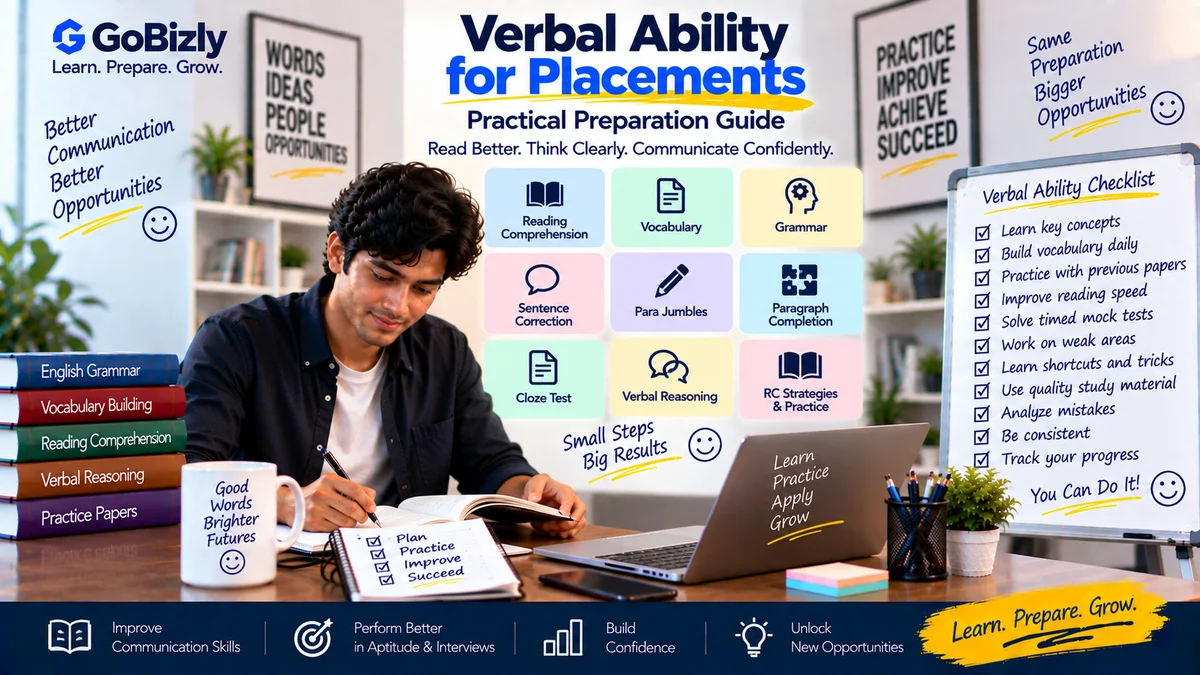
Possible areas include:
Reading comprehension
Grammar
Vocabulary
Sentence correction
Para jumbles
Fill-in-the-blanks
Sentence completion
Verbal reasoning
Check the assessment information whenever available.
2. Build Grammar Fundamentals
Review:
Parts of speech
Tenses
Subject-verb agreement
Articles
Prepositions
Pronouns
Conjunctions
Active and passive voice
Focus on understanding how the rules work.
3. Practice Sentence Correction
When reviewing a sentence, check:
Grammar
Subject-verb agreement
Tense
Word choice
Sentence structure
Punctuation where relevant
Don't change a sentence simply because it sounds unfamiliar.
4. Improve Vocabulary Through Context
Instead of memorizing huge lists of words, learn vocabulary through reading.
When you encounter a new word:
Check its meaning.
Understand the sentence.
Identify related words.
Create your own sentence.
Review it later.
5. Learn Synonyms and Antonyms
Practice common word relationships.
For example:
Accurate → Correct
Expand → Contract
But remember that exact meanings depend on context.
6. Read Regularly
Read:
News articles
Business articles
Technology articles
Opinion pieces
Professional blogs
Books
After reading, summarize the main idea in your own words.
7. Practice Reading Comprehension
Before answering questions:
Read the passage carefully.
Identify the main idea.
Notice supporting points.
Identify the author's argument where relevant.
Answer based on the passage.
Don't automatically rely on outside knowledge.
8. Learn to Identify the Main Idea
Ask:
What is the passage mainly trying to communicate?
Supporting details may be interesting but aren't necessarily the main point.
9. Practice Inference Questions
Inference questions require you to determine what can reasonably be concluded from the information provided.
Avoid assumptions that aren't supported by the passage.
10. Practice Para Jumbles
Para jumbles require you to arrange sentences logically.
Look for:
Opening statements
Pronoun references
Connecting words
Cause and effect
Chronological sequence
Start with the sentence that establishes the context.
11. Practice Fill-in-the-Blanks
Consider:
Grammar
Meaning
Context
Vocabulary
Read the entire sentence before selecting an answer.
12. Understand Context
A word can have different meanings depending on how it is used.
Always evaluate the surrounding sentence or paragraph.
13. Improve Sentence Formation
Practice converting complicated thoughts into simple sentences.
For example:
Instead of:
"Due to the fact that the project was delayed, we were unable to complete..."
You could write:
"Because the project was delayed, we couldn't complete..."
Clear writing is often easier to understand.
14. Practice Under Time Limits
Once you're comfortable with the concepts, practice timed sections.
Track:
Questions attempted
Correct answers
Time
Mistakes
15. Don't Spend Too Long on One Question
If a question is taking too much time:
Make the best decision permitted by the test rules
Move forward
Return later if possible
Protect your overall score by managing time carefully.
16. Keep a Vocabulary Notebook
Record:
Word
Meaning
Example sentence
Related words
Review periodically.
17. Keep a Grammar Error Log
Record mistakes such as:
Incorrect tense
Subject-verb disagreement
Wrong preposition
Article usage
Sentence structure
Review recurring mistakes.
18. Practice Mixed Questions
After studying individual topics, combine them.
For example:
10 grammar questions
10 vocabulary questions
1 reading passage
5 sentence correction questions
This better resembles mixed assessments.
19. Practice Speaking Too
Verbal ability preparation can also support communication.
After reading an article, explain it aloud in one minute.
This combines:
Reading → Understanding → Organizing → Speaking
20. Create a Weekly Routine
Monday
Grammar
Tuesday
Vocabulary
Wednesday
Reading comprehension
Thursday
Para jumbles and sentence correction
Friday
Mixed practice
Saturday
Timed test
Sunday
Review mistakes
Adjust the routine based on your needs.
Verbal Ability Checklist
☐ Review grammar
☐ Build vocabulary
☐ Read regularly
☐ Practice comprehension
☐ Practice inference
☐ Practice sentence correction
☐ Practice para jumbles
☐ Practice fill-in-the-blanks
☐ Track mistakes
☐ Practice timed tests
☐ Review vocabulary
☐ Practice mixed questions
Conclusion
Verbal ability improves through consistent exposure and practice.
Read regularly.
Understand grammar.
Learn vocabulary through context.
Practice questions.
Review your mistakes.
Then gradually introduce time limits.
You don't need to know every word in the English language.
You need to understand information accurately and communicate ideas clearly.
Read. Understand. Practice. Communicate.
Learn. Prepare. Grow.