Resume Summary for Freshers: How to Write One With Examples
# Resume Summary for Freshers: How to Write One With Examples
Writing a resume for your first job can be confusing.
You may have a degree, certifications, academic projects, technical skills, internships or personal projects, but you may not have years of professional experience to talk about.
That often creates another question:
“What should I write at the top of my resume?”
This is where a strong resume summary can help.
A resume summary is a short introduction placed near the top of your resume. It gives a recruiter a quick understanding of who you are, what you have learned, what skills you bring and what kind of opportunity you are looking for.
For freshers, a good summary does not need to pretend that you have extensive professional experience.
Instead, it should present your education, relevant skills, practical exposure, career interests and willingness to contribute in a concise and professional way.
A well-written summary can help the recruiter quickly understand your profile before they read the rest of your resume.
This guide explains how to write a resume summary for freshers, what information to include, what to avoid, how to customize it for different jobs and several examples you can use as inspiration.
---
# 1. What Is a Resume Summary?
A resume summary is a short professional introduction at the beginning of your resume.
It normally appears below your name and contact information and before sections such as:
• Education
• Skills
• Projects
• Experience
• Certifications
Its purpose is simple:
Give the recruiter a quick overview of your professional profile.
For example:
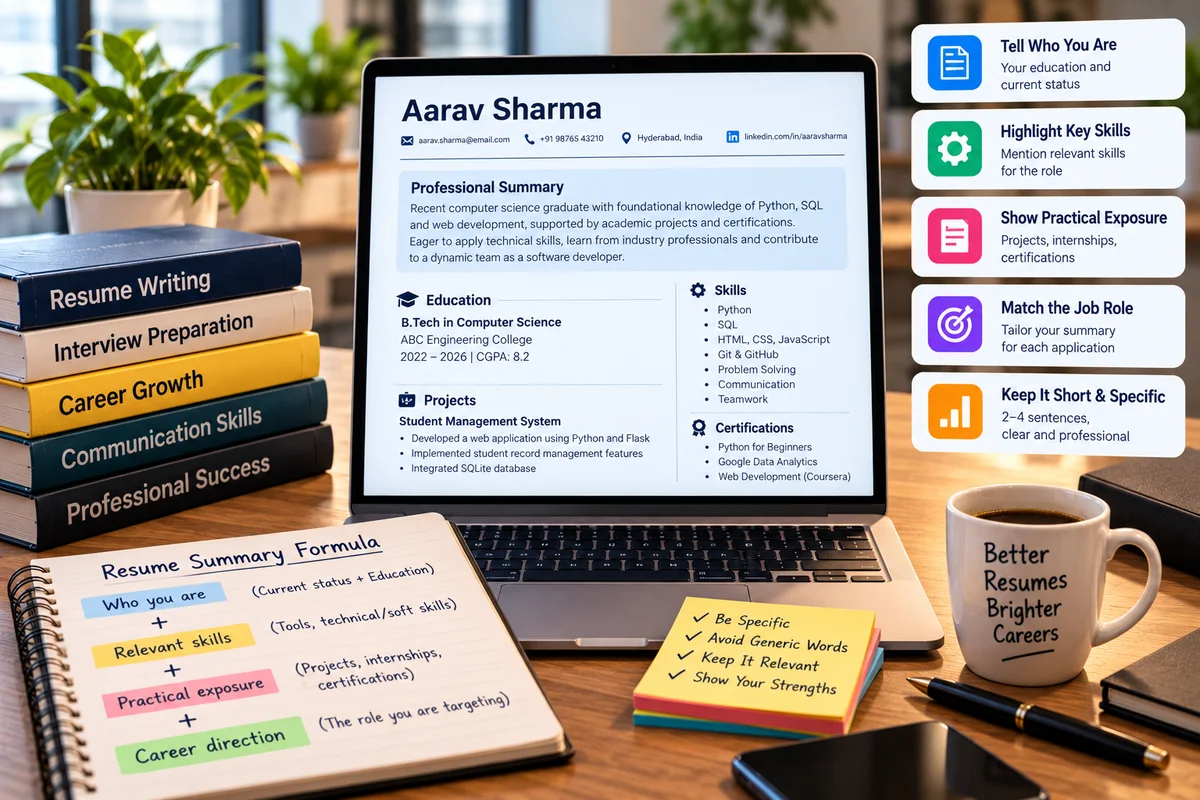
“Recent computer science graduate with foundational knowledge of Python, SQL and web development, along with hands-on experience through academic projects. Interested in starting a career in software development and applying technical skills in a professional environment.”
This example tells the recruiter several things quickly:
• The candidate is a recent graduate.
• The candidate studied computer science.
• The candidate knows Python and SQL.
• The candidate has project experience.
• The candidate wants a software development role.
That is the purpose of a summary.
It should create context for the rest of your resume.
---
# 2. Do Freshers Really Need a Resume Summary?
A resume summary is not mandatory for every resume.
However, it can be useful for freshers because they often have limited professional experience.
A good summary can help connect different parts of your profile.
For example, imagine your resume contains:
Degree: B.Com
Skills: Excel, SQL, Power BI
Project: Sales dashboard
Certification: Data analytics
Without a summary, the recruiter has to connect these details independently.
A summary can connect them:
“Recent commerce graduate with foundational knowledge of Excel, SQL and Power BI, supported by hands-on experience creating a sales dashboard as an academic project. Interested in beginning a career in data analytics and using data to support business decisions.”
Now the profile has a clear direction.
The summary does not create experience that does not exist.
It simply organizes the information you already have.
---
# 3. Resume Summary vs Resume Objective
Freshers often hear two terms:
Resume summary
Resume objective
They are related, but they are not exactly the same.
A resume objective traditionally focuses more heavily on what the candidate wants.
For example:
“Seeking an entry-level position in digital marketing where I can use my communication and analytical skills while developing my professional knowledge.”
A summary is more focused on what the candidate brings.
For example:
“Recent graduate with foundational knowledge of digital marketing, Google Ads, analytics and social media marketing, supported by coursework and practical projects. Interested in contributing to digital campaigns while developing hands-on marketing experience.”
The second version gives the recruiter more information about the candidate.
For most modern fresher resumes, a concise summary can be more useful than a generic objective.
---
# 4. What Should a Fresher Resume Summary Include?
A strong fresher summary can include several elements.
You do not need to include every element in every summary.
The most useful components are:
1. Your current professional status
2. Your educational background
3. Relevant skills
4. Practical exposure
5. Career direction
6. A relevant strength
7. Potential value to the employer
For example:
“Recent business administration graduate with foundational knowledge of digital marketing, market research and Excel, along with practical exposure through academic projects. Strong interest in performance marketing and customer acquisition, with a willingness to learn new tools and contribute to campaign execution.”
Notice that the summary is not simply:
“I am a hardworking person looking for a challenging opportunity.”
It provides actual information.
---
# 5. Start With Your Professional Identity
Your opening phrase should quickly establish who you are.
Examples:
“Recent computer science graduate…”
“Entry-level digital marketing professional…”
“Recent MBA graduate…”
“Business administration graduate…”
“Entry-level data analytics candidate…”
“Recent engineering graduate…”
“Certified digital marketing learner…”
“Junior graphic design candidate…”
Choose an opening that accurately represents your current position.
Avoid exaggeration.
If you are a fresher, you can say:
“Recent graduate…”
“Entry-level…”
“Fresher…”
“Early-career…”
You do not need to hide the fact that you are starting your career.
---
# 6. Mention Your Degree When It Is Relevant
Your education can provide important context.
For example:
“Recent B.Tech graduate…”
“Recent B.Com graduate…”
“Recent MBA graduate…”
“Computer science graduate…”
“Bachelor's graduate with a specialization in…”
However, avoid filling the summary with unnecessary academic details.
You usually do not need to include:
• College address
• Graduation month
• School name
• Every subject studied
• Marks
• Every academic award
Those details can appear elsewhere in the resume if relevant.
The summary should remain focused.
---
# 7. Highlight Relevant Skills
The word “relevant” is important.
Do not list every skill you have.
Select skills that match the job you are applying for.
For a digital marketing position:
• Google Ads
• SEO
• Google Analytics
• Social media marketing
• Content marketing
• Campaign reporting
For a software development position:
• Python
• Java
• SQL
• Git
• HTML
• CSS
For a data analyst position:
• Excel
• SQL
• Power BI
• Python
• Data visualization
For an HR position:
• Communication
• Recruitment fundamentals
• Excel
• Interview coordination
• HR documentation
The summary should reflect the target role.
---
# 8. Include Practical Exposure
Freshers often think:
“I don't have experience.”
But professional experience is not the only form of practical exposure.
You may have:
• Academic projects
• Internships
• Freelance projects
• Personal projects
• College projects
• Volunteer work
• Case studies
• Certifications with practical assignments
• Portfolio projects
• Competitions
• Student organizations
If relevant, mention them.
For example:
“Recent computer science graduate with hands-on experience building academic web development projects using HTML, CSS and JavaScript.”
That is stronger than:
“Computer science graduate looking for a job.”
---
# 9. Show Career Direction
A recruiter should understand what kind of opportunity you are seeking.
For example:
“Interested in starting a career in data analytics.”
“Seeking an entry-level opportunity in digital marketing.”
“Interested in software development roles.”
“Looking to begin a career in human resources.”
This helps avoid ambiguity.
Suppose your resume lists:
Python
Photoshop
Google Ads
Excel
SQL
Video editing
Content writing
Social media
If you apply for a data analyst position, the recruiter may wonder:
“What exactly does this person want to do?”
Your summary can provide direction.
For example:
“Recent commerce graduate with foundational knowledge of Excel, SQL and Power BI, interested in beginning a career in data analytics.”
Now the profile has a clearer purpose.
---
# 10. Do Not Turn the Summary Into a Life Story
A resume summary should be short.
It is not an autobiography.
You do not need to explain:
• Your childhood
• Why you chose your degree
• Your personal hobbies
• Your family background
• Your complete career dream
• Every certification
• Every project
The recruiter can learn more from the rest of the resume.
The summary should provide enough information to encourage them to continue reading.
---
# 11. How Long Should a Fresher Resume Summary Be?
A practical target is around 2–4 sentences.
Depending on the resume design, approximately 40–80 words can be enough.
The exact length depends on your profile.
A candidate with multiple projects may need slightly more context.
A very simple fresher profile may need less.
The important rule is:
Be concise without becoming vague.
Compare these two examples.
Weak:
“Hardworking and motivated graduate looking for a challenging opportunity to utilize my skills and grow professionally.”
Better:
“Recent B.Tech graduate with foundational knowledge of Python, SQL and web development, supported by academic projects in application development. Interested in an entry-level software development role where I can apply my technical skills and continue building practical experience.”
The second version provides evidence and direction.
---
# 12. Use Specific Skills Instead of Generic Words
Generic words are easy to write.
That is exactly why they are often weak.
Examples:
“Hardworking”
“Passionate”
“Dedicated”
“Motivated”
“Enthusiastic”
“Dynamic”
“Result-oriented”
These words are not automatically bad.
The problem occurs when they appear without evidence.
Instead of:
“Hardworking and passionate digital marketing fresher.”
Try:
“Recent graduate with foundational knowledge of Google Ads, SEO and analytics, supported by hands-on campaign exercises and digital marketing projects.”
The second version tells the recruiter something concrete.
---
# 13. A Simple Formula for Writing a Fresher Resume Summary
Use this formula:
WHO YOU ARE + WHAT YOU KNOW + WHAT YOU HAVE DONE + WHAT YOU WANT
For example:
“Recent B.Com graduate with foundational knowledge of Excel, SQL and Power BI, supported by an academic sales analytics project. Interested in beginning a career in data analytics and applying analytical skills to real-world business problems.”
Break it down:
WHO YOU ARE:
Recent B.Com graduate
WHAT YOU KNOW:
Excel, SQL and Power BI
WHAT YOU HAVE DONE:
Academic sales analytics project
WHAT YOU WANT:
Career in data analytics
This formula works for many entry-level profiles.
---
# 14. Another Useful Formula
You can also use:
CURRENT STATUS + RELEVANT SKILLS + PRACTICAL EXPOSURE + CAREER DIRECTION
Example:
“Recent computer science graduate with foundational knowledge of Python, SQL and web technologies. Built academic projects involving database management and basic web applications, and currently seeking an entry-level software development opportunity.”
This is simple and professional.
---
# 15. Resume Summary Formula for Candidates With No Experience
If you have no internship or formal work experience, use:
EDUCATION + SKILLS + PROJECTS/LEARNING + TARGET ROLE
Example:
“Recent BBA graduate with foundational knowledge of digital marketing, market research and Excel. Completed academic projects involving customer research and social media strategy and seeking an entry-level opportunity in digital marketing.”
You do not need to pretend you have professional experience.
Your projects and learning can provide evidence of your capabilities.
---
# 16. Resume Summary Formula for Candidates With an Internship
If you completed an internship:
EDUCATION + SKILLS + INTERNSHIP + TARGET ROLE
Example:
“Recent MBA graduate with foundational knowledge of marketing analytics, customer research and digital marketing. Completed a marketing internship supporting competitor research, campaign reporting and content planning, and seeking an entry-level marketing role.”
This is stronger because the internship provides practical context.
---
# 17. Resume Summary Formula for Candidates With Projects
If projects are your strongest experience:
EDUCATION + TECHNICAL SKILLS + PROJECT EXPERIENCE + TARGET ROLE
Example:
“Recent computer science graduate with knowledge of Python, SQL and JavaScript, with hands-on experience developing academic projects involving data processing and web applications. Interested in an entry-level software development role.”
---
# 18. Resume Summary Formula for Certified Candidates
Certifications can be useful when they are relevant.
Example:
“Recent graduate with foundational knowledge of digital marketing and certifications in Google Ads and Google Analytics. Completed practical learning projects covering campaign planning, performance measurement and basic analytics, and seeking an entry-level digital marketing opportunity.”
Do not list ten certifications in the summary.
The certification section can provide the complete list.
---
# 19. Resume Summary for Computer Science Freshers
Example:
“Recent computer science graduate with foundational knowledge of Python, SQL, data structures and web development. Completed academic projects involving database management and basic application development, with a strong interest in starting a career in software development.”
Alternative:
“Entry-level software development candidate with knowledge of Python, Java, SQL and Git, supported by academic programming projects. Interested in applying problem-solving and programming skills in a professional development environment.”
---
# 20. Resume Summary for Software Developers
Example:
“Recent computer science graduate with foundational knowledge of Python, JavaScript, SQL and web development. Built academic projects involving frontend interfaces and database integration, and seeking an entry-level software development role where I can strengthen my programming and problem-solving skills.”
---
# 21. Resume Summary for Python Developers
Example:
“Recent computer science graduate with foundational knowledge of Python, SQL and object-oriented programming. Developed academic projects using Python for data processing and basic application development, and seeking an entry-level Python development opportunity.”
---
# 22. Resume Summary for Data Analyst Freshers
Example:
“Recent graduate with foundational knowledge of Excel, SQL, Power BI and data visualization. Completed academic projects involving data cleaning, analysis and dashboard creation, and interested in beginning a career in data analytics.”
Another version:
“Entry-level data analytics candidate with knowledge of Excel, SQL and Power BI, supported by practical projects involving data analysis and visualization. Interested in using data to identify patterns and support business decision-making.”
---
# 23. Resume Summary for Digital Marketing Freshers
Example:
“Recent graduate with foundational knowledge of digital marketing, Google Ads, SEO, social media marketing and Google Analytics. Completed practical learning projects covering campaign planning and performance measurement, and seeking an entry-level digital marketing opportunity.”
---
# 24. Resume Summary for Performance Marketing Freshers
Example:
“Entry-level digital marketing candidate with foundational knowledge of paid advertising, campaign measurement, Google Ads and analytics. Familiar with core performance metrics such as CTR, CPC, conversion rate and ROAS, and interested in building practical experience in performance marketing.”
---
# 25. Resume Summary for Programmatic Advertising Freshers
Example:
“Digital marketing candidate with foundational knowledge of programmatic advertising, campaign operations, audience targeting and performance measurement. Familiar with concepts including DSPs, ad exchanges, CPM, CTR and frequency, and seeking an opportunity to develop hands-on experience in programmatic advertising.”
---
# 26. Resume Summary for SEO Freshers
Example:
“Recent graduate with foundational knowledge of SEO, keyword research, on-page optimization, technical SEO and content strategy. Completed practical SEO learning projects and interested in beginning a career focused on organic search visibility and website growth.”
---
# 27. Resume Summary for Content Marketing Freshers
Example:
“Recent graduate with strong interest in content marketing and digital communication, supported by knowledge of content planning, SEO fundamentals and social media. Experienced in developing academic and personal content projects and seeking an entry-level content marketing opportunity.”
---
# 28. Resume Summary for Social Media Marketing Freshers
Example:
“Recent graduate with foundational knowledge of social media marketing, content planning, audience engagement and digital campaign fundamentals. Interested in creating data-informed social media strategies and beginning a career in digital marketing.”
---
# 29. Resume Summary for Google Ads Freshers
Example:
“Entry-level digital marketing candidate with foundational knowledge of Google Ads, keyword targeting, campaign structure, bidding and performance measurement. Familiar with metrics including CTR, CPC, conversion rate and ROAS, and seeking an opportunity to develop hands-on paid advertising experience.”
---
# 30. Resume Summary for Finance Freshers
Example:
“Recent commerce graduate with foundational knowledge of accounting, financial analysis, Excel and business fundamentals. Completed academic projects involving financial statements and basic analysis, and seeking an entry-level opportunity in finance or accounting.”
---
# 31. Resume Summary for Accounting Freshers
Example:
“Recent B.Com graduate with foundational knowledge of accounting principles, financial statements, Excel and bookkeeping concepts. Detail-oriented and interested in beginning a career in accounting while developing practical experience in a professional environment.”
---
# 32. Resume Summary for HR Freshers
Example:
“Recent graduate with foundational knowledge of human resources, recruitment, employee engagement and HR processes. Developed practical understanding through academic projects and interested in starting a career in HR while contributing to recruitment and people-focused initiatives.”
---
# 33. Resume Summary for Recruitment Freshers
Example:
“Recent graduate with strong communication and organizational skills and foundational knowledge of recruitment processes, candidate sourcing and interview coordination. Interested in beginning a career in talent acquisition and developing practical experience in recruitment operations.”
---
# 34. Resume Summary for Sales Freshers
Example:
“Recent graduate with strong communication, presentation and customer interaction skills, supported by academic and project experience involving market research and customer analysis. Interested in beginning a career in sales and developing skills in customer acquisition and relationship management.”
---
# 35. Resume Summary for Business Development Freshers
Example:
“Recent business administration graduate with foundational knowledge of sales, market research, customer relationship management and business development. Strong interest in client interaction and growth opportunities, with a goal of beginning a career in business development.”
---
# 36. Resume Summary for Management Graduates
Example:
“Recent management graduate with foundational knowledge of business strategy, marketing, operations and organizational management. Completed academic projects involving market research and business analysis and seeking an entry-level opportunity to develop practical management experience.”
---
# 37. Resume Summary for MBA Freshers
Example:
“Recent MBA graduate with knowledge of business strategy, marketing, market research and data-driven decision-making. Completed academic projects involving customer analysis and business planning, and seeking an entry-level role where I can apply management concepts in a practical environment.”
Customize this according to your specialization.
For example:
MBA Marketing
MBA Finance
MBA HR
MBA Operations
should each have different summaries.
---
# 38. Resume Summary for Engineering Freshers
Example:
“Recent engineering graduate with foundational technical knowledge, analytical problem-solving skills and hands-on academic project experience. Interested in an entry-level engineering opportunity where I can apply technical concepts, learn from experienced professionals and contribute to practical projects.”
Make it more specific when possible.
---
# 39. Resume Summary for Mechanical Engineering Freshers
Example:
“Recent mechanical engineering graduate with foundational knowledge of engineering design, manufacturing processes and CAD concepts, supported by academic project experience. Interested in beginning a career in mechanical engineering and developing practical industry knowledge.”
---
# 40. Resume Summary for Electrical Engineering Freshers
Example:
“Recent electrical engineering graduate with foundational knowledge of electrical systems, circuit analysis and engineering fundamentals. Completed academic projects involving electrical system design and interested in an entry-level opportunity to develop practical engineering experience.”
---
# 41. Resume Summary for Civil Engineering Freshers
Example:
“Recent civil engineering graduate with foundational knowledge of structural concepts, construction materials and project planning, supported by academic project experience. Interested in an entry-level civil engineering role where I can develop practical site and project experience.”
---
# 42. Resume Summary for Communication-Focused Roles
If the job emphasizes communication:
“Recent graduate with strong written and verbal communication skills, supported by academic presentations, team projects and customer-focused activities. Interested in an entry-level role where I can apply communication, organization and problem-solving skills while developing professional experience.”
---
# 43. Resume Summary for Customer Support Roles
Example:
“Recent graduate with strong communication, problem-solving and customer interaction skills. Comfortable learning new tools and handling questions in a structured manner, and seeking an entry-level customer support opportunity where I can contribute to positive customer experiences.”
---
# 44. Resume Summary for Operations Roles
Example:
“Recent graduate with strong organizational and analytical skills and foundational knowledge of business operations, process management and Excel. Interested in an entry-level operations role where I can contribute to efficient processes while developing practical experience.”
---
# 45. Resume Summary for Project Management Roles
Example:
“Recent graduate with foundational knowledge of project planning, task coordination, documentation and team collaboration. Experienced in academic projects involving timelines and group coordination, and interested in developing a career in project management.”
---
# 46. Resume Summary for UI/UX Design Freshers
Example:
“Recent design graduate with foundational knowledge of user research, wireframing, interface design and usability principles. Developed academic and personal design projects and interested in an entry-level UI/UX opportunity where I can build practical design experience.”
---
# 47. Resume Summary for Graphic Design Freshers
Example:
“Recent graduate with foundational knowledge of graphic design, visual communication and design tools, supported by academic and personal design projects. Interested in creating clear and engaging visual content while developing professional design experience.”
---
# 48. Resume Summary for Journalism or Media Freshers
Example:
“Recent media graduate with strong writing, research and communication skills and practical exposure through academic content and media projects. Interested in an entry-level role involving content creation, research, digital media or communications.”
---
# 49. Resume Summary for Students With No Internship
If you do not have an internship, do not panic.
Use your projects and learning.
Example:
“Recent graduate with foundational knowledge of business analytics, Excel and data visualization, developed through academic coursework and project work. Interested in starting a career in analytics and gaining practical experience in a professional environment.”
The absence of an internship does not mean your resume must be empty.
---
# 50. Resume Summary for Candidates With Online Courses
Online courses can demonstrate initiative when they are relevant.
Example:
“Recent graduate with foundational knowledge of digital marketing developed through academic coursework and specialized online certifications in Google Ads and analytics. Completed practical exercises involving campaign planning and performance measurement and seeking an entry-level marketing opportunity.”
Do not turn the summary into a list of course names.
---
# 51. Resume Summary for Candidates With Personal Projects
Personal projects can be particularly useful for technical candidates.
Example:
“Recent computer science graduate with knowledge of Python, SQL and web development, supported by personal projects involving data processing and basic web applications. Interested in an entry-level software development role where I can apply my technical skills and continue learning.”
---
# 52. Resume Summary for Career Changers
Not every entry-level candidate is a recent graduate.
Some people change careers after working in another field.
In that case, focus on transferable skills and the new direction.
Example:
“Professional transitioning into digital marketing with foundational knowledge of Google Ads, SEO, analytics and content marketing developed through structured learning and practical projects. Bringing previous experience in communication, organization and client interaction, with a goal of building a career in digital marketing.”
This is different from a traditional fresher summary.
---
# 53. Resume Summary After a Career Break
If you have a career gap, you do not necessarily need to make the summary about the gap.
Focus on:
• Current skills
• Relevant experience
• Recent learning
• Target role
• Readiness to return
Example:
“Digital marketing professional with experience in campaign operations and performance marketing, recently refreshing knowledge across advertising platforms, analytics and campaign measurement. Interested in returning to a professional environment where I can apply my existing experience while continuing to develop current digital marketing skills.”
The detailed explanation of a career break can be handled separately when appropriate.
---
# 54. Resume Summary for Returning Professionals
Example:
“Marketing professional with previous experience in campaign execution, reporting and digital advertising, supported by recent learning in analytics and current marketing practices. Seeking an opportunity to return to a professional role and contribute to campaign performance and execution.”
Keep the emphasis on your current readiness.
---
# 55. Resume Summary for Internship Applications
A student applying for an internship can use:
“Final-year computer science student with foundational knowledge of Python, SQL and web development and hands-on experience through academic projects. Seeking a software development internship to apply technical skills, gain practical exposure and learn from an experienced team.”
For a marketing internship:
“Final-year business student with foundational knowledge of digital marketing, social media and analytics, supported by academic projects and online certifications. Seeking a marketing internship to gain practical campaign experience and develop professional skills.”
---
# 56. Resume Summary for Campus Placements
Campus placement resumes should be straightforward.
Example:
“Final-year B.Tech student with foundational knowledge of Python, SQL and data structures, supported by academic programming projects. Strong interest in software development and problem solving, seeking an entry-level opportunity through campus recruitment.”
Avoid making the summary overly complicated.
Recruiters reviewing campus resumes may process many applications.
Clarity matters.
---
# 57. Resume Summary for Freshers With Strong Academic Performance
If academic achievement is genuinely strong and relevant, it can be included.
Example:
“Recent engineering graduate with a strong academic record and foundational knowledge of Python, SQL and software development. Completed academic projects involving application development and interested in beginning a career in software engineering.”
Do not make grades the entire summary.
Skills and direction still matter.
---
# 58. Resume Summary for Candidates With Leadership Experience
Leadership does not require a job title.
It can come from:
• College organizations
• Student clubs
• Project teams
• Events
• Volunteer activities
• Competitions
Example:
“Recent business graduate with foundational knowledge of marketing and business analysis, along with experience coordinating academic projects and student activities. Strong communication and organizational skills, with an interest in beginning a career in business development.”
---
# 59. Resume Summary for Candidates With Volunteer Experience
Example:
“Recent graduate with strong communication and organizational skills and volunteer experience coordinating student and community activities. Interested in an entry-level role where I can apply teamwork, communication and problem-solving abilities while developing professional experience.”
---
# 60. Should You Mention Soft Skills?
Yes, but carefully.
Soft skills can be useful when they are relevant to the role.
Examples:
• Communication
• Teamwork
• Organization
• Problem solving
• Adaptability
• Time management
• Attention to detail
However, do not simply write:
“Hardworking, honest, punctual, sincere, dedicated, passionate, team player.”
That sounds generic.
Instead, connect skills to evidence.
For example:
“Strong communication and presentation skills developed through academic presentations and team projects.”
This gives the claim context.
---
# 61. Should You Mention “Hardworking”?
You can, but it is rarely the strongest use of limited resume space.
Almost every candidate can describe themselves as hardworking.
A better approach is to demonstrate the quality through achievements or responsibilities.
Instead of:
“Hardworking graduate.”
Try:
“Recent graduate with hands-on project experience and a consistent focus on developing practical skills in data analytics.”
Specific information is usually more valuable.
---
# 62. Should You Mention “Quick Learner”?
This is another common phrase.
You can mention learning ability, but evidence is stronger.
Instead of:
“Quick learner with a positive attitude.”
Try:
“Built foundational knowledge of SQL, Power BI and data visualization through structured coursework and independent projects.”
The second statement demonstrates initiative and learning.
---
# 63. Customize Your Summary for Every Job
One of the biggest resume mistakes is using exactly the same summary for every application.
Suppose you have this generic summary:
“Recent graduate with strong communication and analytical skills seeking a challenging position in a growing organization.”
You could apply to:
• Marketing
• HR
• Finance
• Software
• Sales
The summary would look exactly the same.
That is a missed opportunity.
Instead, adjust the summary based on the role.
For a marketing position:
“Recent business graduate with foundational knowledge of digital marketing, SEO and campaign analytics…”
For a data position:
“Recent graduate with foundational knowledge of Excel, SQL and data visualization…”
For HR:
“Recent graduate with foundational knowledge of recruitment, employee engagement and HR processes…”
The underlying candidate is the same.
The positioning changes.
---
# 64. Read the Job Description Before Editing the Summary
Take the job description and identify repeated or important requirements.
For example:
“Candidate should have knowledge of Excel, reporting, data analysis and communication.”
Your summary could naturally highlight:
“Recent graduate with foundational knowledge of Excel, reporting and data analysis, supported by academic projects involving business data…”
Do not copy the job description word-for-word.
Use the requirements to decide which genuine skills to emphasize.
---
# 65. Avoid Keyword Stuffing
Adding every keyword from a job description can make a summary unreadable.
For example:
“Dynamic hardworking motivated team player with Excel SQL Python Java Power BI Tableau AWS AI ML communication leadership management…”
This is not a professional summary.
Use relevant keywords naturally.
A recruiter should be able to read the sentence comfortably.
---
# 66. Resume Summary Should Match the Rest of the Resume
Consistency is important.
If your summary says:
“Digital marketing professional with Google Ads experience.”
but the rest of your resume contains no Google Ads evidence, the recruiter may question the statement.
If you mention:
“Data analyst with SQL and Power BI skills.”
your skills or projects should support those claims.
Your summary should introduce the evidence found later in the resume.
---
# 67. Don't Claim Professional Experience You Don't Have
Avoid statements such as:
“Experienced digital marketing professional…”
if you have never worked professionally in digital marketing.
Instead:
“Digital marketing candidate with foundational knowledge…”
or:
“Recent graduate with practical digital marketing project experience…”
Accuracy is important.
Your resume should present your strongest genuine profile, not an inflated one.
---
# 68. Avoid Using First Person
Resume summaries usually do not need:
“I am…”
“I have…”
“My goal is…”
“My objective is…”
Instead of:
“I am a recent graduate with knowledge of Python.”
Use:
“Recent computer science graduate with foundational knowledge of Python.”
Instead of:
“I am looking for an opportunity in marketing.”
Use:
“Seeking an entry-level opportunity in digital marketing.”
This makes the writing more concise.
---
# 69. Avoid Long Sentences
A summary should be easy to scan.
If one sentence contains five clauses, break it down.
Weak:
“Recent graduate who has completed multiple academic projects and certifications and has developed knowledge of several tools and is interested in finding an opportunity where I can learn and grow and use my skills…”
Better:
“Recent graduate with foundational knowledge of digital marketing and analytics, supported by academic projects and relevant certifications. Seeking an entry-level opportunity to apply these skills and gain practical campaign experience.”
Shorter sentences are easier to read.
---
# 70. Avoid Overused Career Objectives
Avoid phrases such as:
“Seeking a challenging position in a reputed organization where I can utilize my skills for the growth of the organization while enhancing my knowledge.”
This sounds generic.
It also focuses more on a vague future than your actual profile.
Replace it with something specific.
For example:
“Recent B.Com graduate with foundational knowledge of accounting and Excel, seeking an entry-level accounting role where I can apply academic knowledge and develop practical experience.”
---
# 71. Avoid Mentioning Salary in Your Summary
Your salary expectations do not belong in your resume summary.
Do not write:
“Looking for a job with a salary of…”
Compensation can be discussed during the hiring process when appropriate.
The summary should focus on professional value.
---
# 72. Avoid Personal Information
A resume summary usually does not need:
• Age
• Marital status
• Religion
• Family details
• Home address
• Personal financial circumstances
Focus on professional information.
---
# 73. Avoid Hobbies Unless They Add Relevant Value
You generally do not need to write:
“I enjoy watching movies and playing cricket.”
in your resume summary.
If a hobby is directly relevant to the role or demonstrates meaningful achievement, it can be discussed elsewhere.
But it usually does not belong in the professional summary.
---
# 74. Don't Copy an Online Example Exactly
Online examples are useful for understanding structure.
They should not become your final resume.
A copied summary may contain:
• Skills you don't have
• Experience you don't have
• Generic statements
• Wrong terminology
• Irrelevant claims
Use examples as templates.
Then rewrite them around your own profile.
---
# 75. A Simple Step-by-Step Method to Write Your Summary
If you don't know where to start, follow these steps.
### Step 1: Identify your current status
Are you:
A student?
Recent graduate?
Fresher?
Entry-level candidate?
Career changer?
Returning professional?
Write that down.
### Step 2: Identify the target role
For example:
Digital Marketing Executive
Data Analyst
Software Developer
HR Executive
Business Development Executive
### Step 3: Select 3–5 relevant skills
Choose skills that genuinely match the role.
### Step 4: Identify your strongest practical evidence
This could be:
Project
Internship
Certification
Portfolio
Academic work
Personal project
### Step 5: Write your career direction
What type of opportunity are you targeting?
### Step 6: Combine the information
Use:
Status + Skills + Evidence + Career direction
### Step 7: Remove unnecessary words
Cut:
“I am”
“hardworking”
“passionate”
“seeking a challenging opportunity”
unless they genuinely add meaning.
### Step 8: Read it aloud
If it sounds unnatural, rewrite it.
---
# 76. Resume Summary Before and After
### Weak version
“Hardworking and dedicated fresher looking for a challenging opportunity in a reputed organization where I can use my skills and grow professionally.”
Problems:
• Generic
• No education
• No skills
• No evidence
• No role direction
• Could belong to almost anyone
### Improved version
“Recent B.Com graduate with foundational knowledge of Excel, accounting principles and financial analysis, supported by academic projects involving financial statement analysis. Seeking an entry-level accounting opportunity to apply academic knowledge and develop practical experience.”
Why it is better:
• Identifies the candidate
• Provides relevant skills
• Includes practical evidence
• Specifies the target role
• Remains concise
---
# 77. Another Before-and-After Example
### Weak
“Passionate and enthusiastic computer science student seeking a challenging career in IT.”
### Better
“Final-year computer science student with foundational knowledge of Python, SQL and web development, supported by academic programming projects. Interested in an entry-level software development opportunity where I can apply technical skills and gain practical experience.”
The second version communicates much more information.
---
# 78. How to Write a Summary Without Professional Experience
Use this structure:
EDUCATION + SKILLS + PROJECTS + TARGET ROLE
Example:
“Recent graduate with foundational knowledge of Python, SQL and data visualization, developed through coursework and academic projects. Completed a data analysis project involving data cleaning and dashboard creation, and seeking an entry-level opportunity in analytics.”
You do not need to apologize for having no professional experience.
---
# 79. How to Write a Summary With an Internship
Use:
EDUCATION + SKILLS + INTERNSHIP + TARGET ROLE
Example:
“Recent marketing graduate with foundational knowledge of SEO, social media and campaign analytics. Completed a marketing internship supporting content planning, competitor research and campaign reporting, and seeking an entry-level digital marketing role.”
---
# 80. How to Write a Summary With Multiple Projects
Choose only the most relevant projects.
You do not need to mention all of them.
Example:
“Recent computer science graduate with knowledge of Python, SQL and web development, supported by academic projects involving a database application and a responsive web application. Interested in an entry-level software development role.”
Two relevant projects can be more useful than listing ten unrelated projects.
---
# 81. How to Write a Summary for a Specific Job Posting
Imagine the job description says:
“Looking for an entry-level digital marketing candidate with knowledge of Google Ads, SEO, analytics and social media.”
Your summary could be:
“Recent graduate with foundational knowledge of Google Ads, SEO, Google Analytics and social media marketing, supported by practical digital marketing projects. Interested in an entry-level role involving campaign execution, performance monitoring and digital growth.”
This is customized without copying the job description.
---
# 82. How to Write a Summary for a Data Analyst Job Posting
Suppose the job requires:
Excel
SQL
Power BI
Data analysis
Reporting
Your summary could be:
“Recent graduate with foundational knowledge of Excel, SQL and Power BI, supported by academic projects involving data cleaning, analysis and dashboard creation. Interested in an entry-level data analyst role focused on reporting and data-driven decision-making.”
---
# 83. How to Write a Summary for a Software Developer Job Posting
Suppose the role requires:
Python
SQL
Problem solving
Web development
Your summary could be:
“Recent computer science graduate with foundational knowledge of Python, SQL and web development, supported by academic programming projects. Strong interest in software development and problem solving, seeking an entry-level opportunity to apply technical skills in a professional environment.”
---
# 84. How to Write a Summary for a Sales Job Posting
Suppose the role requires:
Communication
Customer interaction
Lead generation
Relationship management
Your summary could be:
“Recent business graduate with strong communication and customer interaction skills and foundational knowledge of sales and business development. Experienced in academic activities involving presentations and customer research, and interested in an entry-level sales opportunity.”
---
# 85. How to Write a Summary for an HR Job Posting
Suppose the role requires:
Recruitment
Communication
Coordination
Documentation
Your summary could be:
“Recent graduate with foundational knowledge of recruitment, employee engagement and HR processes, supported by academic projects and strong communication skills. Interested in an entry-level HR opportunity involving recruitment coordination and people-focused activities.”
---
# 86. Should a Resume Summary Mention Certifications?
Only when they add value.
For example, if you are applying for digital marketing and have:
Google Ads certification
Google Analytics certification
Meta certification
you can mention relevant certification exposure.
But you do not need:
“Certified in 12 courses…”
in your summary.
The detailed certification list belongs in a separate section.
---
# 87. Should a Fresher Mention Academic Projects?
Yes, when they are relevant.
Projects can provide evidence of practical learning.
Instead of:
“Knowledge of SQL.”
Use:
“Foundational knowledge of SQL supported by an academic database project.”
This is more credible.
---
# 88. Should You Mention Grades?
Only if they are strong and useful.
For example:
“Graduated with distinction…”
can be appropriate if true.
But grades usually should not dominate the summary.
---
# 89. Should You Mention College Name?
Usually, your education section can provide this information.
The summary can focus on the qualification rather than the institution.
For example:
“Recent B.Tech graduate with…”
rather than:
“Recent B.Tech graduate from XYZ College…”
There may be exceptions if the institution is particularly relevant to the opportunity, but it is rarely necessary.
---
# 90. Should You Mention Location?
Usually, no.
Your contact information can provide your location.
However, if location is highly relevant to your job search, you can mention it elsewhere in the resume.
Do not waste summary space unnecessarily.
---
# 91. How Recruiters May Read Your Summary
Imagine a recruiter has many resumes to review.
They may initially scan:
Name
Location
Professional summary
Skills
Experience/projects
Education
The summary should therefore answer quickly:
Who is this candidate?
What can they do?
What role are they targeting?
Why might they be relevant?
A clear summary makes the rest of the resume easier to understand.
---
# 92. Make Your First Sentence Strong
The first sentence should immediately establish your profile.
Compare:
“I am looking for an opportunity to start my career…”
with:
“Recent computer science graduate with foundational knowledge of Python, SQL and web development…”
The second sentence immediately gives useful information.
---
# 93. Focus on Relevance, Not Quantity
You may have learned:
Python
SQL
Java
Excel
Photoshop
Canva
Google Ads
SEO
Power BI
AWS
Communication
Leadership
and many other skills.
You do not need all of them in the summary.
Choose the ones most relevant to the target role.
Your full skills section can contain additional relevant skills.
---
# 94. Use the Same Language as Your Target Industry
Different industries use different terminology.
Marketing may use:
Campaigns
Conversions
SEO
Paid media
Analytics
Performance
Technology may use:
Programming
APIs
Databases
Cloud
Development
Data
Finance may use:
Financial analysis
Accounting
Reporting
Reconciliation
Forecasting
HR may use:
Recruitment
Talent acquisition
Employee engagement
HR operations
Use terminology accurately.
Do not insert keywords simply to sound professional.
---
# 95. Check Your Grammar
A resume is a professional document.
Review:
• Spelling
• Grammar
• Capitalization
• Punctuation
• Tense
• Sentence structure
Common issues include:
“Good in communication”
Better:
“Strong communication skills”
“Knowledge about Python”
Better:
“Knowledge of Python”
“Looking for a challenging opportunity to utilize my skills”
Better:
“Seeking an entry-level opportunity to apply relevant skills…”
Small improvements can make the resume sound more professional.
---
# 96. Keep Your Summary Professional
Your resume is not social media.
Avoid:
“Hey! I'm a passionate tech enthusiast looking for an awesome opportunity.”
Instead:
“Recent computer science graduate with foundational knowledge of Python and SQL, seeking an entry-level software development opportunity.”
Professional does not mean complicated.
Simple writing is often stronger.
---
# 97. Don't Overuse Buzzwords
Buzzwords can make a resume sound impressive but empty.
Examples:
“Synergy”
“Dynamic”
“Strategic thinker”
“Results-driven”
“Go-getter”
“Visionary”
“Proactive self-starter”
Use these only when supported by real evidence.
Specific skills and accomplishments are usually stronger.
---
# 98. Resume Summary Examples by Career Direction
Here is a quick reference.
### Technology
“Recent computer science graduate with foundational knowledge of Python, SQL and web development, supported by academic projects. Seeking an entry-level software development opportunity.”
### Data
“Recent graduate with knowledge of Excel, SQL and Power BI, supported by data analysis and dashboard projects. Interested in beginning a career in data analytics.”
### Digital Marketing
“Recent graduate with foundational knowledge of SEO, Google Ads, analytics and social media marketing, supported by practical projects. Seeking an entry-level digital marketing opportunity.”
### Finance
“Recent commerce graduate with foundational knowledge of accounting, Excel and financial analysis. Seeking an entry-level finance or accounting opportunity.”
### HR
“Recent graduate with foundational knowledge of recruitment, employee engagement and HR processes, supported by academic projects. Interested in beginning a career in human resources.”
### Sales
“Recent business graduate with strong communication and customer interaction skills and foundational knowledge of sales and business development. Seeking an entry-level sales opportunity.”
### Operations
“Recent graduate with strong organizational and analytical skills and foundational knowledge of Excel and business operations. Seeking an entry-level operations role.”
---
# 99. A Resume Summary Should Evolve
Your summary does not need to remain unchanged throughout your job search.
Update it when you:
• Complete a new certification
• Build a new project
• Gain internship experience
• Develop a new technical skill
• Change your target role
• Apply to a different industry
• Gain professional experience
For example, your summary before an internship may say:
“Recent graduate with foundational knowledge…”
After an internship, it can become:
“Recent graduate with practical internship experience in…”
Your resume should reflect your current profile.
---
# 100. Final Resume Summary Checklist
Before adding your summary to your resume, ask:
□ Does it clearly identify me?
□ Does it mention relevant skills?
□ Does it match the job I am applying for?
□ Does it include practical evidence where possible?
□ Does it communicate my career direction?
□ Is everything accurate?
□ Is it concise?
□ Is it easy to read?
□ Does it avoid unnecessary personal information?
□ Does it avoid generic phrases?
□ Does it match the rest of my resume?
□ Have I checked grammar and spelling?
□ Have I customized it for the role?
If the answer to most of these questions is yes, your summary is probably doing its job.
---
# 101. Final Thoughts
A resume summary does not need to make you sound like an experienced executive.
As a fresher, your goal is different.
Your summary should make your profile clear.
You want the recruiter to understand:
Who you are.
What you know.
What you have worked on.
What skills you are developing.
What role you want.
And why your profile is relevant to that role.
You do not need to exaggerate your experience.
You do not need to fill the summary with impressive-sounding words.
You do not need to copy someone else's resume.
Instead, present your genuine strengths clearly.
A useful formula to remember is:
WHO YOU ARE + RELEVANT SKILLS + PRACTICAL EVIDENCE + TARGET ROLE
For example:
“Recent computer science graduate with foundational knowledge of Python, SQL and web development, supported by academic programming projects. Interested in an entry-level software development role where I can apply my technical skills and continue building practical experience.”
That is enough.
Your resume summary is not supposed to tell your entire story.
It is supposed to open the door to the rest of your resume.
Make it clear.
Make it relevant.
Make it truthful.
And most importantly, make it specific to the opportunity you are pursuing.
Learn. Prepare. Grow.