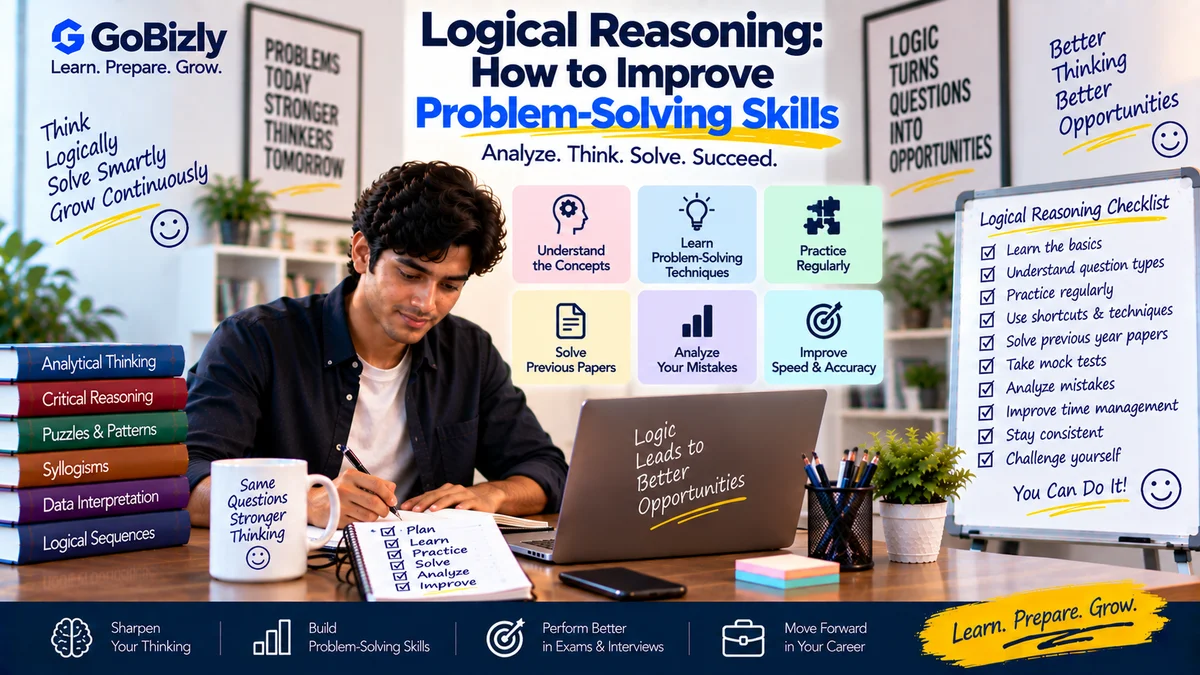
Quantitative Aptitude Basics: Topics Every Fresher Should Know
Quantitative Aptitude Basics: Topics Every Fresher Should Know
Quantitative aptitude tests your ability to work with numbers, calculations and mathematical relationships.
You don't necessarily need advanced mathematics for many placement aptitude assessments.
However, you should be comfortable with fundamental concepts and know how to apply them efficiently.
Here are some important areas to build your foundation.
1. Percentages
Percentages appear in many aptitude problems.
Basic formula:
Percentage = (Part ÷ Whole) × 100
For example:
If 25 out of 100 students pass a test:
(25 ÷ 100) × 100 = 25%
Practice:
Percentage increase
Percentage decrease
Successive changes
Percentage comparisons
2. Ratios
A ratio compares two quantities.
For example:
If the ratio of boys to girls is 2:3, the quantities are divided into five equal parts.
Practice:
Simplifying ratios
Equivalent ratios
Proportions
Ratio-based word problems
3. Averages
Basic formula:
Average = Total ÷ Number of values
For example:
The average of 10, 20 and 30 is:
60 ÷ 3 = 20
Practice problems involving:
Groups
Ages
Scores
Salaries
Changes in values
4. Profit and Loss
Important concepts include:
Cost Price
Selling Price
Profit
Loss
Basic formulas:
Profit = Selling Price − Cost Price
Loss = Cost Price − Selling Price
Percentage calculations are often involved.
5. Simple Interest
Basic formula:
SI = (P × R × T) ÷ 100
Where:
P = Principal
R = Rate
T = Time
Understand what each variable represents before applying the formula.
6. Compound Interest
Compound interest calculates interest on the accumulated amount.
The formula and approach depend on the compounding period.
Practice:
Annual compounding
Half-yearly compounding
Growth calculations
7. Time and Work
These problems involve how quickly people or machines complete tasks.
A useful concept is:
Work = Rate × Time
If one person completes a task faster than another, their work rates differ.
Practice:
Individual work
Combined work
Efficiency
Work remaining
8. Time, Speed and Distance
The basic relationship is:
Speed = Distance ÷ Time
Therefore:
Distance = Speed × Time
Time = Distance ÷ Speed
Practice problems involving:
Trains
Relative speed
Average speed
Boats and streams
Walking and travel
9. Number Systems
Number-system questions can involve:
Odd and even numbers
Prime numbers
Factors
Multiples
Divisibility
Remainders
Understanding number properties can make several problems easier.
10. HCF and LCM
HCF means Highest Common Factor.
LCM means Lowest Common Multiple.
These concepts are useful in problems involving:
Divisibility
Repeating events
Fractions
Number relationships
11. Fractions and Decimals
Be comfortable converting between:
Fractions
Decimals
Percentages
For example:
0.25 = 25% = 1/4
These conversions can save time.
12. Probability
Probability measures the likelihood of an event.
Basic formula:
Probability = Favorable outcomes ÷ Total possible outcomes
For example, when a fair six-sided die is rolled, the probability of getting a 6 is:
1 ÷ 6
13. Permutations and Combinations
These topics deal with arrangements and selections.
Permutation: Arrangement matters.
Combination: Selection matters.
Understanding this difference is essential before applying formulas.
14. Data Interpretation
Data interpretation involves extracting information from:
Tables
Graphs
Charts
Data sets
You may need to calculate:
Percentages
Ratios
Differences
Averages
Growth
15. Algebra Basics
You may encounter:
Linear equations
Simplification
Basic algebraic expressions
Equations involving variables
Practice translating word problems into equations.
16. Age Problems
Age problems often use equations and relationships.
For example:
If one person is twice the age of another, represent the younger person's age as x and the older person's age as 2x.
Then use the additional information provided.
17. Mixtures and Alligation
These questions involve combining quantities with different values or concentrations.
They can appear in:
Price problems
Concentration problems
Mixture calculations
Understand the relationship between quantities before using shortcut methods.
18. Clocks and Calendars
Some aptitude tests include:
Clock angles
Time relationships
Days
Dates
Calendar patterns
These require specific formulas and logical reasoning.
19. Learn Shortcuts Carefully
Shortcuts can save time.
However, learn the underlying method first.
A shortcut you don't understand can increase mistakes.
Use shortcuts after becoming comfortable with the concept.
20. Build a Formula Revision Sheet
Create sections for:
Percentages
Ratios
Averages
Profit & Loss
Interest
Time & Work
Speed & Distance
Probability
Permutation & Combination
Review the sheet regularly.
Quantitative Aptitude Checklist
☐ Percentages
☐ Ratios
☐ Averages
☐ Profit and loss
☐ Simple interest
☐ Compound interest
☐ Time and work
☐ Speed and distance
☐ Number systems
☐ HCF and LCM
☐ Fractions and decimals
☐ Probability
☐ Permutations and combinations
☐ Data interpretation
☐ Basic algebra
☐ Age problems
☐ Mixtures
☐ Clocks and calendars
Conclusion
Quantitative aptitude becomes manageable when you break it into smaller topics.
Start with arithmetic fundamentals.
Understand the formulas.
Practice different question types.
Then gradually improve your speed.
Don't try to memorize solutions.
Learn the method so you can apply it to unfamiliar questions.
Master the basics first. Speed comes with practice.
Learn. Prepare. Grow.