Mock Tests and Practice: How to Use Them Effectively
Mock Tests and Practice: How to Use Them Effectively
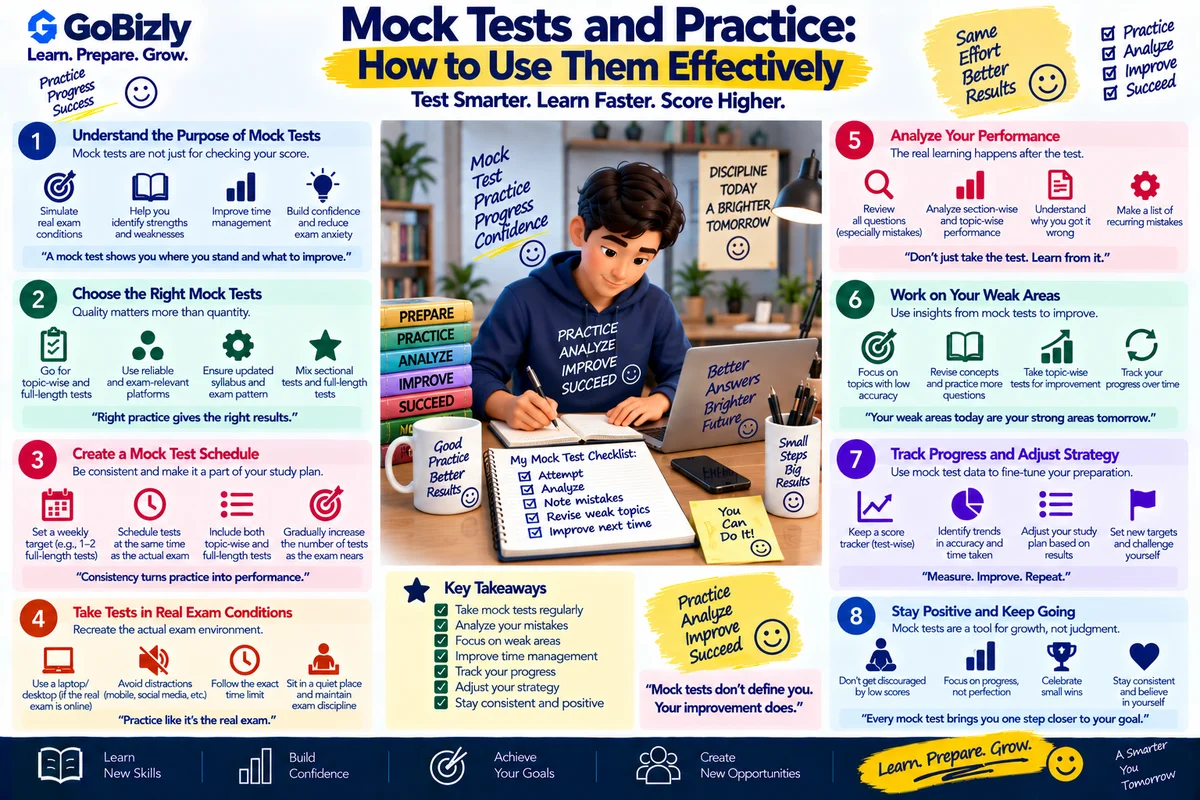
Mock tests are an important part of competitive exam preparation, but simply taking test after test does not automatically improve performance.
The real value of a mock test comes from what you do before, during and after the test.
A good mock-test process looks like:
Attempt → Analyze → Identify mistakes → Fix weaknesses → Practice → Re-test
This article explains how to make mock tests a useful part of your preparation.
1. Why Mock Tests Matter
Mock tests allow you to practice more than subject knowledge.
They can help you evaluate:
Accuracy
Speed
Time management
Question selection
Concentration
Section management
Repeated mistakes
Performance under time pressure
They also help you become familiar with the experience of solving multiple sections within a limited time.
2. Don't Start With Full-Length Tests Too Early
If you have just started learning the syllabus, taking full-length tests may not provide much useful information.
Instead, progress through stages.
Stage 1: Topic Tests
Focus on individual topics.
Example:
20 percentage questions
Stage 2: Section Tests
Combine several related topics.
Example:
Quantitative aptitude test
Stage 3: Mixed Tests
Combine multiple sections.
Stage 4: Full-Length Mock Tests
Simulate the examination environment.
This creates a gradual transition from learning to performance.
3. Follow Realistic Test Conditions
When taking a full mock test:
Use the actual time limit.
Avoid unnecessary interruptions.
Keep your phone away if possible.
Use only permitted materials.
Attempt the test in one sitting when practical.
Follow the examination's expected rules.
The purpose is to make the practice environment reasonably similar to the actual test.
4. Don't Focus Only on Your Score
Your score is useful, but it is not the only metric.
Suppose you score 70%.
That number alone does not tell you why.
You should also examine:
Accuracy
How many attempted questions were correct?
Speed
How much time did you spend?
Selection
Did you spend too long on difficult questions?
Weaknesses
Which topics caused the most mistakes?
Careless errors
How many mistakes could have been avoided?
5. Analyze Every Mock Test
After completing a test, divide your questions into categories.
Correct and Confident
You understood the concept and solved it efficiently.
Correct but Slow
Your understanding is good, but your approach needs improvement.
Incorrect Due to Concept
Review the underlying topic.
Incorrect Due to Calculation
Practice calculation accuracy.
Incorrect Due to Misreading
Work on reading the question carefully.
Skipped Due to Difficulty
Review whether the question type needs more preparation.
This analysis is often more useful than immediately taking another mock test.
6. Maintain a Mock-Test Analysis Sheet
You can use a simple table:
Area | Observation | Action |
|---|---|---|
Percentages | Calculation mistakes | Practice |
Puzzles | Too much time | Learn approach |
Grammar | Strong | Maintain |
Reading comprehension | Slow | Timed practice |
Data interpretation | Concept gap | Revise |
Over several tests, patterns become easier to identify.
7. Identify Repeated Mistakes
One mistake is not necessarily a major problem.
A repeated mistake is more important.
For example:
Test 1: Percentage calculation error
Test 2: Percentage calculation error
Test 3: Percentage calculation error
Now you have identified a recurring weakness.
Instead of simply taking another mock, spend time fixing the underlying issue.
8. Improve Question Selection
Competitive examinations often involve time constraints.
You do not necessarily need to solve every question.
You need to make sensible decisions about:
Which question to attempt first
Which question to skip
Which question to return to
How long to spend on a difficult question
During practice, observe where you spend excessive time.
9. Use Timed Practice Between Mock Tests
Mock tests alone may not fix a weakness.
Suppose you repeatedly struggle with time and work questions.
Between mocks, conduct targeted practice:
20 questions → fixed time → analyze mistakes → repeat
This gives you focused improvement.
10. Track Performance Across Multiple Tests
Don't judge your preparation based on one mock test.
Create a simple record:
Test | Accuracy | Main Weakness |
|---|---|---|
Mock 1 | 72% | Time management |
Mock 2 | 75% | Quantitative |
Mock 3 | 78% | Reasoning |
Mock 4 | 80% | Careless mistakes |
The exact numbers are only examples.
The important point is to identify patterns over time.
11. Avoid Taking Too Many Tests Without Analysis
Taking five tests without reviewing them can be less useful than taking fewer tests and analyzing them carefully.
A productive cycle is:
Mock Test → Analysis → Targeted Practice → Revision → Next Mock
This converts testing into an improvement system.
12. Create a Final Revision List
As your examination approaches, maintain a short list of:
Important formulas
Difficult concepts
Repeated mistakes
Frequently confused rules
Common question patterns
Topics requiring final revision
This becomes a personalized revision resource.
Practical Mock Test Checklist
Before the Test
Choose an appropriate test
Understand the time limit
Create a distraction-free environment
Keep required materials ready
During the Test
Manage time carefully
Read questions properly
Avoid spending excessive time on one question
Make deliberate attempt/skip decisions
After the Test
Record your score
Check accuracy
Identify slow questions
Categorize mistakes
Identify weak topics
Review incorrect answers
Practice weak areas
Update your revision list
Conclusion
Mock tests should not be treated simply as score-generating exercises.
Their real value comes from the feedback they provide.
Use each test to answer:
What did I do well, what went wrong, and what will I change before the next test?
When mock tests are combined with targeted practice, revision and mistake analysis, they become a practical tool for improving examination readiness.