Marketing Fundamentals: The 4Ps Explained
Marketing Fundamentals: The 4Ps Explained
Marketing is often described simply as promoting a product.
In reality, marketing involves understanding customers, creating value and deciding how an offering should reach the market.
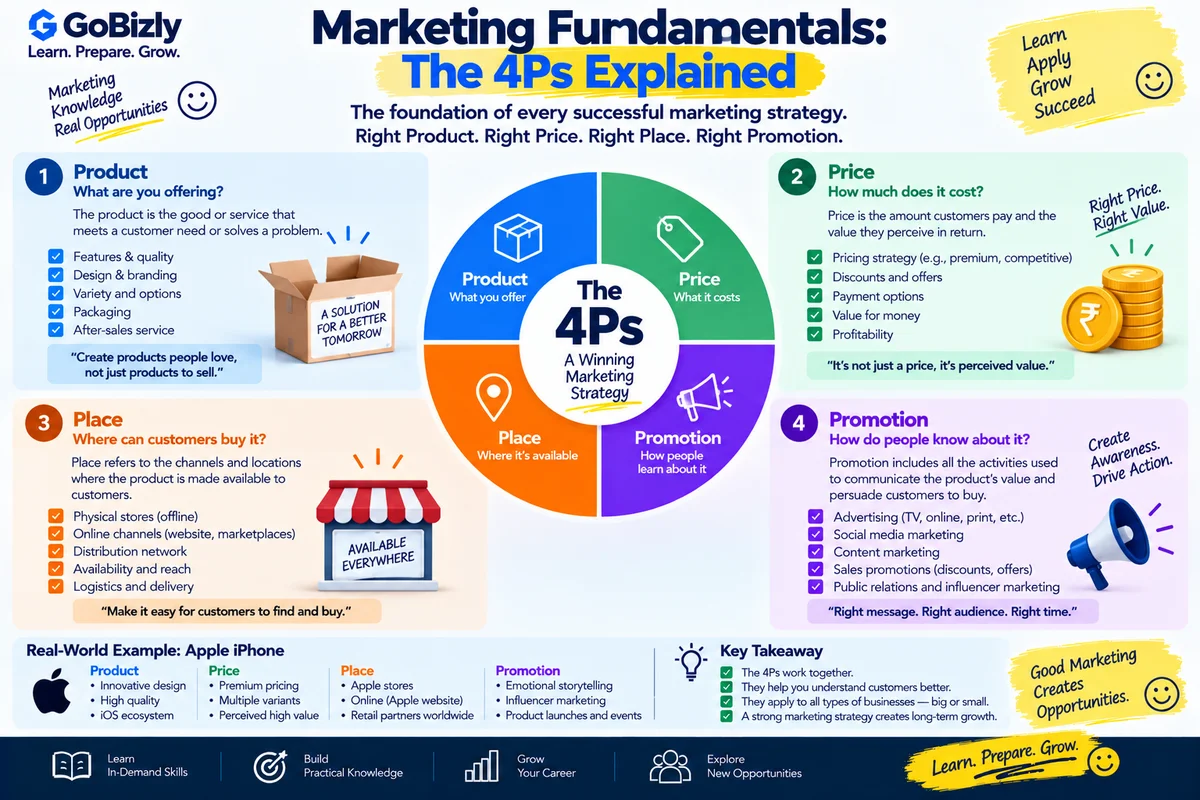
One of the classic frameworks for understanding marketing is the 4Ps:
Product → Price → Place → Promotion
Understanding these four elements gives beginners a useful foundation.
1. What Is the Marketing Mix?
The marketing mix is a framework used to think about key marketing decisions.
The traditional 4Ps are:
Product
Price
Place
Promotion
These elements should work together rather than being considered separately.
2. Product
The product is what the business offers to customers.
It could be:
A physical product
A digital product
A software application
A service
A subscription
Important questions include:
What problem does it solve?
Who is it for?
What features does it provide?
What makes it useful?
How is it different from alternatives?
3. Price
Price determines what customers pay for the offering.
Pricing decisions can consider:
Production costs
Customer value
Competition
Demand
Business objectives
Positioning
Common approaches can include:
Competitive pricing
Premium pricing
Penetration pricing
Value-based pricing
The appropriate method depends on the business.
4. Place
Place refers to how and where customers can access the product or service.
Examples include:
Physical stores
Websites
Marketplaces
Mobile applications
Distributors
Sales teams
For digital businesses, the distribution channel may be almost entirely online.
5. Promotion
Promotion involves communicating with potential customers.
Examples include:
Advertising
Social media
SEO
Email
Content marketing
Influencer marketing
Public relations
Sales promotions
Promotion should communicate a relevant message to the intended audience.
6. The 4Ps Should Work Together
Imagine a business selling premium headphones.
Product
High-quality headphones.
Price
Premium pricing.
Place
Specialized stores and an online website.
Promotion
Product demonstrations, digital advertising and creator partnerships.
The four decisions support the same positioning.
7. Product and Customer Needs
Before promoting a product, understand the customer.
Ask:
What problem do they have?
What alternatives do they currently use?
What matters most to them?
What prevents them from buying?
Marketing should connect the product with a relevant customer need.
8. Pricing and Perceived Value
Price isn't evaluated in isolation.
Customers often compare price with the perceived value of the product.
For example, a ₹500 product and a ₹5,000 product may serve completely different market segments.
The objective isn't always to have the lowest price.
9. Distribution Channels
Choosing the right channel affects customer accessibility.
For example:
A local restaurant may depend heavily on:
Physical location
Delivery platforms
Direct ordering
An online software company may depend on:
Website
App stores
Direct sales
10. Promotion Strategy
Different channels can serve different purposes.
For example:
SEO → Capture relevant search demand
Social media → Build awareness and engagement
Paid advertising → Reach targeted audiences
Email → Nurture and retain customers
Use channels based on the audience and objective.
11. Digital Marketing and the 4Ps
Digital marketing supports multiple parts of the marketing mix.
For example:
Product
→ Website content can explain features.
Price
→ Online pricing pages communicate offers.
Place
→ E-commerce enables digital distribution.
Promotion
→ Google Ads, Meta Ads, SEO and content can reach audiences.
12. The 4Ps and Career Interviews
The 4Ps are also useful in marketing interviews.
A simple interview answer can explain:
"The 4Ps provide a framework for evaluating a marketing strategy through the product being offered, its pricing, distribution and promotion."
Then provide an example.
Marketing Mix Checklist
☐ Understand the product
☐ Identify the target customer
☐ Understand pricing
☐ Identify distribution channels
☐ Understand promotion
☐ Connect the four Ps
☐ Analyze competitors
☐ Consider customer needs
☐ Select appropriate marketing channels
☐ Measure results
Conclusion
The 4Ps provide a simple framework for understanding important marketing decisions.
Remember:
Product — What are we offering?
Price — What does the customer pay?
Place — Where can they access it?
Promotion — How do we communicate it?
Use the framework as a starting point and adapt it to the specific business and market.
Learn. Prepare. Grow.