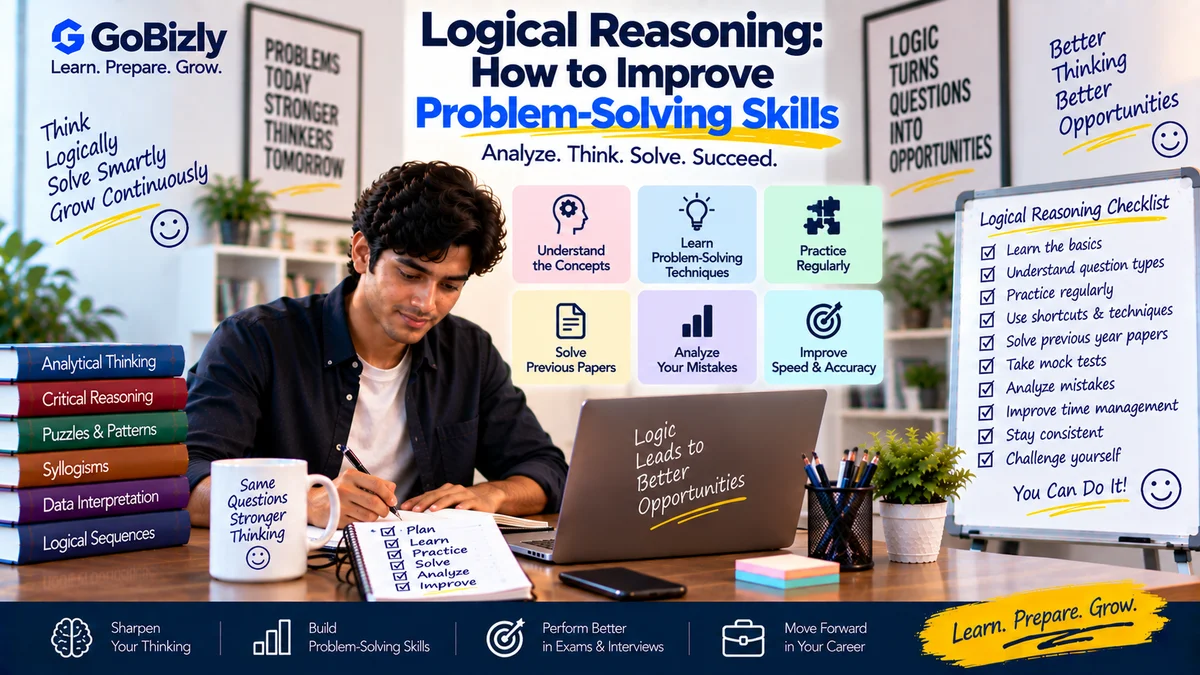
Logical Reasoning: How to Improve Problem-Solving Skills
Logical Reasoning: How to Improve Problem-Solving Skills
Logical reasoning questions test how you analyze information and identify relationships.
They aren't always about advanced mathematics.
They can involve:
Patterns
Sequences
Relationships
Arrangements
Conditions
Statements
Conclusions
Puzzles
The most effective way to improve is to practice structured thinking.
1. Understand the Information First
Before trying to solve a problem, identify:
What is given?
What is being asked?
What conditions must be followed?
Many reasoning mistakes happen because the question is misunderstood.
2. Look for Patterns
Pattern questions may involve:
Numbers
Letters
Shapes
Sequences
Look for changes such as:
Addition
Subtraction
Multiplication
Division
Alternating patterns
Don't assume the first pattern you notice is correct.
Test it against multiple terms.
3. Practice Number Series
For example:
2, 4, 8, 16, ?
Each number is multiplied by 2.
The next number is 32.
More difficult sequences may use multiple operations.
4. Practice Letter Patterns
Questions may use:
Alphabet positions
Forward movement
Reverse movement
Alternating patterns
Knowing the alphabet positions can help.
5. Learn Coding and Decoding
Coding questions may transform words or letters according to a rule.
Your approach should be:
Identify the transformation → Test it → Apply it
Don't guess based on one example.
6. Practice Blood Relations
Draw a simple family tree when necessary.
Identify:
Parent
Child
Sibling
Grandparent
Uncle/Aunt
Cousin
Visual representation can reduce confusion.
7. Practice Direction Problems
Draw a quick diagram.
Mark:
North
South
East
West
Then track each movement.
Don't try to visualize complicated paths entirely in your head.
8. Solve Seating Arrangements Systematically
For seating questions:
Identify the number of positions.
Determine fixed positions.
Add known relationships.
Apply conditions.
Eliminate impossible arrangements.
Use a diagram.
9. Practice Syllogisms
Syllogism questions provide statements and ask whether a conclusion follows.
Don't rely on real-world assumptions.
Use only the information provided.
10. Understand Statements and Conclusions
Separate:
What the statement says
from
What you assume it means
Reasoning tests often expect you to work strictly with the given information.
11. Practice Puzzles
Start with simpler puzzles.
Then gradually increase complexity.
Break the puzzle into smaller conditions instead of trying to solve everything at once.
12. Use Elimination
Sometimes finding the correct answer directly is difficult.
Instead, eliminate options that clearly violate the conditions.
This can simplify the problem.
13. Draw Diagrams
Use diagrams for:
Seating
Directions
Relationships
Networks
Ordering
A visual representation can reduce cognitive load.
14. Write Down Conditions
For complex questions, list the conditions.
For example:
A sits before B.
C cannot sit next to D.
E must be at one end.
Then test arrangements against each condition.
15. Avoid Unnecessary Assumptions
If a question doesn't tell you something, don't automatically assume it.
Use only the information provided unless the question explicitly establishes an additional rule.
16. Practice Time Management
Reasoning puzzles can consume significant time.
If you're stuck:
Mark the question.
Move to another question.
Return later if time permits.
17. Review Wrong Answers
When you make a mistake, identify the reason.
Was it:
Misreading?
Incorrect assumption?
Calculation?
Pattern error?
Diagram error?
Time pressure?
Correcting the reason is more useful than simply memorizing the answer.
18. Increase Difficulty Gradually
A useful progression is:
Basic patterns
↓
Simple relationships
↓
Moderate puzzles
↓
Complex arrangements
↓
Timed mixed tests
Build confidence progressively.
19. Practice Without Looking at Solutions Immediately
Give yourself enough time to attempt the problem.
Then compare your approach with the solution.
Ask:
Was there a simpler method?
20. Build a Reasoning Practice Routine
15 Minutes
Learn one concept.
20 Minutes
Solve practice questions.
10 Minutes
Review mistakes.
5 Minutes
Record the method you learned.
Consistency is more useful than occasional long sessions.
Logical Reasoning Checklist
☐ Understand the question
☐ Identify conditions
☐ Practice patterns
☐ Practice sequences
☐ Practice coding
☐ Practice relationships
☐ Practice directions
☐ Practice arrangements
☐ Practice syllogisms
☐ Use diagrams
☐ Avoid assumptions
☐ Use elimination
☐ Track mistakes
☐ Practice under time limits
Conclusion
Logical reasoning improves when you learn to break complicated information into smaller parts.
Read carefully.
Identify conditions.
Draw diagrams.
Test patterns.
Eliminate impossible options.
Review your mistakes.
With consistent practice, reasoning becomes less about guessing and more about following a structured process.
Don't rush to the answer. Understand the logic behind it.
Learn. Prepare. Grow.