Leadership Skills: A Practical Guide for Beginners
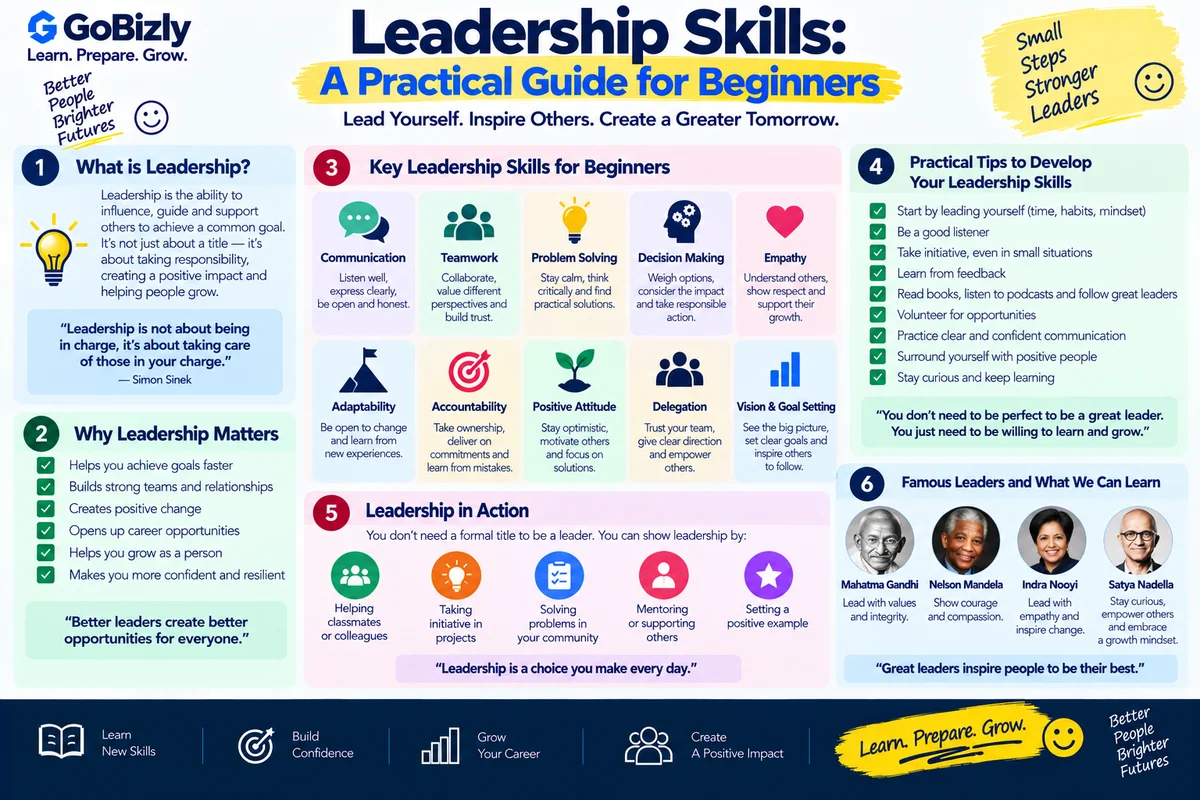
Leadership Skills: A Practical Guide for Beginners
Leadership isn't limited to people with managerial titles.
A student leading a project, a professional coordinating a campaign or a team member taking ownership of a problem can all demonstrate leadership.
Leadership is largely about helping people move toward a shared objective.
1. What Is Leadership?
Leadership involves influencing, guiding and supporting people toward a common goal.
A leader may need to:
Set direction
Communicate expectations
Make decisions
Support team members
Solve problems
Take responsibility
Leadership style can vary depending on the situation.
2. Communication
Strong leaders communicate clearly.
This includes:
Explaining expectations
Listening carefully
Asking questions
Giving useful feedback
Communicating changes
Good communication should be two-way.
3. Active Listening
Leadership isn't only about speaking.
Active listening means paying attention to what others are saying and trying to understand their perspective.
Useful habits include:
Avoid interrupting
Ask clarifying questions
Summarize important points
Confirm understanding
4. Accountability
Accountability means taking responsibility for commitments and outcomes.
A leader should be willing to say:
"This is my responsibility. Let me understand what went wrong and what we can do next."
Accountability helps build trust.
5. Decision-Making
Leaders frequently need to make decisions with incomplete information.
A simple framework is:
Understand the problem
↓
Collect relevant information
↓
Identify options
↓
Evaluate consequences
↓
Make a decision
↓
Review the outcome
6. Problem-Solving
Good problem-solving begins with understanding the actual problem.
Ask:
What happened?
Why did it happen?
What evidence do we have?
What options are available?
What should we do next?
Avoid jumping directly to solutions without understanding the cause.
7. Delegation
Delegation means assigning responsibility for work to others.
Effective delegation includes:
Clearly defining the task
Explaining the expected outcome
Setting a deadline
Providing necessary resources
Allowing appropriate ownership
Following up
Delegation isn't simply telling someone what to do.
8. Teamwork
Leaders work with people who may have different:
Skills
Experiences
Communication styles
Perspectives
Good teamwork requires respect, clarity and shared objectives.
9. Conflict Management
Disagreements can happen in any team.
A constructive approach is:
Understand the issue.
Listen to both perspectives.
Separate facts from assumptions.
Identify the shared objective.
Discuss possible solutions.
Agree on the next step.
The goal is to solve the issue rather than simply prove someone wrong.
10. Giving Feedback
Useful feedback should be:
Specific
Timely
Respectful
Actionable
Instead of:
"This isn't good."
Try:
"The analysis is useful, but the report would be clearer if the key findings were summarized at the beginning."
11. Receiving Feedback
Leadership also requires being open to feedback.
Ask:
What could I have done better?
What should I continue doing?
What should I change?
What impact did my approach have?
Feedback can reveal areas for improvement.
12. Time Management
Leaders often need to balance competing priorities.
Useful practices include:
Prioritize important work
Set realistic deadlines
Identify dependencies
Avoid unnecessary meetings
Review progress regularly
13. Building Trust
Trust develops through consistent behavior.
Examples include:
Keeping commitments
Being honest about problems
Giving credit to others
Communicating clearly
Treating people respectfully
Trust usually develops over time.
14. Leadership Without Authority
You don't need a management title to demonstrate leadership.
For example, you can:
Take ownership of a problem
Help teammates
Organize a project
Share useful knowledge
Improve a process
Communicate proactively
These behaviors demonstrate initiative.
15. How Students Can Build Leadership Skills
Students can practice leadership through:
Group projects
Student organizations
Events
Presentations
Volunteering
Team activities
Focus on taking responsibility rather than simply holding a title.
16. How Professionals Can Build Leadership Skills
At work, look for opportunities to:
Own tasks
Mentor colleagues
Lead meetings
Improve processes
Coordinate projects
Present ideas
Solve recurring problems
Small examples can gradually build leadership experience.
Leadership Skills Checklist
☐ Communicate clearly
☐ Listen actively
☐ Take accountability
☐ Make structured decisions
☐ Solve problems
☐ Delegate effectively
☐ Work collaboratively
☐ Handle disagreements constructively
☐ Give useful feedback
☐ Receive feedback
☐ Manage priorities
☐ Build trust
☐ Take initiative
Conclusion
Leadership is a skill that can be developed through everyday actions.
You don't have to wait until you become a manager.
Start by taking ownership, communicating clearly, helping others, solving problems and following through on commitments.
Leadership starts with responsibility before authority.
Learn. Prepare. Grow.