Interview Preparation Checklist for Job Seekers
Interview Preparation Checklist for Job Seekers
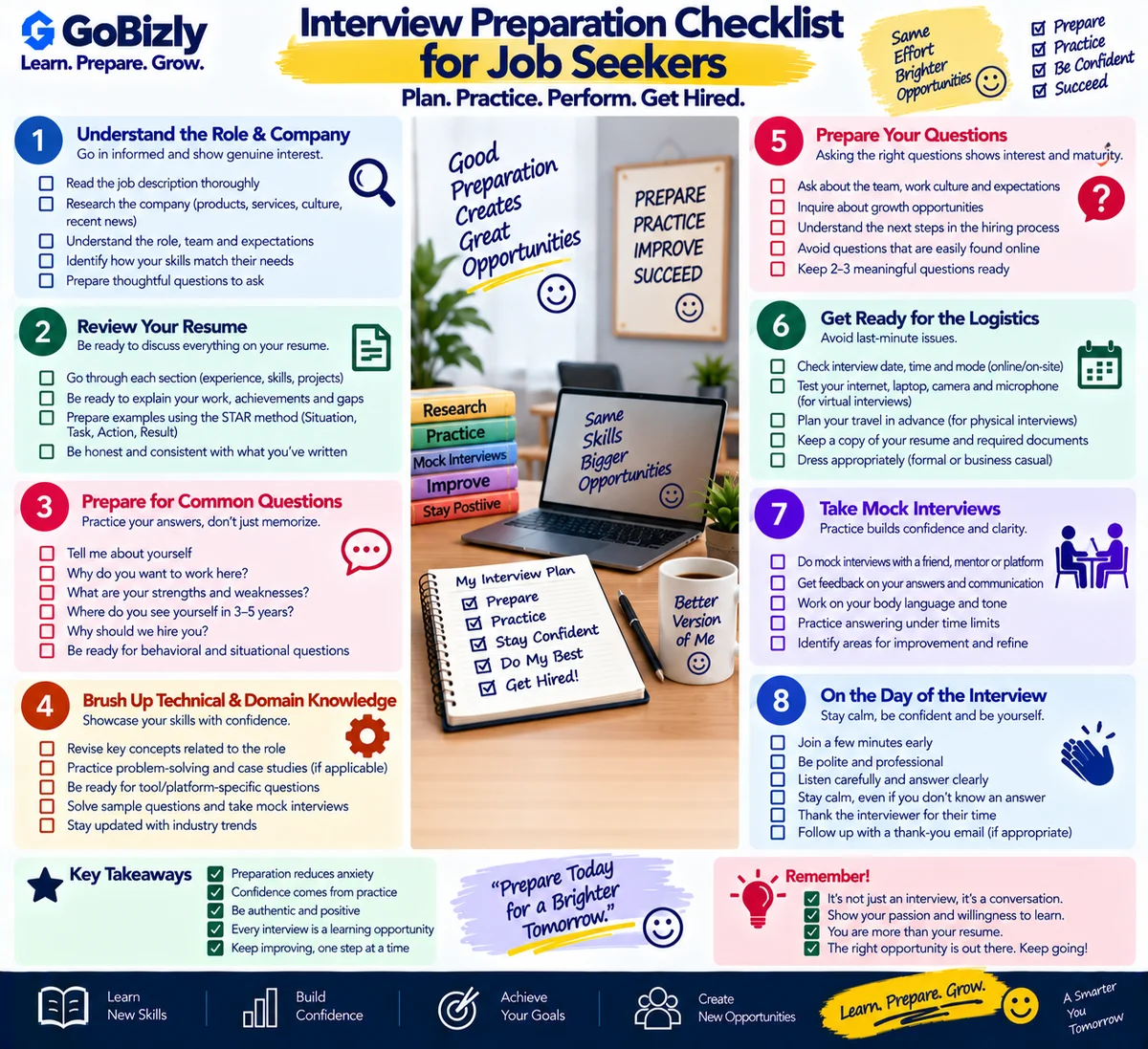
Interview preparation is easier when you break it into smaller tasks.
Instead of trying to prepare everything at once, use a checklist covering the company, role, technical knowledge, experience, communication, logistics and questions.
1. Understand the Job Description
Read the job description carefully.
Identify:
Required skills
Preferred skills
Responsibilities
Tools
Experience requirements
Industry knowledge
Key terms
Then compare these requirements with your own experience.
2. Research the Organization
Learn basic information such as:
What the organization does
Its products or services
Its industry
The type of customers it serves
Recent publicly available developments
The role you are interviewing for
The purpose is not to memorize an entire company website.
You should simply understand the context in which you may work.
3. Prepare Your Introduction
Be ready to answer:
"Tell me about yourself."
A practical structure is:
Present → Past → Skills → Relevant Experience → Future Direction
Keep your answer focused on your professional background rather than providing an unrelated personal biography.
4. Review Your Resume
Interviewers may ask questions based on anything listed on your resume.
Review:
Every company
Every role
Projects
Tools
Certifications
Achievements
Responsibilities
If you mention a technology or platform, be prepared to explain how you used it.
5. Prepare Common HR Questions
Practice questions such as:
Tell me about yourself.
Why are you interested in this role?
What are your strengths?
What area are you working to improve?
Why are you looking for a change?
Where do you want to develop professionally?
Tell me about a challenging situation.
Tell me about a time you worked with a team.
Don't memorize robotic answers.
Prepare structured talking points and examples.
6. Prepare Technical Topics
Create a technical preparation list based on the role.
For a digital marketing position, for example, this could include:
Google Ads
Analytics
Campaign structure
Conversion tracking
Programmatic advertising
Ad operations
Reporting
Optimization
The exact topics should come from the job description and your claimed experience.
7. Prepare Real-World Scenarios
Technical interviews often involve situations rather than definitions.
For example:
"A campaign is not spending. How would you troubleshoot it?"
A useful approach is:
Identify → Investigate → Diagnose → Fix → Validate → Monitor
Practice explaining your reasoning rather than jumping immediately to one solution.
8. Prepare Questions for the Interviewer
An interview is also an opportunity to understand the role.
Possible questions include:
What would the main priorities be in the first few months?
Which tools does the team use?
How is performance measured?
What does a typical day in this role look like?
How does the team collaborate?
Choose questions that are genuinely useful to you.
9. Prepare Your Documents
Depending on the interview format, keep relevant documents ready:
Resume
Portfolio
Certifications
Project details
Identification or other documents if specifically requested through an appropriate process
For virtual interviews, keep important files accessible without having to search for them during the meeting.
10. Check Interview Logistics
For a virtual interview:
Test your internet connection.
Check your microphone.
Test your camera if required.
Check the meeting link.
Choose a quiet environment.
Keep your device charged.
For an in-person interview:
Confirm the location.
Check travel time.
Plan your route.
Arrive with reasonable time to spare.
11. Practice Speaking
Good preparation is not only about knowing answers.
Practice explaining concepts aloud.
You can record yourself answering:
"Tell me about yourself."
Then review:
Clarity
Structure
Repetition
Pace
Filler words
Confidence
Answer length
12. Do a Final Review
Before the interview, review:
Role → Resume → Technical Topics → Examples → Questions → Logistics
Don't attempt to learn an entirely new subject at the last minute.
Focus on organizing what you already know and identifying the most important gaps.
Interview Preparation Checklist
Role
Read the job description
Understand responsibilities
Identify required skills
Review important tools
Company
Understand the organization
Research the role
Review relevant public information
Resume
Review every section
Know your projects
Review tools and certifications
Prepare examples
Questions
Prepare introduction
Practice HR questions
Prepare technical questions
Practice scenario questions
Prepare questions for interviewer
Final Preparation
Resume ready
Interview link/location confirmed
Device tested
Internet checked
Appropriate environment arranged
Final revision completed
Conclusion
Interview preparation becomes more manageable when you turn it into a checklist rather than trying to remember everything at once.
Understand the role, review your resume, prepare relevant technical and behavioral questions, practice explaining your experience and make sure the practical details are ready.
The objective is not to memorize every possible interview question. It is to understand your own experience well enough to communicate it clearly.
Learn. Prepare. Grow.