How to Write a Professional Message to a Recruiter
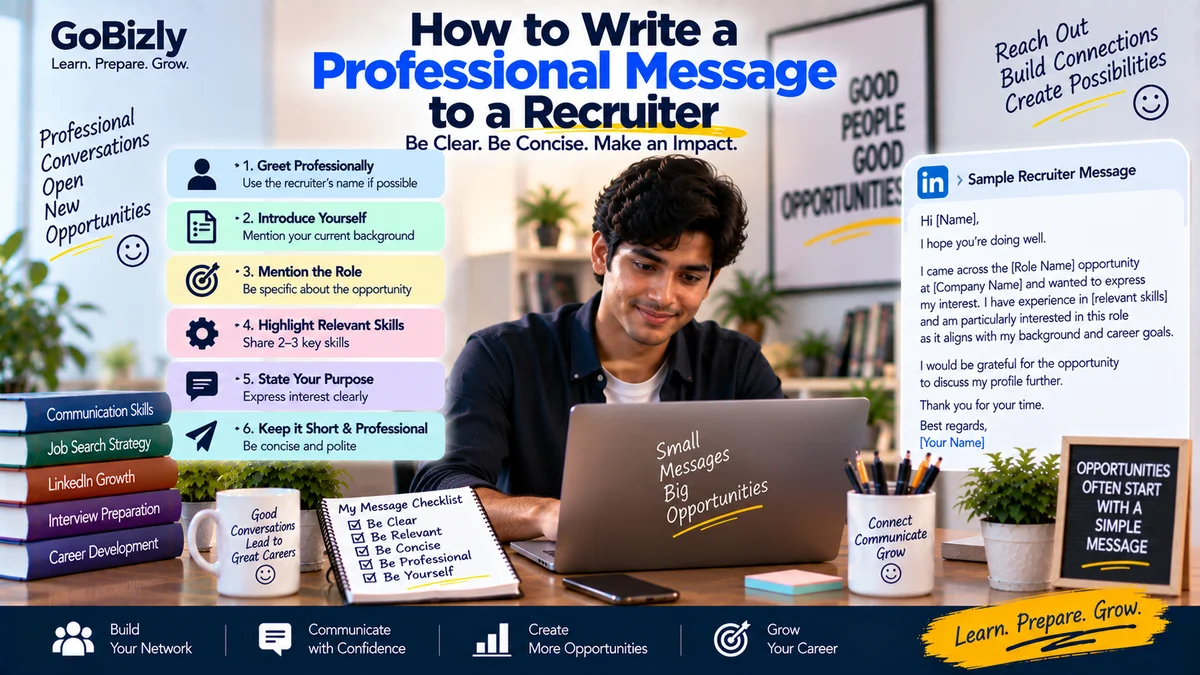
How to Write a Professional Message to a Recruiter
Messaging a recruiter can feel awkward, especially when you're unsure what to say.
A good recruiter message doesn't need to be long.
It should quickly communicate:
Who you are
What role you're interested in
Why you're relevant
What you're asking for
The objective is to start a professional conversation, not write your entire resume in a chat message.
1. Start With a Professional Greeting
If you know the recruiter's name:
Hi [Name],
is usually sufficient.
If you don't know the person's name, use a professional greeting appropriate to the platform.
2. Introduce Yourself Briefly
Mention your current professional position.
For example:
"I'm a recent B.Com graduate with an interest in digital marketing and analytics."
Or:
"I'm a marketing professional with experience in programmatic advertising and campaign operations."
Keep it relevant.
3. Mention the Role
Be specific.
For example:
"I noticed the Programmatic Account Manager opportunity at your organization."
This immediately tells the recruiter why you're contacting them.
4. Highlight Relevant Skills
Choose two or three relevant points.
For example:
"My experience includes DV360, CM360, campaign troubleshooting and performance reporting."
Don't list every skill you have.
Focus on what connects to the opportunity.
5. Mention the Source
If you found the role through a specific source, you can mention it.
For example:
"I came across the opening on your careers page."
or:
"I saw your post about the position on LinkedIn."
This provides context.
6. State What You're Looking For
Be clear about your purpose.
For example:
"I'd be interested in discussing whether my background could be relevant to the position."
This is more useful than simply saying:
"Please give me a job."
7. Keep the Message Short
Recruiters may receive many messages.
A useful structure is:
Greeting
↓
Introduction
↓
Role
↓
Relevant experience
↓
Request
Aim for a concise message rather than a long career history.
8. Example — Fresher
Hi [Name],
I'm a recent B.Com graduate interested in entry-level digital marketing roles. I've developed skills in Google Ads, analytics and digital marketing through coursework and practical projects. I noticed the [Role] opportunity at [Company] and would be interested in learning whether my profile could be relevant. Thank you.
9. Example — Experienced Professional
Hi [Name],
I came across the [Role] opening at [Company]. I have experience in digital marketing, programmatic advertising, campaign operations and platforms including DV360 and CM360. The role looks relevant to my background, and I'd appreciate the opportunity to discuss it further. Thank you.
Customize this with your actual experience.
10. Example — After Applying
Hi [Name],
I recently applied for the [Role] position at [Company] and wanted to briefly introduce myself. My background includes [relevant skill/experience], which aligns with the role requirements. I would be glad to discuss my profile if the position is still being considered. Thank you.
11. Example — Asking About Opportunities
If there isn't a specific vacancy:
Hi [Name],
I'm exploring opportunities in [field/role] and came across your profile while researching the industry. My background includes [relevant skills]. If your team has any suitable openings, I'd be grateful if you could point me toward them. Thank you.
Don't assume the recruiter has an opening.
12. Avoid Sending Your Entire Resume in the Message
Your message should encourage the recruiter to review your profile or resume.
You don't need to paste:
Full employment history
Every certification
Every project
Long career story
Keep the first message focused.
13. Personalize When Appropriate
If the recruiter has posted about the role, you can reference it.
For example:
"I saw your recent post about the marketing analyst opening..."
This can make the message more relevant.
Avoid fake personalization.
14. Don't Use Aggressive Follow-Ups
Avoid sending messages such as:
"Any update??"
or:
"Why haven't you responded?"
Instead, use a professional follow-up.
15. Example Follow-Up
Hi [Name],
I wanted to follow up regarding my earlier message about the [Role] opportunity. I'm still interested in the position and would be happy to provide any additional information required. Thank you.
One or two appropriate follow-ups are generally more professional than repeated messages.
16. Don't Misrepresent Your Experience
Never claim:
Experience you don't have
Skills you haven't learned
Certifications you haven't earned
Employment you didn't complete
Your message should accurately represent your background.
17. Check Grammar Before Sending
A short message with clear grammar is easier to read.
Check:
Name
Company
Role
Dates if mentioned
Spelling
Attachments or links
Avoid sending the same message with the wrong company name.
18. Use the Right Communication Channel
Depending on the situation, communication may happen through:
LinkedIn
Email
Company application system
Recruiter-provided contact method
Use the channel provided by the recruiter or organization when possible.
19. Don't Ask for Confidential Information
Keep your questions professional.
You can ask about:
Role responsibilities
Application process
Relevant qualifications
Next steps
Avoid asking for internal or confidential information.
20. Think of Recruiter Communication as Professional Networking
Not every recruiter message will result in an interview.
The objective is to communicate professionally and make your interest clear.
A respectful message can be useful even when there isn't an immediate opening.
Recruiter Message Checklist
☐ Professional greeting
☐ Brief introduction
☐ Specific role
☐ Relevant skills
☐ Clear purpose
☐ Concise message
☐ Accurate information
☐ Correct company name
☐ Professional tone
☐ Appropriate follow-up
Conclusion
A recruiter message doesn't need to be complicated.
Introduce yourself.
Mention the relevant opportunity.
Highlight the skills that connect to it.
Clearly explain why you're reaching out.
Then give the recruiter space to respond.
The goal isn't to write the perfect message.
It's to communicate clearly, accurately and professionally.
Be concise. Be relevant. Be professional.
Learn. Prepare. Grow.