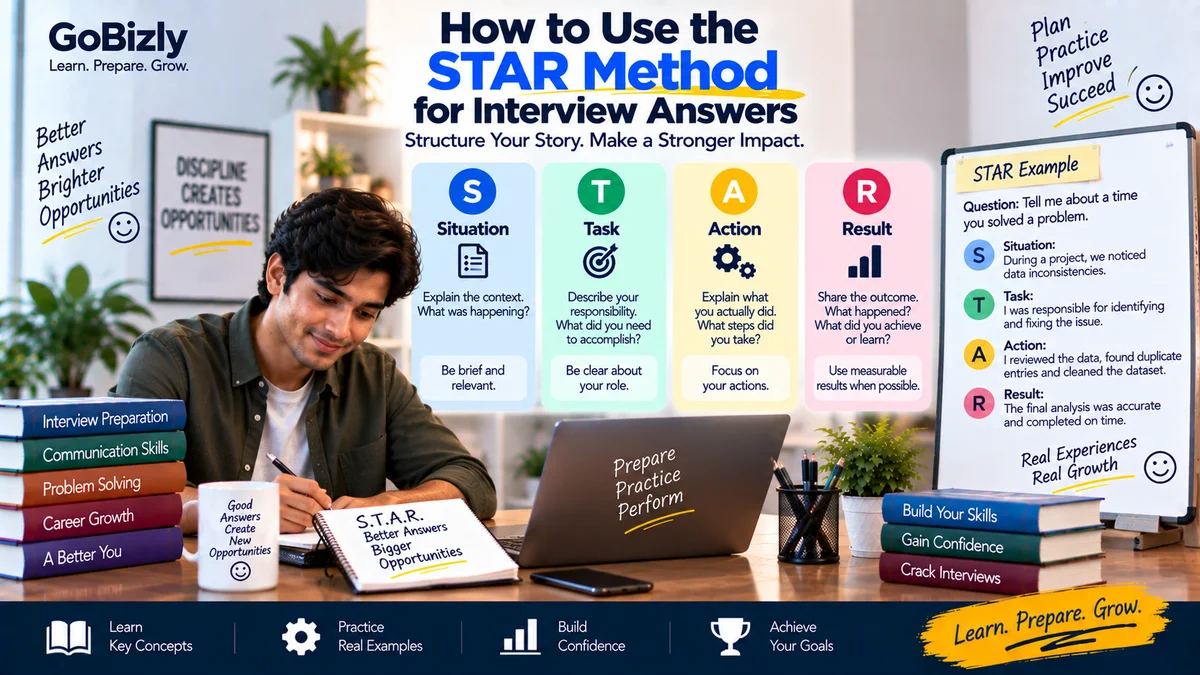
How to Use the STAR Method for Interview Answers
How to Use the STAR Method for Interview Answers
Behavioral interview questions often ask you to describe something that happened in your past.
For example:
Tell me about a difficult situation you handled.
Describe a time you worked in a team.
Tell me about a mistake you made.
Describe a time you solved a problem.
Tell me about a conflict you experienced.
Instead of answering these questions randomly, you can use a structured framework.
One commonly used framework is STAR:
S — Situation
T — Task
A — Action
R — Result
1. Situation
Start by explaining the context.
Answer:
What was happening?
Keep this part brief.
For example:
"During a college project, our team had to analyze survey responses and present the findings within one week."
The interviewer now understands the setting.
2. Task
Explain your responsibility.
Answer:
What did you need to accomplish?
For example:
"I was responsible for organizing the survey data and preparing the analysis."
This makes your individual contribution clear.
3. Action
Explain what you actually did.
This is usually the most important part.
For example:
"I cleaned the data, grouped responses into categories and used Excel to identify common patterns. I then created charts that the team used in the presentation."
Focus on your actions.
4. Result
Explain what happened.
For example:
"We completed the analysis on time and used the charts to present the findings clearly to the class."
If there is a genuine measurable result, include it.
Don't invent numbers.
The STAR Formula
A simple way to remember it:
Situation → What was happening?
Task → What was your responsibility?
Action → What did you do?
Result → What happened?
5. Example: Teamwork Question
Question
"Tell me about a time you worked in a team."
STAR Answer
Situation:
"During a college presentation, our team had to prepare a market research project."
Task:
"I was responsible for organizing the research findings and helping prepare the presentation."
Action:
"I created a shared structure for the research, consolidated the findings and worked with the team to organize the presentation."
Result:
"We completed the presentation on time and were able to present the research in a clear structure."
6. Example: Problem-Solving Question
Question
"Tell me about a time you solved a problem."
STAR Answer
Situation:
"While working on a project, we noticed that some of the data contained duplicate entries."
Task:
"I needed to identify the duplicates before the analysis was completed."
Action:
"I reviewed the data, identified duplicate records and cleaned the dataset before continuing the analysis."
Result:
"The final analysis was based on the corrected dataset."
7. Example: Failure or Mistake Question
Question
"Tell me about a mistake you made."
Don't try to present yourself as someone who has never made mistakes.
Choose a genuine example where you learned something.
Structure it:
Situation: What happened?
Task: What were you responsible for?
Action: What did you do after identifying the problem?
Result: What changed or what did you learn?
8. Focus on Your Actions
A common mistake is spending most of the answer describing what the team did.
The interviewer wants to understand your contribution.
Use phrases such as:
"I analyzed..."
"I organized..."
"I identified..."
"I prepared..."
"I communicated..."
"I proposed..."
"I reviewed..."
Don't claim work you didn't personally perform.
9. Keep the Situation Short
You don't need to spend two minutes explaining the background.
Usually, the interviewer needs enough context to understand the problem.
Then move to your responsibility and actions.
10. Spend More Time on the Action
The Action section should explain your thinking and behavior.
For example:
Instead of:
"I solved the issue."
say:
"I first reviewed the source data, identified where the discrepancy occurred and then compared the records to determine which entries needed correction."
This gives the interviewer something concrete to evaluate.
11. Make the Result Specific
If you have a genuine result, explain it.
Examples:
Completed the project on time
Reduced manual work
Improved accuracy
Resolved an issue
Received positive feedback
Completed a presentation successfully
Use measurable results when you actually have them.
12. STAR Doesn't Mean You Need Perfect Results
Not every story has a dramatic result.
A result can also be:
What you learned
What changed
What you would do differently
How the experience improved your approach
Be honest.
13. Questions Where STAR Can Help
STAR can be useful for questions about:
Teamwork
"Tell me about a time you worked with a difficult teammate."
Leadership
"Tell me about a time you took initiative."
Problem Solving
"Describe a difficult problem you solved."
Conflict
"Tell me about a disagreement."
Failure
"Tell me about a mistake."
Adaptability
"Tell me about a time you had to adapt."
Time Management
"Tell me about a time you handled multiple deadlines."
14. Build a Story Bank
Instead of preparing 50 separate answers, prepare several genuine stories.
For example:
Story 1: Team project
Story 2: Problem solved
Story 3: Leadership
Story 4: Mistake
Story 5: Difficult deadline
One story can sometimes answer several related questions if adapted truthfully.
15. Don't Force STAR Into Every Question
Not every interview question requires STAR.
For example:
"What is Google Ads?"
doesn't need STAR.
STAR is primarily useful for behavioral and experience-based questions.
16. Avoid Memorized Stories
If you memorize every word, the answer may sound rehearsed.
Remember:
Situation
Task
Action
Result
Then explain the story naturally.
17. Use Academic Examples if You're a Fresher
You don't need professional employment experience to use STAR.
Examples can come from:
College projects
Internships
Student clubs
Competitions
Volunteering
Presentations
Part-time work
Choose experiences that genuinely happened.
18. Prepare Your Stories
For each story, write:
Situation:
What happened?
Task:
What was expected from me?
Action:
What did I personally do?
Result:
What happened afterward?
Then practice explaining it in about one to two minutes.
19. Avoid Blaming Others
If the story involves a disagreement or problem, explain the situation factually.
Focus on:
What happened → What you did → What you learned
Avoid turning your answer into a complaint about another person.
20. Practice With Different Questions
Take one story and test it against different questions.
For example, a college project could potentially demonstrate:
Teamwork
Leadership
Problem solving
Time management
Communication
But don't distort the facts just to fit a question.
STAR Interview Checklist
☐ Situation
☐ Task
☐ Your Action
☐ Result
☐ Focus on your contribution
☐ Keep context concise
☐ Give specific actions
☐ Use genuine examples
☐ Include measurable results when available
☐ Mention lessons learned when useful
☐ Practice naturally
☐ Don't force STAR into factual questions
Conclusion
The STAR method gives your behavioral interview answers a clear structure.
You don't need dramatic stories.
A simple college project, internship task or workplace situation can become a useful interview example when you explain it clearly.
Remember:
Situation → Task → Action → Result
Focus especially on what you did and what you learned.
Structure your story. Explain your actions. Show what happened.
Learn. Prepare. Grow.