How to Take Better Notes for Learning and Revision
How to Take Better Notes for Learning and Revision
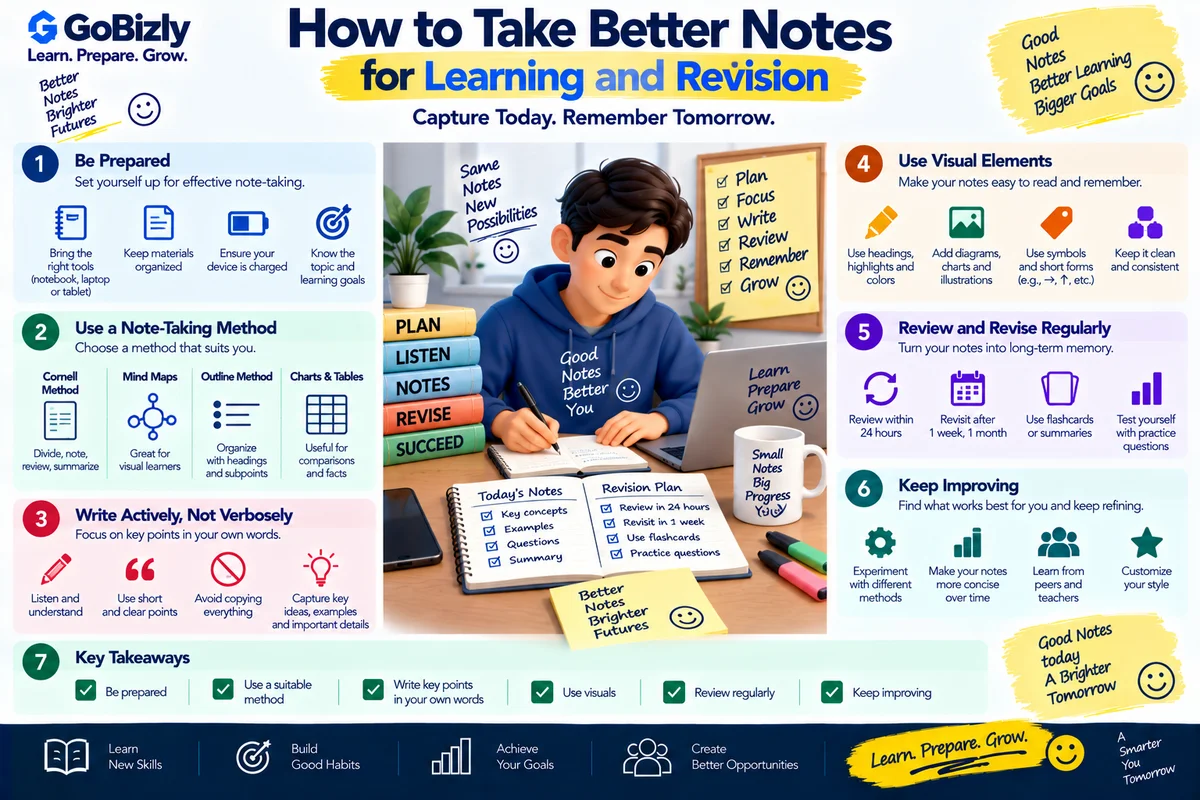
Good notes aren't a transcript of everything a teacher says or everything written in a textbook.
Useful notes help you:
Understand concepts
Remember important information
Find information quickly
Review before exams
Identify areas you don't understand
The goal is not to create the longest notes.
The goal is to create useful notes.
1. Know Why You're Taking Notes
Your note-taking approach can depend on the purpose.
During a Lecture
Capture important concepts and explanations.
During Reading
Record key ideas, examples and questions.
During Revision
Create concise summaries and recall prompts.
2. Identify the Main Idea
Before writing details, identify the central idea.
For example:
Topic: Digital Marketing
Main idea:
Digital marketing uses digital channels to reach and engage audiences.
Then add supporting concepts such as SEO, paid advertising, social media and analytics.
3. Use Headings
Organize notes into sections.
For example:
SEO
Definition
Search intent
Keywords
On-page SEO
Technical SEO
Measurement
This makes later revision easier.
4. Don't Write Everything
Trying to capture every sentence can prevent you from understanding the lesson.
Instead, focus on:
Key concepts
Definitions
Examples
Formulas
Important explanations
Questions
5. Use Your Own Words
After reading or listening, try to write the idea in your own words.
This forces you to process the information rather than simply copy it.
6. Add Examples
Examples can make abstract concepts easier to remember.
For example:
Revenue = income generated from business activities.
Example:
A business sells 100 products at ₹500 each → ₹50,000 revenue.
7. Turn Important Ideas Into Questions
Instead of writing only:
"What is SEO?"
Create a recall question:
"What is SEO and why is it important?"
Then answer it separately.
Questions can become useful revision material.
8. Use Visual Structures
Some information is easier to understand visually.
Use:
Tables
Flowcharts
Diagrams
Mind maps
Timelines
For example:
Awareness → Consideration → Conversion → Retention
can communicate a process more quickly than a paragraph.
9. Separate Facts From Questions
If something isn't clear, don't pretend you understand it.
Add a section:
Questions to Review
What is the difference between X and Y?
Why is this process used?
What happens after this step?
Return to these questions later.
10. Use a Consistent Structure
A simple note template can be:
Topic
Definition
Key Concepts
Examples
Important Terms
Questions
Summary
This works for many subjects.
11. Summarize After Studying
At the end of a topic, write a short summary without looking at your notes.
Then compare it with the original material.
This combines note-taking with active recall.
12. Keep Notes Organized
Use a consistent system for:
File names
Subject folders
Dates
Topics
Revision versions
For digital notes, searchability is another major advantage.
13. Don't Spend Too Much Time Formatting
Beautiful notes aren't necessarily effective notes.
Avoid spending excessive time on:
Colors
Decorations
Fonts
Layouts
unless they genuinely help you understand or navigate the material.
14. Review Notes Actively
Don't just reread.
Try:
Covering the answer
Explaining concepts aloud
Answering your questions
Creating flashcards
Solving practice questions
Active review is more useful than passive reading alone.
15. Create a One-Page Revision Sheet
After completing a large topic, create a concise revision sheet containing:
Key definitions
Formulas
Important concepts
Common mistakes
Examples
Questions
This can be useful before an exam.
Note-Taking Checklist
☐ Identify the main idea
☐ Use clear headings
☐ Record important concepts
☐ Use your own words
☐ Add examples
☐ Create questions
☐ Use diagrams where useful
☐ Mark unclear areas
☐ Summarize after studying
☐ Keep notes organized
☐ Review actively
☐ Create revision sheets
Conclusion
Good notes should make learning and revision easier.
Focus on understanding rather than copying.
Use headings, examples, questions and summaries to turn information into something you can actually work with.
Don't aim for more notes. Aim for more useful notes.
Learn. Prepare. Grow.