How to Study Effectively: Practical Learning Strategies for Students
How to Study Effectively: Practical Learning Strategies for Students
Studying for long hours doesn't always mean you're learning effectively.
You can spend several hours reading a textbook and still struggle to remember the information later.
Effective learning is less about simply increasing the number of hours you study and more about how you use those hours.
A good study approach combines understanding, active practice, revision, focus and rest.
Whether you're preparing for college exams, placement tests, certifications or learning a new professional skill, the following strategies can help you build a more effective learning routine.
1. Understand Before You Memorize
One of the biggest mistakes students make is trying to memorize information before understanding it.
Start by asking:
What does this concept mean?
Why does it matter?
How does it work?
Can I explain it in my own words?
For example, instead of memorizing a definition from a textbook, understand the concept first and then explain it without looking at your notes.
Understanding creates a stronger foundation for later revision.
2. Set a Clear Study Goal
Don't begin a study session with a vague goal such as:
"I will study for three hours."
Instead, define what you want to accomplish.
For example:
Complete one chapter
Understand percentages
Solve 20 aptitude questions
Revise five topics
Create notes for one lecture
Practice 10 interview questions
A specific goal makes it easier to know whether the study session was productive.
3. Break Large Topics Into Smaller Parts
Large subjects can feel overwhelming.
Instead of trying to study an entire subject at once, divide it into smaller sections.
For example:
Digital Marketing
→ SEO
→ Paid Search
→ Social Media
→ Analytics
→ Email Marketing
Then break each section down further.
Smaller learning units make it easier to focus on one concept at a time.
4. Use Active Recall
Active recall means trying to remember information without looking at the answer.
After studying a topic, close your notes and ask yourself:
What did I just learn?
What are the key concepts?
Can I explain them?
What examples can I remember?
What am I still unclear about?
You can also turn your notes into questions.
Instead of writing:
"The marketing funnel has awareness, consideration and conversion stages."
Create a question:
"What are the main stages of a marketing funnel?"
Then try to answer it without looking at your notes.
5. Use Practice Questions
Practice questions are particularly useful for subjects that involve problem solving.
Examples include:
Mathematics
Aptitude
Reasoning
Programming
Accounting
Statistics
Technical subjects
Don't just check whether your answer is correct.
Understand why it is correct.
When you make a mistake, identify what caused it.
6. Try Spaced Repetition
Instead of studying something once and never returning to it, review it at increasing intervals.
For example:
Day 1: Learn the topic
Day 2: Quick review
Day 4: Test yourself
Day 7: Review again
Day 14: Test yourself
Day 30: Final review
The exact schedule can vary.
The important idea is to revisit information rather than relying on one long study session.
7. Create Useful Notes
Good notes don't need to contain every sentence from a lecture or textbook.
Focus on:
Key concepts
Definitions
Examples
Formulas
Important relationships
Questions
Mistakes
Areas requiring revision
Try to organize information so that you can quickly review it later.
8. Use the Feynman Technique
The Feynman technique is a simple way to test your understanding.
Step 1 — Choose a concept
Pick something you've studied.
Step 2 — Explain it simply
Pretend you're explaining it to someone who knows nothing about it.
Step 3 — Identify gaps
Notice where your explanation becomes unclear.
Step 4 — Review
Go back to the source and clarify those areas.
Step 5 — Explain again
Try explaining the concept more simply.
If you cannot explain something clearly, it may indicate that you need to understand it more deeply.
9. Reduce Distractions
Your study environment can have a major effect on your concentration.
Before starting:
Put unnecessary notifications on silent.
Keep only relevant tabs open.
Keep your study materials ready.
Put your phone away if possible.
Choose a comfortable study location.
You don't need a perfect environment.
The goal is simply to reduce avoidable interruptions.
10. Try Focused Study Sessions
Instead of forcing yourself to study continuously for several hours, divide your time into focused sessions.
For example:
45 minutes study
↓
10 minutes break
↓
45 minutes study
↓
10 minutes break
You can adjust the duration according to your concentration level.
The important part is to make the study period genuinely focused.
11. Take Useful Breaks
A break should help your brain recover rather than create another distraction.
During a short break, you could:
Walk around
Drink water
Stretch
Rest your eyes
Take a few deep breaths
Avoid turning a 10-minute break into an hour of scrolling.
12. Teach Someone Else
One useful way to test your understanding is to teach the concept to someone else.
You can explain it to:
A classmate
A friend
A family member
A study partner
You can even explain it aloud when you're alone.
Teaching forces you to organize information and identify gaps in your understanding.
13. Mix Different Types of Practice
If you're preparing for an exam, don't always solve the same type of question repeatedly.
Once you've learned the basics, mix different topics.
For example:
Question 1: Percentages
Question 2: Ratios
Question 3: Averages
Question 4: Logical reasoning
Question 5: Data interpretation
This can help you practice identifying which method is appropriate instead of automatically applying the same method every time.
14. Review Your Mistakes
Mistakes can provide valuable information.
Create a simple mistake log:
Topic | Mistake | Why It Happened | Correct Approach |
|---|---|---|---|
Percentages | Formula error | Didn't identify the base value | Review percentage change |
Reasoning | Pattern missed | Rushed the question | Practice series |
Grammar | Sentence error | Misunderstood rule | Review grammar concept |
Review this list regularly.
Your mistakes can tell you what needs more attention.
15. Use Different Learning Resources
You don't have to rely on a single source.
Depending on the subject, you can use:
Textbooks
Class notes
Videos
Practice questions
Articles
Documentation
Online courses
Interactive tools
AI learning assistants
However, using more resources isn't automatically better.
Choose resources that actually improve your understanding.
16. Use AI as a Study Assistant
AI can support learning in several ways.
You can ask it to:
Explain difficult concepts
Generate practice questions
Quiz you
Create revision summaries
Compare concepts
Give examples
Create study plans
For example:
"Explain this concept in simple language, give me a practical example and then ask me five questions to test my understanding."
Don't simply copy AI-generated answers.
Use AI to support active learning and verify important information.
17. Practice Without Your Notes
A useful test of learning is whether you can perform without assistance.
After studying a topic, put your notes away and try to:
Answer questions
Solve problems
Explain the concept
Write a summary
Create an example
If you struggle, return to the material and identify the gap.
18. Plan Your Week
Instead of deciding what to study every day at the last minute, create a simple weekly plan.
For example:
Day | Focus |
|---|---|
Monday | New concepts |
Tuesday | Practice |
Wednesday | New concepts |
Thursday | Practice |
Friday | Revision |
Saturday | Mock test |
Sunday | Review weak areas |
Adjust the schedule according to your classes, work and exams.
19. Prioritize Difficult Topics
It's tempting to spend most of your study time on topics you already understand because they feel comfortable.
Instead, identify your weak areas.
Use a simple system:
Strong
I understand it and can solve questions independently.
Developing
I understand the basics but need more practice.
Weak
I struggle to understand or apply the concept.
Spend more time on the Developing and Weak areas.
20. Sleep and Recovery Matter
Learning isn't only about what happens while you're sitting at your desk.
Your ability to concentrate and function effectively also depends on adequate rest.
Avoid making all-night study sessions your regular strategy.
A consistent routine that includes study, breaks and sufficient rest is generally more sustainable than repeatedly sacrificing sleep.
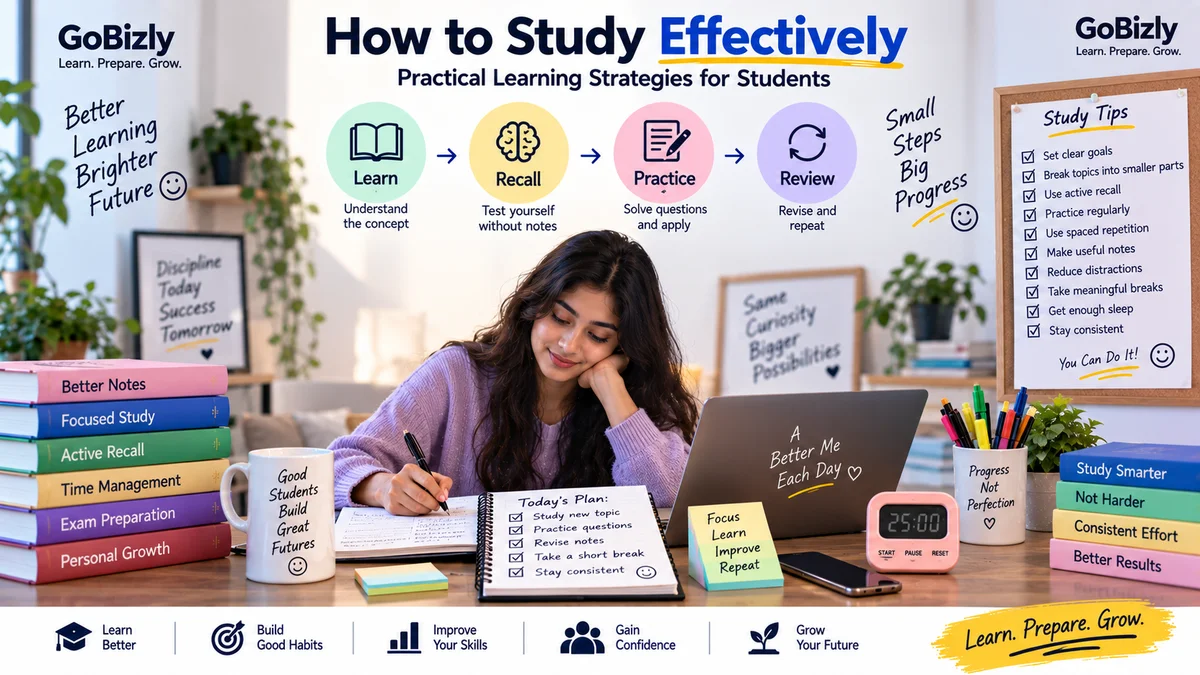
A Simple Study Framework
Use this cycle:
LEARN → RECALL → PRACTICE → REVIEW → REPEAT
Learn
Understand the concept.
Recall
Try to remember it without looking.
Practice
Apply it through questions or examples.
Review
Identify mistakes and gaps.
Repeat
Return to the topic later.
This creates a continuous learning cycle.
A 7-Day Study Routine
Day 1
Learn new concepts.
Day 2
Review yesterday's material and learn something new.
Day 3
Practice questions.
Day 4
Review difficult areas.
Day 5
Test yourself without notes.
Day 6
Take a mixed practice test.
Day 7
Review mistakes and plan the next week.
You can repeat this structure for longer preparation periods.
Common Study Mistakes
Studying Without a Goal
You may spend time without knowing what you've actually accomplished.
Reading Without Testing Yourself
Recognition isn't the same as recall.
Studying Everything at Once
Large topics become easier when divided into smaller parts.
Ignoring Mistakes
Mistakes show you where additional practice is needed.
Constantly Switching Resources
Too many resources can create unnecessary confusion.
Studying Only What You Like
Give attention to weak areas too.
Sacrificing Sleep Regularly
Exhaustion can make studying less productive.
Measuring Study Time Instead of Learning
Three hours at a desk doesn't necessarily equal three hours of effective learning.
Effective Study Checklist
☐ Set a specific study goal
☐ Break large topics into smaller sections
☐ Understand before memorizing
☐ Use active recall
☐ Practice questions
☐ Review topics at intervals
☐ Maintain useful notes
☐ Track your mistakes
☐ Reduce distractions
☐ Take meaningful breaks
☐ Practice without notes
☐ Review difficult topics
☐ Use AI and other tools thoughtfully
☐ Take practice tests
☐ Maintain a sustainable routine
Conclusion
Effective studying isn't about spending every available hour with a textbook.
It's about making your learning sessions purposeful.
Understand the concept.
Test yourself.
Practice.
Review your mistakes.
Return to the material later.
And give yourself enough time to rest.
Whether you're preparing for an exam, placement test, interview or learning a professional skill, these principles can help you build a more effective learning routine.
Study with purpose. Practice actively. Learn consistently.
Learn. Prepare. Grow.