How to Start a Career in IT: A Practical Guide for Beginners
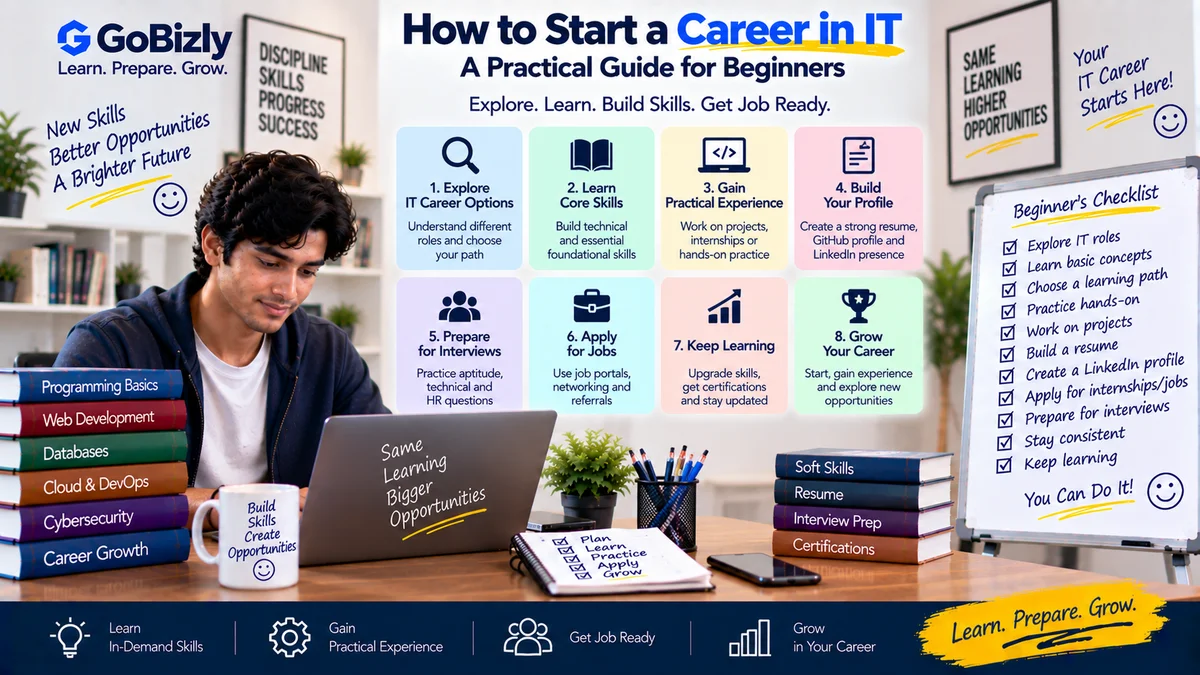
How to Start a Career in IT: A Practical Guide for Beginners
Information technology includes many different career paths.
You don't have to become a software developer to build a career in technology.
Depending on your interests, you could explore areas such as:
Software development
Data analytics
Cloud computing
Cybersecurity
IT support
Testing and quality assurance
Networking
Database administration
Business analysis
Technology operations
The first step is understanding which direction matches your interests and strengths.
1. Understand the Different IT Career Paths
Before choosing a course or certification, explore different roles.
Software Development
Focuses on building and maintaining applications.
Data Analytics
Focuses on collecting, analyzing and communicating insights from data.
Cloud Computing
Involves cloud infrastructure, services and deployment.
Cybersecurity
Focuses on protecting systems, networks and information.
IT Support
Helps users troubleshoot technology and system issues.
Quality Assurance
Focuses on testing software and identifying defects.
Understanding these paths can help you make a more informed choice.
2. Choose One Starting Direction
You don't need to learn everything at once.
Choose one primary area.
For example:
Interested in coding?
Explore programming and software development.
Enjoy working with numbers?
Explore data analytics.
Interested in infrastructure?
Explore cloud or networking.
Interested in security?
Explore cybersecurity fundamentals.
3. Learn the Fundamentals
Before pursuing advanced topics, build basic knowledge.
For example, a beginner exploring software development could start with:
Programming fundamentals
Data structures
Databases
Web basics
Version control
Someone exploring data analytics might start with:
Excel
SQL
Basic statistics
Data visualization
The exact learning path depends on your target role.
4. Choose a Programming Language if Needed
If you're pursuing development, choose one beginner-friendly language and learn it properly.
Possible starting points include:
Python
Java
JavaScript
C#
Don't try to learn five programming languages simultaneously.
Understanding programming concepts is more important than collecting languages.
5. Learn Through Projects
Projects turn theoretical knowledge into practical experience.
Examples:
Beginner Developer
Build a simple task-management application.
Data Beginner
Analyze a public dataset and create a dashboard.
Cloud Beginner
Deploy a simple application using a cloud service.
Cybersecurity Beginner
Create a basic security-awareness project.
Clearly describe what you actually built.
6. Create a Portfolio
Your portfolio can include:
Projects
GitHub repositories
Dashboards
Technical documentation
Case studies
Presentations
You don't need dozens of projects.
A few well-explained projects can demonstrate how you approach problems.
7. Learn Version Control
If you're pursuing development, understand the basics of Git.
Learn concepts such as:
Repository
Commit
Branch
Merge
Pull
Push
Version control is useful for managing changes to code and collaborating with others.
8. Understand Databases
Many technology roles interact with data.
Learn basic concepts such as:
Tables
Rows
Columns
Primary keys
Relationships
Queries
SQL is particularly useful for many data-related roles.
9. Learn Basic Networking Concepts
Even if networking isn't your target career, basic concepts can be useful.
Understand terms such as:
IP address
DNS
HTTP
HTTPS
Client
Server
Router
These concepts help explain how systems communicate.
10. Explore Cloud Computing
Cloud platforms are widely used in modern technology environments.
Start by understanding concepts such as:
Virtual machines
Storage
Databases
Networking
Scalability
Regions
Availability
Don't start with advanced architecture before understanding the fundamentals.
11. Learn About Cybersecurity
Every technology professional benefits from understanding basic security concepts.
Learn about:
Password security
Authentication
Authorization
Phishing
Malware
Encryption
Access control
Security awareness is relevant across many technology roles.
12. Build Communication Skills
Technology careers aren't only about technical knowledge.
You may need to:
Explain technical concepts
Write documentation
Present findings
Communicate with clients
Work with teams
Discuss problems
Technical knowledge combined with communication can help you work more effectively.
13. Consider Certifications Carefully
Certifications can help structure learning.
Before choosing one, ask:
Is it relevant to my target role?
What skills does it cover?
Is the certification recognized in my target industry?
Can I demonstrate the knowledge practically?
Don't collect certifications without building actual skills.
14. Look for Entry-Level Opportunities
Possible starting positions include:
Trainee
Junior Developer
IT Support Associate
QA Tester
Data Analyst
Technical Support
Operations Associate
The exact entry-level opportunities depend on your background and location.
15. Prepare Your Resume
Highlight:
Technical skills
Projects
Education
Certifications
Internships
Relevant experience
For beginners, projects can be especially useful.
16. Prepare for Technical Interviews
Expect questions related to:
Fundamentals
Projects
Tools
Problem solving
Scenarios
Practice explaining concepts rather than memorizing definitions.
17. Build a Learning Routine
A simple routine could be:
30 minutes: Learn a concept
30 minutes: Practice
30 minutes: Work on a project
15 minutes: Review
Consistency matters more than studying for long hours once a week.
18. Don't Try to Learn Everything
Technology is a huge field.
Trying to learn programming, cloud, cybersecurity, data science and networking simultaneously can make your learning unfocused.
Start with one direction.
Expand later.
19. Keep Learning From Real Problems
When you encounter an issue:
Understand the problem.
Research possible causes.
Test a solution.
Document what happened.
Review what you learned.
This develops practical problem-solving ability.
20. Build a Long-Term Learning Plan
Think in stages:
Foundation
↓
Practice
↓
Projects
↓
Portfolio
↓
Interview Preparation
↓
Entry-Level Opportunity
Then continue learning after you enter the industry.
IT Career Checklist
☐ Explore IT career paths
☐ Choose a starting direction
☐ Learn fundamentals
☐ Build practical projects
☐ Create a portfolio
☐ Learn relevant tools
☐ Understand databases
☐ Learn basic networking
☐ Explore cloud concepts
☐ Learn security fundamentals
☐ Improve communication
☐ Prepare your resume
☐ Practice technical interviews
☐ Apply for relevant roles
Conclusion
Starting an IT career doesn't require learning every technology available.
Choose a direction.
Build the fundamentals.
Practice through projects.
Create evidence of your skills.
Then prepare for relevant entry-level opportunities.
Your first technology role doesn't have to determine your entire career.
It can be the starting point from which you continue to specialize and grow.
Choose a direction. Build practical skills. Keep learning.
Learn. Prepare. Grow.