How to Prepare for Your First Job Interview
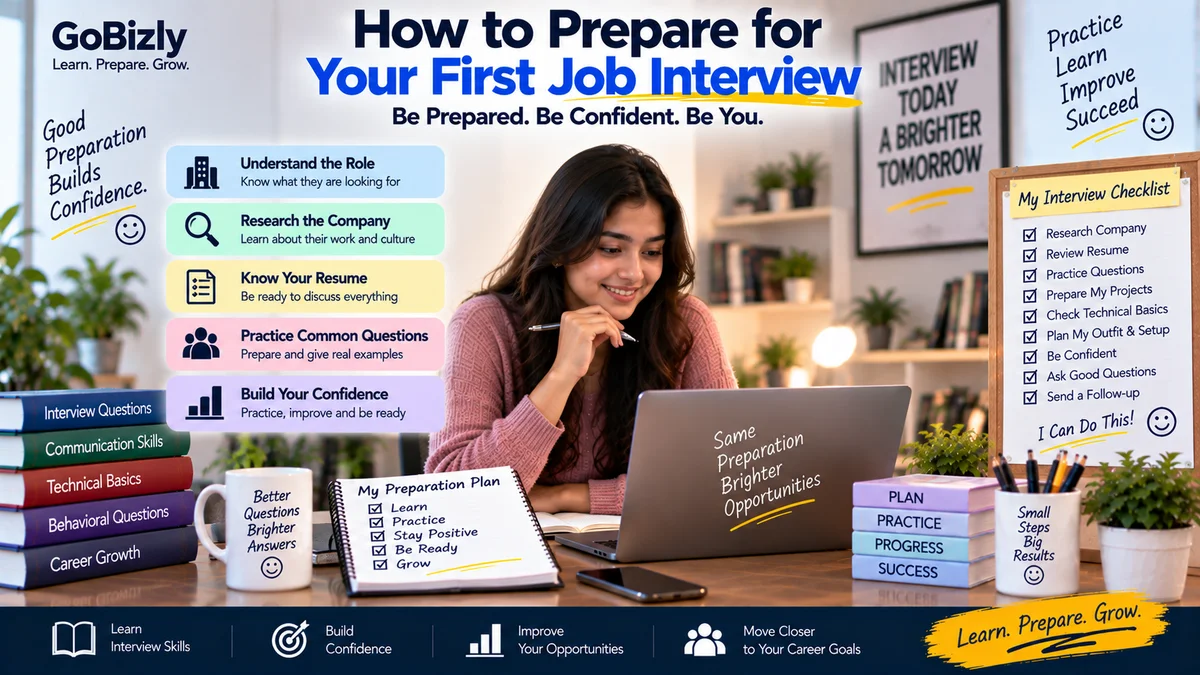
How to Prepare for Your First Job Interview
Your first job interview can feel unfamiliar because you may not know what to expect.
You might wonder:
What questions will they ask?
How should I introduce myself?
What should I say about my lack of experience?
What should I research?
How should I prepare for technical questions?
The best preparation isn't memorizing hundreds of answers.
It is understanding the role, reviewing your own background, practicing communication and preparing examples you can explain naturally.
1. Understand the Role
Start with the job description.
Identify:
Main responsibilities
Required skills
Preferred skills
Education
Tools
Experience expectations
This tells you what areas are likely to matter during the interview.
2. Research the Company
Learn basic information about:
Products or services
Industry
Customers
Company website
Role you're applying for
Don't try to memorize the entire company history.
Focus on information relevant to the position.
3. Know Your Resume
Everything on your resume should be something you can discuss.
Review:
Education
Projects
Certifications
Skills
Internships
Achievements
If you list a skill, expect questions about it.
4. Prepare Your Introduction
Use a simple structure:
Who you are → Education → Relevant skills → Projects → Career interest
For example:
"I'm a recent commerce graduate with an interest in digital marketing and analytics. During college, I worked on academic projects related to marketing and completed certifications in relevant tools. I'm now looking for an entry-level opportunity where I can apply these skills and continue developing professionally."
Customize the answer to your actual background.
5. Prepare for "Why This Role?"
Connect your answer to:
Your interests
Your skills
What you want to learn
The responsibilities of the role
Avoid saying only:
"I need a job."
Explain why the particular role interests you.
6. Prepare for "Why Should We Hire You?"
As a fresher, you may not have extensive professional experience.
Focus on what you can genuinely offer:
Relevant knowledge
Projects
Communication
Learning ability
Problem solving
Relevant technical skills
Support your claims with examples.
7. Prepare Your Projects
For every major project, know:
Problem
Objective
Your role
Tools
Process
Challenges
Outcome
Lessons learned
Interviewers may use projects to understand how you apply what you've learned.
8. Prepare for Behavioral Questions
Examples:
Tell me about a challenge.
Tell me about a mistake.
Describe a time you worked in a team.
Tell me about a disagreement.
Describe a time you solved a problem.
Use the STAR structure where appropriate:
Situation → Task → Action → Result
9. Prepare for Technical Questions
Technical questions depend on the role.
For example:
Marketing: Advertising, analytics, SEO, campaigns.
IT: Programming, databases, networking.
Finance: Accounting, financial concepts.
Operations: Processes, Excel, problem solving.
Start with fundamentals.
10. Practice Out Loud
Reading answers silently isn't the same as speaking.
Practice:
Introduction
Project explanation
Strengths
Development areas
Why this role
Technical concepts
Focus on explaining rather than memorizing.
11. Record Practice Interviews
If possible, record yourself answering questions.
Review:
Speaking pace
Clarity
Repetition
Answer structure
Filler words
Body language
Use the recording as a learning tool, not as a reason to criticize yourself.
12. Prepare Questions for the Interviewer
Useful questions may include:
What would success look like in this role?
What skills are most important for someone starting in this position?
What does the initial training process look like?
What kind of projects could a new team member work on?
Choose questions that are genuinely relevant.
13. Prepare Your Interview Setup
For an online interview:
☐ Stable internet
☐ Working microphone
☐ Working camera if required
☐ Quiet environment
☐ Appropriate background
☐ Charged device
☐ Interview link available
Test everything before the interview.
14. Dress Appropriately
The appropriate level of formality depends on the company and role.
When uncertain, choose professional and presentable clothing.
The goal is to avoid your appearance becoming a distraction from the conversation.
15. Arrive Early
For an in-person interview, plan your route and allow extra time.
For an online interview, join early enough to check your setup.
Avoid joining at the last possible minute.
16. Be Honest About What You Don't Know
If you don't know an answer, don't invent one.
You can say:
"I haven't worked with that yet, but I understand the basic concept and I'm interested in learning it."
Then explain what you genuinely know.
17. Prepare for Unexpected Questions
Interviewers may ask questions you haven't practiced.
Instead of trying to predict every possible question, develop a framework:
Understand → Think → Structure → Answer
Take a moment if needed.
A short pause is generally better than rushing into an unclear answer.
18. Send a Professional Follow-Up
After an interview, if appropriate, send a concise thank-you or follow-up message.
Mention:
Appreciation for the conversation
Continued interest
One relevant point from the discussion
Keep it professional.
19. Review the Interview
Afterward, write down:
Questions I answered well
Questions I struggled with
Topics I need to learn
Communication improvements
Questions I should prepare next time
Each interview can become a preparation opportunity for the next one.
20. Create a First-Interview Preparation Plan
7 Days Before
Research company and role.
5 Days Before
Review technical fundamentals.
3 Days Before
Practice common questions.
2 Days Before
Practice projects and scenarios.
1 Day Before
Review notes and logistics.
Interview Day
Keep your preparation concise and focus on communicating clearly.
First Job Interview Checklist
☐ Understand role
☐ Research company
☐ Review resume
☐ Prepare introduction
☐ Prepare projects
☐ Review technical basics
☐ Practice behavioral questions
☐ Practice speaking
☐ Prepare questions
☐ Check interview setup
☐ Plan travel or login
☐ Prepare documents
☐ Review after interview
Conclusion
Your first interview doesn't require perfect answers.
Good preparation means understanding the role, knowing your own background, practicing communication and being ready to explain what you've learned.
Be honest.
Be prepared.
Listen carefully.
Take a moment when you need to think.
And remember that an interview is also an opportunity to understand whether the role is suitable for you.
Prepare the knowledge. Practice the communication. Learn from every conversation.
Learn. Prepare. Grow.