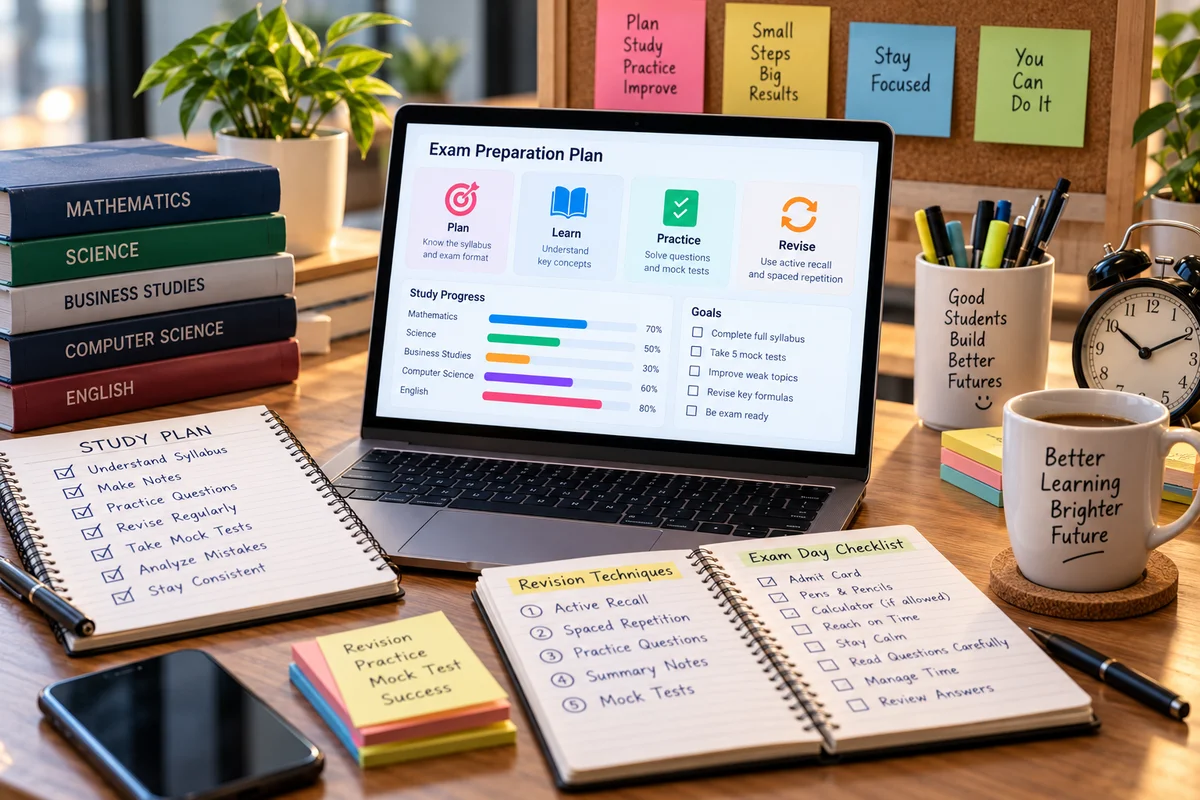
How to Prepare for Exams Effectively
How to Prepare for Exams Effectively
Exam preparation is not simply about studying for long hours.
A student can spend eight hours with a textbook and still remember very little if the study process is unplanned, passive or filled with distractions.
Effective exam preparation is about using your available time intelligently.
It involves understanding what you need to learn, organizing the syllabus, creating a realistic study plan, learning concepts actively, practicing questions, reviewing difficult areas and preparing yourself to perform under exam conditions.
A good preparation strategy also needs to account for something students often overlook: energy.
Studying when you are exhausted, distracted or overwhelmed can make even simple topics feel difficult.
That is why effective preparation combines:
• Planning
• Understanding
• Active learning
• Revision
• Practice
• Time management
• Concentration
• Sleep and recovery
• Exam strategy
• Progress tracking
This guide explains how to prepare for exams step by step, whether you have several weeks available or only a limited amount of time.
---
## 1. What Does Effective Exam Preparation Mean?
Effective exam preparation means preparing in a way that increases your ability to understand, remember and apply the information you are expected to know.
It is different from simply reading the syllabus repeatedly.
A strong preparation process usually involves four major stages:
### Stage 1: Understand
Learn what the topic means.
### Stage 2: Practice
Use questions, examples, exercises or problems to apply what you learned.
### Stage 3: Retrieve
Try to recall information without looking at the answer.
### Stage 4: Review
Identify mistakes and revisit areas that still need improvement.
You can think of the process as:
Understand → Practice → Recall → Review → Repeat
This cycle is more useful than simply reading the same chapter several times.
---
# 2. Start by Understanding the Exam
Before creating a study plan, understand what you are preparing for.
Different examinations require different approaches.
You should identify:
• Exam date
• Subjects
• Number of papers
• Syllabus
• Units or chapters
• Exam format
• Question types
• Mark distribution
• Duration
• Previous question patterns
• Internal assessment or practical components
• Important deadlines
For example, a multiple-choice examination may require extensive recall and practice questions.
A mathematics examination may require repeated problem-solving practice.
A theory examination may require conceptual understanding, structured answers and revision.
A practical examination may require hands-on practice.
Do not begin by randomly opening the first chapter and studying.
Begin by understanding the examination itself.
---
# 3. Know Your Syllabus
Your syllabus is the foundation of your preparation plan.
Break it into manageable sections.
For example:
### Subject: Business Management
Unit 1 — Fundamentals
Unit 2 — Planning
Unit 3 — Organization
Unit 4 — Leadership
Unit 5 — Control
Instead of writing:
"Study Business Management."
you now have five identifiable study areas.
You can break them down even further into chapters, concepts and subtopics.
A detailed syllabus breakdown helps you answer:
• What do I need to study?
• How much content is there?
• Which topics are difficult?
• Which topics are high priority?
• What have I already completed?
• What remains?
This reduces uncertainty.
---
# 4. Divide Topics Into Priority Levels
Not every topic deserves exactly the same amount of time.
A practical approach is to divide topics into three categories.
### Priority A — High Priority
Topics that are:
• Frequently tested
• Important for understanding other topics
• Difficult for you
• Worth significant marks
• Repeated in previous examinations
### Priority B — Medium Priority
Topics that:
• Are moderately important
• You understand partially
• Need regular revision
### Priority C — Lower Priority
Topics that:
• You already understand well
• Carry relatively less weight
• Need only occasional revision
This does not mean ignoring lower-priority topics.
It means allocating your limited study time intelligently.
---
# 5. Identify Your Strong and Weak Areas
Before starting serious revision, perform a quick self-assessment.
For each topic, ask:
"How confident am I with this?"
You could use a simple scale:
1 — I don't understand it.
2 — I recognize the topic but cannot explain it.
3 — I understand the basics.
4 — I can explain and solve questions.
5 — I can confidently answer exam-level questions.
For example:
| Topic | Confidence |
|---|---:|
| Algebra | 4/5 |
| Geometry | 3/5 |
| Trigonometry | 2/5 |
| Statistics | 5/5 |
This immediately shows where additional time may be needed.
Do not spend most of your preparation time repeatedly studying topics you already know simply because they feel comfortable.
Use some time to maintain strengths, but dedicate more attention to meaningful gaps.
---
# 6. Set a Realistic Study Goal
A study goal should be specific enough to guide your session.
"Study for three hours" is a time goal.
It does not tell you what you need to accomplish.
A stronger goal would be:
"Complete the concepts of Chapter 3, solve 20 practice questions and review mistakes."
Another example:
"Revise the five major theories from Unit 2 and recall each one without looking at notes."
Specific goals make progress easier to measure.
---
# 7. Create an Exam Preparation Timeline
Once you know the exam date, work backward.
Suppose you have four weeks.
You might structure the preparation like this:
### Week 1
Understand major concepts.
### Week 2
Complete remaining syllabus and begin revision.
### Week 3
Practice questions and strengthen weak areas.
### Week 4
Full revision, mock tests and exam preparation.
The exact structure depends on your syllabus.
The important principle is:
Do not leave all revision and practice until the final few days.
---
# 8. Build a Study Plan
A useful study plan should answer:
• What will I study?
• When will I study it?
• How long will I study?
• What will I practice?
• When will I revise?
• When will I test myself?
A simple daily plan could look like:
### Morning
8:00–9:00 — Mathematics concepts
9:15–10:15 — Mathematics practice
### Afternoon
2:00–3:00 — Science theory
3:15–4:00 — Science recall
### Evening
6:00–7:00 — Previous questions
7:15–7:45 — Revision
This does not mean everyone needs this exact schedule.
Your schedule should match your school, college, work, sleep and personal responsibilities.
---
# 9. Avoid Making an Unrealistic Timetable
One of the biggest mistakes students make is creating a timetable that looks impressive but cannot realistically be followed.
For example:
5:00 AM — Wake up
5:15–7:00 — Study
7:00–7:30 — Exercise
8:00–10:00 — Study
10:00–10:15 — Break
10:15–12:00 — Study
12:00–1:00 — Revision
And so on.
A timetable packed with study blocks may look productive.
But if you cannot maintain it after two days, it is not a useful plan.
Build a schedule you can actually follow.
Consistency is more valuable than an unrealistic timetable.
---
# 10. Use Study Blocks
Instead of studying continuously for several hours, divide your time into focused blocks.
For example:
50 minutes study
10 minutes break
50 minutes study
10 minutes break
50 minutes study
Then take a longer break.
Another student may prefer:
25 minutes study
5 minutes break
25 minutes study
5 minutes break
The best structure depends on your concentration ability and the difficulty of the material.
The important principle is to create periods of focused attention and intentional recovery.
---
# 11. Start With Difficult Topics When Your Energy Is High
Many students naturally prefer studying easy topics first.
It feels productive because progress comes quickly.
But your most difficult topics often require more mental energy.
If you are most focused in the morning, consider placing difficult subjects or complex chapters earlier in the day.
For example:
Morning:
Difficult mathematics problems
Afternoon:
Theory revision
Evening:
Light review
You can adjust this based on your own energy pattern.
The objective is to use your strongest concentration periods for demanding work.
---
# 12. Understand Before You Memorize
Memorization has a place in exam preparation.
But memorizing information without understanding it can make application difficult.
For example, instead of memorizing:
"Photosynthesis is the process by which..."
first understand:
• What photosynthesis is
• Why plants need it
• What inputs are required
• What outputs are produced
• Where the process occurs
• How the process works
Once the concept is understood, memorization becomes easier.
Always ask:
"Can I explain this in my own words?"
If the answer is no, you may need to understand the concept more deeply before trying to memorize it.
---
# 13. Use Active Recall
Active recall is one of the most useful study techniques.
Instead of repeatedly reading information, close the book and try to retrieve the information from memory.
For example:
Read:
"The three stages of the process are A, B and C."
Close the book.
Ask:
"What are the three stages?"
Try to answer without looking.
Then check your answer.
If you forgot one, review it and try again.
Active recall forces your brain to retrieve information rather than simply recognize it.
---
# 14. How to Use Active Recall in Practice
You can use active recall in many ways.
### Method 1: Questions
Turn headings into questions.
Heading:
"Causes of Inflation"
Question:
"What are the major causes of inflation?"
Answer from memory.
### Method 2: Blank Page
Read a topic.
Close your notes.
Write everything you remember on a blank page.
Compare it with your notes.
### Method 3: Flashcards
Front:
"What are the three types of market structures?"
Back:
"Perfect competition, monopolistic competition and oligopoly."
### Method 4: Teach Yourself
Explain the topic aloud without looking at the material.
These approaches make learning more active.
---
# 15. Use Spaced Repetition
Spaced repetition involves reviewing information at increasing intervals rather than trying to memorize everything in one session.
For example:
Day 1 — Learn
Day 2 — Review
Day 4 — Review
Day 7 — Review
Day 14 — Review
Day 21 — Review
The exact schedule does not need to be perfect.
The important idea is to revisit information over time.
Spaced review can be especially useful for:
• Definitions
• Formulas
• Vocabulary
• Dates
• Concepts
• Terminology
• Language learning
• Lists
Combine spaced repetition with active recall for better practice.
---
# 16. Do Not Confuse Recognition With Recall
This is a common study problem.
You read a page and think:
"I know this."
Then the exam asks you a question and you cannot explain it.
Why?
Because recognizing information while looking at it is easier than retrieving it without the material.
For example:
Seeing the answer:
"Photosynthesis occurs in chloroplasts."
may feel familiar.
But being asked:
"Where does photosynthesis occur?"
requires retrieval.
That is why self-testing is important.
---
# 17. Practice With Questions
Reading provides information.
Questions require application.
That makes practice questions an essential part of exam preparation.
Use:
• Textbook questions
• Previous examination questions
• Practice worksheets
• Sample papers
• Mock tests
• Online quizzes where appropriate
• Teacher-provided exercises
Do not wait until the syllabus is completely finished before practicing.
Begin practicing as you learn.
---
# 18. Use Previous Question Papers
Previous question papers can reveal useful patterns.
They may help you understand:
• Question formats
• Frequently tested topics
• Difficulty levels
• Mark distribution
• Time requirements
• Common question styles
However, do not assume that every previous question will repeat.
Use previous papers to understand the examination style, not to predict the future with certainty.
---
# 19. Create a Mistake Log
One of the most useful study tools is a mistake log.
Whenever you make a mistake, record:
• The question
• Your answer
• Correct answer
• Why your answer was wrong
• What concept you misunderstood
• What you should remember
For example:
Question:
Calculate the percentage increase.
Mistake:
Used the original value incorrectly.
Cause:
Confused percentage increase with percentage difference.
Correction:
Review the formula and solve five similar questions.
This turns mistakes into learning opportunities.
---
# 20. Review Mistakes More Than Correct Answers
If you answered a question correctly and understood why, you may not need to spend much time on it.
Mistakes deserve more attention.
Ask:
"Why did I get this wrong?"
Possible reasons include:
• I did not understand the concept.
• I forgot the formula.
• I misunderstood the question.
• I made a calculation error.
• I rushed.
• I misread the instruction.
• I used the wrong method.
• I knew the concept but could not recall it.
Different mistakes require different solutions.
---
# 21. Learn the Difference Between Concept Errors and Careless Errors
Not every wrong answer means you do not understand the topic.
### Concept error
You do not understand the underlying idea.
Solution:
Relearn the concept.
### Recall error
You understood it previously but could not remember it.
Solution:
Use active recall and spaced review.
### Application error
You know the concept but cannot apply it to a question.
Solution:
Practice more problems.
### Careless error
You know how to solve it but made a small mistake.
Solution:
Slow down and develop a checking process.
Understanding the type of mistake helps you choose the right response.
---
# 22. Use Practice Tests
Practice tests simulate the examination environment.
They can help you identify:
• Knowledge gaps
• Time-management problems
• Question interpretation issues
• Concentration problems
• Anxiety
• Weak topics
Take practice tests under realistic conditions whenever possible.
That means:
• Set a timer
• Use the appropriate materials
• Avoid checking answers during the test
• Complete the paper in one sitting when practical
• Review afterward
A practice test is not only a test of knowledge.
It is also a test of exam execution.
---
# 23. Analyze Your Practice Test
Do not simply calculate your score and move on.
Analyze the result.
For each incorrect question, classify the mistake.
For example:
10 mistakes
3 — Concept gaps
2 — Recall problems
2 — Calculation errors
2 — Misread questions
1 — Time pressure
Now you know what to improve.
This is much more useful than simply saying:
"I scored 70%."
---
# 24. Practice Under Time Pressure
Knowing the answer is not always enough.
You need to answer within the available time.
For example, if an exam provides 180 minutes for 100 marks, you need to develop a reasonable pace.
Practice helps you understand:
• How long questions take
• Which questions consume too much time
• When to move on
• How much time to reserve for checking
Do not wait until exam day to discover that you cannot finish within the time limit.
---
# 25. Learn How to Read Questions Carefully
Sometimes students know the topic but answer the wrong question.
Look for words such as:
• Explain
• Describe
• Compare
• Analyze
• Evaluate
• Define
• Discuss
• Calculate
• Justify
• List
• Illustrate
These words indicate what the examiner expects.
For example:
"Define leadership."
requires a different response from:
"Evaluate the importance of leadership in an organization."
Understanding the instruction is part of answering correctly.
---
# 26. Understand the Mark Allocation
If a question carries two marks, it probably does not require the same response as a ten-mark question.
Use marks as a guide.
For a short-answer question:
• Be direct
• Include the required points
• Avoid unnecessary writing
For a longer question:
• Structure the response
• Explain key ideas
• Use examples where appropriate
• Address different parts of the question
• Conclude clearly when useful
Always follow your institution's specific examination instructions.
---
# 27. Learn How to Structure Long Answers
For theory-based exams, a clear structure can make answers easier to understand.
A useful structure is:
### Introduction
Briefly introduce the topic.
### Main explanation
Explain the key concepts.
### Supporting points
Use relevant details, examples or evidence.
### Application
Where appropriate, explain how the concept applies.
### Conclusion
Summarize the main idea.
Not every answer requires this exact structure, but organized writing can make your response clearer.
---
# 28. Use Diagrams When Appropriate
Some subjects benefit from diagrams.
Examples include:
• Biology
• Geography
• Engineering
• Business processes
• Computer science
• Economics
• Physics
A diagram can sometimes communicate a process more clearly than several paragraphs.
However, only use diagrams when they are relevant and correctly labeled.
Do not add decorative diagrams simply to make an answer look longer.
---
# 29. Build a Formula Sheet
For subjects involving formulas, create a compact formula sheet.
For each formula, include:
• Formula
• Meaning of variables
• Units
• Example
• Common mistakes
For example:
Speed = Distance ÷ Time
Distance = Speed × Time
Time = Distance ÷ Speed
Then practice using the formulas rather than merely reading them.
---
# 30. Understand Formulas Instead of Memorizing Them Blindly
Whenever possible, understand what a formula represents.
Ask:
• What does each variable mean?
• What happens when one variable increases?
• What units should be used?
• When should this formula be applied?
• What similar formulas could be confused with it?
Understanding the logic behind a formula can make recall easier and reduce application mistakes.
---
# 31. Create a One-Page Summary
After completing a chapter, create a concise summary.
Include:
• Key concepts
• Definitions
• Formulas
• Important examples
• Processes
• Common mistakes
• Questions you still struggle with
The goal is not to rewrite the entire textbook.
The goal is to create a compact revision tool.
A good one-page summary can become particularly useful during final revision.
---
# 32. Use the Feynman Technique
The Feynman technique is a simple way to test whether you actually understand a concept.
### Step 1
Choose a topic.
### Step 2
Explain it as if teaching someone who knows nothing about it.
### Step 3
Notice where your explanation becomes unclear.
### Step 4
Return to the source material.
### Step 5
Simplify the explanation.
For example, if you cannot explain how an API works without repeatedly using technical terms you cannot define, you may need to strengthen your understanding.
---
# 33. Teach Someone Else
Teaching can reveal gaps in your understanding.
Ask a friend or family member to listen while you explain a topic.
They can ask:
"Why?"
"How?"
"What does that mean?"
"What is an example?"
If you cannot answer, identify the gap and review it.
You do not need to become a professional teacher.
Even explaining a topic aloud to yourself can be useful.
---
# 34. Study With Friends Carefully
Group study can be helpful when used properly.
It can help with:
• Discussion
• Question solving
• Explaining concepts
• Testing one another
• Sharing resources
• Identifying misunderstandings
But group study can also become social time.
If 90 minutes of "group study" produces only 20 minutes of actual learning, it may not be effective.
Set an objective before the session.
For example:
"Complete 30 questions and discuss the five most difficult ones."
That creates structure.
---
# 35. Use Your Phone Carefully
Your phone can support learning.
It can provide:
• Flashcards
• Timers
• Educational videos
• Digital notes
• Calculators
• Reference materials
• Study applications
But it can also create constant interruptions.
During focused study, consider:
• Turning off unnecessary notifications
• Using focus mode
• Keeping social media closed
• Placing the phone away from your desk
• Using only required educational apps
The objective is not to eliminate technology.
It is to control it.
---
# 36. Manage Social Media During Exam Preparation
Social media can consume small amounts of time repeatedly.
Five minutes here.
Ten minutes there.
Another quick check.
The problem is not always the total time.
It is also the interruption of concentration.
Consider setting specific periods when you can check social media.
For example:
30–60 minutes after completing your major study goals.
The exact schedule depends on your habits.
The key is intentional use.
---
# 37. Create a Distraction-Free Study Environment
Your environment affects concentration.
A useful study space should ideally have:
• Good lighting
• Comfortable seating
• Necessary materials
• Minimal unnecessary objects
• Stable internet if required
• Water
• A clock or timer
• A place to keep your phone away
You do not need an expensive study room.
A simple, consistent environment can work well.
---
# 38. Keep Your Study Materials Organized
Create separate folders or sections for:
• Notes
• Textbooks
• Practice questions
• Previous papers
• Mistake logs
• Flashcards
• Formula sheets
• Revision summaries
Organization reduces the time spent searching for materials.
It also makes revision easier.
---
# 39. Use Different Study Methods for Different Subjects
One method does not work equally well for every subject.
### Mathematics
Focus on:
• Worked examples
• Practice problems
• Error analysis
• Timed practice
### Science
Use:
• Concept understanding
• Diagrams
• Active recall
• Practice questions
### History
Use:
• Timelines
• Cause-and-effect relationships
• Active recall
• Short summaries
### Languages
Use:
• Reading
• Writing
• Vocabulary
• Grammar practice
• Speaking where relevant
### Computer Science
Use:
• Conceptual understanding
• Coding practice
• Problem solving
• Debugging
• Practice questions
Adapt your method to the nature of the subject.
---
# 40. Do Not Study Every Subject in the Same Way
This is an important extension of the previous point.
A student may spend hours reading a mathematics textbook without solving enough problems.
Another student may memorize science definitions without understanding the processes.
The study technique should match the skill being tested.
If the exam requires application, practice application.
If it requires recall, practice recall.
If it requires writing, practice writing.
If it requires calculations, solve calculations.
Prepare for the actual performance required by the examination.
---
# 41. Use a Revision Cycle
A useful revision cycle could be:
### First Pass
Understand the topic.
### Second Pass
Recall the key concepts.
### Third Pass
Practice questions.
### Fourth Pass
Review mistakes.
### Fifth Pass
Take a test.
### Sixth Pass
Review weak areas.
This is more effective than reading the same chapter six times.
Each pass has a different purpose.
---
# 42. Plan Your Final Week
The final week should not be about learning everything from scratch.
Ideally, most major topics should already have been studied.
Use the final week for:
• High-priority revision
• Active recall
• Practice papers
• Mistake review
• Formula review
• Definitions
• Weak topics
• Exam strategy
Avoid suddenly creating an entirely new study system in the final few days.
Use the process you have already practiced.
---
# 43. Avoid Starting Too Many New Resources
During exam preparation, students often collect:
• Multiple textbooks
• YouTube playlists
• Notes
• Study apps
• Websites
• Question banks
• Guides
More resources can create confusion.
Choose reliable primary resources and a limited number of supplementary resources.
Ask:
"Does this resource solve a specific problem in my preparation?"
If not, you may not need it.
---
# 44. Be Careful With Last-Minute Study Content
Short videos and social posts may offer quick tips.
Some can be useful.
But avoid replacing systematic study with endless consumption of study advice.
Watching ten videos about:
"How to study effectively"
is not the same as studying.
Use advice to improve your process, then spend most of your time actually learning and practicing.
---
# 45. Sleep Is Part of Exam Preparation
Sleep should not be treated as wasted study time.
Adequate sleep supports:
• Attention
• Learning
• Memory
• Concentration
• Decision-making
• Mood
Reducing sleep dramatically to create additional study hours can negatively affect your ability to use those hours effectively.
A student who studies for five focused hours and sleeps adequately may perform better than someone who studies for eight exhausted hours.
Individual sleep needs vary, but maintaining a consistent sleep routine is generally a useful part of exam preparation.
---
# 46. Do Not Make All-Nighters Your Main Strategy
An all-nighter may sometimes seem like the fastest way to cover more material.
But it can leave you exhausted and reduce concentration.
It also creates a difficult cycle:
Less sleep
↓
Lower concentration
↓
Slower learning
↓
More study time required
↓
Less sleep
A sustainable preparation plan should reduce the need for emergency overnight study.
---
# 47. Take Breaks Intentionally
Breaks are not necessarily a sign of poor discipline.
They can help maintain attention during longer study periods.
A useful break might involve:
• Walking
• Stretching
• Drinking water
• Having a light snack
• Resting your eyes
• Briefly stepping outside
Avoid turning every five-minute break into a 45-minute social media session.
The purpose of a break is recovery, not abandoning the study session.
---
# 48. Take Care of Basic Physical Needs
During exam preparation, students sometimes neglect:
• Food
• Water
• Sleep
• Movement
• Rest
These basics affect how effectively you can study.
Keep water available.
Eat regular meals appropriate for your needs.
Take short movement breaks.
Maintain a reasonable sleep routine.
Exam preparation is a mental activity, but your physical condition influences your ability to perform it.
---
# 49. Manage Exam Stress
Some exam stress is normal.
Stress can increase when:
• The syllabus feels too large
• The exam is approaching
• Preparation is incomplete
• Students compare themselves with others
• Expectations are high
• Previous results were disappointing
The best response is not to panic about the entire syllabus.
Break the problem into smaller actions.
Instead of:
"I have so much left."
write:
"Today I will complete Chapter 4 concepts and 20 questions."
Small, concrete actions make the situation more manageable.
If stress becomes overwhelming or seriously affects daily functioning, speaking with a trusted adult, teacher, counselor or qualified professional can be appropriate.
---
# 50. Avoid Constant Comparison
Every student has a different:
• Starting point
• Learning speed
• Schedule
• Strength
• Weakness
• Background
• Study environment
Someone saying:
"I finished the whole syllabus."
does not tell you whether they actually understand it.
Someone studying for ten hours does not necessarily study more effectively than someone studying for five focused hours.
Measure yourself primarily against your own progress.
---
# 51. Use a Progress Tracker
A simple tracker can show what has been completed.
For example:
| Topic | Learn | Recall | Practice | Test |
|---|---|---|---|---|
| Chapter 1 | ✓ | ✓ | ✓ | ✓ |
| Chapter 2 | ✓ | ✓ | ✓ | |
| Chapter 3 | ✓ | | | |
| Chapter 4 | | | | |
This makes unfinished work visible.
It also creates a sense of progress.
---
# 52. Track Confidence Separately From Completion
Completing a chapter does not necessarily mean mastering it.
You might mark:
Chapter 1 — Completed, confidence 4/5
Chapter 2 — Completed, confidence 2/5
Chapter 3 — Completed, confidence 5/5
This helps prevent false confidence.
A completed checkbox should mean:
"I studied it."
A confidence rating tells you:
"How well can I actually use it?"
Both are useful.
---
# 53. Use a Red-Yellow-Green System
Another simple approach:
### Green
I understand this and can answer questions.
### Yellow
I understand the basics but need practice.
### Red
I do not understand this or cannot answer questions.
During revision:
Prioritize red.
Then yellow.
Maintain green.
This can make a large syllabus easier to manage.
---
# 54. Build a Question Bank
Collect questions by topic.
For example:
### Algebra
20 questions
### Geometry
15 questions
### Statistics
20 questions
Then track performance.
If you repeatedly miss a certain type of question, create a dedicated practice set.
This is more useful than solving random questions without analyzing the results.
---
# 55. Practice Writing Answers
For essay-based subjects, reading model answers is not enough.
Write your own answers.
Practice:
• Introductions
• Explanations
• Examples
• Comparisons
• Conclusions
• Short answers
• Long answers
Then compare your answer with the expected content or marking guidance when available.
This helps improve both knowledge and exam expression.
---
# 56. Improve Your Speed Gradually
Do not immediately try to complete everything at maximum speed.
Start with accuracy.
Then introduce time limits.
For example:
Week 1:
Solve questions without strict timing.
Week 2:
Use moderate timing.
Week 3:
Practice under exam conditions.
This helps build both accuracy and speed.
---
# 57. Learn When to Move On From a Difficult Question
During an exam, one question should not consume the time needed for several other questions.
Practice recognizing when you are stuck.
You might:
1. Read the question carefully.
2. Attempt it.
3. If you cannot progress, mark it.
4. Move to the next question.
5. Return later.
The exact strategy depends on the exam rules.
The important principle is to manage your total available time.
---
# 58. Develop an Exam-Day Strategy
Before the exam, decide:
• What time will you wake up?
• What will you eat?
• What materials do you need?
• How will you reach the exam location?
• How early should you arrive?
• What identification is required?
• What stationery is allowed?
• What is the exam duration?
• How will you divide your time?
Preparing these details beforehand reduces unnecessary stress.
---
# 59. Prepare Your Materials the Night Before
Depending on the examination, prepare:
• Admit card or required identification
• Pens
• Pencils
• Eraser
• Ruler
• Calculator if permitted
• Water
• Other approved materials
Check the examination instructions rather than assuming what is allowed.
Avoid discovering on exam morning that something important is missing.
---
# 60. Do Not Overload Yourself With Last-Minute Revision
A short review can be useful.
But trying to learn an entire subject minutes before the exam may create anxiety and confusion.
Instead, focus on:
• Key formulas
• Important definitions
• Major concepts
• Mistake areas
• Short summaries
Then allow yourself time to settle before the exam begins.
---
# 61. Read the Entire Paper Carefully
When the exam begins, do not rush immediately into writing.
Follow the examination instructions.
Understand:
• Number of questions
• Required questions
• Marks
• Sections
• Choices
• Time available
A few minutes of careful reading can prevent avoidable mistakes.
---
# 62. Allocate Time Based on Marks
If the examination allows it, use marks as a rough guide for time allocation.
A high-mark question may reasonably receive more time than a low-mark question.
Do not spend a disproportionate amount of time perfecting a small question while leaving a major section incomplete.
Your exact approach should follow the exam format and instructions.
---
# 63. Answer the Question That Was Asked
This sounds obvious, but it is a common issue.
A student may know everything about a topic but fail to answer the specific question.
Before writing, identify:
• What is being asked?
• What is the command word?
• What information is required?
• How many marks are available?
Then answer that question directly.
---
# 64. Show Your Working Where Appropriate
For calculation-based subjects, showing relevant working can help demonstrate the method.
For example:
Formula
↓
Substitution
↓
Calculation
↓
Answer
Follow the examination's marking expectations.
Do not write unnecessary calculations that make your answer difficult to follow.
---
# 65. Leave Time for Review
If possible, reserve some time at the end.
Use it to check:
• Unanswered questions
• Calculation errors
• Units
• Question numbers
• Labels
• Spelling where important
• Missing sections
• Instructions
• Answer-sheet markings
Do not spend the entire exam working until the final second if you can reasonably reserve review time.
---
# 66. What to Do If You Forget an Answer
Forgetting something during an exam does not necessarily mean you have forgotten everything.
Stay calm.
Try:
1. Read the question again.
2. Identify keywords.
3. Recall related concepts.
4. Write down what you do know.
5. Move on if necessary.
6. Return later.
Sometimes another question can trigger the memory you were trying to retrieve.
Avoid spending excessive time panicking over one forgotten fact.
---
# 67. What to Do After the Exam
Once the exam is finished, give yourself some space before analyzing every answer.
If another exam remains, your priority should be the next subject.
A common mistake is spending several hours discussing the previous exam and losing preparation time for the next one.
Learn what you can from the experience, then move forward.
---
# 68. Adjust Your Plan After Each Test
If you have multiple exams, use each one as feedback.
Ask:
• Was my preparation sufficient?
• Did I misjudge any topics?
• Did I run out of time?
• Did I make careless errors?
• Did I struggle with recall?
• Did I need more practice?
• Did my study schedule work?
Then adjust your next preparation cycle.
---
# 69. A Seven-Day Emergency Preparation Plan
Sometimes students have very little time remaining.
If you have approximately one week, focus on priorities.
### Day 1
Map the syllabus.
Identify:
• High-priority topics
• Weak areas
• Frequently tested concepts
### Day 2
Study major weak areas.
### Day 3
Complete remaining high-priority concepts.
### Day 4
Practice questions.
### Day 5
Take a mock or previous paper.
### Day 6
Review mistakes and weak topics.
### Day 7
Final revision and light review.
This is not a replacement for long-term preparation.
It is a prioritization strategy when time is limited.
---
# 70. A Three-Day Emergency Strategy
If you have only three days, avoid trying to study everything equally.
### Day 1
Identify high-value topics and major knowledge gaps.
Study the most important concepts.
### Day 2
Practice questions and previous papers.
Focus heavily on mistakes.
### Day 3
Review key concepts, formulas, definitions and weak areas.
Take a shorter practice test if possible.
Get adequate rest before the examination.
---
# 71. A One-Day Revision Strategy
If the exam is tomorrow, your objective should be consolidation rather than attempting to master an entire syllabus from zero.
Focus on:
• Important concepts
• Formula sheets
• Summary notes
• Previous mistakes
• High-priority topics
• Practice questions
• Frequently tested concepts
Avoid spending hours creating beautiful new notes.
Use the materials you already have.
---
# 72. A Long-Term Preparation Strategy
If you have several months, you have a major advantage: you can distribute learning and revision.
A useful structure is:
### Phase 1 — Foundation
Understand the syllabus.
### Phase 2 — Learning
Study each topic deeply.
### Phase 3 — Practice
Solve questions regularly.
### Phase 4 — Revision
Use active recall and spaced repetition.
### Phase 5 — Testing
Take full practice examinations.
### Phase 6 — Refinement
Focus on mistakes and weak areas.
### Phase 7 — Final Review
Consolidate key information.
This reduces the pressure of last-minute preparation.
---
# 73. Build a Weekly Review Session
Even during normal classes, reserve time each week to review what you learned.
For example:
Saturday:
Review Monday–Friday topics.
Use:
• Active recall
• Short quizzes
• Practice questions
• Summary notes
Weekly review reduces the amount of material that becomes unfamiliar before exams.
---
# 74. Use the 24-Hour Review Principle
After learning a major topic, review it relatively soon rather than waiting until the final week.
A simple routine might be:
Day 1 — Learn
Day 2 — Quick recall
Day 4 — Practice
Day 7 — Review
Later — Test
This creates multiple retrieval opportunities.
---
# 75. Avoid Passive Highlighting
Highlighting can make notes look organized.
But highlighting alone does not guarantee learning.
Instead of highlighting an entire page, ask questions.
For example:
"What are the three reasons?"
"What is the definition?"
"What is the process?"
"What is the difference between A and B?"
Then retrieve the answers.
Use highlighting as a support tool rather than the primary study method.
---
# 76. Use Notes as a Tool, Not the Final Product
The purpose of notes is to help you learn.
You do not receive marks for having beautiful notes.
A useful note should help you:
• Understand
• Recall
• Review
• Practice
If rewriting notes consumes most of your preparation time without improving understanding, change the method.
---
# 77. Create Comparison Tables
Comparison tables can help with concepts that are easily confused.
For example:
| Feature | Method A | Method B |
|---|---|---|
| Purpose | X | Y |
| Advantage | X | Y |
| Limitation | X | Y |
| Example | X | Y |
These can be particularly useful for:
• Theories
• Business concepts
• Scientific processes
• Historical comparisons
• Technical concepts
---
# 78. Use Examples to Strengthen Understanding
Examples make abstract concepts easier to remember.
When studying a concept, ask:
"What is a real-world example?"
For instance, if studying supply and demand, connect it to a real product.
If studying leadership, think about a real organization.
If studying computer networks, think about how your phone connects to the internet.
Application can make abstract material more meaningful.
---
# 79. Build Connections Between Topics
Do not always treat chapters as completely separate.
Ask:
"How does this concept connect to what I learned earlier?"
Connections improve understanding.
For example:
Marketing strategy
↓
Target audience
↓
Campaign
↓
Conversion
↓
Customer
↓
Revenue
Seeing the relationship between topics creates a more complete mental model.
---
# 80. Use the Question-Answer Method
Instead of writing:
"Photosynthesis — process by which plants..."
write:
Question:
"What is photosynthesis?"
Answer:
"Photosynthesis is..."
This converts notes into potential revision material.
The same approach can be used for:
• Definitions
• Processes
• Formulas
• Historical events
• Technical concepts
• Business theories
---
# 81. Study With a Clear Start and Stop
Before beginning a session, define:
Start:
7:00 PM
End:
7:50 PM
Goal:
Complete 15 questions.
At the end:
Check:
How many did I complete?
What did I get wrong?
What should I study next?
This makes study sessions measurable.
---
# 82. Use a Daily Top Three
If your syllabus feels overwhelming, identify the three most important study outcomes for the day.
For example:
1. Complete Chapter 5 concepts.
2. Solve 20 questions.
3. Review yesterday's mistakes.
Additional tasks are useful if time remains.
But completing the top three gives the day a clear purpose.
---
# 83. Avoid Multitasking While Studying
Studying while simultaneously:
• Watching videos unrelated to the topic
• Messaging friends
• Checking social media
• Listening to distracting content
• Switching between multiple tasks
can reduce focus.
Try single-tasking during your main study blocks.
One subject.
One objective.
One task.
Then take a break.
---
# 84. Use Technology Strategically
Technology can make preparation easier when used intentionally.
Possible tools include:
• Digital calendars
• Task managers
• Flashcard apps
• Note-taking tools
• Online practice platforms
• Document scanners
• Timers
• Educational videos
• Spreadsheets
But tools should reduce friction.
If you spend more time customizing a productivity app than studying, the tool has become a distraction.
---
# 85. Use AI Responsibly for Exam Preparation
AI tools can support learning when used as a learning assistant rather than a shortcut.
For example, you can ask an AI tool to:
• Explain a difficult concept in simple language
• Generate practice questions
• Quiz you
• Create examples
• Compare concepts
• Identify gaps in your explanation
• Help structure a study plan
• Summarize material you are allowed to use
But you should verify important information against your textbook, teacher-provided materials and authoritative sources.
Do not rely blindly on generated answers.
Most importantly, use AI to improve your understanding rather than avoiding the learning process.
---
# 86. Ask AI to Quiz You
Instead of asking only:
"Explain this chapter."
try:
"Quiz me on this topic one question at a time. Do not show the answer until I respond."
This creates active retrieval.
You can also request:
• Easy questions
• Medium questions
• Difficult questions
• Scenario-based questions
• Multiple-choice questions
• Short-answer questions
After answering, ask for an explanation of your mistakes.
---
# 87. Create Your Own Mock Examination
If official practice papers are limited, create a mock test from your syllabus.
Include:
• Different difficulty levels
• Different question types
• Appropriate marks
• A time limit
Then complete it without your notes.
Afterward, evaluate:
• Accuracy
• Speed
• Weak topics
• Common mistakes
This can reveal gaps before the actual examination.
---
# 88. Do Not Ignore Easy Topics Completely
Weak topics deserve more attention.
But easy topics still require maintenance.
If you learned a topic well three weeks ago and never reviewed it, you may forget parts of it.
Use short retrieval sessions to maintain strong areas.
For example:
"Can I answer five questions from this chapter without looking?"
If yes, move on.
---
# 89. Prioritize High-Value Learning
When time is limited, ask:
"What will make the biggest difference to my performance?"
That could mean:
• Learning a high-weight topic
• Fixing a common mistake
• Practicing a frequently tested question type
• Improving time management
• Revising formulas
Do not confuse activity with progress.
Writing ten pages of notes may take longer than solving ten questions but produce less learning.
---
# 90. Build a Final Revision Checklist
Before the examination, review:
### Knowledge
□ Major concepts understood
□ Important definitions reviewed
□ Formulas reviewed
□ Key examples understood
### Practice
□ Previous papers attempted
□ Practice questions completed
□ Mistakes reviewed
□ Weak topics revisited
### Exam Skills
□ Timing practiced
□ Question instructions understood
□ Answer structure practiced
### Logistics
□ Exam details confirmed
□ Required materials prepared
□ Travel planned
□ Sleep schedule maintained
This gives you a final readiness check.
---
# 91. What Effective Exam Preparation Looks Like
A strong preparation process can be summarized as:
### Plan
Know what you need to study.
### Prioritize
Identify what deserves the most attention.
### Learn
Understand the concepts.
### Recall
Retrieve information without looking.
### Practice
Solve realistic questions.
### Analyze
Study your mistakes.
### Revise
Return to weak areas.
### Test
Simulate the exam.
### Refine
Fix remaining gaps.
### Rest
Prepare your mind and body to perform.
This cycle is more powerful than simply increasing the number of hours you study.
---
# 92. A Sample Full-Day Study Routine
A student with a flexible day might structure preparation like this:
### 8:00 AM
Review previous material for 30 minutes.
### 8:30 AM
Break.
### 8:45 AM
Study a difficult new topic for 60 minutes.
### 9:45 AM
Short break.
### 10:00 AM
Practice questions for 60 minutes.
### 11:00 AM
Review mistakes.
### Afternoon
Study a different subject.
### Evening
Active recall of the day's material.
### Night
Short review and plan for tomorrow.
This is only an example.
The best schedule is one that fits your actual responsibilities and concentration patterns.
---
# 93. A Sample Weekly Study Plan
### Monday
New concepts + practice
### Tuesday
New concepts + active recall
### Wednesday
New concepts + practice
### Thursday
Revision + weak topics
### Friday
New concepts + practice
### Saturday
Weekly review + practice paper
### Sunday
Mistake review + planning + lighter revision
Again, adjust this to your examination schedule.
---
# 94. How to Know If You Are Actually Ready
Ask yourself:
Can I explain the major concepts without looking at my notes?
Can I answer practice questions?
Can I identify my common mistakes?
Can I complete a practice paper within the required time?
Can I remember important formulas and definitions?
Can I handle questions that are presented differently from the examples I studied?
Can I identify which topics still need work?
If your answer is yes to most of these questions, your preparation is moving in the right direction.
---
# 95. The Difference Between Studying and Preparing
Studying means spending time learning material.
Preparing for an exam means getting ready to perform under exam conditions.
Those are not exactly the same.
You can study for many hours without practicing enough.
You can read every chapter without testing your recall.
You can understand concepts without practicing timed questions.
Exam preparation combines knowledge with performance.
That is why practice and testing are essential.
---
# 96. The Final 24 Hours
The final day should generally focus on consolidation.
Review:
• Key concepts
• Formulas
• Definitions
• Mistake log
• High-priority topics
• Short summaries
Avoid trying to completely rebuild your preparation overnight.
Prepare your materials.
Confirm the exam details.
Plan your travel.
Get adequate rest.
A calm, prepared mind is more useful than another few hours of exhausted studying.
---
# 97. The Exam Morning
Keep your routine simple.
Have the materials you need.
Avoid unnecessary last-minute panic.
If you review, keep it light.
Look at:
• Formulas
• Key definitions
• Short summaries
• Important reminders
Avoid starting a large new chapter immediately before the exam unless absolutely necessary.
Give yourself enough time to reach the examination location without rushing.
---
# 98. After the Exam
If more exams remain, move on to the next preparation cycle.
Ask briefly:
What worked?
What did not?
What should I change?
Then apply the lesson.
Do not allow one difficult paper to convince you that the entire preparation process failed.
Each examination provides information you can use for the next one.
---
# 99. A Complete Exam Preparation Framework
Here is the entire process in one framework:
### Phase 1 — Understand
Understand the exam, syllabus, format and requirements.
### Phase 2 — Plan
Break the syllabus into manageable topics.
### Phase 3 — Prioritize
Identify high-priority and weak areas.
### Phase 4 — Learn
Understand concepts rather than simply memorizing them.
### Phase 5 — Retrieve
Use active recall.
### Phase 6 — Space
Review information over multiple sessions.
### Phase 7 — Practice
Solve questions and previous papers.
### Phase 8 — Analyze
Identify mistakes and their causes.
### Phase 9 — Test
Take timed practice examinations.
### Phase 10 — Refine
Focus on remaining weak areas.
### Phase 11 — Consolidate
Review summaries, formulas and important concepts.
### Phase 12 — Perform
Use good time management and exam techniques.
### Phase 13 — Recover
Sleep, rest and maintain your routine.
---
# 100. Final Exam Preparation Checklist
### Planning
□ Know the exam date
□ Understand the exam format
□ Have the complete syllabus
□ Break the syllabus into topics
□ Identify priorities
□ Create a realistic schedule
### Learning
□ Understand concepts
□ Make useful notes
□ Use examples
□ Connect related topics
□ Build formula or definition sheets where appropriate
### Active Learning
□ Use active recall
□ Use flashcards where useful
□ Explain concepts in your own words
□ Teach someone else
□ Use practice questions
### Revision
□ Review topics at spaced intervals
□ Revisit weak areas
□ Review mistakes
□ Maintain strong topics
### Practice
□ Solve textbook questions
□ Use previous papers
□ Take timed tests
□ Practice writing answers
□ Analyze mock-test performance
### Productivity
□ Reduce unnecessary distractions
□ Control phone usage
□ Use focused study blocks
□ Take intentional breaks
□ Keep materials organized
### Health and Well-Being
□ Maintain a reasonable sleep routine
□ Stay hydrated
□ Eat regular meals
□ Take movement breaks
□ Manage stress
### Exam Day
□ Confirm exam details
□ Prepare required materials
□ Plan travel
□ Arrive with enough time
□ Read instructions carefully
□ Manage time
□ Review answers when possible
---
# Conclusion
Effective exam preparation is not about studying for the maximum number of hours.
It is about making those hours useful.
Start by understanding the exam and breaking the syllabus into manageable pieces.
Create a realistic plan.
Prioritize difficult and important topics.
Learn concepts rather than relying entirely on memorization.
Use active recall and spaced repetition to strengthen memory.
Practice questions regularly.
Keep a mistake log.
Take timed practice tests.
Analyze why you get questions wrong.
Adjust your strategy based on the results.
As the exam approaches, shift from learning everything for the first time to consolidating what you already know.
And remember that sleep, breaks, food, movement and stress management are not separate from preparation. They support your ability to learn and perform.
The most effective preparation cycle is simple:
Plan → Learn → Recall → Practice → Review → Test → Improve
You do not need a perfect study routine.
You need a realistic routine that you can follow consistently.
The goal is not to spend every available hour studying.
The goal is to enter the examination knowing what you have learned, having practiced how to use it and feeling prepared to demonstrate your knowledge.
That is what effective exam preparation looks like.