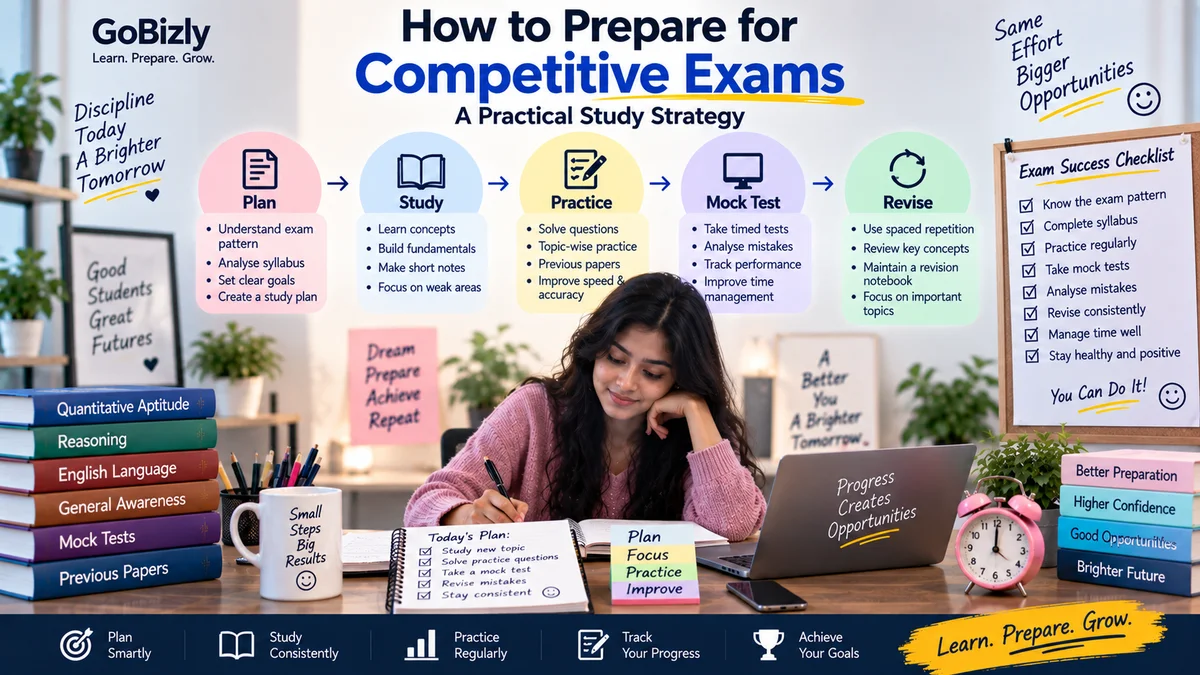
How to Prepare for Competitive Exams: A Practical Study Strategy
How to Prepare for Competitive Exams: A Practical Study Strategy
Preparing for a competitive exam can feel overwhelming, especially when the syllabus is large and the competition is high.
Many students make the mistake of immediately starting with long study sessions without first understanding the exam structure.
A better approach is to build a clear preparation system.
Understand the syllabus.
Identify your strengths and weaknesses.
Create a realistic schedule.
Practice regularly.
Take mock tests.
Analyze your mistakes.
Then adjust your preparation.
This guide explains a practical approach that can be adapted to different competitive and entrance examinations.
1. Understand the Exam Before You Start
Your first step should be understanding the examination itself.
Find out:
Exam pattern
Syllabus
Number of sections
Question types
Duration
Marking scheme
Negative marking, if applicable
Number of attempts or stages
Selection process
Don't start preparing based only on what someone else tells you.
Use the official examination information whenever available.
Your preparation strategy should be based on the actual exam you're targeting.
2. Break Down the Syllabus
A large syllabus can look intimidating when viewed as one list.
Divide it into smaller subjects and topics.
For example:
Quantitative Aptitude
→ Percentages
→ Ratios
→ Averages
→ Time & Work
→ Data Interpretation
Reasoning
→ Series
→ Coding
→ Syllogisms
→ Puzzles
→ Seating Arrangements
This makes your preparation easier to organize.
3. Categorize Your Topics
After breaking down the syllabus, classify topics into three groups.
Strong
You understand the topic and can solve questions independently.
Moderate
You understand the basics but need additional practice.
Weak
You struggle to understand or solve questions.
Start by identifying your weak and moderate areas.
Don't spend all your preparation time studying topics you already know well.
4. Set a Realistic Target
Your study plan should reflect the time you actually have.
If you have three months, create a three-month plan.
If you have one month, prioritize the most important areas.
Avoid creating a schedule that requires studying 12 hours every day if you realistically cannot maintain it.
A plan that you follow consistently is more useful than an unrealistic plan that you abandon after a few days.
5. Create a Study Schedule
Divide your preparation into:
Learning
Understand new concepts.
Practice
Solve questions based on those concepts.
Revision
Review previously studied material.
Testing
Take timed assessments.
A simple weekly schedule might look like:
Day | Primary Focus |
|---|---|
Monday | New concepts |
Tuesday | Practice |
Wednesday | New concepts |
Thursday | Practice |
Friday | Revision |
Saturday | Mock test |
Sunday | Mistake analysis |
Adjust the schedule according to your exam and availability.
6. Prioritize High-Value Topics
Not every topic may require the same amount of preparation time.
Review previous exam patterns or official information where available to understand which areas are commonly tested.
However, don't assume that a topic will definitely appear simply because it appeared frequently in previous examinations.
Use past papers as a preparation resource, not as a guarantee of future questions.
7. Build Strong Fundamentals
Before attempting difficult questions, make sure your fundamentals are clear.
For example, in quantitative aptitude, understand:
Basic arithmetic
Fractions
Percentages
Ratios
Averages
Algebraic concepts
In reasoning, understand how different question patterns work.
In verbal ability, develop:
Reading comprehension
Grammar
Vocabulary
Sentence structure
Strong fundamentals make advanced questions easier to approach.
8. Practice Previous Question Papers
Previous question papers can help you understand:
Question formats
Difficulty levels
Time pressure
Frequently tested concepts
Your current preparation level
Don't simply solve them and check your score.
Analyze every mistake.
Ask:
Did I not understand the concept?
Did I misread the question?
Did I make a calculation error?
Did I run out of time?
This analysis is often more valuable than the score itself.
9. Maintain a Mistake Log
Create a simple record of questions you got wrong.
For example:
Topic | Mistake | Reason | Correct Approach |
|---|---|---|---|
Percentages | Wrong calculation | Rushed | Review percentage change |
Reasoning | Pattern missed | Insufficient practice | Solve similar questions |
English | Grammar error | Rule unclear | Revise grammar |
Review your mistake log regularly.
Your mistakes can reveal patterns that aren't obvious from your overall score.
10. Use Mock Tests Strategically
Mock tests should become increasingly important as the exam approaches.
Early in preparation, use them to understand your current level.
Later, use them to practice:
Time management
Question selection
Accuracy
Exam strategy
Mental endurance
After every mock test, spend time analyzing the result.
Don't immediately take another test without understanding what went wrong in the previous one.
11. Track Your Performance
Maintain a simple record of your mock tests.
For example:
Test | Score | Accuracy | Time | Main Weakness |
|---|---|---|---|---|
Test 1 | 58% | 68% | 60 min | Quantitative |
Test 2 | 64% | 73% | 60 min | Reasoning |
Test 3 | 71% | 80% | 58 min | Verbal |
The exact metrics depend on the examination.
The objective is to identify whether your performance is improving and where additional work is required.
12. Improve Time Management
Competitive exams often require you to solve questions under significant time constraints.
Practice deciding:
Which questions should I attempt first?
Which questions should I skip temporarily?
How much time should I spend on a difficult question?
A useful general strategy is:
First Pass
Solve questions you can answer confidently.
Second Pass
Return to questions that require more time.
Final Review
Use remaining time according to the exam's rules.
Your strategy should also account for negative marking and whether you can return to previous questions.
13. Don't Spend Too Long on One Question
One difficult question can consume several minutes.
During practice, notice which question types take disproportionately long.
If a question is taking too much time, consider moving forward when the exam format allows it.
You can return later if appropriate.
The goal isn't to solve every question.
The goal is to use your available time effectively.
14. Balance Speed and Accuracy
Speed without accuracy can reduce your score.
Accuracy without reasonable speed can also create problems in a timed examination.
Work toward:
Understand → Practice → Improve accuracy → Increase speed
Don't rush into shortcuts before you understand the underlying method.
15. Use Active Recall for Theory
For subjects that involve substantial theoretical content, active recall can be useful.
Instead of repeatedly reading notes:
Study a concept.
Close your notes.
Recall the important points.
Explain them in your own words.
Check what you missed.
This turns revision into an active process.
16. Use Spaced Revision
Don't study a topic once and leave it untouched until the final week.
Create multiple revision points.
For example:
Day 1: Learn
Day 3: Review
Day 7: Test
Day 14: Review
Day 30: Test again
Adjust the intervals based on your preparation timeline.
17. Avoid Collecting Too Many Resources
You may find dozens of books, videos, websites, courses and question banks.
Using everything can become counterproductive.
Choose a manageable set of reliable resources.
For each subject, ideally have:
One primary learning resource
One practice source
Previous papers
Mock tests
Then focus on using them consistently.
18. Create a Revision Notebook
Keep a compact revision resource containing:
Important formulas
Key concepts
Common mistakes
Difficult question types
Short notes
Important rules
The notebook should become shorter and more useful over time.
Avoid copying entire chapters into it.
Its purpose is quick revision.
19. Practice Under Exam Conditions
As your exam approaches, simulate the actual environment.
Try to match:
Duration
Number of questions
Timing
Allowed materials
Question order
Break conditions
This can help you become familiar with the practical demands of the test.
20. Prepare for Exam Day
Preparation doesn't stop with studying.
Before the examination, confirm:
Exam date
Reporting time
Location or online platform
Required documents
Allowed items
Travel arrangements
Technical requirements if applicable
Don't leave these details until the last minute.
A 30-Day Competitive Exam Strategy
If you have approximately one month remaining, you can structure your preparation like this.
Days 1–7 — Foundation
Understand the syllabus
Identify weak areas
Review fundamentals
Create your study schedule
Days 8–15 — Practice
Solve topic-based questions
Work on weak areas
Review mistakes
Begin timed practice
Days 16–23 — Mixed Practice
Combine different topics
Solve previous papers
Take regular mock tests
Improve time management
Days 24–27 — Intensive Revision
Review important concepts
Revisit mistakes
Practice difficult areas
Take additional mock tests
Days 28–30 — Final Review
Review concise notes
Practice key question types
Check exam logistics
Avoid trying to learn large amounts of new material
Adjust this plan according to the actual exam timeline.
What to Do When You Fall Behind
Almost every long preparation plan will have days when you don't complete everything.
Don't abandon the entire schedule.
Instead:
Identify what remains incomplete.
Prioritize the most important topics.
Move lower-priority tasks forward.
Continue with the next planned session.
Avoid trying to compensate with an unrealistic schedule.
Consistency is more valuable than perfection.
Common Competitive Exam Preparation Mistakes
Studying Without Understanding the Exam
Know the pattern and syllabus first.
Creating Unrealistic Timetables
Build a schedule you can actually maintain.
Ignoring Weak Areas
Identify and address them systematically.
Taking Mock Tests Without Analysis
Your mistakes contain useful information.
Focusing Only on Speed
Accuracy should come first.
Using Too Many Resources
More resources don't automatically mean better preparation.
Ignoring Previous Papers
Past papers provide useful practice and exam familiarity.
Learning New Topics Until the Last Minute
Reserve time for revision and consolidation.
Neglecting Exam Logistics
Know where, when and how you need to appear for the exam.
Competitive Exam Preparation Checklist
☐ Understand the exam pattern
☐ Review the official syllabus
☐ Break the syllabus into topics
☐ Identify strong and weak areas
☐ Create a realistic study plan
☐ Learn the fundamentals
☐ Practice topic-wise questions
☐ Solve previous papers
☐ Maintain a mistake log
☐ Take mock tests
☐ Analyze mock-test performance
☐ Improve time management
☐ Revise using active recall
☐ Use spaced revision
☐ Avoid excessive resources
☐ Prepare a revision notebook
☐ Practice under exam conditions
☐ Check exam-day requirements
Conclusion
Competitive exam preparation doesn't have to mean studying every waking hour.
A structured approach can make your preparation more manageable.
Understand the exam.
Break down the syllabus.
Build strong fundamentals.
Practice consistently.
Track your mistakes.
Take mock tests.
Improve your time management.
Revise regularly.
Most importantly, create a preparation routine that you can realistically maintain.
Plan clearly. Practice consistently. Analyze your mistakes. Keep improving.
Learn. Prepare. Grow.