How to Prepare for Competitive Exams: A Practical Guide
How to Prepare for Competitive Exams: A Practical Guide
Competitive exams can feel overwhelming because they often involve multiple subjects, large syllabi, time limits and significant competition. The difficulty is not always about understanding every topic. A major part of preparation is knowing what to study, how to practice, how to revise and how to measure your progress.
Whether you are preparing for an entrance examination, government examination, placement assessment or another competitive test, a structured preparation system can make the process easier to manage.
This guide explains a practical framework you can adapt to different examinations.
1. Understand the Examination Before You Start
One of the first mistakes students make is beginning preparation without understanding the examination.
Before creating a study plan, identify:
Subjects or sections
Number of questions
Total duration
Question types
Marking scheme
Negative marking, if applicable
Syllabus
Previous question patterns
Eligibility requirements
Examination stages
The exact structure varies between examinations, so always use the relevant official examination information when available.
Create an exam overview
You can create a simple table:
Area | What to Identify |
|---|---|
Syllabus | Topics you need to study |
Pattern | Sections and question types |
Time | Total examination duration |
Difficulty | Based on previous papers/practice |
Scoring | Marks and negative marking |
Preparation time | Days/weeks available |
This gives you a clear starting point.
2. Break the Syllabus Into Smaller Topics
A large syllabus can make preparation feel difficult.
Instead of thinking:
"I have to complete the entire syllabus."
Break it into smaller units.
For example:
Quantitative Aptitude
Percentages
Ratios
Averages
Profit and loss
Time and work
Speed and distance
Basic probability
Reasoning
Number series
Coding-decoding
Blood relations
Direction sense
Syllogisms
Puzzles
Arrangements
Verbal Ability
Grammar
Vocabulary
Reading comprehension
Sentence correction
Para jumbles
The smaller the learning unit, the easier it becomes to plan and track.
3. Separate Learning From Practice
Preparation should not consist only of reading.
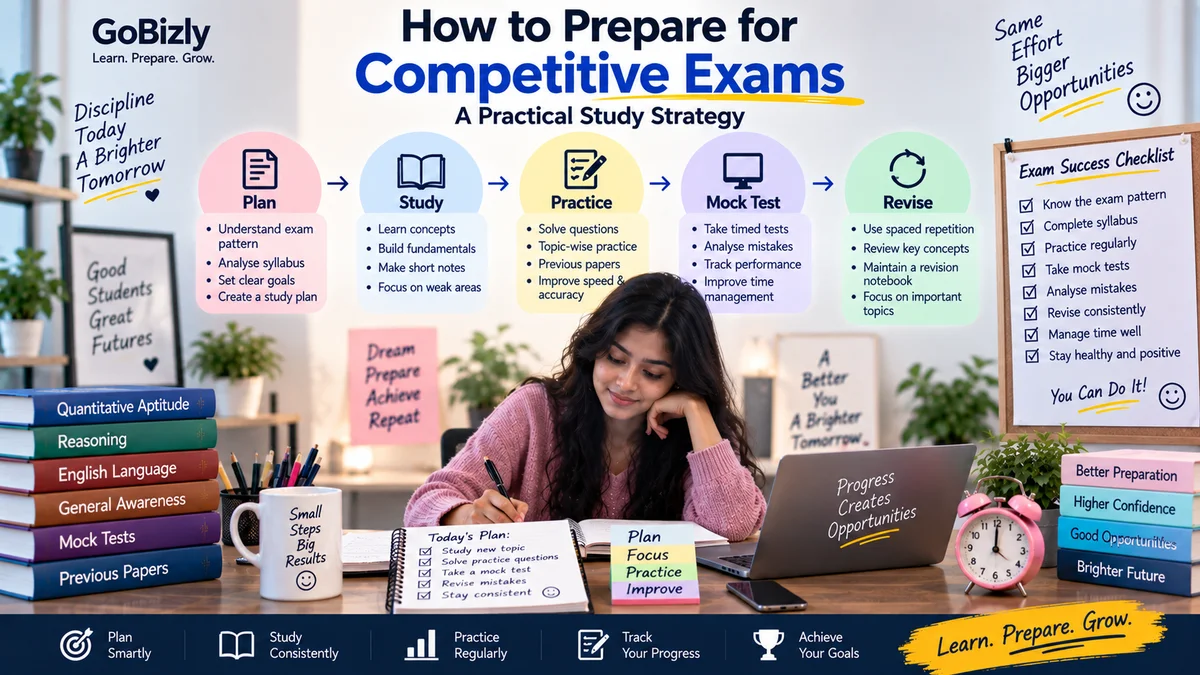
A useful cycle is:
Learn → Understand → Practice → Review → Revise → Test
For example, if you are learning percentages:
Understand the concept.
Learn the basic formulas.
Solve simple examples.
Attempt mixed questions.
Identify mistakes.
Revise weak areas.
Test yourself under time constraints.
This helps turn theoretical knowledge into usable problem-solving ability.
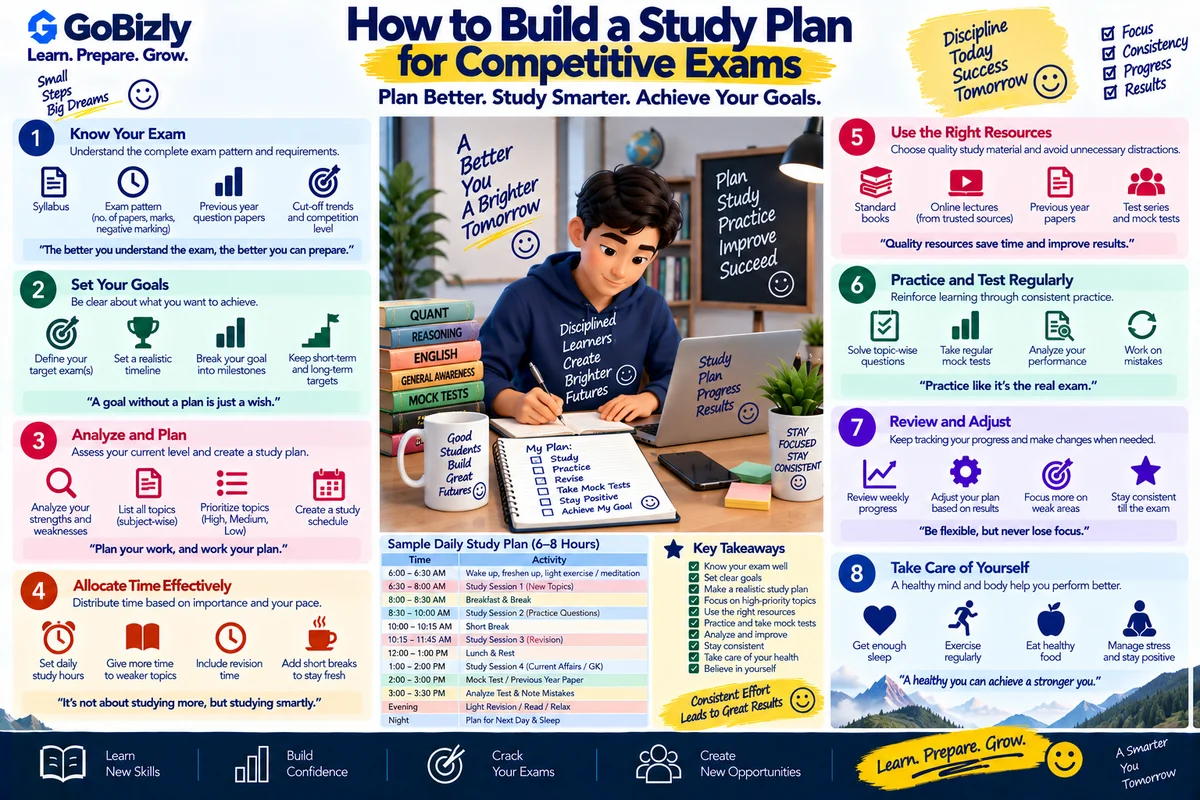
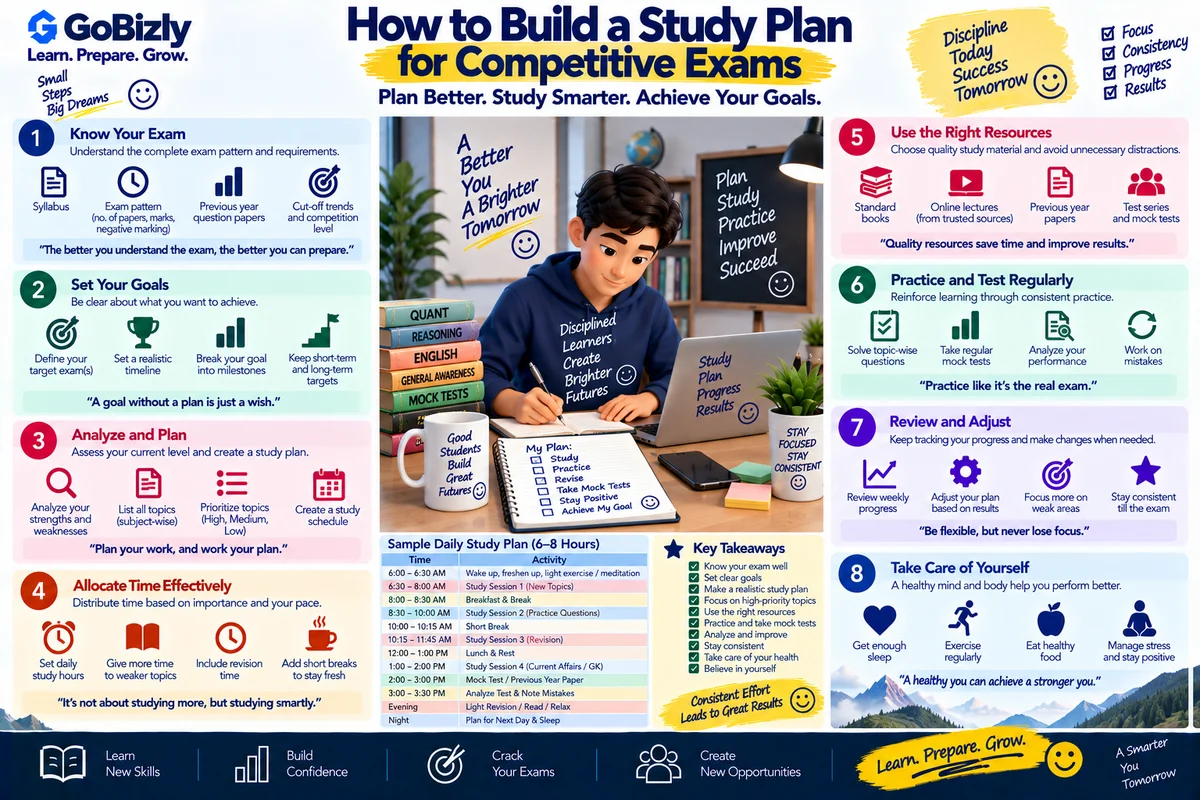
4. Build a Realistic Study Schedule
A study plan should reflect your actual availability.
If you can realistically study three hours per day, do not create a plan requiring eight hours every day.
A simple daily structure could be:
Session | Activity |
|---|---|
60 minutes | New concept |
45 minutes | Practice questions |
30 minutes | Revision |
30 minutes | Weak topic |
15 minutes | Mistake review |
You can modify this depending on the examination.
5. Prioritize Important and Weak Topics
Not every topic requires the same amount of preparation time.
Divide topics into:
Strong
I understand the concept.
I can solve questions accurately.
Moderate
I understand the basics.
I sometimes make mistakes.
Weak
I struggle to understand the concept.
I take too long.
My accuracy is low.
Spend more time on moderate and weak areas while maintaining your strong areas through revision.
6. Practice Previous Questions
Previous question papers can help you understand how concepts are tested.
While practicing, don't only check whether your answer is correct.
Ask:
Why was this method used?
Did I understand the question correctly?
Was my calculation wrong?
Did I use too much time?
Was there a simpler method?
Did I guess?
Was the question based on a concept I have not studied?
This turns practice into learning.
7. Keep a Mistake Log
A mistake notebook can become one of your most useful revision resources.
Record:
Question → Mistake → Correct approach → Reason for mistake
Common reasons include:
Concept not understood
Formula forgotten
Calculation error
Misread question
Time pressure
Careless mistake
Incorrect assumption
Review this log regularly.
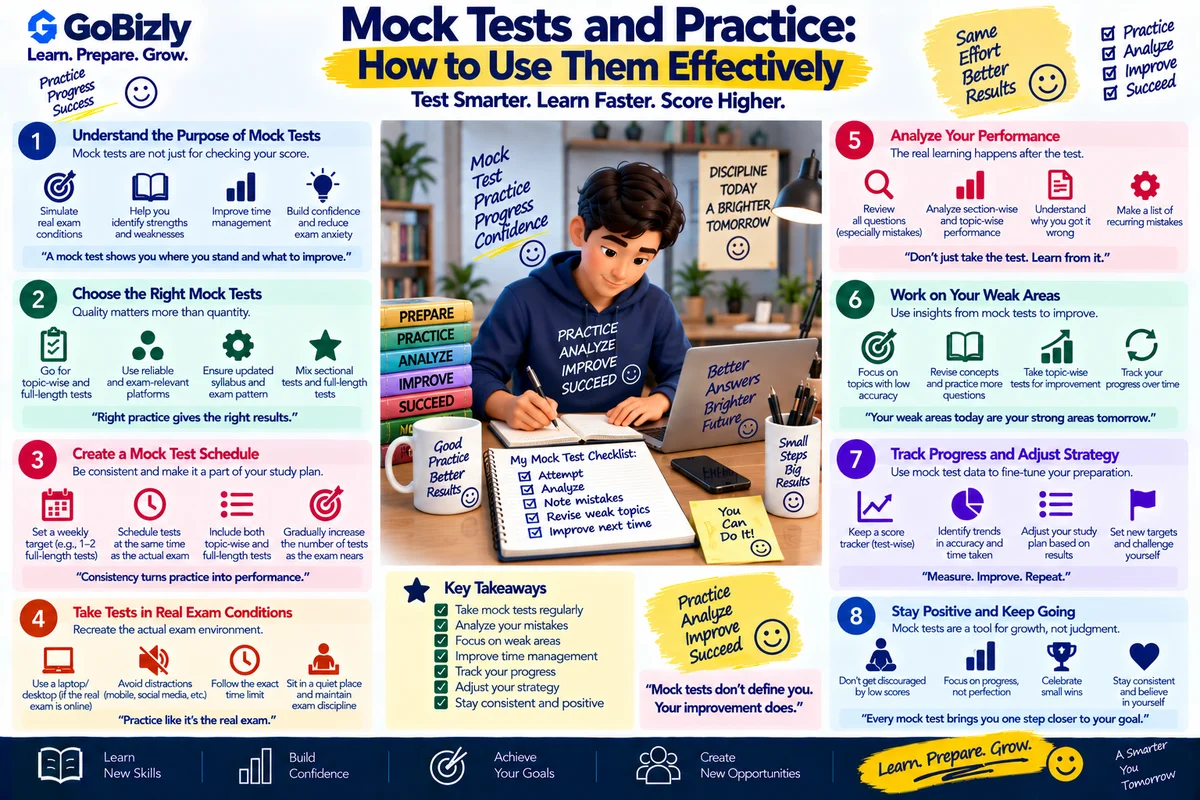
8. Use Mock Tests Strategically
Mock tests are useful for more than measuring marks.
They can help you evaluate:
Accuracy
Speed
Time allocation
Question selection
Weak sections
Repeated mistakes
After every mock test, conduct an analysis.
Don't immediately move to another test without reviewing the previous one.
9. Revise Regularly
Revision should happen throughout preparation rather than only at the end.
A simple cycle could be:
Daily → Weekly → Monthly
Daily:
Review formulas
Review notes
Review mistakes
Weekly:
Revise completed topics
Solve mixed questions
Monthly:
Take a broader test
Identify weak areas
Adjust your study plan
10. Avoid Constantly Changing Resources
Using too many books, videos, websites and courses can create confusion.
Choose a manageable set of resources and complete them properly.
More resources do not automatically mean better preparation.
The objective is to understand, practice and revise.
Practical Preparation Checklist
Understand the examination pattern
Review the syllabus
Break the syllabus into topics
Identify strong and weak areas
Create a realistic study schedule
Practice regularly
Solve previous questions
Maintain a mistake log
Take mock tests
Analyze every mock test
Revise systematically
Adjust the plan based on progress
Conclusion
Competitive exam preparation becomes easier to manage when you treat it as a process rather than one large task.
Understand the examination, divide the syllabus, build a realistic schedule, practice consistently, review mistakes and use mock tests to measure your progress.
The goal is not simply to spend more hours studying. It is to make each study session more useful.
Learn. Prepare. Grow.