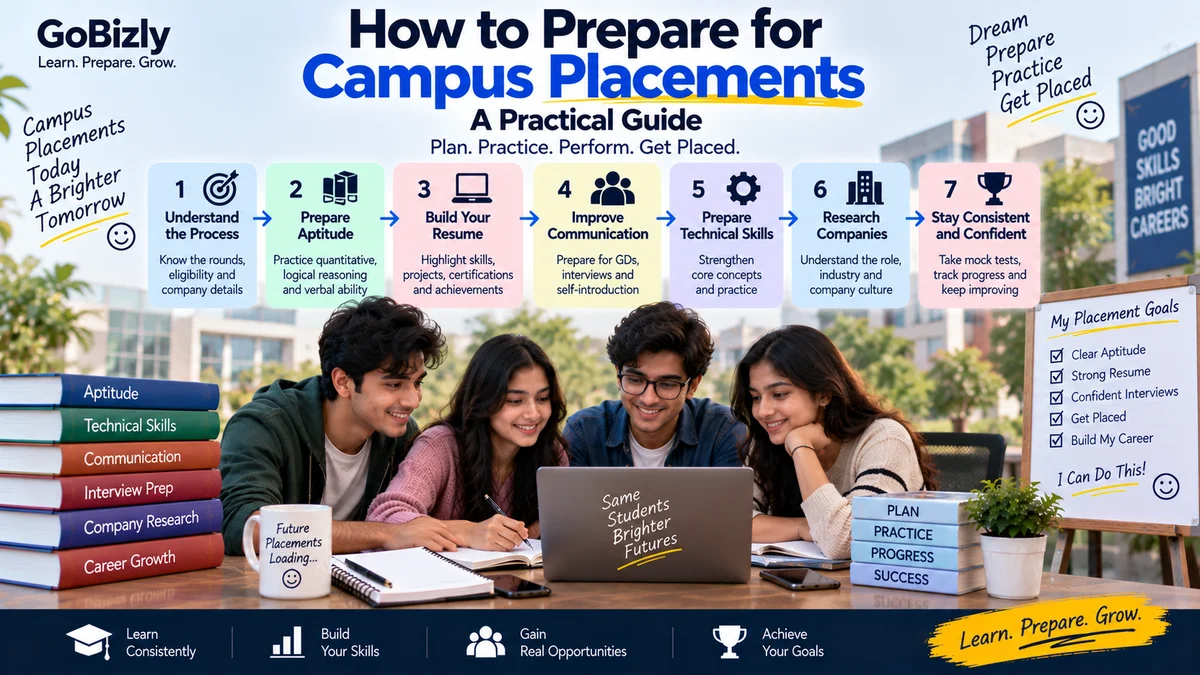
How to Prepare for Campus Placements: A Practical Guide
How to Prepare for Campus Placements: A Practical Guide
Campus placements can be exciting, but the preparation process can also feel confusing.
You may need to prepare for several stages:
Aptitude tests
Communication assessments
Group discussions
Technical interviews
HR interviews
Coding tests for some roles
Case studies or practical assessments
The exact process varies by college, company and role.
The best approach is to prepare across multiple areas rather than focusing only on the interview.
1. Understand the Placement Process
Before preparing, find out what your college placement process normally includes.
Ask:
Which companies are participating?
What roles are available?
What are the eligibility criteria?
Are there aptitude tests?
Are there technical rounds?
Are there group discussions?
How many interview rounds are expected?
Knowing the process helps you plan.
2. Build Your Resume Early
Don't wait until the placement announcement to create your resume.
Prepare a basic version early.
Include:
Education
Skills
Projects
Internships
Certifications
Achievements
Then update it as you gain experience.
3. Prepare for Aptitude Tests
Common areas can include:
Quantitative Aptitude
Percentages
Ratios
Averages
Profit and loss
Time and work
Data interpretation
Logical Reasoning
Series
Puzzles
Coding
Syllogisms
Arrangements
Verbal Ability
Grammar
Vocabulary
Reading comprehension
Sentence correction
The exact topics depend on the assessment.
4. Practice Under Time Limits
Knowing how to solve a question isn't always enough.
Placement tests may require you to solve questions quickly.
Practice with:
Timed sets
Mock tests
Previous questions
Mixed-topic tests
Track both accuracy and time.
5. Improve Communication
Communication can be important throughout the placement process.
Practice:
Self-introduction
Speaking clearly
Explaining projects
Answering interview questions
Group discussions
Presentations
You don't need complicated vocabulary.
Focus on clarity.
6. Prepare for Group Discussions
If your placement process includes a GD, practice:
Opening a discussion
Presenting an argument
Supporting an idea
Listening to others
Disagreeing respectfully
Summarizing
A group discussion isn't simply about speaking as much as possible.
Relevant and clear contributions matter.
7. Prepare Your Introduction
Practice a concise response to:
"Tell me about yourself."
Include:
Your education
Relevant skills
Projects
Interests related to the role
Career direction
Avoid memorizing a speech word-for-word.
8. Know Your Resume
Anything on your resume can become an interview question.
If you mention:
Python
be prepared for questions about Python.
If you mention:
Digital Marketing
be prepared to explain what you know.
Don't add skills simply because they appear in the job description.
9. Prepare Your Projects
For each project, know:
Problem
Objective
Your role
Tools used
Process
Challenges
Outcome
What you learned
A project becomes much more valuable when you can explain your contribution clearly.
10. Research the Company
Before an interview, understand:
What the company does
Products or services
Industry
Role
Basic company background
Use reliable sources, particularly the company's official information.
11. Understand the Job Description
Look for:
Responsibilities
Required skills
Qualifications
Tools
Experience requirements
Then connect your preparation to those requirements.
12. Prepare Common HR Questions
Examples include:
Tell me about yourself.
Why do you want this role?
Why should we hire you?
What are your strengths?
What would you like to improve?
Where do you see yourself developing?
Tell me about a challenge you faced.
Prepare ideas rather than memorizing exact sentences.
13. Practice Technical Questions
Technical preparation depends on your degree and target role.
For example:
IT: Programming, databases, operating systems, networking.
Commerce: Accounting, finance, business concepts.
Marketing: Marketing fundamentals, analytics, campaigns.
Engineering: Core engineering subjects and practical concepts.
Focus on fundamentals before advanced topics.
14. Prepare for Scenario Questions
Interviewers may ask:
"What would you do if..."
Use a structured approach:
Understand → Analyze → Decide → Act → Review
Explain your reasoning rather than jumping directly to the answer.
15. Build a Mock Interview Routine
Practice with:
Friends
Classmates
Mentors
Career services
AI interview tools
Record yourself if possible.
Review:
Clarity
Answer structure
Repetition
Speaking pace
Examples
16. Track Applications
Keep a simple placement tracker.
Company | Role | Test | Interview | Status |
|---|---|---|---|---|
Company A | Analyst | Completed | Pending | Active |
Company B | Associate | Upcoming | — | Preparing |
This prevents confusion when multiple companies are recruiting.
17. Don't Ignore College Academics
Some companies have eligibility criteria involving:
Percentage
CGPA
Backlogs
Graduation year
Check the specific eligibility requirements for each opportunity.
18. Prepare for Online Assessments
Some companies may use online tests.
Before the assessment:
Check your internet connection
Test your device
Read instructions
Understand the time limit
Keep required materials ready
Follow the assessment rules provided by the company.
19. Build a Weekly Placement Routine
For example:
Monday: Aptitude
Tuesday: Technical preparation
Wednesday: Communication
Thursday: Interview questions
Friday: Company research
Saturday: Mock test
Sunday: Review mistakes
Adapt this to your schedule.
20. Stay Organized
Create one placement folder containing:
Resume
Certificates
Projects
Interview notes
Company research
Application tracker
Preparation resources
Organization becomes increasingly useful when multiple opportunities are active.
Campus Placement Checklist
☐ Resume ready
☐ Skills reviewed
☐ Projects prepared
☐ Aptitude practice started
☐ Communication practice started
☐ GD preparation
☐ Technical preparation
☐ HR questions
☐ Company research
☐ Mock interviews
☐ Application tracker
☐ Documents organized
Conclusion
Campus placement preparation isn't just about memorizing interview answers.
Build a complete preparation system.
Improve your aptitude.
Strengthen your communication.
Understand your technical fundamentals.
Know your resume.
Practice interviews.
Research the roles you're applying for.
And keep track of your progress.
Prepare before the opportunity arrives.
Learn. Prepare. Grow.