How to Prepare for Aptitude Tests for Placements
How to Prepare for Aptitude Tests for Placements
Aptitude tests are included in some campus placements, recruitment processes and competitive selection programs.
Depending on the organization, a test may include:
Quantitative aptitude
Logical reasoning
Verbal ability
Data interpretation
Problem-solving questions
The exact pattern varies between employers.
The best approach is not simply solving hundreds of random questions.
You need to understand the concepts, practice systematically and improve your speed and accuracy.
1. Understand the Test Pattern
Before preparing, find out what the assessment includes.
Check:
Sections
Number of questions
Time limit
Negative marking
Question types
Difficulty level
Online or offline format
If the employer provides official information, use that as your primary reference.
2. Identify Your Weak Areas
Take a short diagnostic test.
Divide topics into:
Strong
Needs Practice
Needs Learning
Start by identifying the areas where you consistently make mistakes.
3. Build Quantitative Fundamentals
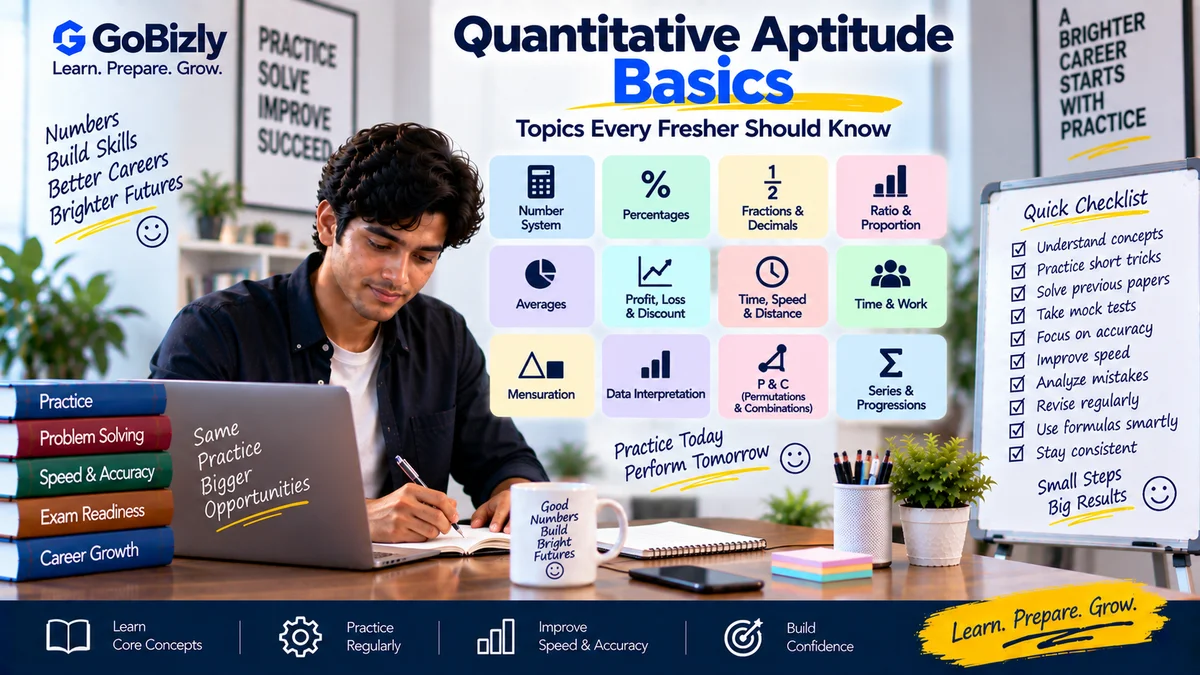
Common areas can include:
Percentages
Ratios
Averages
Profit and loss
Simple and compound interest
Time and work
Time, speed and distance
Number systems
Probability
Permutations and combinations
Data interpretation
The exact syllabus varies by test.
4. Practice Logical Reasoning
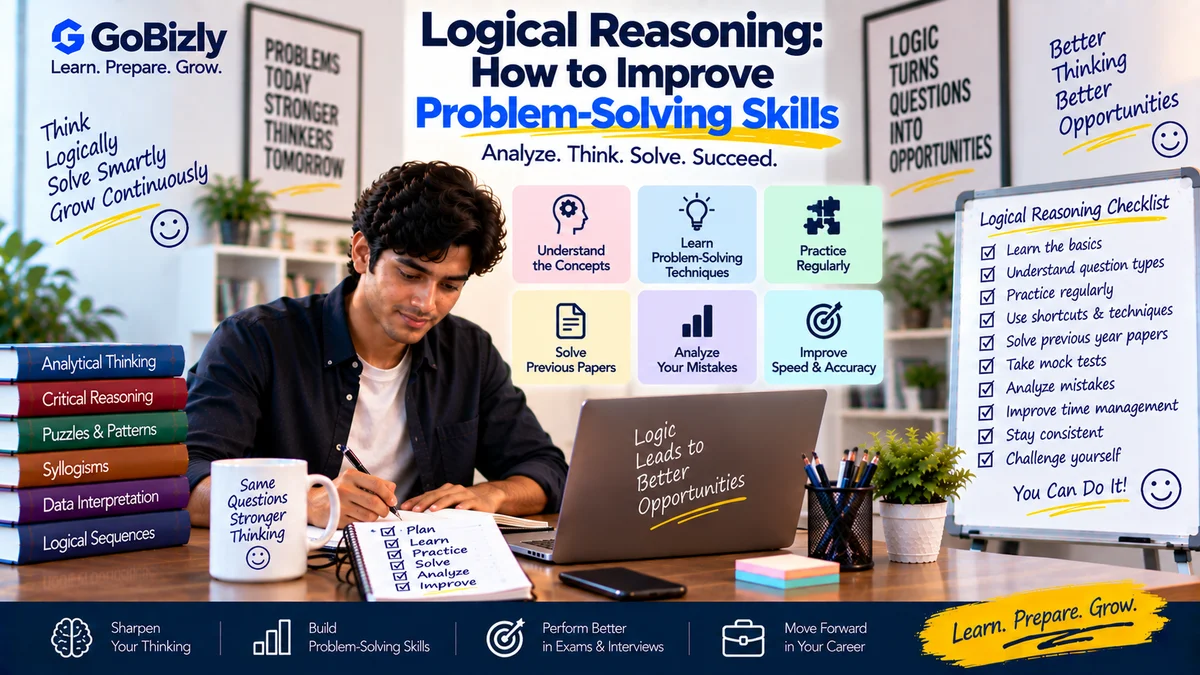
Logical reasoning may involve:
Number patterns
Coding and decoding
Series
Directions
Blood relations
Seating arrangements
Syllogisms
Puzzles
Statements and conclusions
Focus on understanding the logic rather than memorizing answers.
5. Improve Verbal Ability
Possible areas include:
Reading comprehension
Grammar
Vocabulary
Sentence correction
Fill-in-the-blanks
Para jumbles
Synonyms and antonyms
Read regularly and practice questions under time limits.
6. Learn the Basic Formulas
Create a revision sheet for important formulas.
For example:
Percentage
Percentage = (Part / Whole) × 100
Average
Average = Sum of values / Number of values
Speed
Speed = Distance / Time
Don't only memorize formulas.
Practice using them.
7. Practice One Topic at a Time
Instead of solving random questions initially, choose one topic.
For example:
Day 1: Percentages
Day 2: Ratios
Day 3: Averages
This helps you identify patterns and understand the underlying method.
8. Focus on Accuracy First
When starting preparation, don't worry too much about speed.
First learn to solve questions correctly.
Then gradually reduce the time required.
A fast incorrect answer doesn't help.
9. Develop Time Management
During a timed test, don't spend too long on one question.
Use:
Easy → Moderate → Difficult
Solve questions you're confident about first.
Return to harder questions when time permits.
10. Learn to Skip Strategically
Skipping a difficult question temporarily isn't failure.
If a question is consuming too much time:
Mark it if the test allows.
Move forward.
Return later.
This can help protect your overall test time.
11. Practice Mental Calculation
Basic calculations can sometimes be performed faster without extensive written work.
Practice:
Multiplication
Division
Fractions
Percentages
Squares
Common conversions
However, follow the rules of the actual assessment regarding calculators.
12. Take Timed Tests
Once you've learned the fundamentals, take full-length or section-based mock tests.
Track:
Score
Accuracy
Time
Topics causing errors
13. Analyze Your Mistakes
Don't simply check the correct answer.
Ask:
Why did I get it wrong?
Possible reasons:
Didn't know the concept
Calculation error
Misread the question
Used the wrong method
Ran out of time
Your mistake pattern tells you what to improve.
14. Maintain an Error Log
Create a simple table:
Topic | Mistake | Correct Method |
|---|---|---|
Percentages | Formula error | Review percentage conversion |
Ratio | Misread values | Identify quantities first |
Reasoning | Wrong assumption | Follow given conditions |
Review the log regularly.
15. Don't Ignore Verbal Ability
Some candidates spend almost all their preparation time on mathematics.
If verbal ability is part of the assessment, give it consistent attention.
16. Practice Data Interpretation
Data interpretation may involve:
Tables
Bar charts
Pie charts
Line graphs
Caselets
Practice extracting relevant information quickly.
17. Build a Study Routine
For example:
30 minutes: Concepts
30 minutes: Topic practice
20 minutes: Timed questions
10 minutes: Error review
Adjust this based on your schedule.
18. Practice Under Exam Conditions
Occasionally simulate the real test.
Use:
Fixed time
No unnecessary distractions
Similar question distribution
Same calculator rules
This helps you understand your current performance.
19. Prepare for the Actual Assessment
Before the test:
Check the test instructions
Verify your login
Check your device
Ensure stable internet if required
Keep required documents ready
Follow the employer's instructions.
20. Review Before Test Day
Don't try to learn everything at the last minute.
Review:
Formulas
Common question types
Error log
Weak areas
Time strategy
Then get adequate rest.
Aptitude Preparation Checklist
☐ Understand test pattern
☐ Identify weak areas
☐ Learn fundamentals
☐ Practice quantitative aptitude
☐ Practice reasoning
☐ Practice verbal ability
☐ Create formula sheet
☐ Build accuracy
☐ Improve speed
☐ Take timed tests
☐ Maintain error log
☐ Practice full assessments
☐ Review weak topics
Conclusion
Aptitude preparation becomes easier when you approach it systematically.
Learn the concepts.
Practice by topic.
Track your mistakes.
Improve accuracy.
Then work on speed.
Most importantly, use mock tests to understand your actual performance rather than relying only on how many questions you've practiced.
Understand. Practice. Measure. Improve.
Learn. Prepare. Grow.