How to Learn New Skills Faster: A Practical Framework
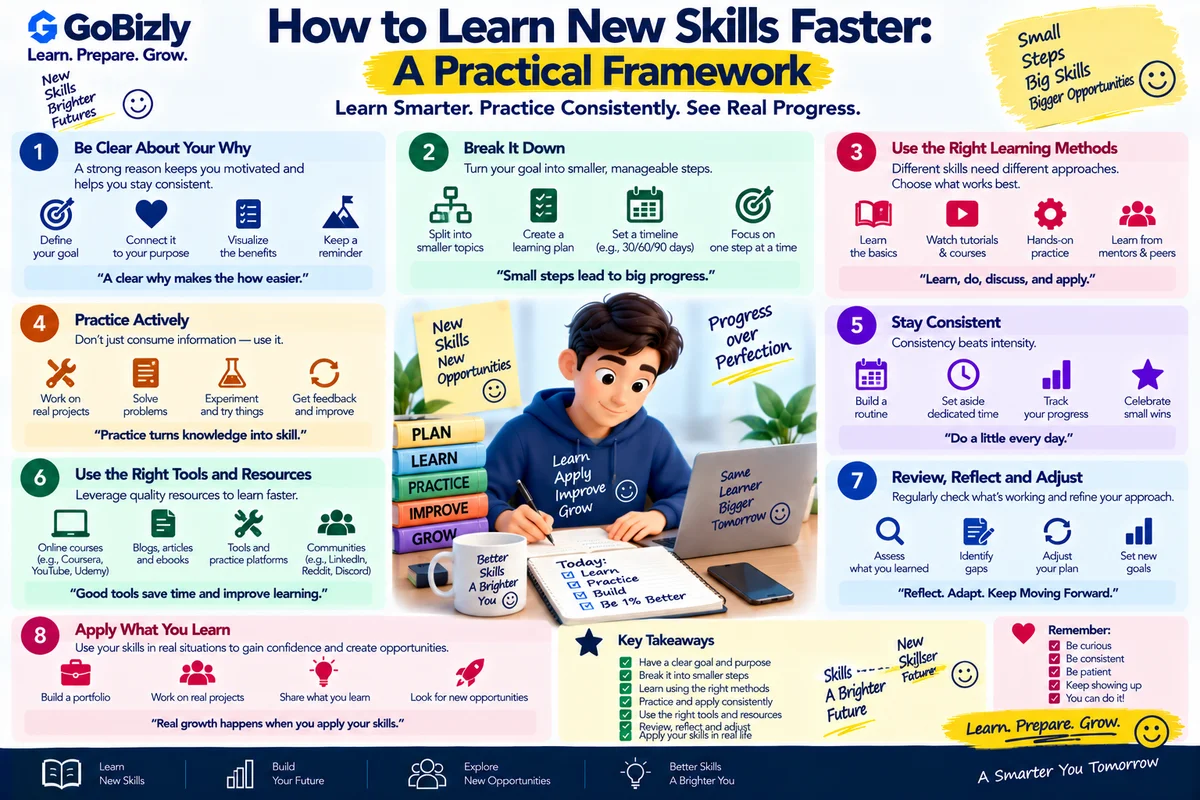
How to Learn New Skills Faster: A Practical Framework
Learning a new skill can feel overwhelming when you don't know where to begin.
Whether you're learning Excel, digital marketing, programming, communication or a new professional skill, the process becomes easier when you have a clear structure.
A practical learning framework is:
Define → Learn → Practice → Build → Get Feedback → Improve → Repeat
1. Define the Skill Clearly
"Learn digital marketing" is a broad goal.
Instead, define a specific outcome:
"Learn how to create and analyze a basic Google Ads campaign."
The clearer the goal, the easier it becomes to plan your learning.
2. Understand Why You Need the Skill
Ask:
Why am I learning this?
Where will I use it?
What outcome do I want?
How will I know I've learned it?
A meaningful reason can help you stay consistent.
3. Break the Skill Into Components
Most skills contain smaller skills.
For example:
Public Speaking
→ Structure
→ Voice
→ Body language
→ Storytelling
→ Audience interaction
→ Practice
Learn the components individually before combining them.
4. Learn the Fundamentals
Start with the basic concepts.
Don't rush into advanced topics before understanding the foundation.
For example, before learning advanced analytics, understand:
Metrics
Dimensions
Events
Conversions
Reports
Fundamentals make advanced learning easier.
5. Use Multiple Learning Resources
Depending on the skill, you might use:
Courses
Books
Documentation
Articles
Videos
Tutorials
Practice exercises
Real projects
Don't spend all your time consuming resources.
Learning requires application.
6. Practice Deliberately
Practice should focus on specific weaknesses.
Instead of:
"I practiced for two hours."
Try:
"I practiced five interview questions and focused on structuring my answers clearly."
Specific practice makes improvement easier to observe.
7. Build Projects
Projects turn knowledge into practical ability.
For example:
Learning Web Development
Build a website.
Learning Digital Marketing
Create a simulated campaign plan.
Learning Excel
Build a budget tracker.
Learning Presentation Skills
Create and deliver a five-minute presentation.
Projects demonstrate what you can actually do.
8. Get Feedback
Feedback helps identify gaps you may not notice yourself.
Feedback can come from:
Teachers
Mentors
Colleagues
Peers
Practice partners
Review tools
Ask for specific feedback rather than simply:
"Is this good?"
9. Track Progress
Create measurable milestones.
For example:
Week 1: Fundamentals
Week 2: Guided practice
Week 3: Independent exercises
Week 4: First project
Week 5: Feedback
Week 6: Improvement
The timeline can vary significantly by skill.
10. Use Retrieval and Repetition
Revisit important concepts instead of learning them once and forgetting them.
Use:
Practice questions
Flashcards
Self-testing
Mini projects
Explaining concepts
11. Teach What You Learn
One powerful way to test understanding is to explain the topic to another person.
If you can explain a concept simply and answer follow-up questions, you likely understand it better than if you can only recognize it when reading.
12. Apply the Skill in Real Situations
Move from:
Learning
to
Doing
to
Solving problems
to
Creating outcomes
For example, learning Excel formulas is different from using Excel to solve an actual reporting problem.
13. Avoid Resource Overload
It's easy to collect:
10 courses
20 videos
50 articles
Multiple books
and complete very little practice.
Choose a reasonable primary learning resource and supplement it when necessary.
14. Expect Mistakes
Making mistakes doesn't necessarily mean you're failing.
Use mistakes to identify what needs improvement.
Ask:
What went wrong?
Why?
What did I misunderstand?
What should I do differently next time?
15. Build a Learning Loop
A useful cycle is:
Learn
↓
Practice
↓
Test
↓
Identify Gaps
↓
Improve
↓
Apply
↓
Repeat
This keeps learning active.
16. Know When You're Ready
You don't need to know everything before using a skill.
A useful question is:
"Can I independently perform the task at the level required for my current goal?"
If yes, start applying the skill while continuing to improve.
17. Create a Personal Skill Plan
For each skill, record:
Skill: Google Ads
Goal: Understand campaign setup and optimization
Fundamentals: Campaigns, keywords, bidding, conversions
Practice: Build sample campaigns
Project: Create a campaign plan
Feedback: Review with an experienced person
Milestone: Explain and execute the process independently
Skill-Learning Checklist
☐ Define the skill
☐ Set a specific goal
☐ Understand why you're learning it
☐ Break it into components
☐ Learn the fundamentals
☐ Choose useful resources
☐ Practice deliberately
☐ Build a project
☐ Get feedback
☐ Track progress
☐ Review regularly
☐ Apply the skill independently
Conclusion
Learning faster doesn't mean rushing through information.
It means spending more of your learning time on activities that actually develop the skill.
Set a clear goal, learn the fundamentals, practice deliberately, build projects and use feedback to improve.
Learn → Practice → Apply → Improve → Repeat.
Learn. Prepare. Grow.