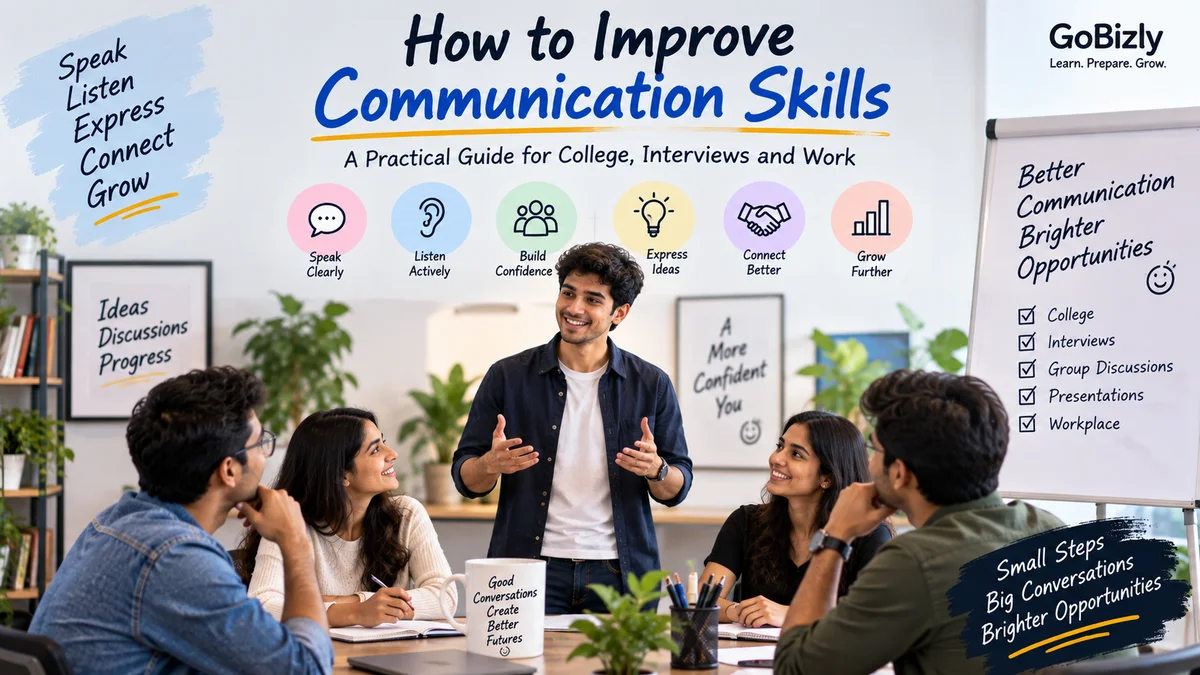
How to Improve Communication Skills for College, Interviews and Work
How to Improve Communication Skills for College, Interviews and Work
Communication is one of the most useful skills you can develop as a student, job seeker or working professional.
It affects how you participate in a classroom, explain an idea during a presentation, answer an interview question, contribute to a group discussion and communicate with colleagues.
Good communication isn't about using complicated words or speaking continuously.
It is about expressing your thoughts clearly, listening carefully and adapting your communication to the situation.
The good news is that communication can be improved through regular practice.
1. Understand What Good Communication Means
Communication involves more than speaking.
It includes:
Speaking
Listening
Writing
Reading
Body language
Tone
Questioning
Understanding context
For example, someone may know a lot about a subject but struggle to explain it clearly.
Another person may have average technical knowledge but communicate ideas in a structured and understandable way.
The goal isn't to become the most talkative person in the room.
The goal is to become clear, confident and purposeful.
2. Start With Clear Thinking
Good communication often begins before you speak.
If your thoughts are unorganized, your answer may also become difficult to follow.
Before answering an important question, take a moment to identify:
What is the question?
What is my main point?
What example can I give?
How should I conclude?
A simple structure can make a significant difference.
Try:
Point → Explanation → Example → Conclusion
For example, if someone asks:
"Why is teamwork important?"
You could say:
Point: Teamwork helps people combine different skills.
Explanation: Different team members may have different strengths.
Example: In a college project, one person might handle research while another handles presentation and another manages analysis.
Conclusion: Working together can help the team complete the project more effectively.
3. Practice Speaking Every Day
You don't need a formal speaking class to start improving.
Spend a few minutes each day speaking about a topic.
Choose something simple:
A recent experience
Something you learned
A movie or book
A current topic
Your career goal
A college project
A technology you use
Speak for one or two minutes.
Don't worry about being perfect.
Focus on:
Clear sentences
Logical structure
Appropriate pace
Avoiding unnecessary repetition
With regular practice, speaking can become more natural.
4. Try the One-Minute Speaking Exercise
The Just A Minute (JAM) format is a useful way to practice spontaneous speaking.
Choose a topic and speak about it for one minute.
For example:
"Is social media useful for students?"
Use a simple structure:
Opening
Introduce your position or the topic.
Main Points
Give two or three relevant points.
Example
Provide a practical example.
Conclusion
Summarize your main idea.
The objective isn't to use impressive vocabulary.
It's to keep your thoughts organized while speaking continuously.
5. Record Yourself
One of the easiest ways to identify communication habits is to record yourself.
Choose a topic and record a short response.
Then listen to it.
Look for:
Filler words
Repeated phrases
Long pauses
Very fast speech
Very slow speech
Unclear sentences
Lack of structure
Unnecessary information
Common filler words include:
"Um"
"Actually"
"Basically"
"Like"
"You know"
Everyone uses fillers occasionally.
The goal is not to eliminate every filler word.
The goal is to become aware of them and reduce unnecessary usage.
6. Slow Down
When people feel nervous, they may speak faster than usual.
This can make their communication difficult to follow.
Practice speaking at a comfortable pace.
After making an important point, allow a short pause.
Pauses can help you:
Organize your thoughts
Emphasize important information
Avoid rushing
Give the listener time to understand
Speaking slowly does not mean speaking unnaturally.
Aim for a pace that is clear and comfortable.
7. Improve Your Listening Skills
Communication is a two-way process.
Listening is just as important as speaking.
Good listening means:
Paying attention
Not interrupting unnecessarily
Understanding what the other person is saying
Asking relevant questions
Responding to the actual point
For example, if an interviewer asks a specific question, don't immediately give a memorized answer.
Listen carefully.
Understand the question.
Then respond.
8. Ask Better Questions
Questions can improve both learning and communication.
Instead of asking:
"I don't understand."
try asking:
"Could you explain how this part works?"
Instead of:
"What should I do?"
try:
"Which part should I prioritize first?"
Specific questions demonstrate that you're actively thinking about the situation.
This is useful in:
College
Interviews
Meetings
Training
Client conversations
Team discussions
9. Improve Your Vocabulary Naturally
You don't need to memorize hundreds of difficult words.
Focus on learning words that you can actually use.
Read:
Articles
Books
Industry publications
Business content
Well-written professional posts
When you encounter an unfamiliar word:
Understand its meaning.
Look at how it is used.
Create your own sentence.
Try using it naturally later.
A smaller vocabulary that you can use correctly is more useful than a large vocabulary that you rarely understand or use.
10. Read Regularly
Reading improves communication in several ways.
It exposes you to:
New vocabulary
Different sentence structures
Ideas
Arguments
Examples
Professional language
You don't need to read for hours.
Even 15–20 minutes of focused reading each day can become a useful habit.
After reading an article, try explaining what you learned in your own words.
That combines reading + understanding + speaking.
11. Practice Explaining Concepts Simply
A powerful communication skill is the ability to explain something complicated in simple language.
Imagine you're explaining a concept to someone who has never heard of it.
Try this structure:
What is it?
How does it work?
Why does it matter?
Can I give an example?
This approach is useful for:
Interviews
Presentations
Training
Client communication
Team meetings
If you can explain a concept simply, it often means you understand the concept well enough to communicate it.
12. Improve Your Interview Communication
Interview communication is different from casual conversation.
Your answers should generally be:
Relevant
Structured
Concise
Honest
Supported by examples
For example, when asked:
"Tell me about a challenge you faced."
Don't simply say:
"I have faced many challenges."
Give a specific example.
Explain:
Situation → Task → Action → Result
This gives the interviewer a clear understanding of what happened and what you did.
13. Prepare for Group Discussions
Group discussions require a combination of speaking and listening.
A good participant should:
Understand the topic
Contribute relevant ideas
Listen to others
Build on useful points
Disagree respectfully
Avoid interrupting unnecessarily
Encourage constructive discussion
You don't need to speak the most.
Focus on contributing useful and relevant points.
For example:
"I'd like to add another perspective to that point..."
or:
"I agree with that idea, and I think another factor is..."
These phrases can help you enter a discussion naturally.
14. Improve Presentation Skills
When presenting to a group, use a simple structure.
Introduction
Tell the audience what you're going to discuss.
Main Content
Explain your key points in a logical order.
Examples
Use examples to make ideas easier to understand.
Conclusion
Summarize the main takeaway.
Avoid putting too much information on your slides.
Your slides should support your explanation rather than replace it.
15. Pay Attention to Body Language
Communication isn't only about words.
During professional conversations, consider:
Eye contact
Facial expressions
Posture
Hand movements
Sitting position
Attention
For online interviews, look toward the camera when appropriate and maintain a professional setup.
Body language should support your communication rather than distract from it.
16. Learn Professional Communication
Workplace communication often requires more precision than casual conversation.
For example, instead of saying:
"I'll do it soon."
you might say:
"I'll complete this by 4 PM today."
Instead of:
"There is a problem."
you might say:
"I've identified an issue with the data upload, and I'm checking the source now."
Professional communication should make it easier for others to understand:
What happened?
What are you doing?
What happens next?
17. Practice Writing Clearly
Written communication is equally important.
You may need to write:
Emails
Reports
Messages
Documentation
Presentations
Project updates
Meeting notes
Before sending an important message, check:
Clarity
Is the main point obvious?
Relevance
Did I include unnecessary information?
Structure
Is the information organized?
Tone
Does it sound appropriate for the audience?
Accuracy
Are the facts, names and dates correct?
18. Adapt Your Communication to Your Audience
The same information may need to be communicated differently to different people.
For example, explaining a technical concept to:
A technical colleague
You may use more technical terminology.
A customer
You may focus on the business impact.
A senior manager
You may focus on the outcome, risk and next steps.
Good communication isn't about saying the same thing to everyone.
It's about making the information useful to the person you're communicating with.
19. Stop Trying to Sound Perfect
Many people hesitate to speak because they are worried about making mistakes.
This can prevent them from practicing.
You don't need perfect vocabulary or grammar to communicate effectively.
Focus on:
Clarity over complexity.
Practice over perfection.
Understanding over memorization.
Every speaking opportunity can become practice.
20. Build a Simple Daily Communication Routine
You can practice communication without spending hours on it.
10 minutes — Reading
Read an article or professional content.
5 minutes — Speaking
Explain what you learned.
5 minutes — Vocabulary
Learn a few useful words or phrases.
5 minutes — Listening
Watch or listen to a professional conversation and observe how ideas are communicated.
5 minutes — Reflection
Think about one communication habit you want to improve.
Consistency matters more than spending a large amount of time occasionally.
A 30-Day Communication Improvement Plan
Week 1 — Awareness
Record yourself speaking
Identify filler words
Observe your speaking speed
Practice one-minute topics
Week 2 — Structure
Practice Point → Explanation → Example → Conclusion
Explain concepts in simple language
Practice interview answers
Week 3 — Interaction
Practice group discussions
Ask better questions
Practice active listening
Have structured conversations
Week 4 — Professional Communication
Practice presentations
Write professional emails
Practice interview simulations
Review your progress
Common Communication Mistakes
Speaking too quickly
Slow down and use natural pauses.
Using complicated words unnecessarily
Choose words that communicate your meaning clearly.
Giving long answers
Answer the question first and add relevant details.
Interrupting frequently
Listen completely before responding.
Memorizing answers
Understand the idea instead of memorizing a script.
Avoiding practice
Communication improves through repeated use.
Focusing only on speaking
Listening, writing and body language are also important.
Communication Skills Checklist
☐ Can I explain an idea clearly?
☐ Can I speak for one minute on a random topic?
☐ Can I introduce myself confidently?
☐ Can I answer interview questions with examples?
☐ Can I participate in a group discussion?
☐ Can I listen without interrupting?
☐ Can I ask clear questions?
☐ Can I explain technical concepts simply?
☐ Can I write a professional email?
☐ Can I adjust my communication for different audiences?
☐ Do I know which communication habits I need to improve?
You don't need to master everything immediately.
Pick one area, practice it consistently and gradually add another.
Conclusion
Communication is not a talent that only some people are born with.
It is a skill that can be developed through practice, observation, feedback and repetition.
Start by organizing your thoughts.
Speak clearly.
Listen carefully.
Practice explaining ideas.
Record yourself.
Participate in discussions.
Learn to communicate professionally.
Most importantly, don't wait until your first interview or first job to start practicing.
Communicate clearly. Practice consistently. Grow confidently.
Learn. Prepare. Grow.