How to Improve Communication Skills | Practical Guide
How to Improve Communication Skills | Practical Guide
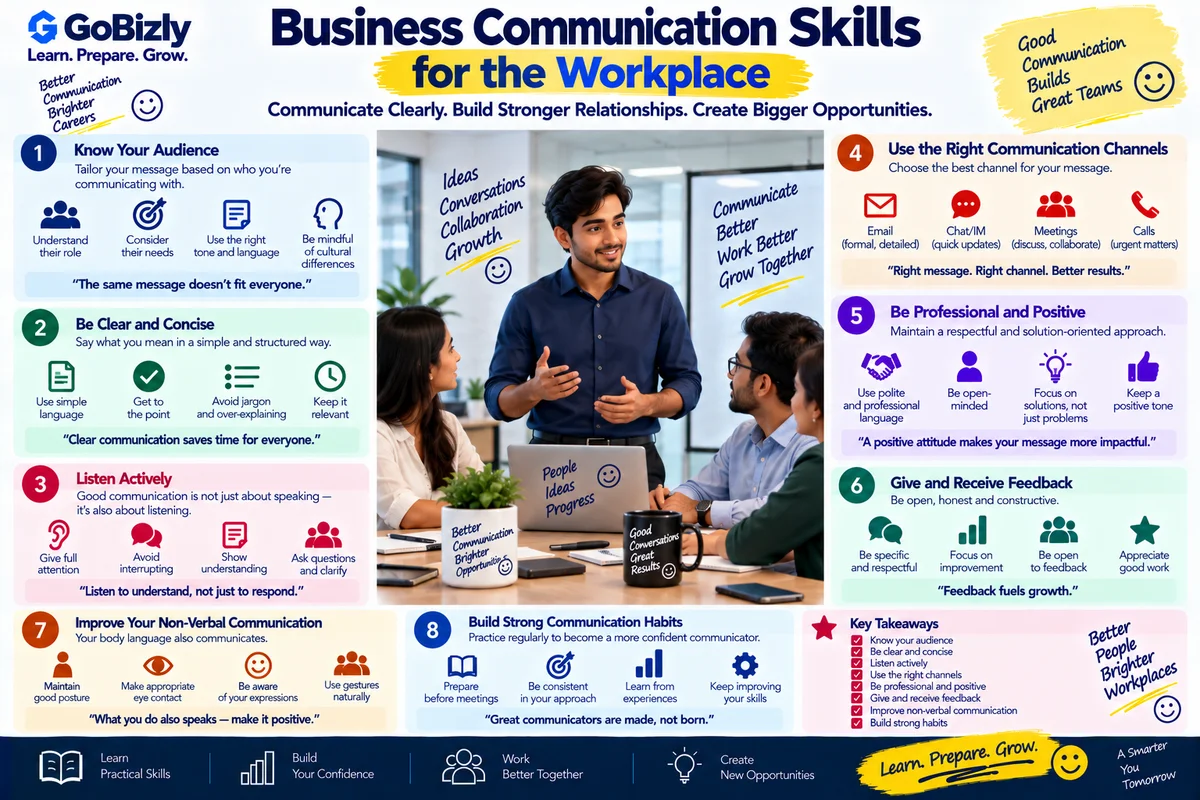
Communication is one of the most useful skills you can develop for college, interviews, work and everyday professional situations.
Good communication isn't simply about speaking fluent English or using complicated vocabulary.
It involves several skills:
Speaking clearly
Listening carefully
Organizing your thoughts
Asking useful questions
Explaining ideas
Writing professionally
Understanding the other person
Communicating with confidence
The good news is that communication can be practiced.
1. Focus on Clarity
Good communication starts with making your message easy to understand.
Before speaking, ask yourself:
What am I trying to say?
What does the other person need to know?
What is the main point?
Avoid adding unnecessary information before explaining the actual point.
2. Listen Before Responding
Communication isn't only about speaking.
Active listening means:
Paying attention
Avoiding unnecessary interruptions
Understanding the question
Asking clarification when needed
Responding to what was actually said
Try not to prepare your response while the other person is still speaking.
3. Organize Your Thoughts
If you frequently struggle to explain your ideas, use a simple structure.
Point → Explanation → Example
For example:
Point: Communication is important at work.
Explanation: It helps teams understand responsibilities and expectations.
Example: A clear project update can help a team identify a delay before it becomes a larger issue.
This structure can make your answers easier to follow.
4. Improve Your Vocabulary Naturally
You don't need to memorize hundreds of difficult words.
Focus on learning words that are useful in your studies or profession.
When you learn a new word:
Understand its meaning.
See how it is used.
Create your own sentence.
Use it naturally.
Useful vocabulary is better than complicated vocabulary you rarely use.
5. Practice Speaking Every Day
Set aside a few minutes each day.
Choose a topic and speak about it for one or two minutes.
Possible topics:
Your college
A recent project
A technology you use
A movie you watched
A current learning goal
A professional topic
Focus on speaking continuously rather than being perfect.
6. Record Yourself
Record a short response and listen to it afterward.
Look for:
Filler words
Repetition
Long pauses
Unclear sentences
Speaking too quickly
Speaking too softly
You don't need to eliminate every imperfection.
Focus on improving gradually.
7. Reduce Filler Words
Common filler words include:
Um
Uh
Like
Basically
Actually
You know
A short pause is often better than filling every silence.
Instead of saying:
"Basically, um, what I think is..."
pause briefly and say:
"What I think is..."
8. Slow Down
Speaking quickly doesn't necessarily mean communicating effectively.
Try:
Speak → Pause → Continue
Pauses give the listener time to process your point and give you time to organize your thoughts.
9. Ask Better Questions
Good questions improve communication.
Instead of:
"I don't understand."
try:
"Could you clarify which part I should complete first?"
Specific questions make it easier for the other person to help.
10. Practice Explaining Simple Concepts
Choose something you know well.
Explain it as though you're speaking to someone who has never heard of it.
Use:
What → How → Example → Why
This is especially useful for interviews and professional communication.
11. Improve Your Writing
Professional communication also includes writing.
Practice:
Emails
Messages
Reports
Documentation
LinkedIn posts
Project summaries
Before sending an important message, check:
Is it clear?
Is it concise?
Is the tone appropriate?
12. Learn Professional Email Structure
A simple professional email can contain:
Subject
Greeting
Purpose
Relevant details
Action required
Closing
Avoid unnecessarily long emails.
13. Practice Interview Answers
Interview preparation is an excellent communication exercise.
Practice answering:
Tell me about yourself.
Why do you want this role?
Explain your project.
What are your strengths?
Describe a challenge you faced.
Focus on structure and clarity.
14. Participate in Group Discussions
Group discussions can help develop:
Listening
Speaking
Reasoning
Collaboration
Confidence
Don't focus only on speaking first.
Listen to the discussion and contribute relevant points.
15. Practice JAM
JAM — Just A Minute — is useful for practicing spontaneous speaking.
Choose a topic and speak for one minute.
Try topics such as:
Social media
Artificial intelligence
Education
Technology
Leadership
Time management
Start with simple topics and gradually increase the difficulty.
16. Read Regularly
Reading can help you develop:
Vocabulary
Sentence structure
Knowledge
Ideas
Speaking material
Read topics related to your interests and career.
After reading something, summarize it in your own words.
17. Summarize What You Learn
After watching a video or reading an article, explain:
What was it about?
What did I learn?
What was the most important point?
This turns passive consumption into communication practice.
18. Work on Body Language
Communication isn't only verbal.
Pay attention to:
Posture
Eye contact
Facial expressions
Hand movements
Listening posture
The goal isn't to create artificial body language.
Aim for comfortable and professional behavior.
19. Don't Fear Mistakes
You may make grammar mistakes.
You may forget words.
You may pause.
That's part of learning.
Instead of trying to eliminate every mistake before speaking, practice communicating and improve through repetition.
20. Create a 30-Day Communication Practice Plan
Week 1
Speak for one minute every day.
Week 2
Record and review your answers.
Week 3
Practice interview questions and JAM.
Week 4
Practice discussions, presentations and professional communication.
Track your progress.
Communication Skills Checklist
☐ Listen actively
☐ Speak clearly
☐ Organize your thoughts
☐ Practice daily
☐ Record yourself
☐ Reduce filler words
☐ Improve vocabulary
☐ Read regularly
☐ Practice JAM
☐ Participate in discussions
☐ Practice interviews
☐ Improve professional writing
☐ Work on body language
☐ Review your progress
Conclusion
Strong communication isn't built by memorizing complicated words.
It develops through repeated practice.
Listen carefully.
Organize your thoughts.
Speak clearly.
Ask useful questions.
Practice regularly.
And learn from every conversation.
Speak clearly. Listen carefully. Communicate with purpose.
Learn. Prepare. Grow.