How to Identify Your Strengths and Weaknesses
How to Identify Your Strengths and Weaknesses
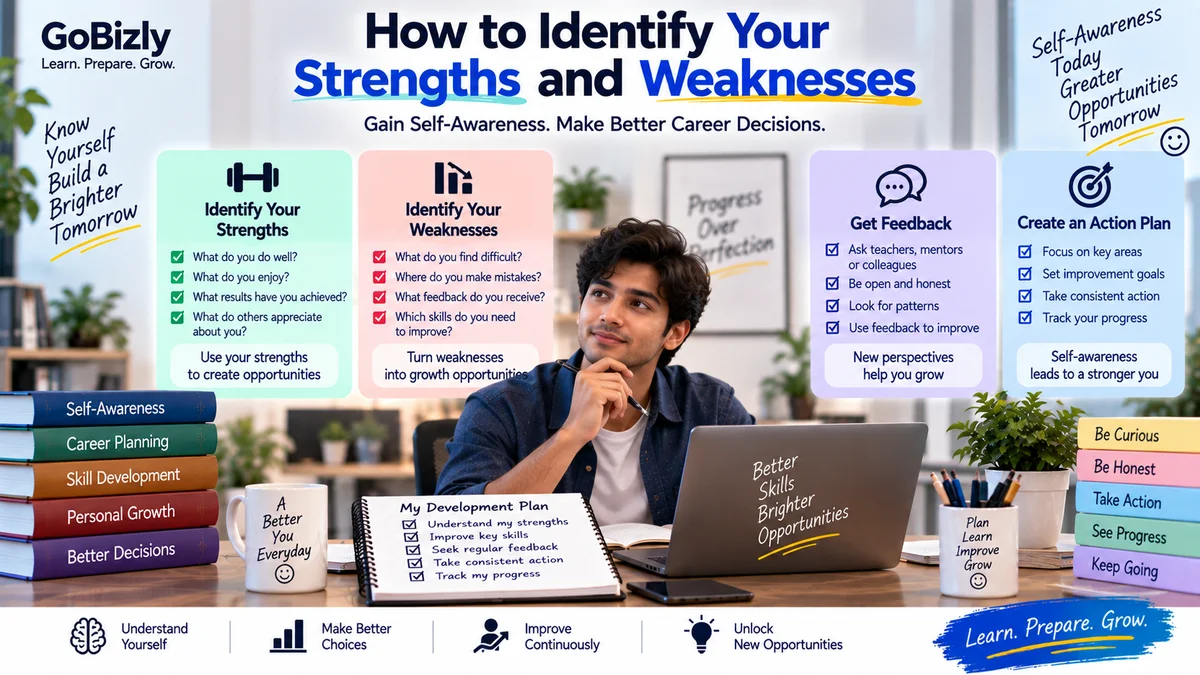
Understanding your strengths and areas for improvement can help you make better career decisions.
It can help you answer questions such as:
Which roles suit my current abilities?
Which skills should I develop?
What type of work do I enjoy?
Where do I perform well?
Where do I need more practice?
Self-awareness is not about labeling yourself as "good" or "bad" at something.
It is about understanding your current capabilities and identifying opportunities to improve.
1. Review Your Past Experiences
Start by looking at your education, work, projects and other experiences.
Ask:
What tasks did I perform well?
What tasks did I struggle with?
What did people ask me for help with?
Which activities did I enjoy?
Patterns may reveal useful strengths and development areas.
2. Look at Your Results
Your past results can provide evidence.
For example:
Projects completed successfully
Problems you solved
Positive feedback
Presentations delivered
Targets achieved
Difficult situations handled
Don't rely only on what you think you're good at.
Look for evidence.
3. Ask for Feedback
Ask people who have worked or studied with you.
For example:
"What is one professional strength you think I have?"
and:
"What is one skill you think I could improve?"
You may discover strengths you hadn't considered.
4. Separate Skills From Personality
A weakness doesn't necessarily mean something is permanently wrong with you.
For example:
"I'm not good at presentations."
could actually mean:
"I haven't had enough opportunities to practice presentations."
This distinction matters.
Many professional skills can improve with practice.
5. Create a Strengths List
Consider areas such as:
Communication
Analysis
Organization
Creativity
Problem solving
Technical skills
Leadership
Teamwork
Learning ability
Attention to detail
For each strength, write one example that demonstrates it.
6. Create an Improvement List
Use the same process for areas that need development.
Examples:
Public speaking
Time management
Technical knowledge
Business communication
Presentation skills
Data analysis
Interview confidence
Don't list everything.
Focus on areas that are relevant to your goals.
7. Use a Strengths and Development Table
Area | Current Level | Evidence | Next Action |
|---|---|---|---|
Communication | Strong | Presentations | Practice advanced communication |
Excel | Intermediate | Projects | Learn advanced functions |
Public Speaking | Developing | Limited practice | Weekly speaking practice |
This makes self-assessment more practical.
8. Compare Your Skills With Target Roles
Look at job descriptions for roles you're interested in.
Identify:
Required skills
Preferred skills
Responsibilities
Then compare them with your current abilities.
This can reveal skill gaps that matter specifically for your career direction.
9. Don't Turn Weaknesses Into Interview Clichés
During interviews, you may be asked:
"What is your biggest weakness?"
Avoid answers that sound rehearsed, such as:
"I'm a perfectionist."
Instead, describe a genuine development area and explain how you're working on it.
For example:
"Earlier, I sometimes spent too much time refining work before sharing an initial version. I've been improving this by setting review checkpoints and sharing early drafts when appropriate."
The example should be truthful and relevant.
10. Look for Patterns
One mistake doesn't necessarily define a weakness.
But if the same issue appears repeatedly, pay attention.
For example:
If you repeatedly miss deadlines, the issue might be planning.
If you repeatedly struggle to explain technical concepts, communication may need practice.
If you repeatedly avoid unfamiliar tasks, you may need more exposure to new situations.
Patterns provide better information than isolated incidents.
11. Understand Your Learning Style Through Practice
Instead of simply asking:
"How do I learn best?"
experiment.
Try:
Reading
Videos
Practice exercises
Teaching others
Projects
Discussions
Then observe which approaches help you understand and retain information.
12. Turn a Weakness Into an Action
Don't stop at identifying the problem.
Create an action.
Weakness: Public speaking
Action: Speak for five minutes twice a week.
Weakness: Excel
Action: Complete one practical exercise each day.
Weakness: Interview communication
Action: Complete two mock interviews per week.
13. Review Progress
After several weeks, reassess.
Ask:
Has the problem improved?
What changed?
What still needs work?
What should I practice next?
Your assessment should evolve with your experience.
14. Avoid Overestimating Strengths
A strength should be supported by evidence.
Instead of:
"I'm excellent at leadership."
ask:
"What have I actually done that demonstrates leadership?"
Maybe you've:
Coordinated a project
Helped teammates
Organized an event
Managed responsibilities
Resolved a conflict
Evidence makes self-assessment more meaningful.
15. Avoid Being Too Critical of Yourself
Self-awareness shouldn't become constant self-criticism.
Everyone has areas they haven't mastered yet.
Focus on:
Current ability → Development → Progress
rather than:
I'm good → I'm bad
16. Create a Personal Development Priority List
Choose three areas:
Maintain
A strength you want to continue using.
Improve
A skill that needs development.
Learn
A new skill that supports your career goal.
For example:
Maintain: Communication
Improve: Data analysis
Learn: SQL
17. Use Your Strengths Strategically
Knowing your strengths can help you choose projects and opportunities.
For example, someone who enjoys:
Analysis may enjoy data-related work.
Communication may enjoy client-facing roles.
Organization may enjoy project coordination.
Creativity may enjoy content or design work.
This doesn't mean strengths determine your career.
They are simply useful information when exploring options.
18. Reassess After Major Experiences
After completing a major project, internship or job, ask:
What did I learn?
What did I handle well?
What was difficult?
What feedback did I receive?
What should I improve?
Career experiences can change your understanding of your strengths.
19. Create Your Personal Skill Map
Divide your skills into:
Technical Skills
Tools and role-specific knowledge.
Professional Skills
Communication, teamwork and organization.
Business Skills
Understanding customers, processes and objectives.
Leadership Skills
Ownership, coordination and decision-making.
This provides a broader picture of your capabilities.
20. Turn Self-Awareness Into Career Action
The ultimate purpose of identifying strengths and weaknesses is action.
Use your findings to:
Choose learning priorities
Select projects
Improve your resume
Prepare interview examples
Choose relevant opportunities
Build a development plan
Self-awareness becomes useful when it changes what you do next.
Self-Assessment Checklist
☐ Review past experiences
☐ Identify successful tasks
☐ Identify recurring challenges
☐ Ask for feedback
☐ Collect evidence
☐ Compare skills with target roles
☐ Identify three development priorities
☐ Create actions for improvement
☐ Track progress
☐ Review regularly
Conclusion
Understanding your strengths and weaknesses isn't about creating a permanent label.
Your abilities can change.
Skills can be developed.
Experience can reveal new strengths.
Use self-awareness as a starting point for development.
Know where you are. Understand where you want to go. Build the skills that connect the two.
Learn. Prepare. Grow.