How to Find Your First Job as a Fresher
How to Find Your First Job as a Fresher
Finding your first job can feel very different from looking for opportunities after gaining professional experience.
You may not have years of work history.
You may not know which job titles to search for.
You may also see job descriptions asking for experience even when you're applying for entry-level roles.
The good news is that your first job search doesn't have to depend entirely on previous employment.
You can build your profile around:
Education
Skills
Projects
Internships
Certifications
Communication
Relevant achievements
Willingness to learn
The goal is to identify suitable opportunities and present your current capabilities clearly.
1. Decide What Type of Role You Want
Don't begin by applying to every job you see.
Start by identifying a few role types that match your interests and skills.
For example:
Marketing Executive
Business Analyst
HR Associate
Operations Executive
Software Developer
Customer Success Associate
Sales Executive
Data Analyst
You don't need to know your entire career path.
You simply need a reasonable starting direction.
2. Understand Entry-Level Job Titles
Companies don't always use the word "fresher" in job titles.
Look for terms such as:
Graduate
Trainee
Associate
Executive
Junior
Entry Level
Analyst
Coordinator
Intern
Apprentice
Read the job description instead of relying only on the title.
3. Define Your Target Profile
Create a simple profile for yourself.
Education
What are you studying or what have you completed?
Skills
What can you actually do?
Projects
What have you built or worked on?
Interests
Which career areas interest you?
Target Roles
Which positions match these areas?
This gives your job search more direction.
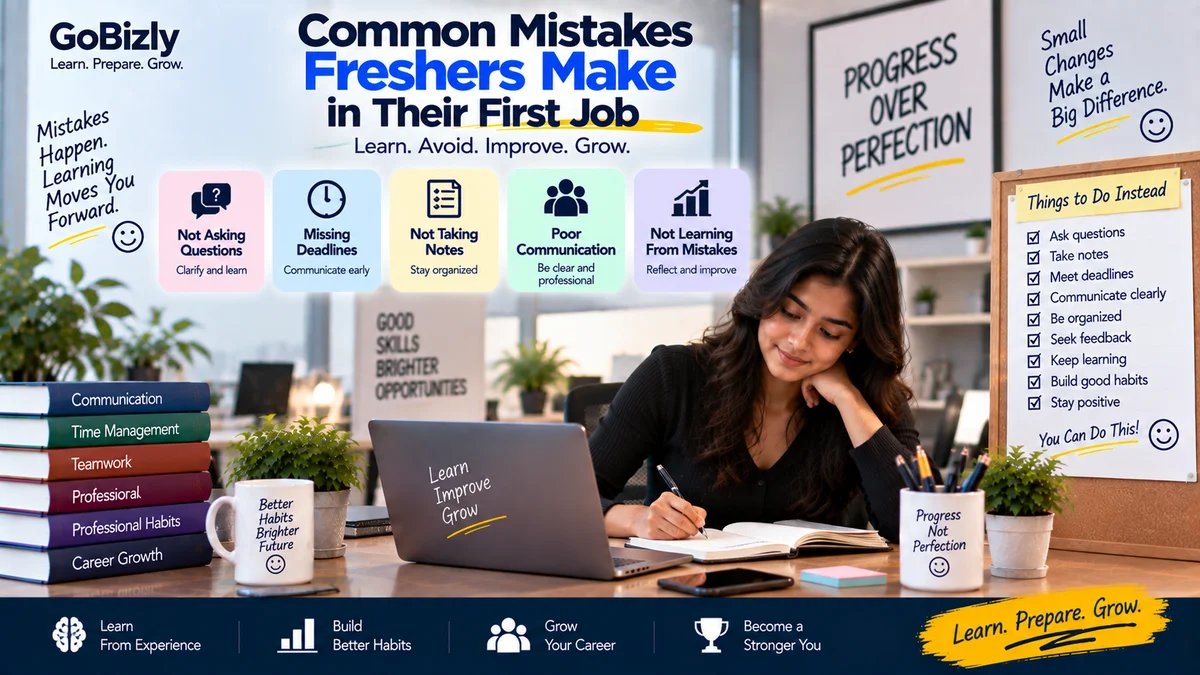
4. Build a Fresher Resume
Your resume should focus on relevant evidence.
Include:
Education
Skills
Projects
Internships
Certifications
Achievements
Relevant extracurricular activities
Don't worry if your resume doesn't have several years of employment history.
Focus on demonstrating preparation for the role.
5. Create a Professional LinkedIn Profile
Your LinkedIn profile should be consistent with your resume.
Review:
Profile photo
Headline
About section
Education
Skills
Projects
Certifications
Your headline can clearly communicate your current position and career direction.
For example:
B.Com Graduate | Aspiring Digital Marketing Professional | Google Ads & Analytics Learner
Only mention skills you genuinely have.
6. Search Using Multiple Sources
Don't depend on one job platform.
Consider:
Company career pages
Professional networking platforms
Job portals
College placement cells
Alumni networks
Recruitment agencies
Industry communities
Internship-to-job opportunities
Different companies use different hiring channels.
7. Search Company Career Pages
If there are companies you genuinely want to explore, visit their official career pages.
Search for relevant roles using terms such as:
Graduate
Associate
Trainee
Junior
Analyst
Executive
This can help you discover opportunities directly from the organization.
8. Read the Job Description Carefully
Before applying, identify:
Responsibilities
Required skills
Preferred skills
Education requirements
Experience requirements
Location
Work arrangement
Then compare them with your profile.
9. Don't Automatically Reject a Role Because of Experience
Some job descriptions may mention experience requirements.
Consider the entire description.
If you meet many of the core requirements and the role is clearly intended for an early-career candidate, you can decide whether it is appropriate to apply.
However, don't misrepresent your experience.
10. Tailor Your Resume
Your resume doesn't need to be completely rewritten for every application.
But emphasize the most relevant information.
For example:
If you're applying for a marketing role, highlight:
Marketing projects
Analytics
Advertising knowledge
Content work
For an operations role, highlight:
Organization
Excel
Process-related projects
Problem solving
11. Build Relevant Projects
If your experience is limited, projects can demonstrate initiative.
Examples:
Marketing: Create a mock campaign strategy.
Data: Build an analysis dashboard.
Finance: Analyze a company's financial statements.
Technology: Build a small application.
HR: Create a sample employee engagement study.
Clearly label simulated projects as academic or practice projects.
12. Apply Strategically
Don't measure your job search only by the number of applications.
Instead, track:
Relevant applications
Responses
Assessments
Interviews
Follow-ups
A smaller number of relevant applications can be easier to manage and tailor effectively.
13. Keep a Job Application Tracker
For example:
Company | Role | Date | Status | Next Action |
|---|---|---|---|---|
Company A | Analyst | Sept 20 | Applied | Wait |
Company B | Executive | Sept 21 | Screening | Prepare |
Company C | Associate | Sept 22 | Interview | Practice |
Add notes where useful.
14. Prepare for Aptitude Tests
Some entry-level recruitment processes include:
Quantitative aptitude
Logical reasoning
Verbal ability
Data interpretation
Practice regularly if these assessments are relevant to the roles you're targeting.
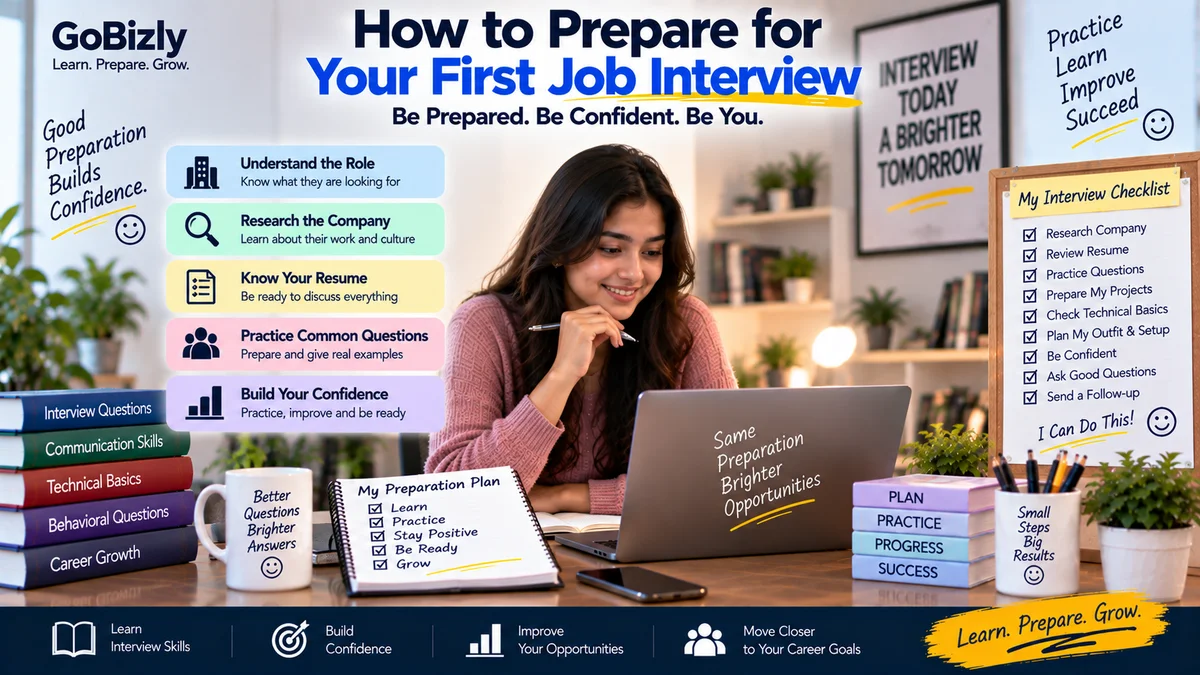
15. Prepare Your Introduction
Be ready to answer:
"Tell me about yourself."
A simple structure:
Present → Education/Experience → Skills → Projects → Career Direction
Keep the answer relevant to the role.
16. Prepare Common Interview Questions
Examples:
Why do you want this role?
Why did you choose your degree?
What are your strengths?
What would you like to improve?
Tell me about your project.
Why should we consider you?
What do you know about our company?
What are your career goals?
Prepare your ideas and examples rather than memorizing scripts.
17. Research the Company
Before an interview, understand:
What the company does
Its products or services
The industry
The role
Basic company information
This can also help you prepare relevant questions.
18. Build Professional Communication
Your first job search is also an opportunity to practice:
Email writing
Recruiter communication
Interview communication
LinkedIn networking
Follow-ups
Keep your messages concise and professional.
19. Be Careful With Job Scams
Be cautious if an opportunity:
Requests money to guarantee a job
Asks for unusual payments
Uses suspicious communication channels
Makes unrealistic promises
Requests sensitive information without a clear reason
Verify opportunities through reliable sources.
20. Keep Improving While Searching
Don't stop developing your skills just because you're applying for jobs.
Use the search period to:
Build projects
Practice interviews
Improve your resume
Learn relevant skills
Improve communication
Expand your professional network
Your job search and skill development can happen simultaneously.
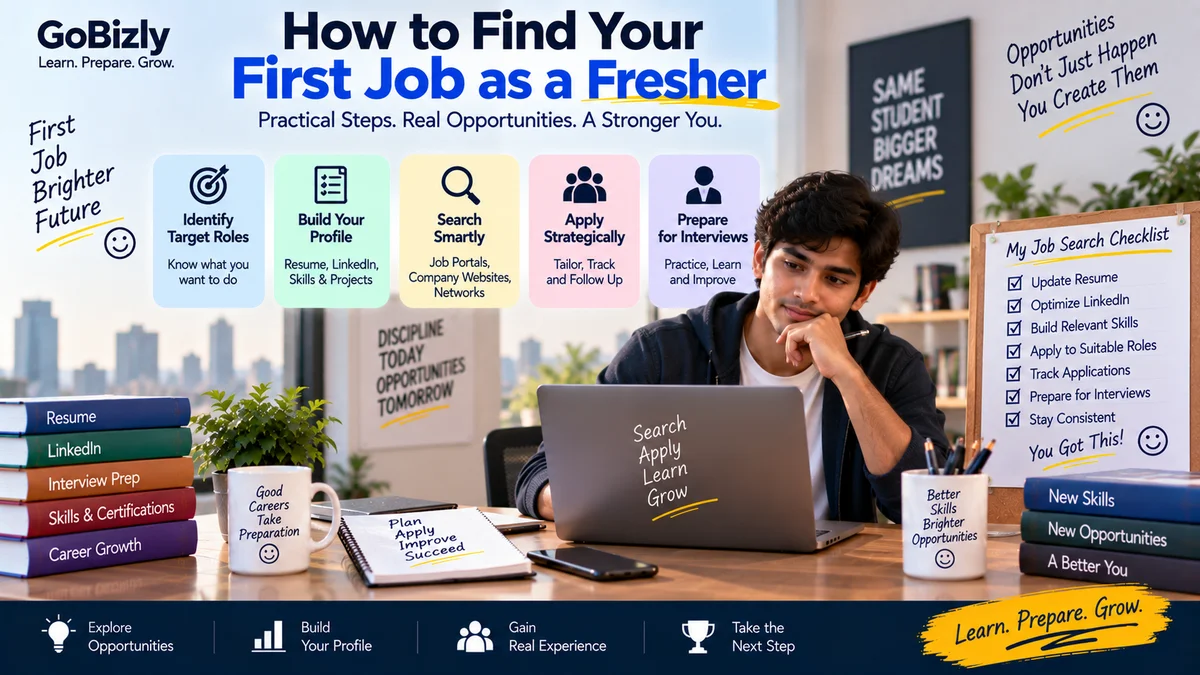
First Job Search Checklist
☐ Identify target roles
☐ Understand entry-level job titles
☐ Prepare your resume
☐ Build LinkedIn
☐ Create relevant projects
☐ Search multiple sources
☐ Check company career pages
☐ Read job descriptions
☐ Tailor applications
☐ Track applications
☐ Practice aptitude
☐ Prepare interview answers
☐ Research companies
☐ Practice professional communication
☐ Verify opportunities
Conclusion
Finding your first job is a process.
Start by understanding what type of work you want to explore.
Build a profile around your education, skills and practical experience.
Search across multiple channels.
Apply thoughtfully.
Prepare for assessments and interviews.
And continue developing your skills while you search.
Your first job doesn't have to define your entire career.
It can simply be the first professional step in a much longer journey.
Start with direction. Build your profile. Keep learning.
Learn. Prepare. Grow.