How to Build a Study Plan for Competitive Exams
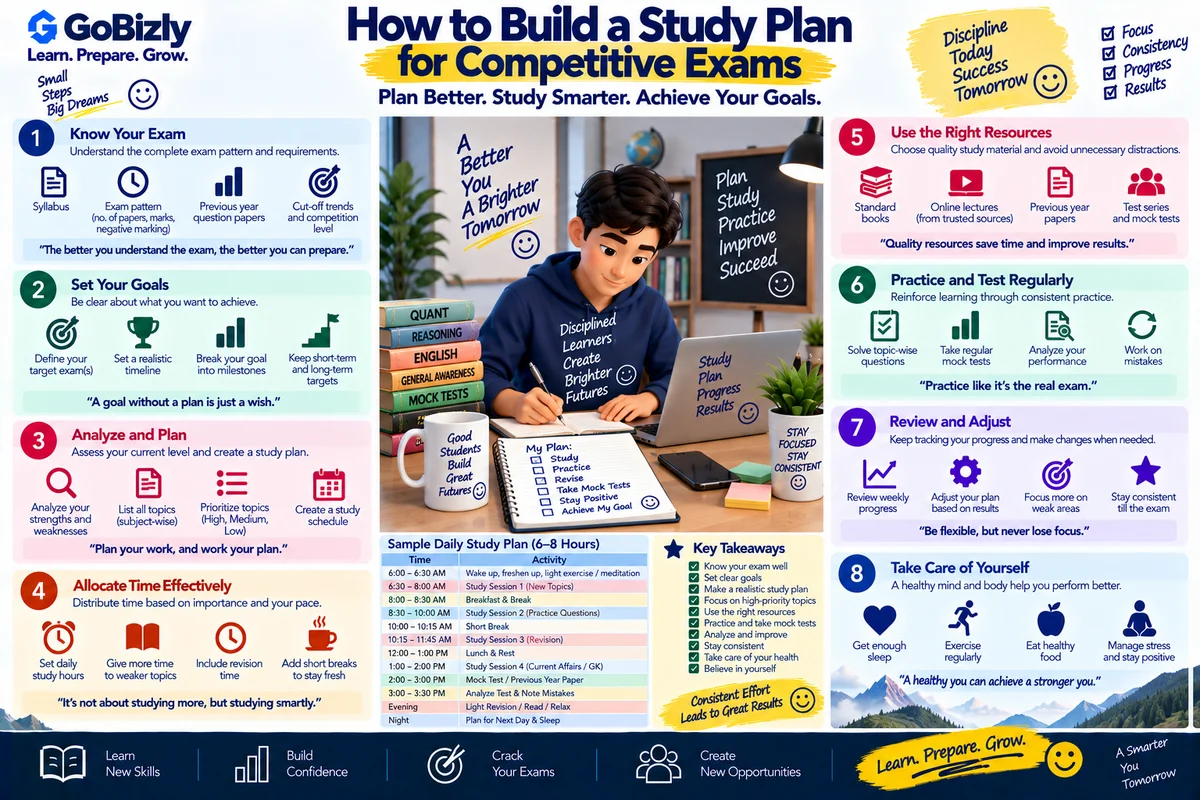
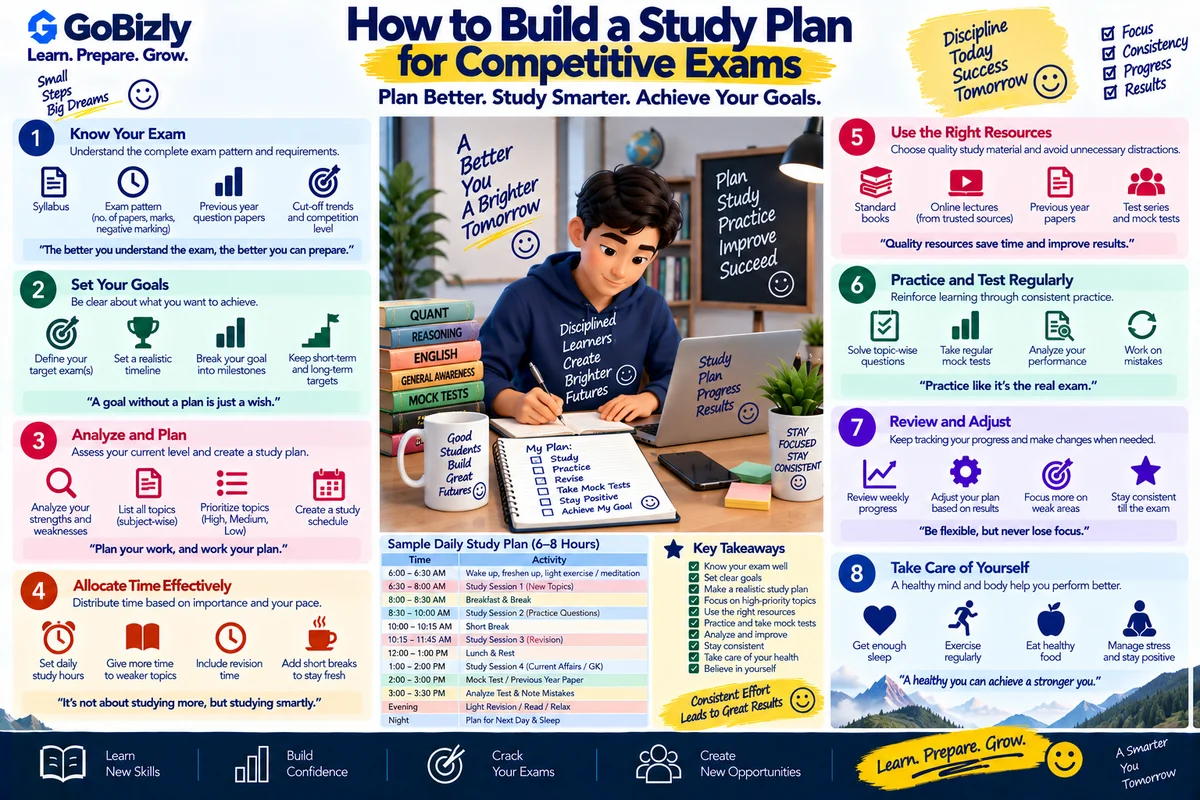
How to Build a Study Plan for Competitive Exams
A study plan is more than a timetable.
A timetable tells you when you will study.
A good study plan also tells you:
What to study
Why you are studying it
How much practice is required
When to revise
How to measure progress
What to change when your plan is not working
A practical plan should be flexible enough to handle college, work, family responsibilities and unexpected changes.
1. Start With Your Available Time
First determine how much time you actually have.
For example:
Day | Available Study Time |
|---|---|
Monday | 3 hours |
Tuesday | 2 hours |
Wednesday | 3 hours |
Thursday | 2 hours |
Friday | 3 hours |
Saturday | 4 hours |
Sunday | 4 hours |
This is more useful than simply deciding:
"I will study 8 hours every day."
Your plan should match your real schedule.
2. Identify the Syllabus
Create a complete topic list.
Then divide each topic into:
Not Started → Learning → Practicing → Revised → Strong
This gives you a visual representation of your progress.
3. Prioritize Topics
Not every topic deserves the same amount of time.
Consider three factors:
Importance + Difficulty + Your Current Ability
A difficult topic that appears frequently in your examination may require more preparation time.
A topic you already understand may only require periodic revision.
4. Create Weekly Goals
Instead of creating a detailed six-month timetable that becomes difficult to maintain, start with weekly goals.
For example:
Week 1
Quantitative
Percentages
Ratios
Reasoning
Series
Coding-decoding
English
Grammar fundamentals
Practice
100 mixed questions
Revision
Sunday review
The exact targets should depend on your available time and examination.
5. Use Different Study Sessions
A useful study day can contain several types of sessions.
Learning Session
Understand a new concept.
Practice Session
Solve questions based on that concept.
Revision Session
Review previously studied material.
Testing Session
Work under time constraints.
This prevents your preparation from becoming purely theoretical.
6. Don't Ignore Revision
One of the biggest problems with long-term preparation is forgetting previously studied material.
You may spend several days learning percentages and then move on to another subject.
Weeks later, you may realize that you cannot remember the formulas or methods clearly.
Schedule revision deliberately.
A simple approach:
Day 1: Learn
Day 2–3: Short review
End of week: Practice
Following weeks: Periodic revision
You can adjust the intervals according to your learning needs.
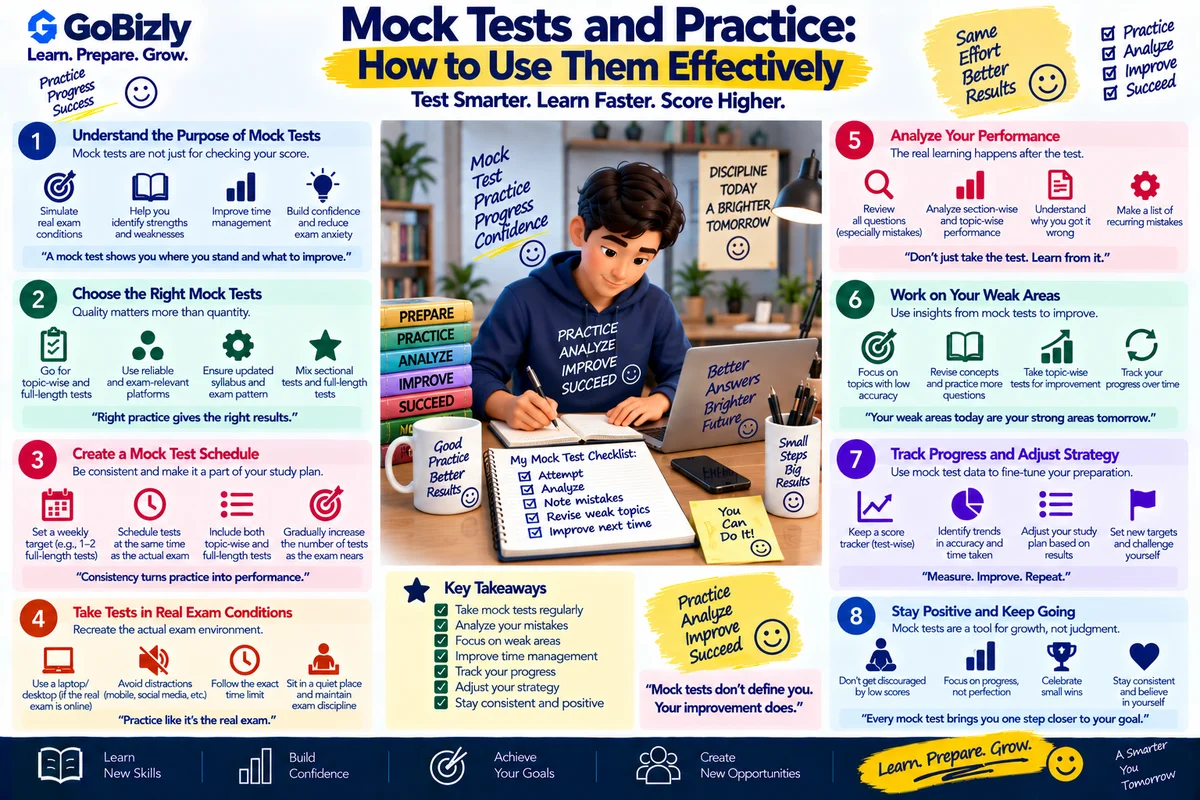
7. Reserve Time for Practice Tests
Do not leave mock tests until the final days.
Introduce them gradually.
Early stage:
Topic tests
Middle stage:
Section tests
Later stage:
Full-length tests
This gives you time to improve before the actual examination.
8. Track Your Progress
Create a simple tracker.
Topic | Status | Accuracy | Next Action |
|---|---|---|---|
Percentages | Practicing | 75% | More practice |
Ratios | Revised | 90% | Maintain |
Puzzles | Learning | 60% | Review concepts |
Grammar | Strong | 92% | Weekly revision |
The purpose is not to create complicated spreadsheets.
It is to know what you should do next.
9. Build Buffer Time
Do not schedule every minute.
If your plan is completely full, one missed study session can disrupt the entire week.
Keep some buffer time for:
Difficult topics
Missed sessions
Additional revision
Unexpected commitments
A flexible plan is easier to maintain.
10. Review Your Plan Every Week
At the end of each week ask:
What did I complete?
What did I miss?
Which topics remain weak?
What mistakes am I repeating?
Did I spend too much time on one area?
What should I change next week?
Then adjust the next week's plan.
Your study plan should evolve as your preparation improves.
Example Weekly Structure
Day | Main Focus |
|---|---|
Monday | New quantitative topic |
Tuesday | Reasoning + practice |
Wednesday | New verbal topic |
Thursday | Quantitative revision |
Friday | Reasoning practice |
Saturday | Mixed practice |
Sunday | Mock test + analysis |
This is only a framework. Your actual schedule should be customized to your examination and availability.
Practical Study Plan Checklist
Determine available study hours
Understand the syllabus
Break topics into smaller units
Prioritize difficult areas
Set weekly goals
Include learning and practice
Schedule revision
Include mock tests
Track accuracy
Keep buffer time
Review progress every week
Adjust the plan when necessary
Conclusion
A useful study plan should make preparation clearer, not more stressful.
Start with your actual available time, divide the syllabus into manageable topics, prioritize weak areas, schedule practice and revision, and regularly evaluate your progress.
The best plan is not necessarily the most complicated one. It is the one you can follow consistently and adjust when needed.
Learn. Prepare. Grow.