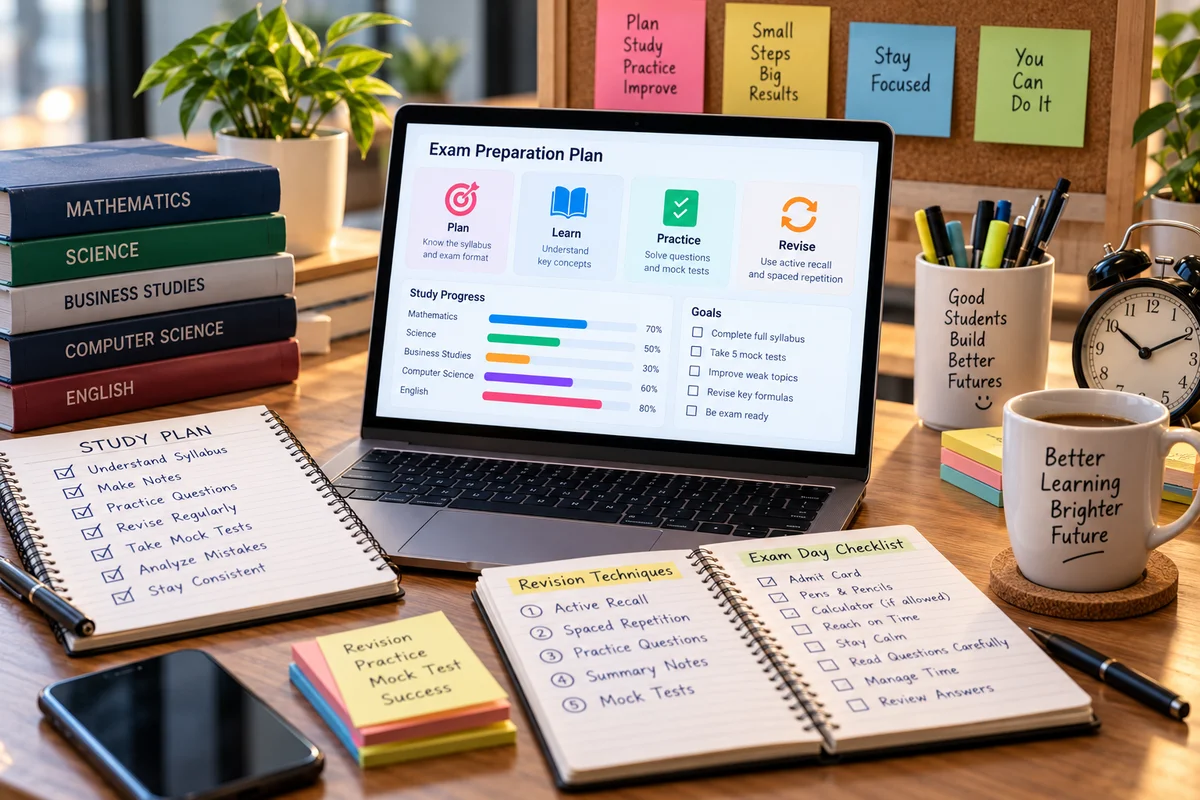
How to Build Good Study Habits: A Practical Guide to Studying Better
How to Build Good Study Habits: A Practical Guide to Studying Better
Studying effectively is not simply about spending more hours with a textbook.
You can sit at a desk for five hours and still remember very little if you are constantly checking your phone, rereading the same paragraph, switching between subjects, studying without a plan, or trying to learn everything the night before an exam.
On the other hand, a student who studies for a shorter but focused period can make much better progress by using a structured approach.
That is why good study habits matter.
Study habits are the routines, behaviors, methods, and decisions you repeatedly use when learning. They include everything from choosing a study time and organizing your materials to reviewing information, practicing questions, managing distractions, and preparing for exams.
The goal is not to create a perfect routine that looks impressive on paper.
The goal is to create a study system that you can actually follow.
Effective learning also involves actively thinking about information rather than simply exposing yourself to it. For example, retrieval practice asks you to recall information rather than repeatedly rereading it, while spacing learning across time can create more opportunities to retrieve and strengthen knowledge.
This guide explains how to build good study habits step by step.
1. What Are Study Habits?
Study habits are the regular actions and routines you follow when learning.
They include:
- When you study
- Where you study
- How you organize your study materials
- How you plan your subjects
- How long you study
- How you take breaks
- How you revise
- How you practice questions
- How you test yourself
- How you deal with distractions
- How you prepare for exams
- How you track your progress
For example, consider two students.
Student A studies only when an exam is close.
The routine usually looks like this:
Exam announced → procrastination → panic → long study sessions → little sleep → rushed revision → exam.
Student B follows a simple routine:
Attend class → review the topic → practice questions → revisit difficult areas → weekly revision → exam preparation.
Student B may not necessarily be studying for more total hours.
The difference is consistency and structure.
Good study habits reduce the amount of decision-making required every day.
Instead of asking:
"Should I study today?"
you build a routine where studying becomes a normal part of your day.
2. Why Good Study Habits Matter
Good study habits can make learning more organized and sustainable.
They can help you:
- Reduce last-minute studying
- Remember information more effectively
- Understand difficult concepts
- Identify weak areas earlier
- Improve concentration
- Reduce distractions
- Manage academic workload
- Prepare for exams gradually
- Reduce unnecessary stress
- Build consistency
- Make better use of available study time
However, good study habits do not mean studying every available minute.
A healthy study routine should leave room for:
- Sleep
- Meals
- Exercise
- Family
- Friends
- Relaxation
- Hobbies
- Personal responsibilities
A routine that requires you to sacrifice everything else is difficult to maintain.
The best study system is one you can continue for weeks and months.
3. Good Study Habits Are Built, Not Discovered
One common mistake students make is believing that successful students naturally have excellent discipline.
In reality, many effective study habits are developed gradually.
You do not have to wake up tomorrow and become a completely different student.
Instead, start with one behavior.
For example:
Week 1
Study for 30 focused minutes every evening.
Week 2
Add a short review session.
Week 3
Introduce practice questions.
Week 4
Add weekly planning.
The goal is to make the behavior increasingly automatic.
This is much more realistic than trying to completely redesign your life overnight.
4. Start by Understanding Your Current Study Habits
Before creating a new routine, examine what you already do.
Ask yourself:
- When do I usually study?
- How long can I concentrate?
- What distracts me most?
- Which subjects do I avoid?
- Do I usually study before exams?
- Do I review what I learned?
- Do I practice questions?
- Do I understand concepts or mostly memorize them?
- Do I sleep enough before important exams?
- Where do I study most effectively?
- What causes me to procrastinate?
Do not use this exercise to criticize yourself.
Use it as a diagnosis.
For example, you might discover:
"I don't actually have a problem with studying. My biggest problem is starting."
Or:
"I spend enough time studying, but I mostly reread notes and rarely test myself."
That observation tells you what needs to change.
5. Define Your Study Goal
A study session should have a purpose.
Compare these two plans:
Weak goal:
"Study mathematics."
Better goal:
"Complete 15 algebra problems and review the mistakes."
The second goal is measurable.
Other examples include:
"Read and summarize Chapter 4."
"Learn and explain the five stages of the process."
"Complete one practice test."
"Create flashcards for today's biology terms."
"Revise the formulas from Unit 3 and solve ten questions."
A clear objective makes it easier to start and finish a study session.
6. Create a Realistic Study Schedule
A study schedule should reflect your actual life.
Do not create a timetable that assumes you will study six hours every day if you currently struggle to study for one hour.
Start realistically.
For example:
6:30–7:00 PM — Mathematics
7:00–7:10 PM — Break
7:10–7:40 PM — Science
7:40–8:00 PM — Dinner
8:00–8:30 PM — Revision
This may look simple.
That's the point.
A schedule that you follow is more valuable than an impressive schedule that you abandon after two days.
7. Use Fixed Study Times When Possible
Studying at random times can make consistency harder.
If your schedule allows it, choose a regular study period.
For example:
Monday–Friday: 7:00 PM–8:30 PM
or:
Every morning: 6:30 AM–7:15 AM
When a behavior happens repeatedly at a similar time, it can become easier to initiate.
You don't have to wait until you "feel motivated."
The schedule becomes the reminder.
8. Start Small
If you currently study very little, don't immediately aim for four-hour sessions.
Start with something achievable.
For example:
Day 1: 20 minutes
Day 2: 20 minutes
Day 3: 25 minutes
Day 4: 25 minutes
Day 5: 30 minutes
Gradually increase the amount if necessary.
The first objective is not maximum study time.
It is consistency.
9. Build a Study Routine Around Priorities
Not every subject deserves the same amount of time.
Suppose you have:
Mathematics — weak
Physics — average
English — strong
History — average
You might distribute your time accordingly.
Mathematics — High priority
Physics — High priority
History — Medium priority
English — Maintenance
This prevents the common mistake of spending most of your time studying subjects you already enjoy because they feel easier.
10. Identify Your Difficult Subjects Early
Students often avoid difficult subjects.
The problem is that avoidance makes the subject increasingly intimidating.
Instead, identify difficult topics early.
Create a list.
Topics I understand:
- Fractions
- Basic equations
- Percentages
Topics I partly understand:
- Quadratic equations
- Graphs
Topics I struggle with:
- Trigonometry
- Complex word problems
Now your study plan becomes much more useful.
You know exactly where to spend additional effort.
11. Use the "Start With Five Minutes" Method
Sometimes the biggest problem is not studying.
It is starting.
When you feel resistance, tell yourself:
"I only need to study for five minutes."
Open the book.
Write the first question.
Read the first section.
Solve the first problem.
Once you begin, continuing often becomes easier.
Even if you stop after five minutes, you have still practiced the habit of starting.
12. Create a Dedicated Study Environment
Your environment can influence how easily you concentrate.
A good study environment should ideally be:
- Comfortable
- Well-lit
- Relatively quiet
- Organized
- Free from unnecessary distractions
You do not need an expensive study room.
A simple desk can work.
The important thing is that the environment communicates:
"This is where I study."
13. Keep Your Study Space Organized
Before starting:
- Keep the required textbook nearby.
- Keep your notebook ready.
- Keep pens and stationery available.
- Keep water nearby.
- Close unnecessary tabs.
- Remove unrelated items.
- Put your phone away.
The fewer interruptions you need to handle, the easier it is to maintain focus.
14. Remove Your Biggest Distraction
Identify the distraction that causes the most damage.
For many students, it is the smartphone.
But distractions can also include:
- Social media
- Gaming
- YouTube
- Television
- Messaging
- Notifications
- Friends
- Background conversations
- Constant email checking
You don't necessarily need to eliminate everything permanently.
Instead, create protected study periods.
For example:
7:00–7:40 PM = no social media.
Afterward, you can take a break.
15. Keep Your Phone Away
Putting your phone next to your notebook can make it very easy to check notifications.
Try:
- Silent mode
- Do Not Disturb
- Focus mode
- Airplane mode
- Keeping the phone in another room
- Giving it to a parent temporarily
- Keeping it inside your bag
The best method is the one that actually works for you.
If you repeatedly reach for your phone, increase the physical distance.
16. Turn Off Unnecessary Notifications
Notifications create interruptions.
Before studying, consider disabling:
- Social media notifications
- Promotional messages
- Nonessential email notifications
- Gaming notifications
- Shopping notifications
- News alerts
Keep only genuinely important notifications if necessary.
17. Use Focused Study Sessions
Instead of thinking:
"I need to study all evening."
Think:
"I will focus for the next 30 minutes."
Then take a short break.
You can experiment with different session lengths.
Option A:
25 minutes study
5 minutes break
Option B:
40 minutes study
10 minutes break
Option C:
50 minutes study
10 minutes break
There is no universal number that works for everyone.
Choose a duration that lets you maintain genuine concentration.
18. Don't Confuse Sitting With Studying
This is one of the most important lessons.
You can sit at a desk for three hours without completing meaningful learning.
Ask:
"What did I actually accomplish?"
Instead of:
"How long did I sit?"
Measure outcomes.
For example:
- 20 questions completed
- One chapter understood
- 15 flashcards reviewed
- One essay drafted
- One practice test completed
- Five concepts explained from memory
This gives you a more useful picture of progress.
19. Use Active Learning
Active learning means doing something with the information rather than simply looking at it.
Examples include:
- Answering questions
- Explaining concepts
- Solving problems
- Creating diagrams
- Teaching another person
- Writing summaries from memory
- Comparing concepts
- Applying knowledge to examples
For example, instead of reading a definition five times, close the book and explain the definition in your own words.
That requires your brain to retrieve and organize the information.
20. Practice Retrieval
Retrieval practice means trying to recall information without looking at the answer.
Suppose you're studying:
"What is photosynthesis?"
Instead of immediately rereading the textbook, close it and ask yourself:
"Can I explain photosynthesis from memory?"
Write what you remember.
Then check the textbook.
Identify what you missed.
This turns studying into a learning activity rather than simply an exposure activity.
21. Use the "Close the Book" Test
After studying a section:
1. Close the book.
2. Take a blank sheet.
3. Write the main ideas.
4. Explain the concept.
5. List important terms.
6. Identify anything you cannot remember.
7. Reopen the book.
8. Correct your gaps.
This simple process can reveal whether you actually learned the material.
22. Explain Concepts in Simple Language
One powerful technique is to explain a concept as if you were teaching a beginner.
Suppose you are studying:
Supply and demand.
Don't simply memorize the textbook definition.
Try saying:
"If something becomes more difficult to obtain while people still want it, its price may increase."
Then create an example.
For instance:
If a popular product becomes scarce while many customers still want it, sellers may be able to charge more.
If you cannot explain a concept simply, that may indicate that you need to understand it more deeply.
23. Use Examples
Examples make abstract information easier to understand.
If you're studying a business concept, find a business example.
If you're studying mathematics, solve a real problem.
If you're studying science, connect the concept to an observable situation.
If you're studying grammar, write your own sentences.
The more you connect knowledge to application, the more useful it becomes.
24. Don't Rely Only on Rereading
Rereading feels productive because the material looks familiar.
But familiarity and recall are not the same thing.
You may read a paragraph and think:
"Yes, I understand this."
Then close the book and realize you cannot explain it.
Instead, combine reading with:
- Retrieval
- Questions
- Practice
- Explanation
- Application
- Self-testing
Reading can be useful.
But it should not be the only activity.
25. Create Questions While Studying
Turn headings into questions.
For example:
Heading:
Causes of World War I
Questions:
- What were the major causes?
- What role did alliances play?
- Why did tensions increase?
- Which events triggered the conflict?
Now your study material becomes a set of problems to solve.
26. Make Your Own Practice Questions
After completing a topic, create five to ten questions.
For example:
1. What is the main concept?
2. Why does it matter?
3. What are the key components?
4. Can you give an example?
5. What is a common mistake?
6. How would you apply the concept?
7. How is it different from a related concept?
Then answer without looking at your notes.
27. Use Spaced Review
Instead of studying a topic once and never returning to it, review it at intervals.
For example:
Day 1: Learn
Day 2: Short review
Day 4: Retrieval practice
Day 7: Practice questions
Day 14: Quick review
Day 30: Final review
The exact schedule can vary.
The important principle is that you revisit information rather than relying entirely on one long study session.
28. Avoid Last-Minute Cramming
Cramming may feel productive because you are studying intensely.
But it creates several problems:
- Fatigue
- Stress
- Poor sleep
- Limited time for practice
- Weak long-term retention
- Difficulty identifying knowledge gaps
Instead, distribute your study.
Even 20–30 minutes of regular review can be more manageable than trying to relearn everything the night before an exam.
29. Create a Weekly Review Session
Once a week, spend some time reviewing what you studied.
Ask:
- What did I learn this week?
- Which topics do I remember?
- Which topics have I forgotten?
- Which assignments are pending?
- What exams are coming?
- What needs additional practice?
- What should I study next week?
This gives you control over your workload.
30. Use a Simple Weekly Study Plan
Monday:
Main subject — Mathematics
Secondary task — Physics
Review — 15 minutes
Tuesday:
Main subject — Science
Secondary task — English
Review — 15 minutes
Wednesday:
Main subject — Mathematics
Secondary task — History
Review — 15 minutes
Thursday:
Main subject — Physics
Secondary task — Mathematics
Review — 15 minutes
Friday:
Main subject — Science
Secondary task — English
Review — 15 minutes
Saturday:
Weekly revision
Practice test
Sunday:
Weak areas
Planning
The schedule should be adapted to your actual classes and responsibilities.
31. Break Large Tasks Into Smaller Tasks
"Study biology" is too broad.
Break it down:
Read Chapter 5.
Then:
Study sections 5.1 and 5.2.
Then:
Create 10 questions.
Then:
Complete 15 practice questions.
Large tasks become less intimidating when converted into specific actions.
32. Use the Next Action Method
Whenever you finish a study session, decide what you will do next.
For example:
"Tomorrow: solve questions 21–40."
instead of:
"Tomorrow: study mathematics."
This reduces the amount of planning required when you sit down again.
33. Keep a Study Checklist
Before studying:
- Know today's objective
- Gather materials
- Remove distractions
- Set study duration
During studying:
- Focus on one task
- Take useful notes
- Practice actively
- Test yourself
After studying:
- Summarize key points
- Identify weak areas
- Record completed work
- Decide the next step
34. Take Useful Breaks
Breaks are part of studying.
But not every break is equally useful.
A five-minute break can become thirty minutes if you start scrolling through social media.
Instead, consider:
- Walking
- Stretching
- Drinking water
- Looking away from the screen
- Breathing exercises
- Brief conversation
- Preparing your next study material
The purpose of a break is to reset, not completely abandon the study session.
35. Don't Study for Hours Without Rest
Long sessions can lead to declining concentration.
If you notice that you're reading the same sentence repeatedly, making careless mistakes, or constantly checking the clock, take a short break.
Quality matters.
36. Protect Your Sleep
Sleep should not be treated as wasted study time.
If you regularly stay awake until very late trying to learn everything, your study routine may become unsustainable.
Instead, build your schedule around adequate rest.
A student who sleeps properly and studies consistently may be in a better position than someone who repeatedly sacrifices sleep for last-minute studying.
37. Study Difficult Topics When You're Most Alert
Notice when you naturally concentrate best.
Some students work better:
- Early morning
- Late morning
- Afternoon
- Evening
Use your highest-energy period for demanding subjects when possible.
For example:
Morning → Mathematics
Evening → Reading and revision
There is no single correct schedule for everyone.
38. Match the Method to the Subject
Different subjects require different approaches.
Mathematics:
- Examples
- Problem solving
- Practice
- Error analysis
Science:
- Concepts
- Diagrams
- Processes
- Questions
- Applications
History:
- Timeline
- Causes
- Consequences
- Connections
- Recall
Languages:
- Vocabulary
- Reading
- Writing
- Speaking
- Grammar practice
Programming:
- Writing code
- Debugging
- Projects
- Practice problems
- Explaining concepts
Do not expect one study method to work equally well for every subject.
39. Learn From Your Mistakes
Mistakes are useful when you analyze them.
When you get a question wrong, don't simply look at the correct answer.
Ask:
"Why did I get this wrong?"
Possible reasons include:
- Didn't understand the concept
- Forgot a formula
- Misread the question
- Made a calculation error
- Used the wrong method
- Ran out of time
- Guessed
Record the reason.
Over time, patterns will emerge.
40. Maintain an Error Log
An error log can be particularly useful for exam preparation.
Example:
Question: Q12
Mistake: Forgot formula
Correct approach: Review formula
Question: Q18
Mistake: Misread question
Correct approach: Underline key information
Question: Q25
Mistake: Concept unclear
Correct approach: Relearn topic
Question: Q31
Mistake: Calculation error
Correct approach: Slow down
Review this log before your next practice session.
41. Don't Avoid Difficult Questions
Easy questions can build confidence, but difficult questions expose gaps.
Once you understand the basics, include challenging problems.
Ask:
"What happens if the question changes?"
This develops flexibility rather than memorization.
42. Use Practice Tests
Practice tests help you determine whether your preparation works under exam-like conditions.
Try to recreate:
- Time limit
- Question format
- No notes
- Similar environment
Afterward, don't only calculate your score.
Analyze your performance.
43. Review Your Practice Test Properly
A practice test is most useful when followed by analysis.
Separate questions into:
Correct and confident:
No immediate action.
Correct but uncertain:
Review.
Incorrect because of knowledge gap:
Study the topic.
Incorrect because of careless mistake:
Work on accuracy.
Incorrect because of time:
Practice time management.
This makes your next study session targeted.
44. Avoid Multitasking
Studying while simultaneously:
- Watching videos
- Messaging friends
- Browsing social media
- Checking email
can fragment your attention.
Try single-tasking.
One study block.
One objective.
One primary task.
45. Use Background Music Carefully
Some students like music while studying.
Others find it distracting.
If you use music, pay attention to whether it improves or reduces concentration.
Lyrics can be distracting during tasks involving reading or writing.
If music makes you repeatedly focus on the song, study without it.
46. Make Studying Easy to Start
Prepare your materials before your study session.
For example, if you plan to study at 7 PM:
At 6:55 PM:
- Put the textbook on the desk.
- Open the notebook.
- Keep a pen ready.
- Put the phone away.
- Open the relevant page.
Then at 7 PM you can begin immediately.
47. Use a Study Trigger
Connect studying to an existing routine.
For example:
After dinner → study for 30 minutes.
or:
After returning from college → rest for 20 minutes → study.
The existing activity becomes a trigger for the new habit.
48. Track Your Consistency
You can use a simple calendar.
Every day you complete your planned study session, mark it.
Example:
Monday: ✓
Tuesday: ✓
Wednesday: ✓
Thursday: ✗
Friday: ✓
The objective is not to create a perfect streak.
The objective is to see whether you are consistently returning to the habit.
49. Don't Let One Bad Day Destroy the Routine
Missing one study session does not mean your routine has failed.
The dangerous thought is:
"I missed yesterday, so I'll start again next week."
Instead:
"I missed yesterday. I'll continue today."
Consistency does not mean never failing.
It means returning quickly.
50. Avoid the "All or Nothing" Mindset
You don't always need to complete a two-hour study session.
If you planned two hours but only have thirty minutes available, do thirty minutes.
A shorter useful session is better than doing nothing because you cannot complete the original plan.
51. Build a Minimum Study Routine
Create a minimum version of your routine.
For example:
Minimum: 20 minutes.
On good days:
60–90 minutes.
On difficult days:
20 minutes.
This prevents busy days from completely breaking the habit.
52. Keep a Study Journal
You don't need a complicated journal.
At the end of each session, record:
Today I studied:
Mathematics — quadratic equations
Time:
40 minutes
Completed:
15 problems
Difficulty:
Graphs still confusing
Next session:
Review graphs and solve five problems
This creates continuity between sessions.
53. Use a Priority List
At the beginning of the week, create three categories.
Must do:
Important assignments and upcoming exams.
Should do:
Revision and practice.
Could do:
Additional reading or optional activities.
This prevents less important work from consuming your entire study schedule.
54. Plan Around Deadlines
Write down:
- Exam dates
- Assignment deadlines
- Project deadlines
- Presentation dates
- Submission dates
Then work backward.
If an assignment is due Friday, don't make Thursday night your first work session.
Break it into:
Monday: Research
Tuesday: Outline
Wednesday: Draft
Thursday: Edit
Friday: Submit
55. Use the "Backward Planning" Method for Exams
Suppose an exam is four weeks away.
Instead of waiting until the final week:
Week 1:
Understand the syllabus and identify weak topics.
Week 2:
Complete first-round learning.
Week 3:
Practice questions and revise weak areas.
Week 4:
Practice tests and final revision.
This creates a much more manageable process.
56. Understand Before Memorizing
Memorization has its place.
But whenever possible, understand the underlying concept first.
For example, instead of memorizing:
Formula = X
ask:
What does this formula represent?
Why does it work?
When should I use it?
What happens if one variable changes?
Understanding makes memorization easier and application more reliable.
57. Use Memory Aids Where Appropriate
Memory techniques can be useful for information that genuinely requires memorization.
You can use:
- Acronyms
- Mnemonics
- Associations
- Visual imagery
- Flashcards
- Stories
- Categorization
But don't use a mnemonic as a substitute for understanding.
58. Use Flashcards Properly
Flashcards work best when they require you to recall an answer.
Weak flashcard:
Photosynthesis — definition printed on the same side.
Better:
Front:
What is photosynthesis?
Back:
Explanation.
Then test yourself before flipping the card.
Flashcards can be particularly useful for:
- Vocabulary
- Definitions
- Formulas
- Terminology
- Dates
- Concepts
- Language learning
59. Don't Put Too Much Information on One Flashcard
A card should usually test a manageable piece of knowledge.
Instead of:
"Explain everything about Chapter 5."
Use:
"What are the three major stages?"
"What is the purpose of Stage 1?"
"What happens during Stage 2?"
Smaller questions make retrieval clearer.
60. Connect New Knowledge to Existing Knowledge
When learning something new, ask:
"What does this remind me of?"
"How is this related to what I already know?"
"What is different?"
For example, if you're learning a new programming concept, connect it to a programming concept you already understand.
This helps build a network of knowledge rather than isolated facts.
61. Study With Others When It Helps
Group study can be useful when it has structure.
For example:
Everyone studies the topic for 30 minutes.
Then:
Each person explains one difficult concept.
Then:
Everyone solves five questions independently.
Then:
Compare answers.
This can be productive.
But group study can also become social time.
If the group spends more time talking than learning, individual study may be better.
62. Teach Someone Else
Teaching is a powerful way to identify knowledge gaps.
Choose a topic.
Explain it without looking at notes.
If you get stuck, note the missing part.
Then review it.
You can teach:
- A friend
- A sibling
- A parent
- A classmate
Or simply explain it aloud to yourself.
63. Ask Better Questions
When you don't understand something, don't just say:
"I don't understand this."
Identify exactly what is confusing.
For example:
"I understand the first two steps, but I don't understand why the third step happens."
This makes it easier for a teacher, classmate, tutor, or online resource to help you.
64. Use Teachers Strategically
Don't wait until exam week to ask for help.
If you identify a difficult topic early, ask about it early.
You can say:
"I understand the basic concept, but I am struggling with these types of questions."
This gives your teacher something specific to address.
65. Use Online Resources Carefully
Online learning resources can help you understand difficult concepts.
However, too many resources can create another problem.
You may spend hours watching different explanations without actually practicing.
Use the internet to clarify.
Then return to active learning.
A useful sequence is:
Learn → Practice → Test → Identify gap → Find explanation → Practice again.
66. Don't Keep Switching Study Resources
You don't need:
- Five textbooks
- Ten YouTube channels
- Multiple note-taking apps
- Several flashcard platforms
Choose a small set of reliable resources.
Then focus on learning.
67. Organize Your Digital Files
If you study digitally, create folders.
For example:
College
→ Mathematics
→ Notes
→ Assignments
→ Practice
College
→ Physics
→ Notes
→ Assignments
→ Practice
College
→ English
→ Notes
→ Assignments
Good organization saves time.
68. Keep Your Notes Useful
Notes should help you learn.
They don't need to reproduce every sentence from the textbook.
Useful notes can contain:
- Key ideas
- Definitions
- Examples
- Diagrams
- Formulas
- Questions
- Connections
- Mistakes
69. Don't Spend the Entire Session Making Beautiful Notes
This is another common trap.
You can spend an hour:
- Choosing colors
- Drawing boxes
- Rewriting headings
- Decorating pages
and still not understand the topic.
Make your notes useful first.
Presentation comes second.
70. Summarize in Your Own Words
After learning a topic, write a short summary without copying directly.
For example:
"This process converts X into Y through three stages. The first stage prepares the input, the second changes it, and the final stage produces the output."
If you can explain it clearly, you probably understand it better than if you simply copied the textbook.
71. Use Diagrams for Complex Topics
Some information is easier to understand visually.
Create:
- Flowcharts
- Timelines
- Mind maps
- Comparison tables
- Process diagrams
For example:
Input
↓
Process 1
↓
Process 2
↓
Output
The objective is clarity, not decoration.
72. Compare Similar Concepts
If two concepts are easily confused, create a comparison table.
Feature | Concept A | Concept B
Purpose | ... | ...
Process | ... | ...
Example | ... | ...
Main difference | ... | ...
This can be especially useful before exams.
73. Review Before You Forget Everything
Don't wait until you realize you've forgotten the entire chapter.
Use short review sessions.
For example:
5 minutes:
Recall major concepts.
10 minutes:
Answer questions.
5 minutes:
Review mistakes.
A short review can keep the material active.
74. Build a Pre-Exam Routine
During the final days before an exam, avoid completely changing your study strategy.
Focus on:
- Weak topics
- Practice questions
- Important concepts
- Previous mistakes
- Formula review
- Practice tests
Avoid spending all your time rereading material you already know.
75. Don't Learn Everything the Night Before
The night before an exam should generally be used for light review and preparation rather than trying to learn an entire syllabus from scratch.
Prepare:
- Required materials
- Exam location
- Timetable
- Pens
- Calculator if permitted
- Identification if required
Then get appropriate rest.
76. Create an Exam-Eve Checklist
Academic:
- Review key concepts
- Review formulas
- Review common mistakes
- Check difficult topics
Practical:
- Pack materials
- Check exam time
- Check location
- Set alarm
- Prepare clothes
- Organize transport if necessary
This reduces unnecessary morning stress.
77. Don't Compare Your Study Routine With Everyone Else
One student may study in the morning.
Another may study at night.
One may need frequent breaks.
Another may prefer longer sessions.
One may use handwritten notes.
Another may use digital notes.
The question isn't:
"What does everyone else do?"
The question is:
"What helps me learn effectively and consistently?"
78. Avoid Productivity Comparison
Social media can make studying look like an aesthetic lifestyle.
You might see:
- Perfect desks
- Color-coded notes
- Expensive stationery
- Study timers
- Coffee
- Beautiful planners
None of these automatically creates learning.
A simple notebook and focused attention can be more valuable.
79. Motivation Is Not Enough
Motivation changes.
Some days you will feel motivated.
Other days you won't.
A strong study habit reduces your dependence on motivation.
Instead of:
"I'll study when I feel like it."
build:
"At 7 PM, I study for 30 minutes."
That is a system.
80. Use Discipline Carefully
Discipline doesn't mean forcing yourself to work endlessly.
It means following your priorities even when the task isn't exciting.
But discipline also includes knowing when to rest.
A sustainable routine is more valuable than constant exhaustion.
81. Watch for Signs of Burnout
If studying consistently causes:
- Extreme exhaustion
- Constant irritability
- Loss of interest
- Difficulty concentrating
- Persistent sleep problems
- Feeling overwhelmed
your routine may need adjustment.
More hours are not always the answer.
Consider reducing unnecessary workload, improving breaks, sleeping properly, and asking for support when needed.
82. Make Your Study Plan Flexible
A good schedule should have structure but allow for unexpected events.
For example:
Planned:
7–8 PM Mathematics.
Unexpected event:
Can't study at 7 PM.
Alternative:
8:30–9 PM Mathematics.
The goal is not perfect scheduling.
The goal is maintaining continuity.
83. Create a Backup Study Plan
For busy days:
Full plan:
60 minutes.
Short plan:
30 minutes.
Minimum plan:
15 minutes.
This prevents the common situation where one missed session turns into several missed days.
84. Review Your Study System Every Week
At the end of each week ask:
1. What worked?
2. What didn't?
3. Which subject needs more time?
4. Which distractions caused problems?
5. Did I complete my goals?
6. Was the schedule realistic?
7. What should I change next week?
Your study system should evolve.
85. Example Study Routine for a School Student
A simple weekday routine could look like:
After school:
Rest and eat.
5:00 PM:
Homework.
6:00 PM:
Break.
6:30 PM:
Difficult subject.
7:15 PM:
Break.
7:30 PM:
Second subject.
8:00 PM:
Dinner.
8:30 PM:
Short revision.
Before sleep:
Review tomorrow's plan.
The exact timings can vary.
86. Example Routine for a College Student
College schedules can change frequently.
A flexible structure may work better:
Morning:
Review previous day's material.
Between classes:
Complete short tasks.
Evening:
One focused study block.
Weekend:
Longer revision and assignments.
The key is to avoid leaving all academic work for the weekend.
87. Example Routine for Exam Preparation
Suppose you have three weeks.
Week 1:
Complete first-round learning.
Week 2:
Practice and identify weak areas.
Week 3:
Practice tests, revision, and targeted correction.
Each day:
Learn → Recall → Practice → Review.
This creates a complete learning cycle.
88. A 30-Minute Study Session
Minutes 0–3:
Set objective.
Minutes 3–15:
Learn or review.
Minutes 15–25:
Practice or retrieve.
Minutes 25–28:
Check mistakes.
Minutes 28–30:
Write what to do next.
Even a short session can be structured.
89. A 60-Minute Study Session
0–5 minutes:
Review previous material.
5–30 minutes:
Learn the new topic.
30–40 minutes:
Break.
40–55 minutes:
Practice or retrieve.
55–60 minutes:
Summarize and plan next session.
90. A Two-Hour Study Block
Block 1:
50 minutes focused study.
Break:
10 minutes.
Block 2:
50 minutes focused study.
Final review:
10 minutes.
Use the second block for practice rather than simply repeating the first.
91. The 5-Step Study Cycle
Step 1 — Learn
Understand the material.
Step 2 — Recall
Close your notes and remember it.
Step 3 — Practice
Apply it.
Step 4 — Check
Find mistakes and gaps.
Step 5 — Review
Return to difficult areas later.
This is much stronger than simply reading the same chapter repeatedly.
92. The 7-Day Habit-Building Challenge
If you're starting from zero, try this:
Day 1:
Study for 20 minutes.
Day 2:
Repeat.
Day 3:
Remove one major distraction.
Day 4:
Add five practice questions.
Day 5:
Review previous material.
Day 6:
Study one difficult topic.
Day 7:
Review your week and plan the next one.
Don't aim for perfection.
Aim for repetition.
93. The 30-Day Study Habit Challenge
For a longer reset:
Week 1 — Consistency
Build a fixed study time.
Week 2 — Focus
Reduce distractions.
Week 3 — Active Learning
Introduce retrieval and practice.
Week 4 — Optimization
Analyze results and improve your routine.
At the end of 30 days, you should have a clearer understanding of what actually works for you.
94. Common Bad Study Habits to Avoid
Some habits can make studying less effective.
1. Studying only before exams
Creates unnecessary pressure.
2. Rereading everything repeatedly
Can create an illusion of familiarity.
3. Studying with constant phone interruptions
Breaks concentration.
4. Making unrealistic schedules
Creates frustration.
5. Avoiding difficult subjects
Allows knowledge gaps to grow.
6. Never practicing questions
Makes it difficult to measure understanding.
7. Ignoring mistakes
Prevents improvement.
8. Sacrificing sleep repeatedly
Can make studying unsustainable.
9. Multitasking
Fragments attention.
10. Comparing yourself constantly
Can create unnecessary pressure.
95. How to Fix Procrastination
Procrastination often happens when a task feels:
- Too large
- Too difficult
- Boring
- Unclear
- Uncomfortable
- Far away from its deadline
Break the task down.
Instead of:
"Study chemistry."
write:
"Read pages 40–48 and answer five questions."
Now the task has a clear starting point.
96. Use the Two-Minute Preparation Rule
When you don't feel like studying, spend two minutes preparing.
- Open the book.
- Write the topic.
- Put the phone away.
- Start the timer.
- Read the first paragraph.
The objective is to overcome the starting barrier.
97. Make Progress Visible
Create a simple tracker.
Date | Subject | Time | Task Completed
Monday | Maths | 40 min | 15 problems
Tuesday | Science | 35 min | Chapter review
Wednesday | English | 30 min | Essay
Thursday | Maths | 45 min | Practice test
This lets you see actual progress.
98. Measure Learning, Not Just Time
Time is useful, but it is not the final goal.
Instead of:
"I studied for two hours."
also ask:
"What can I now do that I couldn't do before?"
For example:
"I can solve 15 algebra questions."
"I can explain photosynthesis."
"I can write an essay structure."
"I can identify the three causes."
That is meaningful progress.
99. Build Your Personal Study System
Eventually, your study routine should answer five questions:
What?
What do I need to learn?
When?
When will I study?
Where?
Where will I study?
How?
Which method will I use?
How will I know?
How will I measure whether I learned it?
If you can answer all five, you have a study system rather than simply a study intention.
100. A Complete Good Study Habit Checklist
Planning:
- Know what I need to study
- Identify priorities
- Check deadlines
- Create realistic study blocks
Environment:
- Have a dedicated study area
- Keep materials ready
- Remove unnecessary distractions
- Control phone notifications
Learning:
- Understand concepts
- Use examples
- Ask questions
- Make useful notes
- Explain concepts
Practice:
- Solve questions
- Test myself
- Use retrieval practice
- Review mistakes
- Practice difficult areas
Revision:
- Review regularly
- Space study sessions
- Revisit difficult topics
- Use practice tests
Lifestyle:
- Sleep adequately
- Take breaks
- Eat properly
- Move/exercise
- Make time for relaxation
Consistency:
- Study regularly
- Recover quickly after missed days
- Keep goals realistic
- Review my routine weekly
101. Frequently Asked Questions
How long should I study each day?
There is no universal number that works for every student.
Your ideal study time depends on your age, workload, subjects, deadlines, concentration, and other responsibilities.
Start with a realistic amount that you can consistently maintain.
A focused 45-minute session can be more useful than several hours of distracted studying.
Is studying every day necessary?
Not necessarily.
However, regular study can make learning more manageable because you don't have to relearn everything at once.
Even short review sessions can help maintain continuity.
What is the best time to study?
The best time is the period when you can consistently concentrate.
If you are most alert in the morning, use that time for difficult subjects.
If you concentrate better in the evening, build your routine around that.
How can I study without getting distracted?
Start by identifying your biggest distraction.
If it's your phone, put it away and disable unnecessary notifications.
If it's your computer, close unrelated tabs.
If it's noise, use a quieter environment.
Don't try to solve every distraction at once.
Start with the biggest one.
How can I stop procrastinating?
Make the task smaller.
Instead of:
"I need to study physics."
try:
"I will solve five physics questions."
A specific task is easier to start.
Is rereading a good study method?
Rereading can be useful for initial exposure and review, but it should not be your only method.
Combine reading with recall, questions, practice, explanation, and application.
Should I study one subject at a time?
It depends.
For a focused session, concentrating on one subject can reduce switching.
Across a day or week, however, studying multiple subjects can help distribute your workload.
Are flashcards useful?
They can be very useful for information that benefits from repeated recall, such as vocabulary, definitions, formulas, and terminology.
Use them as active questions rather than simply reading the answers.
How often should I revise?
Regularly.
Instead of relying on one massive revision session, revisit important topics over multiple sessions.
The exact schedule can depend on the subject and exam timeline.
What should I do if I miss a study day?
Continue the next day.
Don't try to punish yourself with an extremely long session.
Return to the routine.
How do I study a difficult subject?
Start by identifying exactly what is difficult.
Break the topic into smaller concepts.
Learn the basics first, then practice increasingly difficult questions.
Ask for help when necessary.
Should I study with friends?
Study groups can work well when they have a clear purpose.
If the group becomes mostly conversation and distraction, individual study may be more effective.
How can I remember what I study?
Use active recall, spaced review, practice questions, explanations, examples, and application.
The goal is to repeatedly retrieve and use information rather than only seeing it.
How can I prepare for exams without cramming?
Start early.
Break the syllabus into smaller sections.
Study regularly.
Practice questions.
Review mistakes.
Use practice tests.
Then use the final days for targeted revision instead of trying to learn everything from scratch.
102. Final Thoughts: Build a System You Can Maintain
Good study habits are not about creating the perfect timetable.
They are about creating a system that makes effective learning easier to repeat.
Start with a realistic study schedule.
Create a distraction-free environment.
Set clear objectives.
Break large tasks into smaller actions.
Use active learning.
Test yourself.
Practice questions.
Review difficult topics.
Space your revision.
Analyze mistakes.
Protect your sleep.
Take breaks.
And most importantly, return to the routine when you fall out of it.
You don't need to become an extremely disciplined student overnight.
You need to become slightly more consistent than you were yesterday.
A good study habit might begin with something as simple as:
Same time. Same place. Clear goal. Focused session. Active practice. Short review. Repeat.
Over time, those small actions can become a dependable learning system.
The objective isn't to study endlessly.
The objective is to learn effectively, remember what you learn, apply your knowledge, and make steady progress without burning yourself out.
That is what makes a study habit genuinely useful.
GoBizly Learning Principle
Learn. Practice. Recall. Review. Improve. Repeat.
That simple cycle can form the foundation of a sustainable study routine.
For students who want to improve their learning process, the most important shift is moving from "How many hours did I study?" to "What did I actually learn, and can I use it?"
Once you start measuring learning rather than just time spent at a desk, your study sessions become more purposeful.
And when purposeful study is repeated consistently, it becomes a habit.