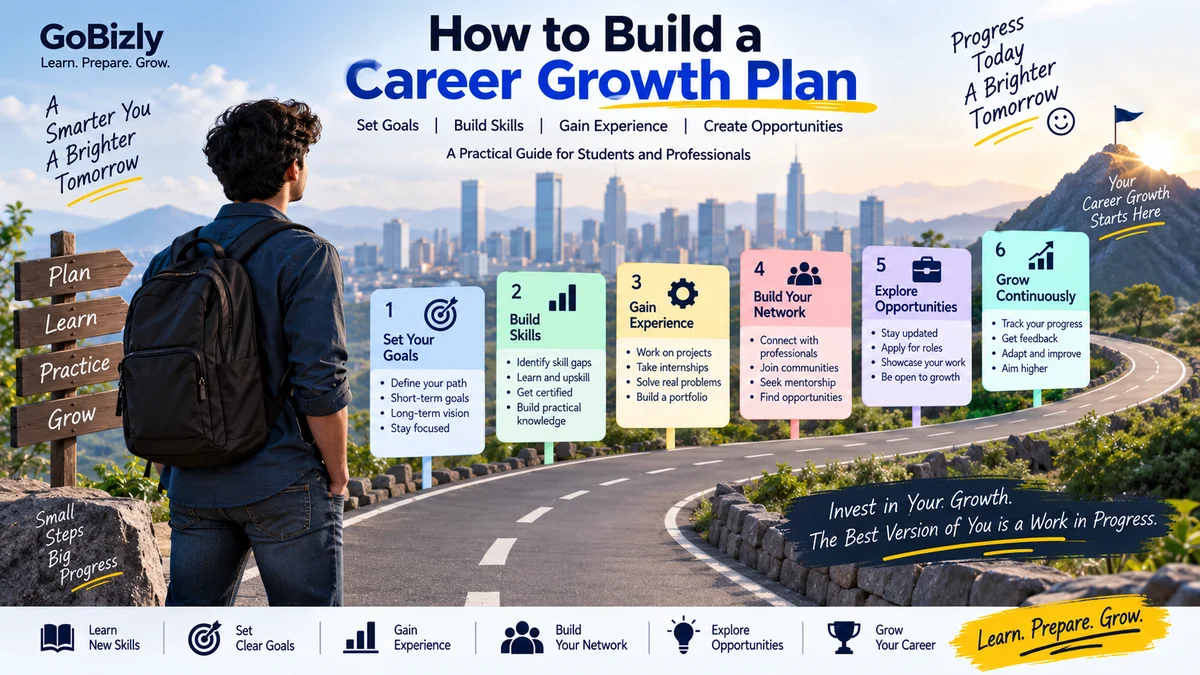
How to Build a Career Growth Plan: A Practical Guide
How to Build a Career Growth Plan: A Practical Guide
Career growth doesn't always happen automatically.
You may gain experience, learn new skills and move between jobs, but without a clear direction, it can be difficult to know whether you're actually moving toward the career you want.
A career growth plan doesn't need to predict your entire future.
Instead, it should give you a practical direction and help you answer:
Where am I now?
Where do I want to go?
What skills do I need?
What experience should I build?
What should I do next?
This guide explains how to create a practical career growth plan that you can review and update over time.
1. Start With Your Current Position
Before deciding where you want to go, understand where you are today.
Review:
Your education
Current skills
Work experience
Projects
Certifications
Strengths
Areas for improvement
Interests
Achievements
Be honest about your current capabilities.
A useful career plan starts with your actual situation rather than an idealized version of your profile.
2. Define Your Career Direction
You don't need to know exactly where you'll be ten years from now.
Start with a direction.
For example:
"I want to build a career in digital marketing."
You can then make that more specific:
"I want to specialize in performance marketing and analytics."
The more specific your direction becomes, the easier it is to identify relevant skills and opportunities.
3. Set Short-Term and Long-Term Goals
Divide your goals into different time horizons.
Short-Term
Usually focused on the next few months.
Examples:
Complete a certification
Improve your resume
Build a project
Apply for relevant roles
Improve communication skills
Medium-Term
Focused on the next one to three years.
Examples:
Move into a specialized role
Take ownership of larger projects
Develop leadership skills
Build deeper technical expertise
Long-Term
Focused on your broader career direction.
Examples:
Become a subject-matter expert
Move into management
Build a specialized career
Start a business
Transition into a new field
Your goals can change as you learn more about yourself and your industry.
4. Identify Your Skill Gaps
Compare your current skills with the skills required for the role you want.
For example:
Skill | Current Level | Target Level | Action |
|---|---|---|---|
Excel | Intermediate | Advanced | Practice |
Analytics | Beginner | Intermediate | Learn + project |
Communication | Intermediate | Strong | Regular practice |
Leadership | Beginner | Intermediate | Take ownership |
This turns a general goal into specific development areas.
5. Prioritize Your Skills
You don't need to improve every skill simultaneously.
Prioritize based on:
Career relevance
How important is the skill for your target role?
Current gap
How far are you from the required level?
Opportunity
Will improving the skill create useful opportunities?
Time required
How realistic is it to develop the skill?
Focus on a few high-priority areas first.
6. Choose the Right Learning Method
Different skills require different learning approaches.
Technical Skills
Use:
Courses
Documentation
Tutorials
Practice exercises
Projects
Communication
Use:
Speaking practice
Presentations
Group discussions
Feedback
Mock interviews
Leadership
Use:
Team projects
Mentoring
Ownership opportunities
Project coordination
Business Knowledge
Use:
Case studies
Articles
Industry reports
Practical projects
Don't assume that completing a course automatically means you've developed a skill.
Application matters.
7. Build Practical Experience
Experience doesn't only come from a full-time job.
You can develop experience through:
Personal projects
College projects
Internships
Freelance work
Volunteer work
Simulations
Case studies
Open-source contributions
For example, if you're learning analytics, build a sample dashboard.
If you're learning digital marketing, create a mock campaign plan.
If you're learning programming, build a small application.
Practical work gives you opportunities to apply what you've learned.
8. Create Evidence of Your Skills
Don't just say:
"I know Excel."
Show what you can do.
Examples:
A dashboard
A project
A presentation
A case study
A portfolio
A written analysis
A campaign plan
A working application
Evidence can make your skills easier to demonstrate during interviews and professional conversations.
9. Build a Professional Portfolio
A portfolio doesn't need to be complicated.
Depending on your career, it could include:
Projects
Case studies
Presentations
Writing
Designs
Dashboards
Campaign examples
Research
Code
Choose examples that demonstrate relevant skills.
Quality and relevance are generally more useful than simply collecting a large number of projects.
10. Develop Your Professional Network
Career opportunities don't come only from job portals.
Professional relationships can help you:
Learn about industries
Understand different roles
Discover opportunities
Learn from experienced professionals
Find mentors
Exchange knowledge
Networking can happen through:
LinkedIn
Professional communities
Events
College alumni
Conferences
Industry groups
Networking should be about building genuine professional relationships, not simply asking everyone for a job.
11. Improve Your Communication
Communication affects almost every career.
Work on:
Writing
Speaking
Listening
Presentations
Business communication
Interview communication
Practice explaining your work clearly.
A technically strong professional who cannot explain their ideas may struggle to communicate their value effectively.
12. Learn to Ask for Feedback
Feedback can help identify blind spots.
Ask specific questions such as:
What is one thing I could improve?
What could I have handled differently?
Which skill would make the biggest difference to my performance?
Specific questions generally produce more useful feedback than simply asking:
"How am I doing?"
13. Track Your Progress
Create a simple career development tracker.
Goal | Action | Target Date | Status |
|---|---|---|---|
Improve Excel | Complete practice project | Oct 10 | In progress |
Build portfolio | Create 2 projects | Oct 20 | Planned |
Improve communication | Weekly speaking practice | Ongoing | Active |
Review it regularly.
A tracker turns career development from an idea into something measurable.
14. Review Your Career Plan Regularly
Your career plan shouldn't be a document you create once and never open again.
Review it every few months.
Ask:
What have I learned?
What have I achieved?
Which goals are still relevant?
What has changed in my industry?
Which skills should I prioritize now?
What opportunities have appeared?
What should I stop doing?
Your plan should evolve as your career develops.
15. Learn From Your Work
Every project can become a learning opportunity.
After completing an important task, ask:
What worked?
What didn't work?
What would I do differently next time?
What skill did I develop?
What should I learn next?
This creates a habit of continuous improvement.
16. Build a Personal Brand
Your professional reputation develops through the work you do and how you communicate it.
You can build your professional presence through:
LinkedIn
Portfolio
Projects
Articles
Presentations
Professional communities
You don't need to post constantly.
Focus on sharing useful and authentic professional information.
17. Don't Chase Every Trend
Industries change quickly.
New tools and technologies appear constantly.
That doesn't mean you need to learn every new tool.
Before investing time in something new, ask:
Is it relevant to my career?
Will it solve a real problem?
Is it becoming important in my industry?
Does it complement my existing skills?
Choose learning priorities based on your goals rather than simply following every trend.
18. Develop Transferable Skills
Some skills remain useful across many roles.
These include:
Communication
Problem solving
Critical thinking
Collaboration
Time management
Adaptability
Presentation
Documentation
Decision-making
Technical skills may change over time, but transferable skills can continue to support your career across different roles.
19. Prepare for Career Changes
Your career may not follow a straight line.
You might eventually:
Change companies
Change roles
Change industries
Move into management
Become a specialist
Start a business
Return to learning
Career planning should therefore leave room for change.
If your interests or circumstances change, reassess your direction instead of treating your original plan as permanent.
A Simple Career Growth Framework
Use this six-step cycle:
ASSESS → DEFINE → LEARN → APPLY → MEASURE → ADAPT
Assess
Understand your current skills and experience.
Define
Choose your career direction and goals.
Learn
Develop the skills you need.
Apply
Use those skills in practical situations.
Measure
Track your progress and results.
Adapt
Update your plan as your career changes.
Then repeat the cycle.
A 90-Day Career Growth Plan
You can start with a simple 90-day plan.
Days 1–30 — Foundation
Focus on:
Defining your target role
Identifying skill gaps
Updating your resume
Improving your LinkedIn profile
Choosing learning resources
Days 31–60 — Development
Focus on:
Learning priority skills
Building projects
Practicing communication
Expanding your professional network
Days 61–90 — Application
Focus on:
Applying your skills
Building your portfolio
Applying for relevant opportunities
Practicing interviews
Reviewing your progress
At the end of 90 days, reassess and create your next plan.
Common Career Growth Mistakes
Setting Vague Goals
"I want to grow" isn't specific enough.
Define what growth means for you.
Learning Without Applying
Practice your skills through real or simulated projects.
Chasing Too Many Skills
Focus on a manageable number of priorities.
Ignoring Communication
Technical skills alone may not be enough.
Comparing Your Timeline With Others
Career paths differ significantly.
Focus on your own progress.
Never Reviewing Your Goals
Your priorities can change.
Waiting for Someone Else to Plan Your Career
Seek guidance, but take ownership of your development.
Career Growth Checklist
☐ Assess your current skills
☐ Define a career direction
☐ Set short-term goals
☐ Set medium-term goals
☐ Identify skill gaps
☐ Prioritize important skills
☐ Choose learning resources
☐ Build practical experience
☐ Create evidence of your skills
☐ Develop your communication
☐ Build professional relationships
☐ Ask for feedback
☐ Track your progress
☐ Review your plan regularly
☐ Adapt when your goals change
Conclusion
Career growth doesn't require having your entire professional life figured out.
Start by understanding where you are.
Choose a direction.
Identify the skills you need.
Learn them.
Apply them.
Track your progress.
Then adjust your plan as you gain experience.
Your career will likely change as you learn more about yourself, your industry and the opportunities available to you.
A good career plan should therefore provide direction without becoming a restriction.
Set a direction. Build the skills. Take action. Keep adapting.
Learn. Prepare. Grow.