How to Attend Your First Interview: A Complete Guide for Freshers
# How to Attend Your First Interview: A Complete Guide for Freshers
Attending your first job interview can feel exciting, confusing and intimidating at the same time.
You may have questions such as:
What should I wear?
What should I carry?
How early should I arrive?
What should I say when I enter the interview room?
How should I introduce myself?
What if I don't know the answer?
How should I answer “Tell me about yourself”?
What if I become nervous?
Should I shake hands?
What should I say at the end?
What should I do after the interview?
These are completely normal questions.
Your first interview is not only about answering technical or HR questions. It is also about demonstrating that you can communicate clearly, behave professionally, listen carefully, stay composed and show genuine interest in the opportunity.
The good news is that interviewing is a skill.
You do not have to be naturally confident to perform well in an interview. You can prepare for it, practise it and improve it.
This guide explains how to attend your first interview from the moment you receive the interview invitation to the time you follow up afterward.
Whether you are a student, fresher, recent graduate, career starter or someone attending an interview after a long break, this guide can help you approach the process with greater confidence.
---
## 1. What Does It Mean to “Attend” an Interview?
Many people think interview preparation means memorizing answers to common questions.
That is only one part of the process.
Attending an interview includes everything from preparing for the opportunity to presenting yourself professionally during the interaction.
A complete interview process can include:
• Understanding the job description
• Researching the company
• Reviewing your resume
• Preparing your introduction
• Preparing for common questions
• Preparing role-specific questions
• Selecting appropriate clothing
• Preparing documents
• Planning your travel
• Arriving on time
• Greeting people professionally
• Listening carefully
• Answering questions clearly
• Asking relevant questions
• Closing the conversation professionally
• Following up afterward
Think of an interview as a professional conversation with a purpose.
The interviewer is trying to understand whether your skills, experience, communication style and expectations are suitable for the role.
You are also evaluating whether the company, role, responsibilities and work environment are suitable for you.
An interview is therefore not simply an examination.
It is a two-way professional interaction.
---
# 2. Your First Interview Starts Before Interview Day
One of the biggest mistakes candidates make is preparing only a few hours before the interview.
Your interview actually begins when you receive the interview invitation.
If you have three days, use those three days.
If you have one week, use that week.
If you have only one day, prioritize the most important preparation areas.
Do not spend all your time trying to memorize hundreds of questions.
Instead, understand the role and prepare your own story.
Your preparation should cover five major areas:
1. Company
2. Role
3. Resume
4. Interview questions
5. Logistics
---
# 3. Understand the Job Description
The job description is one of your most important preparation resources.
Read it carefully instead of simply looking at the job title.
Look for:
• Job responsibilities
• Required skills
• Preferred skills
• Experience requirements
• Educational requirements
• Tools or platforms mentioned
• Communication requirements
• Reporting responsibilities
• Team responsibilities
• Industry knowledge
• Location
• Work arrangement
• Shift requirements
• Other expectations
For example, imagine a job description says:
“Support digital marketing campaigns, monitor campaign performance, prepare reports and coordinate with internal teams.”
You should prepare for questions around:
• Digital marketing fundamentals
• Campaign execution
• Campaign monitoring
• KPIs
• Reporting
• Problem solving
• Team communication
• Basic analytics
The job description can help you predict what the interviewer is likely to explore.
### Create a simple requirement-to-experience map
Make a small table for yourself:
Requirement → My Experience → Example
For example:
Campaign management → Managed campaigns → Explain campaign responsibilities
Reporting → Prepared performance reports → Explain metrics and reporting process
Communication → Worked with internal teams → Give a specific example
Analytics → Used analytics platforms → Explain what you monitored
This exercise makes your preparation much more focused.
---
# 4. Research the Company
You do not need to become an expert on the company.
However, you should know the basics.
Before your interview, understand:
• What the company does
• What products or services it offers
• Who its customers are
• Which industry it operates in
• Where it operates
• What the role contributes to the company
• Recent company developments, if relevant
• Basic information about the team or business unit
Visit the company's official website and read the important sections.
Depending on the company, useful sections may include:
• About
• Products
• Services
• Solutions
• Careers
• News
• Leadership
• Industries
You should be able to answer a simple question such as:
“What do you know about our company?”
A weak answer would be:
“I saw the job on a job portal and applied.”
A better answer would be:
“I understand that the company works in [industry] and provides [product/service] to [customer type]. I was particularly interested in this role because it involves [relevant responsibility], which aligns with my background and the skills I have been developing.”
Keep your answer natural.
Do not sound like you memorized the company's entire website.
---
# 5. Research the Role, Not Just the Company
Knowing the company is useful, but understanding the position is even more important.
Ask yourself:
What would I actually do in this job?
What problems would I be expected to solve?
Which tools would I use?
Who would I work with?
What results would I be responsible for?
What skills are most important?
What would success look like?
If the role involves advertising operations, for example, you might need to understand:
• Campaign setup
• Trafficking
• Targeting
• Budgets
• Pacing
• Bidding
• Creatives
• Tracking
• Reporting
• Troubleshooting
If the role is for a fresher, the interviewer may not expect extensive experience.
They may instead evaluate:
• Learning ability
• Basic knowledge
• Communication
• Problem solving
• Attitude
• Adaptability
• Willingness to learn
Understanding this difference can reduce unnecessary anxiety.
---
# 6. Review Your Resume Carefully
One of the most important rules for interviews is:
Everything on your resume is potentially discussable.
If you mention a skill, project, certification, internship, achievement, tool or responsibility, be prepared to explain it.
Do not add skills simply because they appear in the job description.
For every important item on your resume, ask:
What is it?
How did I use it?
Where did I learn it?
What did I actually do?
What result did it produce?
What was difficult about it?
What did I learn?
For example, if your resume says:
“Google Analytics”
Be prepared for questions such as:
What is Google Analytics?
What is an event?
What is a conversion?
What is the difference between users and sessions?
How do you evaluate website performance?
If you mention:
“Python”
You might be asked:
Why did you learn Python?
What are variables?
What are lists?
What are functions?
Have you built anything using Python?
The interviewer may not ask every question.
But you should be able to defend the information you have presented.
---
# 7. Prepare Your “Tell Me About Yourself” Answer
“Tell me about yourself” is one of the most common opening questions.
Many first-time candidates make one of two mistakes.
They either say too little:
“My name is Rahul. I completed my degree and I am looking for a job.”
Or they tell their entire life story.
Neither approach is ideal.
A professional introduction should be relevant to the role.
A useful structure is:
Present → Background → Skills → Relevant experience/project → Why this opportunity
For example:
“Hi, I’m Rahul. I recently completed my degree in commerce and have developed an interest in digital marketing. During my studies, I worked on academic projects related to social media and online customer behaviour, and I have also completed certifications in Google Ads and analytics. I enjoy understanding how digital campaigns work and how data can be used to improve performance. I’m now looking for an opportunity where I can apply what I’ve learned, gain practical experience and grow within a professional team.”
This is much stronger than listing personal information that has no connection to the job.
---
# 8. Keep Your Introduction Natural
Do not memorize your introduction word-for-word.
If you memorize every sentence, you may sound robotic.
Instead, remember the structure.
Think:
Who am I?
What have I done?
What skills do I have?
Why am I interested in this role?
What do I want to do next?
Practise the answer several times until you can deliver it naturally.
Record yourself on your phone.
Watch the recording.
Check:
• Are you speaking too quickly?
• Are you looking at the camera?
• Are you using unnecessary filler words?
• Are you smiling naturally?
• Are you speaking clearly?
• Is your answer too long?
A good introduction is usually concise and relevant.
You do not need to speak for five minutes.
---
# 9. Prepare for Common Interview Questions
You should prepare for common questions, but do not memorize artificial answers.
Common questions include:
• Tell me about yourself.
• Why do you want this job?
• Why do you want to work for our company?
• What are your strengths?
• What is one area you are working to improve?
• Why should we hire you?
• Where do you see yourself in the future?
• What are your career goals?
• Tell me about a challenge you faced.
• Tell me about a project you worked on.
• How do you handle pressure?
• How do you prioritize tasks?
• How do you handle mistakes?
• How do you work in a team?
• What are your salary expectations?
• Do you have any questions for us?
Prepare your own examples instead of copying answers from the internet.
---
# 10. Use Examples Whenever Possible
One of the best ways to make an answer stronger is to provide an example.
Suppose the interviewer asks:
“How do you handle a difficult task?”
Instead of saying:
“I stay calm and complete it.”
You could say:
“During one of my academic projects, we had limited time to complete the analysis. I first divided the work into smaller tasks, identified the most important deliverables and completed those first. I also communicated with the team when I needed clarification. That helped us complete the project within the deadline.”
The example demonstrates your behaviour.
Whenever possible:
Make a point → Explain your approach → Give an example → State the result or lesson.
---
# 11. Understand the STAR Method
The STAR method is useful for behavioural questions.
STAR stands for:
S — Situation
T — Task
A — Action
R — Result
For example:
Question:
“Tell me about a time you solved a problem.”
Situation:
“Our project team discovered that some of the data we planned to use was incomplete.”
Task:
“I was responsible for helping prepare the analysis.”
Action:
“I checked the available data, identified the missing information and discussed alternative sources with the team.”
Result:
“We were able to complete the analysis using a reliable alternative dataset and submit the project on time.”
You do not have to announce “Situation, Task, Action, Result” during the interview.
Use the structure naturally.
---
# 12. Prepare for Technical Questions
If you are applying for a technical or specialized role, expect role-related questions.
The interviewer may test:
• Basic concepts
• Practical understanding
• Tools
• Processes
• Troubleshooting
• Problem solving
• Industry terminology
• Real-world scenarios
For example, a digital marketing candidate may be asked:
What is CTR?
What is CPC?
What is CPM?
What is conversion rate?
What is ROAS?
What is the difference between SEO and paid advertising?
What is programmatic advertising?
What is a DSP?
What is Google Analytics?
What is campaign tracking?
A software candidate may be asked:
What is a variable?
What is a function?
What is a database?
What is SQL?
What is an API?
What is the difference between frontend and backend?
The goal is not to memorize definitions only.
Try to understand how the concept works in a real situation.
---
# 13. What If You Don't Know the Answer?
This is one of the biggest fears of first-time candidates.
You will probably encounter at least one question you cannot answer.
That is normal.
Do not panic.
Do not invent an answer confidently if you genuinely do not know.
You can say:
“I’m not completely sure about that, but my understanding is…”
Or:
“I haven't worked with that directly yet, but I understand the basic concept as…”
Or:
“I don't know the exact answer at the moment, but I would approach it by…”
This demonstrates honesty and willingness to learn.
If the interviewer corrects you, listen carefully.
Do not become defensive.
You can respond:
“Understood. Thank you for clarifying that.”
A candidate who handles uncertainty professionally can make a better impression than someone who confidently gives incorrect information.
---
# 14. Prepare Questions to Ask the Interviewer
At the end of an interview, you may hear:
“Do you have any questions for us?”
Do not automatically say:
“No.”
Having one or two thoughtful questions shows that you are interested in the opportunity.
You could ask:
“What would success look like in this role during the first three to six months?”
“What would be the main responsibilities of the person joining this position?”
“What does the team structure look like?”
“What are the key skills you would like the selected candidate to develop?”
“What would the next stage of the interview process be?”
For a fresher:
“What kind of training or learning opportunities are available for someone starting in this role?”
Avoid asking questions that were already clearly answered during the conversation.
---
# 15. Prepare Your Interview Documents
Before interview day, prepare everything you may need.
Depending on the interview, carry:
• Updated resume
• Educational certificates if requested
• Experience documents if applicable
• Identification document if required
• Portfolio
• Project details
• Certifications
• Notebook
• Pen
• Interview invitation details
For a physical interview, carry a few printed copies of your resume if appropriate.
Keep digital copies on your phone or cloud storage as a backup.
Organize the files clearly.
For example:
Resume_Name.pdf
Certificates_Name.pdf
Portfolio_Name.pdf
Projects_Name.pdf
This is much better than searching through dozens of random files at the last moment.
---
# 16. Check the Interview Details
Before leaving home, verify:
• Company name
• Interviewer's name
• Interview date
• Interview time
• Office address
• Building name
• Floor
• Meeting room, if provided
• Contact number
• Interview format
• Documents required
• Dress expectations
• Parking or entry requirements
If it is an online interview, verify:
• Meeting platform
• Meeting link
• Login credentials if needed
• Camera
• Microphone
• Internet connection
• Device battery
• Background
• Lighting
Do not assume everything will work automatically.
Test it beforehand.
---
# 17. Plan Your Travel
For an in-person interview, travel planning matters.
Use maps to estimate travel time.
Then add extra time.
For example:
Estimated travel time: 40 minutes
Possible traffic delay: 20 minutes
Entry/security time: 10 minutes
Buffer: 10 minutes
Target departure time should therefore allow approximately 80 minutes.
The exact buffer depends on the location and circumstances.
The important principle is:
Never plan to arrive exactly at the interview time.
---
# 18. How Early Should You Arrive?
For a physical interview, arriving approximately 10–15 minutes early is generally a good target.
Arriving extremely early can also create unnecessary inconvenience if you arrive an hour before the scheduled time.
If you reach the area early, you can wait nearby.
Before entering the office:
• Check your appearance
• Silence your phone
• Review your introduction
• Take a few calm breaths
• Drink some water
• Put your documents in order
Avoid last-minute cramming.
---
# 19. What Should You Wear?
Your clothing should match the professional environment.
When unsure, choose clean, simple and professional clothing.
For many office interviews, appropriate options may include:
• Formal shirt
• Formal trousers
• Clean professional shoes
• Simple accessories
• Neat grooming
Avoid clothing that is:
• Extremely casual
• Dirty
• Wrinkled
• Distracting
• Uncomfortable
You do not need expensive clothing.
Professional presentation is more important than brand names.
Your clothes should allow you to sit, walk and communicate comfortably.
---
# 20. Grooming Matters
You do not need a particular hairstyle or appearance.
The important thing is to look neat and presentable.
Before the interview:
• Keep hair neat
• Maintain clean nails
• Wear clean clothes
• Check your shoes
• Use a moderate amount of fragrance if any
• Keep your overall appearance professional
Small details can affect your confidence.
When you feel prepared physically, you may also feel more prepared mentally.
---
# 21. Entering the Office
When you arrive at reception, communicate clearly.
For example:
“Good morning. I’m Rahul Sharma. I’m here for an interview with the marketing team at 11 AM.”
Speak clearly and politely.
Do not walk into an office without permission.
Follow reception or security instructions.
Keep your phone silent.
Treat every person professionally.
Remember that professionalism is not limited to your interaction with the interviewer.
---
# 22. How to Greet the Interviewer
When the interviewer enters:
Stand if appropriate and greet them politely.
For example:
“Good morning. It’s nice to meet you.”
If they offer a handshake, respond professionally.
If they do not, do not force one.
In virtual interviews, a simple:
“Good morning. Thank you for taking the time to speak with me.”
is appropriate.
Your first few seconds should communicate:
Respect.
Professionalism.
Confidence.
Calmness.
---
# 23. Body Language During an Interview
Your body language can support your verbal communication.
Try to:
• Sit upright
• Maintain comfortable eye contact
• Keep your hands relaxed
• Avoid excessive movement
• Listen when the interviewer speaks
• Nod naturally when appropriate
• Avoid constantly checking your phone
• Avoid crossing your arms tightly
• Avoid looking at the floor throughout the interview
You do not need to maintain intense eye contact continuously.
Natural eye contact is enough.
The goal is to appear comfortable, attentive and engaged.
---
# 24. Listen Before Answering
Many nervous candidates start answering before fully understanding the question.
Take a moment.
Listen carefully.
If you do not understand the question, you can ask:
“Could you please clarify what you mean?”
Or:
“Would you like me to answer that from a technical or practical perspective?”
There is nothing wrong with asking for clarification.
It is better than answering a completely different question.
---
# 25. Do Not Rush Your Answers
Nervousness often causes candidates to speak too quickly.
Slow down.
Take a short pause before answering difficult questions.
A pause of a few seconds is completely normal.
For example:
Interviewer:
“What would you do if you made a mistake at work?”
Pause.
Think.
Then answer.
You do not need to respond instantly to every question.
A thoughtful answer is usually better than a rushed answer.
---
# 26. What If You Become Nervous?
Almost everyone experiences interview nervousness.
Even experienced professionals can feel nervous before important interviews.
Try these techniques:
Take slow breaths.
Relax your shoulders.
Keep your feet stable.
Speak slightly slower.
Focus on the current question rather than the entire interview.
Remember that you do not need to be perfect.
Your objective is to communicate what you know honestly and professionally.
If you lose your train of thought, you can say:
“Let me think about that for a moment.”
Then continue.
---
# 27. How to Handle a Difficult Question
Suppose the interviewer asks something unexpected.
Do not immediately assume the interview is going badly.
Break the question into smaller parts.
For example:
“What would you do if campaign performance suddenly dropped?”
Think:
What changed?
What would I check first?
What data would I review?
What possible causes exist?
What action would I take?
How would I monitor the result?
Then answer logically.
Interviewers often care about your thinking process, not only the final answer.
---
# 28. How to Answer “Why Should We Hire You?”
Do not say:
“Because I need a job.”
Instead, connect your skills to the role.
A simple structure:
Relevant skills + learning ability + attitude + role alignment.
For example:
“I believe I would be a good fit because I have a strong foundation in the skills required for this role, I have been actively developing my practical knowledge and I’m comfortable learning new tools and processes. As someone starting my career, I’m also motivated to learn from the team and contribute consistently.”
Customize this answer based on the actual role.
---
# 29. How to Answer “What Are Your Strengths?”
Choose strengths that are relevant and support them with examples.
Possible strengths include:
• Communication
• Problem solving
• Organization
• Attention to detail
• Learning ability
• Analytical thinking
• Teamwork
• Adaptability
• Time management
• Accountability
Avoid simply listing ten qualities.
Choose two or three.
For example:
“One of my strengths is attention to detail. When working on projects, I prefer to review the important information before submitting the final work. I also try to organize tasks based on priority so that important deadlines are not missed.”
An example makes the answer more credible.
---
# 30. How to Answer “What Is Your Weakness?”
Do not say:
“I have no weaknesses.”
That sounds unrealistic.
Also avoid mentioning a weakness that makes you unsuitable for the job.
Instead, choose a genuine development area and explain what you are doing about it.
For example:
“Earlier, I sometimes spent too much time trying to make a task perfect before moving forward. I have been improving this by setting time limits, prioritizing what matters most and reviewing the work based on the requirements rather than trying to over-polish every detail.”
The important part is not simply the weakness.
It is your awareness and improvement.
---
# 31. How to Answer “Why Do You Want This Job?”
Connect three things:
Your interests.
Your skills.
The opportunity.
For example:
“I’m interested in this role because it aligns with the skills I have been developing and the type of work I want to build my career around. I also like that the position provides an opportunity to work on practical projects and learn from an experienced team.”
Avoid making salary your only reason.
Compensation is important, but your answer should demonstrate broader motivation.
---
# 32. How to Answer “Why Do You Want to Work Here?”
Research helps here.
Instead of:
“Your company is famous.”
Try:
“I was interested in the company because of its work in [industry/area]. When I reviewed the role, I found that the responsibilities closely match my interests in [skill/area]. I also see this as an opportunity to develop my skills while contributing to the team.”
Keep it specific.
---
# 33. How to Discuss Salary
If asked about salary expectations, remain professional.
If you have researched the market and understand the expected range, you can provide a reasonable range rather than an unrealistic number.
For example:
“Based on the role, responsibilities and my current skill level, I would be comfortable discussing a market-aligned package. I’m also open to understanding the company's range for the position.”
If you already know the company's range, you can respond within that context.
Do not become defensive.
Salary discussions are part of professional hiring.
---
# 34. How to Handle Questions About Experience
Freshers often worry because they have limited professional experience.
Do not apologize repeatedly for being a fresher.
Instead, highlight transferable experience.
This can include:
• Academic projects
• Internships
• Certifications
• Freelance work
• Personal projects
• Volunteer activities
• College organizations
• Competitions
• Practical learning
• Portfolio projects
For example:
“Although I haven't worked in a full-time position yet, I have built practical knowledge through projects, certifications and hands-on learning. I understand that there is still a lot to learn, and I'm looking forward to developing that knowledge in a professional environment.”
---
# 35. How to Talk About College Projects
Do not describe a project only by its title.
Explain:
Problem → Objective → Your role → Approach → Result → Learning
For example:
“Our project focused on understanding customer preferences. My responsibility was to collect and organize the data and help prepare the final analysis. We used survey responses and categorized the information to identify patterns. The project helped me understand how structured data can support decision-making.”
Be ready for follow-up questions.
If you worked on the project, you should know the details.
---
# 36. What If You Have a Career Gap?
If you have a gap, do not panic.
Be honest and concise.
You do not need to give unnecessary personal details.
A professional structure is:
Reason → What you did during the period → Current readiness
For example:
“I had to take time away from work due to personal circumstances. During that period, I also used the time to reassess my career direction and refresh my professional skills. I’m now ready to return to a full-time professional role and apply those skills in a structured environment.”
Keep the conversation focused on the present and your readiness.
---
# 37. How to Handle a Career Change
If you are changing fields, explain why the new direction makes sense.
For example:
“My previous experience helped me develop strong communication and analytical skills, but over time I became more interested in technology and data. I started learning the relevant tools and concepts and realized that this is an area I want to build my long-term career in.”
The interviewer needs to understand your motivation.
---
# 38. Online Interview Preparation
Virtual interviews require their own preparation.
Before the interview:
Test your camera.
Test your microphone.
Check your internet.
Charge your device.
Close unnecessary applications.
Disable distracting notifications.
Choose a quiet location.
Use a clean and professional background.
Position your camera at approximately eye level.
Make sure your face is adequately visible.
Keep your resume and job description accessible.
---
# 39. Camera Position Matters
Avoid placing the laptop too low.
If the camera points upward from below your face, the framing can look awkward.
Place the device at a comfortable height.
Look toward the camera when speaking.
When listening, it is natural to look at the screen.
You do not need to stare directly into the camera throughout the entire interview.
---
# 40. What If the Internet Disconnects?
Do not panic.
If possible, reconnect quickly.
Keep your phone available as a backup communication method.
If you return to the meeting, say:
“Apologies for the interruption. My connection dropped briefly. Thank you for waiting.”
Then continue.
Technical problems happen.
How you handle them matters more than the fact that they happened.
---
# 41. Virtual Interview Background
Your background should not become the focus of the interview.
Choose:
• Clean space
• Minimal distractions
• Good lighting
• Quiet environment
Avoid sitting directly in front of a bright window if it makes your face dark.
A simple background is usually better than an elaborate one.
---
# 42. Interview Etiquette: Things to Avoid
Avoid:
• Arriving late without informing anyone
• Checking your phone
• Interrupting the interviewer
• Speaking negatively about previous employers
• Exaggerating skills
• Lying about experience
• Arguing with the interviewer
• Using excessive slang
• Speaking disrespectfully
• Giving extremely long answers
• Memorizing robotic responses
• Asking about holidays immediately
• Focusing only on salary
• Complaining about every previous experience
Professionalism is often demonstrated through small behaviours.
---
# 43. Never Lie About Your Skills
You may be tempted to say:
“Yes, I know that tool.”
because you believe it will increase your chances.
But if the interviewer asks practical questions, the gap becomes obvious.
Instead say:
“I haven't worked with that tool directly yet, but I understand the fundamentals and I'm currently learning it.”
This is a much stronger professional position.
Honesty builds credibility.
---
# 44. Don't Memorize Every Interview Answer
Interview preparation should not become a memorization exercise.
If you memorize:
“Tell me about yourself.”
“What are your strengths?”
“Why should we hire you?”
word-for-word, you may struggle when the interviewer changes the wording.
Instead, understand the key points.
For example:
Introduction:
Education → skills → project → interest → career goal
Strength:
Strength → example → result
Weakness:
Development area → action → improvement
Career goal:
Current direction → skills → future growth
This gives you flexibility.
---
# 45. Practise With Mock Interviews
One of the most effective ways to prepare is to simulate the real experience.
Ask a friend, mentor or family member to conduct a mock interview.
Ask them to include:
• Introduction
• HR questions
• Technical questions
• Situational questions
• Unexpected questions
• Questions about your resume
Record the session if possible.
Afterward, evaluate:
Did I answer directly?
Did I speak too quickly?
Did I use filler words?
Did I provide examples?
Did I avoid eye contact?
Did I interrupt?
Were my answers too long?
Did I sound confident?
---
# 46. Practice in Front of a Camera
You can also practise alone.
Open your phone camera and answer questions.
Watch yourself afterward.
This can reveal things you may not notice during normal conversation.
For example:
“Basically…”
“Actually…”
“Like…”
“You know…”
“Maybe…”
These filler words are common.
You do not have to eliminate them completely.
Simply become aware of them and reduce excessive usage.
---
# 47. Create a One-Page Interview Preparation Sheet
Before the interview, create one page containing:
Company:
[Company name]
Role:
[Job title]
Top responsibilities:
1.
2.
3.
Top skills:
1.
2.
3.
My relevant experience:
1.
2.
3.
My introduction:
Key points
Important technical concepts:
1.
2.
3.
4.
5.
Questions I want to ask:
1.
2.
3.
Interviewer's name:
[Name]
Interview time:
[Time]
Location/link:
[Details]
This sheet can help you stay organized.
---
# 48. A Simple 24-Hour Interview Preparation Plan
If your interview is tomorrow, don't panic.
Use the remaining time strategically.
### 24–18 hours before
Understand the job description.
Research the company.
Review your resume.
Identify important skills.
### 18–12 hours before
Prepare your introduction.
Prepare common HR questions.
Review technical fundamentals.
Prepare examples.
### 12–6 hours before
Practise speaking.
Conduct a mock interview.
Prepare clothing.
Organize documents.
Check travel or meeting details.
### 6–2 hours before
Rest.
Eat appropriately.
Avoid unnecessary last-minute studying.
### 2 hours before
Review your notes.
Check travel.
Charge your phone.
Keep documents ready.
### 30 minutes before
Move to the interview location or join the online meeting setup.
Take a few breaths.
Focus.
---
# 49. A Simple One-Week Interview Preparation Plan
If you have more time, use it.
### Day 1 — Understand the role
Read the job description.
Identify responsibilities and skills.
### Day 2 — Research the company
Understand the company, industry and role.
### Day 3 — Resume preparation
Review every line of your resume.
Prepare examples.
### Day 4 — Technical preparation
Review role-specific concepts and tools.
### Day 5 — HR preparation
Practise common interview questions.
### Day 6 — Mock interview
Simulate the full interview.
### Day 7 — Final preparation
Prepare documents, clothing, travel and final notes.
This approach is better than trying to study everything in one night.
---
# 50. What to Do During the Final Five Minutes Before the Interview
Do not try to learn 20 new concepts.
Instead:
Take a breath.
Check your appearance.
Silence your phone.
Review your introduction.
Remember your key strengths.
Think about the role.
Remind yourself:
“I don't need to know everything. I need to communicate what I know clearly and honestly.”
This mindset can help reduce pressure.
---
# 51. How to End the Interview
When the interviewer indicates that the interview is finished, thank them.
For example:
“Thank you for taking the time to speak with me today. I really appreciate the opportunity to learn more about the role and the team.”
If appropriate, you can add:
“I’m very interested in the opportunity and look forward to hearing from you.”
Keep the ending professional.
Do not immediately stand up and leave without acknowledging the interviewer.
---
# 52. What to Do After the Interview
Your preparation does not end when you leave the room.
Take a few minutes afterward to record:
• Questions you were asked
• Questions you answered well
• Questions you struggled with
• Concepts you need to improve
• Questions you want to research
• Feedback you received
• Things you would answer differently next time
This creates an interview learning system.
Even if you do not receive the job, the interview can make you better prepared for the next opportunity.
---
# 53. Should You Send a Thank-You Message?
If appropriate, a short professional thank-you message can be useful.
For example:
“Thank you for taking the time to speak with me today regarding the [Role Name] position. I appreciated learning more about the role and the team. The conversation further increased my interest in the opportunity, and I look forward to hearing about the next steps.”
Keep it short.
Do not send a long emotional message.
---
# 54. What If You Don't Get Selected?
Not getting selected does not automatically mean you are not capable.
Hiring decisions can depend on many factors.
The company may have selected someone with:
• More relevant experience
• A different skill set
• Internal experience
• Stronger technical knowledge
• Different salary expectations
• Better alignment with the current requirement
Treat rejection as information.
Ask yourself:
What did I learn?
Where did I struggle?
Which questions surprised me?
What should I study?
What should I practise?
Then improve.
---
# 55. How to Turn One Interview Into Better Preparation
Suppose you were asked:
“What is an API?”
and you struggled.
After the interview:
Study APIs.
Understand the concept.
Read practical examples.
Explain it aloud.
Use it in a small project if possible.
Now the next time someone asks the question, you are better prepared.
This is how interview experience compounds.
Every interview can become preparation for the next one.
---
# 56. First Interview Checklist
Use this checklist before your first interview.
### Before the interview
□ Read the job description
□ Research the company
□ Understand the role
□ Review your resume
□ Prepare your introduction
□ Prepare common questions
□ Prepare technical concepts
□ Prepare examples
□ Prepare questions for the interviewer
□ Confirm interview time
□ Confirm location or meeting link
□ Prepare documents
□ Choose your clothing
□ Plan your travel
□ Test your equipment if online
□ Get enough rest
### On interview day
□ Eat appropriately
□ Carry your documents
□ Keep your phone charged
□ Arrive early
□ Silence your phone
□ Stay calm
□ Greet everyone professionally
□ Listen carefully
□ Answer clearly
□ Ask for clarification when needed
□ Be honest about what you know
□ Ask thoughtful questions
□ Thank the interviewer
### After the interview
□ Record important questions
□ Note areas for improvement
□ Send a professional follow-up if appropriate
□ Continue preparing for future opportunities
---
# 57. First Interview Mistakes Freshers Should Avoid
Here are some common mistakes.
### Mistake 1: Not reading the job description
You cannot prepare effectively if you don't understand what the company is hiring you to do.
### Mistake 2: Not knowing your resume
If the interviewer asks about something you wrote, you should be able to explain it.
### Mistake 3: Giving memorized answers
Interviewers usually notice when an answer sounds artificial.
### Mistake 4: Speaking too much
Answer the question first.
Then provide context or an example.
### Mistake 5: Speaking too little
A one-word answer may make it difficult for the interviewer to understand your thinking.
### Mistake 6: Pretending to know everything
Honesty is better than false confidence.
### Mistake 7: Not asking questions
Prepare at least one or two relevant questions.
### Mistake 8: Arriving late
Poor planning can create an avoidable negative impression.
### Mistake 9: Checking your phone
Give the interview your full attention.
### Mistake 10: Giving up after rejection
Every interview provides an opportunity to improve.
---
# 58. Interview Confidence Is Built Through Preparation
Confidence does not always mean feeling completely relaxed.
You can still feel nervous and perform well.
Real interview confidence comes from preparation.
When you know:
• What the company does
• What the role requires
• What your resume says
• What your skills are
• What examples you can provide
• What questions may be asked
• How you will handle questions you don't know
you have a stronger foundation.
The goal is not to eliminate nervousness.
The goal is to become capable of performing despite it.
---
# 59. Your First Interview Does Not Have to Be Perfect
Your first interview may not go exactly as planned.
You might:
Forget an answer.
Speak too quickly.
Get nervous.
Miss a question.
Give an unclear response.
Forget to ask a question.
That is okay.
Your first interview is also a learning experience.
The important thing is to review what happened and improve.
Your second interview can be better than your first.
Your fifth can be better than your second.
Your tenth can be dramatically better than your first.
Interviewing is a skill that develops through preparation and repetition.
---
# 60. A Practical Interview Framework to Remember
If you remember only one framework from this guide, remember:
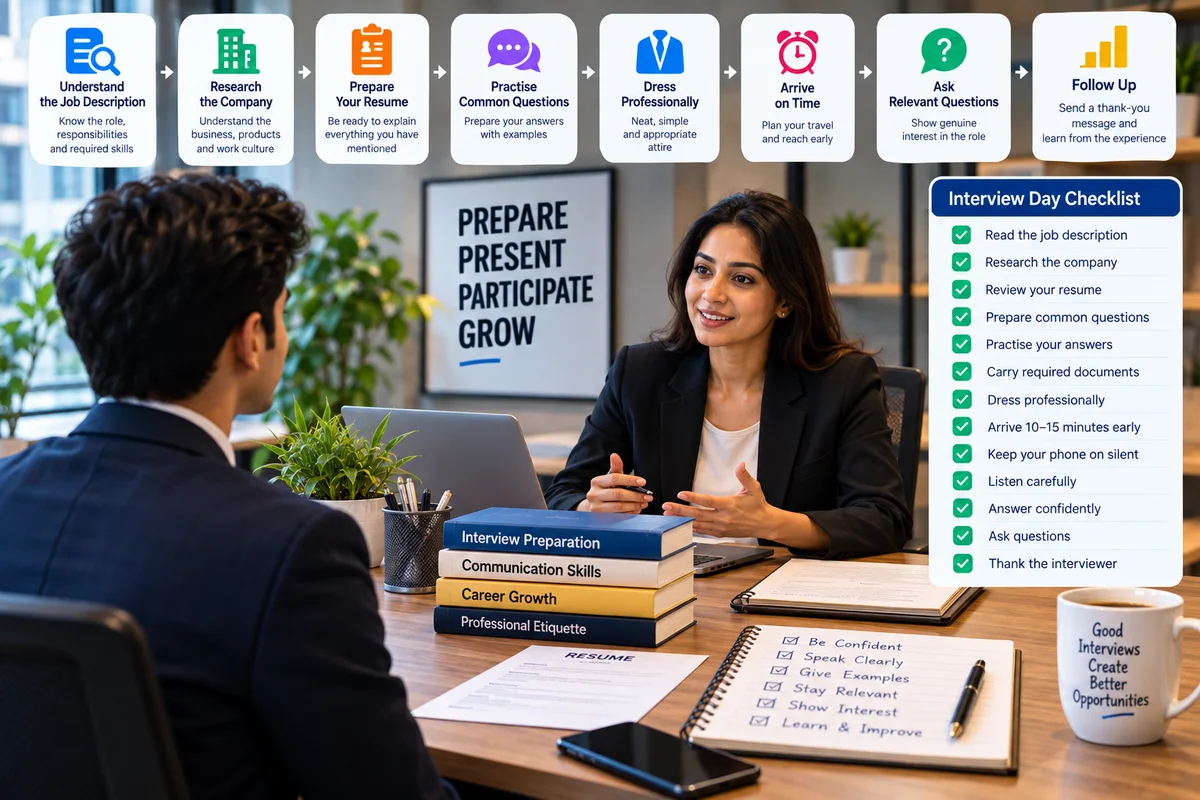
## PREPARE → PRESENT → PARTICIPATE → FOLLOW UP
### PREPARE
Understand the company, role, resume and questions.
### PRESENT
Communicate your skills, experience and personality professionally.
### PARTICIPATE
Listen, answer, ask questions and engage in the conversation.
### FOLLOW UP
Thank the interviewer, reflect on your performance and continue improving.
This simple framework can help you approach almost any interview.
---
# 61. Final Thoughts
Your first interview can feel like a major test.
But it is better to think of it as a professional conversation where you have an opportunity to demonstrate what you know, explain what you have learned and show how you can contribute.
You do not need to know everything.
You do not need to have perfect communication.
You do not need to have years of experience.
You do need to be prepared, honest, professional and willing to learn.
Before your first interview, remember these principles:
Understand the role.
Research the company.
Know your resume.
Prepare your introduction.
Practise common questions.
Use examples.
Listen carefully.
Do not rush.
Be honest when you don't know something.
Dress appropriately.
Arrive early.
Keep your documents ready.
Ask thoughtful questions.
Thank the interviewer.
Learn from every interview.
Most importantly, don't wait until you feel 100% confident before attending an interview.
Preparation creates confidence.
Practice creates familiarity.
Experience creates improvement.
Your first interview is simply the beginning.
Prepare well, show up professionally, communicate clearly and use every interview as an opportunity to become better.
GoBizly — Learn. Prepare. Grow.