How to Answer “Tell Me About Yourself” in an Interview
How to Answer “Tell Me About Yourself” in an Interview
"Tell me about yourself."
It is one of the most common questions candidates encounter during interviews.
Although the question sounds simple, your answer can influence how the conversation begins.
You don't need to tell the interviewer your entire life story.
A strong response should provide a concise overview of your professional background, relevant skills, experience and career direction.
1. Understand What the Question Is Asking
The interviewer usually isn't asking for personal information such as:
Where you grew up
Your family history
Your hobbies in detail
Your entire educational history
The answer should primarily focus on information relevant to the opportunity.
Think of it as:
Who are you professionally?
What have you worked on or learned?
What are you looking to do next?
2. Use a Simple Structure
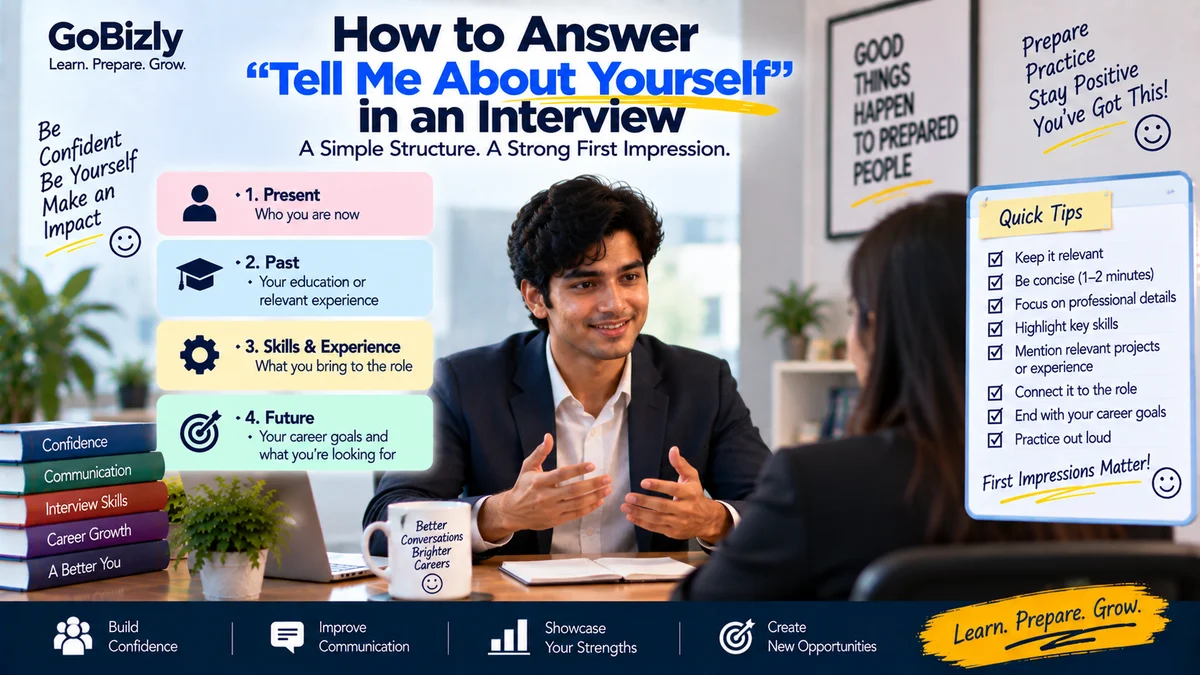
A useful structure is:
Present → Past → Skills/Experience → Future
Present
Explain who you are currently.
Past
Briefly mention relevant education or experience.
Skills/Experience
Highlight what connects you to the role.
Future
Explain what type of opportunity you're looking for.
3. Example for a Fresher
"I'm a recent commerce graduate with an interest in digital marketing and analytics. During college, I worked on academic projects and completed relevant certifications that helped me build a foundation in digital marketing concepts and analytics tools. I'm now looking for an entry-level opportunity where I can apply what I've learned, gain practical experience and continue developing professionally."
Notice that the answer focuses on:
Education
Skills
Projects
Career direction
4. Example for an Experienced Professional
"I have several years of experience in digital marketing and campaign operations, with a focus on programmatic advertising and campaign management. I've worked with platforms such as DV360 and CM360 and have experience with campaign setup, troubleshooting, reporting and optimization. I'm now looking for an opportunity where I can apply that experience while taking on broader responsibilities."
Customize the example to your actual background.
5. Connect Your Answer to the Role
Suppose you're interviewing for a digital marketing role.
Relevant information might include:
Marketing experience
Advertising platforms
Analytics
Campaign management
Projects
Certifications
You don't need to spend most of your answer discussing unrelated experiences.
6. Keep It Concise
A practical target is around 1–2 minutes, depending on the interview and your experience.
If your answer becomes too long, the interviewer may lose the main point.
Focus on the information that helps them understand your professional profile.
7. Don't Memorize Every Word
Memorizing a script can make your answer sound unnatural.
Instead, remember the structure:
Present → Background → Relevant skills → Career direction
Then speak naturally.
8. Highlight Relevant Strengths
Choose strengths connected to the role.
For example:
Marketing: Campaign management, analytics, communication.
Data: Excel, SQL, analysis.
IT: Programming, databases, problem solving.
Operations: Organization, process management, communication.
Use skills you genuinely possess.
9. Mention Projects When They Add Value
For students and freshers, projects can provide useful context.
For example:
"During college, I worked on a project where I analyzed customer survey data using Excel and presented the findings."
This gives the interviewer something specific to ask about.
10. Don't Turn It Into a Resume Reading
Avoid saying every item on your resume one after another.
Instead of:
"I completed this certification, then this course, then this project..."
connect the information into a story.
11. Avoid Unnecessary Personal Details
The interviewer doesn't need your entire personal history.
Keep the answer focused on professional information relevant to the role.
If personal information is directly relevant to the conversation, you can decide how much you're comfortable sharing.
12. Be Careful With Career Gaps
If you have a career gap, you don't necessarily need to begin your introduction with it.
Focus first on:
Your professional background
Relevant skills
Recent learning
Current career direction
If the interviewer asks about the gap separately, answer it honestly and concisely.
13. End With Your Current Goal
A strong closing can connect your background to the opportunity.
For example:
"I'm now looking for a role where I can apply these skills, contribute to the team and continue developing in this area."
This gives the interviewer a natural transition to the next question.
14. Practice Different Versions
Prepare variations for:
Fresher
Education → Projects → Skills → Career direction
Experienced
Experience → Skills → Achievements → Target role
Career Change
Previous experience → Transferable skills → New learning → New direction
Returning After a Break
Previous experience → Recent learning → Current readiness → Target role
15. Avoid Common Mistakes
Avoid:
Speaking for too long
Giving unrelated personal information
Reading your resume word-for-word
Using exaggerated claims
Memorizing a robotic script
Speaking negatively about previous employers
Claiming skills you don't have
16. Practice Out Loud
Practice your answer several times.
Pay attention to:
Speaking pace
Clarity
Structure
Repetition
Filler words
Try recording yourself once or twice.
17. Adapt Based on the Interview
Your introduction doesn't have to be identical in every interview.
For a technical role, emphasize technical preparation.
For a marketing role, emphasize relevant marketing experience.
For an operations role, emphasize process and organizational skills.
Keep the facts consistent.
18. Prepare Follow-Up Questions
Your introduction may lead to questions such as:
"Tell me about that project."
"How did you use that tool?"
"Why did you choose that career?"
"What did you learn?"
Be prepared to expand on anything you mention.
19. Use Evidence
Whenever possible, support your statements with examples.
Instead of:
"I'm good at problem solving."
Try:
"During my college project, we faced a data-quality issue, so I reviewed the source data, identified the inconsistencies and adjusted the analysis."
Specific examples are easier to discuss.
20. Create Your Own Version
Write down:
Who am I professionally?
What have I studied or worked on?
What skills are relevant?
What experience can I discuss?
What type of role am I targeting?
Then combine the answers into a short introduction.
Tell Me About Yourself Checklist
☐ Start with your current professional identity
☐ Mention relevant background
☐ Highlight useful skills
☐ Include relevant projects or experience
☐ Connect your answer to the role
☐ Keep it concise
☐ Avoid unnecessary personal details
☐ Don't memorize word-for-word
☐ Practice aloud
☐ Prepare follow-up questions
☐ End with your career direction
Conclusion
"Tell me about yourself" doesn't require a complicated answer.
Think of it as a short professional introduction.
Explain where you are, what you've learned or done, what skills you bring and where you want to go next.
Keep it relevant.
Keep it honest.
Keep it conversational.
Your introduction should open the interview—not tell your entire life story.
Learn. Prepare. Grow.