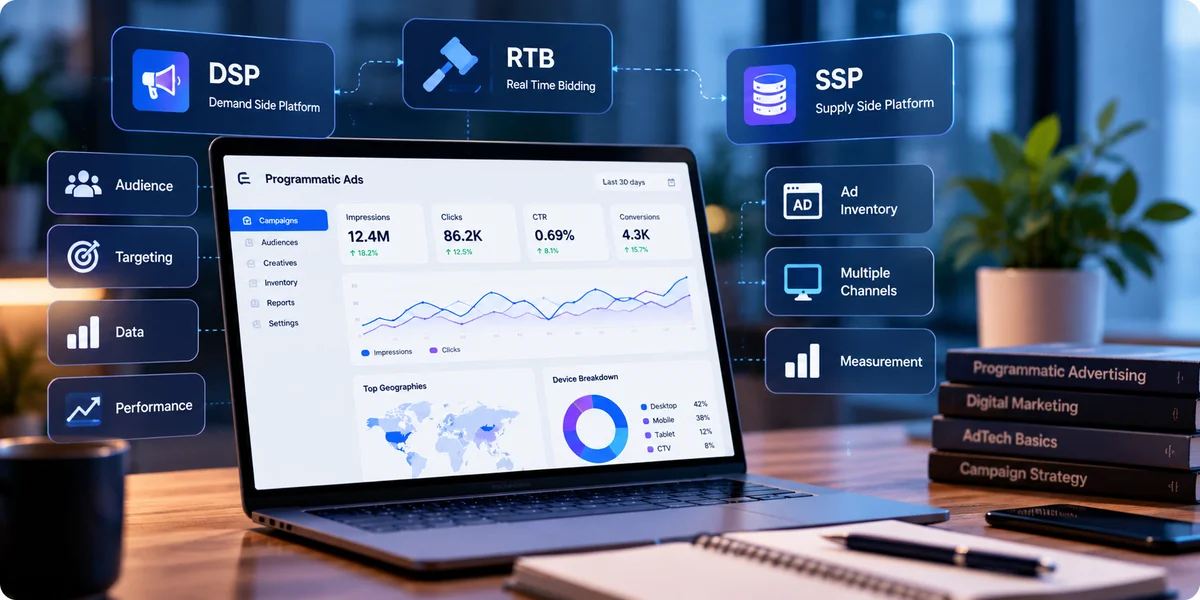
How Programmatic Advertising Works: DSPs, SSPs, RTB & Ad Exchanges
How Programmatic Advertising Works: DSPs, SSPs, RTB & Ad Exchanges
When you visit a website and see an advertisement, several technology systems may have been involved in deciding which advertisement appears on the page.
The process can happen extremely quickly.
An advertiser may want to reach a particular audience.
A publisher may have advertising space available.
A supply-side platform may make that inventory available.
A demand-side platform may evaluate the opportunity for an advertiser.
An auction may determine which eligible bid wins.
And the advertisement may then be delivered to the user.
This ecosystem is commonly known as programmatic advertising.
If you're new to programmatic advertising, you can first read our beginner's guide:
What Is Programmatic Advertising? A Complete Beginner's Guide
This article goes deeper into the technology behind the process.
You'll learn:
What happens during a programmatic ad opportunity
What a DSP does
What an SSP does
What an ad exchange does
How RTB works
How advertisers bid
How publishers sell inventory
Where targeting fits into the process
What happens after an auction
How measurement works
Common programmatic buying methods
A practical example
The Programmatic Advertising Ecosystem
A simplified programmatic ecosystem looks like this:
Advertiser
↓
Agency / Trading Team
↓
DSP
↓
Ad Exchange / SSP
↓
Publisher
↓
User
This is a simplified representation.
In the real ecosystem, there can be additional technologies and relationships, including:
Ad servers
Data providers
Verification vendors
Identity solutions
Measurement platforms
Supply-path partners
Private marketplaces
Direct publisher relationships
The exact architecture varies depending on the campaign.
What Is a DSP?
DSP stands for Demand-Side Platform.
A DSP is a technology platform that allows advertisers or agencies to purchase digital advertising inventory programmatically.
Instead of manually negotiating every individual advertising opportunity, advertisers can use a DSP to manage campaigns across available inventory.
A DSP can help advertisers with tasks such as:
Campaign setup
Audience targeting
Bidding
Budget management
Frequency management
Creative management
Inventory selection
Optimization
Reporting
Examples of DSPs include platforms such as Display & Video 360, The Trade Desk and other programmatic buying platforms.
What Is an SSP?
SSP stands for Supply-Side Platform.
An SSP is technology used by publishers to manage and monetize available advertising inventory.
A publisher may use an SSP to make inventory available to multiple potential buyers.
An SSP can support activities such as:
Inventory management
Yield optimization
Auction management
Buyer access
Deal management
Reporting
The SSP operates primarily from the publisher/supply side.
What Is an Ad Exchange?
An ad exchange is a technology marketplace that facilitates the buying and selling of digital advertising inventory.
It can connect buyers and sellers and facilitate auctions for advertising opportunities.
A simplified flow is:
Publisher inventory → Exchange → Eligible buyers → Auction → Winning bid → Advertisement
In practice, exchanges, SSPs and other supply-side technologies can have overlapping or integrated functionality, so the simplified diagram shouldn't be interpreted as a universal technical architecture.
What Is RTB?
RTB stands for Real-Time Bidding.
RTB is a form of programmatic buying in which advertising opportunities can be auctioned electronically in real time.
Imagine a user opens a webpage containing an advertising placement.
An eligible advertising opportunity becomes available.
Information about the opportunity is passed through the relevant programmatic infrastructure.
Potential buyers evaluate it.
Eligible advertisers submit bids.
An auction determines the winning outcome according to the relevant auction and platform rules.
The winning creative is then delivered.
This entire process can happen extremely quickly.
A Simple RTB Flow
Here's a simplified example:
1. User opens a webpage
↓
2. Publisher has an available ad impression
↓
3. Supply-side technology makes the opportunity available
↓
4. DSPs evaluate the opportunity
↓
5. Advertisers' campaign rules are checked
↓
6. Eligible campaigns may submit bids
↓
7. Auction determines the winning bid
↓
8. Winning creative is returned
↓
9. Advertisement is displayed
The actual technical process can be more complex and may involve multiple systems.
What Does the DSP Evaluate?
When a DSP receives an advertising opportunity, it needs to determine whether that opportunity is relevant to one or more campaigns.
Campaign rules can include:
Geography
Audience
Device
Browser
Context
Inventory type
Frequency
Budget
Bid strategy
Creative eligibility
Brand-safety requirements
Viewability requirements
Deal targeting
If an opportunity doesn't meet the campaign's requirements, the campaign may not participate.
Example: Audience Targeting
Imagine an advertiser wants to reach:
People interested in professional education in India.
The campaign may have additional requirements such as:
Specific geographic locations
Certain devices
Frequency limits
Approved inventory
Specific audience segments
When an impression becomes available, the DSP evaluates whether the opportunity matches the campaign requirements.
If it doesn't match, the campaign may not bid.
If it does match, the campaign may become eligible to participate.
How Does Bidding Work?
Suppose an advertising opportunity becomes available.
Three advertisers are eligible:
Advertiser | Bid |
|---|---|
Advertiser A | ₹4 |
Advertiser B | ₹6 |
Advertiser C | ₹5 |
A simplified example might suggest Advertiser B has the highest bid.
However, real programmatic auctions aren't always as simple as "highest number wins."
Auction rules can vary by marketplace and transaction type.
Other factors can include:
Auction mechanics
Bid eligibility
Deal terms
Floor prices
Creative eligibility
Quality and policy requirements
Platform-specific rules
Therefore, marketers should avoid assuming that every auction operates identically.
What Is an Ad Impression?
An impression represents an instance in which an advertisement is served or recorded as served according to the relevant measurement system.
For example:
A webpage loads an advertising placement and an eligible advertisement is delivered.
That opportunity can result in an impression being recorded.
Impressions are commonly used to measure advertising delivery.
What Is Inventory?
Inventory refers to advertising opportunities that publishers make available to advertisers.
Examples include:
Website display placements
Mobile app placements
Video placements
Connected TV inventory
Audio inventory
Native advertising opportunities
Inventory can differ significantly in:
Format
Environment
Audience
Quality
Price
Availability
Open Auction vs Private Marketplace
Programmatic inventory can be purchased through different transaction types.
Open Auction
The inventory is generally available to a broad set of eligible buyers through an auction environment.
Advertisers compete for eligible impressions.
Private Marketplace
A Private Marketplace (PMP) is a more controlled programmatic buying environment.
A publisher may make selected inventory available to a specific group of buyers.
PMP deals can provide more control over:
Publisher selection
Inventory
Pricing
Audience
Deal terms
Programmatic Guaranteed
Programmatic Guaranteed is a transaction structure in which an advertiser and publisher agree on inventory and commercial terms, while technology is used to facilitate delivery and execution.
It is different from a typical open auction because the transaction is based on an agreed arrangement rather than an impression-by-impression open auction competition.
What Is a Deal ID?
A Deal ID is a unique identifier associated with a specific programmatic deal.
For example, a publisher may create a private deal and provide its Deal ID to an advertiser or agency.
The buyer can then use the Deal ID to access the agreed inventory.
A simplified flow:
Publisher → Creates deal → Deal ID → Buyer → DSP → Campaign
Deal configuration can include conditions such as:
Inventory
Pricing
Audience
Geography
Dates
Frequency
Other deal-specific rules
What Is a First-Price Auction?
In a simplified first-price auction, the winning bidder pays the amount of its winning bid.
For example:
Advertiser A bids ₹4.
Advertiser B bids ₹6.
Advertiser C bids ₹5.
If B wins under a first-price auction structure, the clearing price could be ₹6.
However, actual auction mechanics can vary by platform and marketplace.
Why Bid Higher?
A higher bid can increase the opportunity to win eligible inventory, but higher bidding also increases potential costs.
Advertisers therefore need to balance:
Reach + Opportunity + Cost + Performance
A campaign shouldn't simply increase bids without considering:
Conversion performance
Budget
Inventory quality
Audience value
Frequency
Business objectives
What Is Frequency Capping?
Frequency capping limits how often a user is exposed to an advertisement within a defined period.
For example:
3 impressions per user per day
This means the campaign attempts to limit exposure according to the configured rule.
Frequency management can help advertisers:
Control repeated exposure
Reduce unnecessary impressions
Manage budget
Improve user experience
The exact behavior depends on the platform and measurement environment.
Why Can a DSP Lose a Bid?
A campaign may fail to win an auction for many reasons.
For example:
Bid too low
Another eligible buyer may submit a stronger bid.
Budget constraints
The campaign may have limited available budget.
Targeting mismatch
The impression may not meet campaign targeting requirements.
Frequency cap
The user may already have reached the campaign's exposure limit.
Creative issue
The creative may not be eligible for the placement.
Inventory restrictions
The campaign may exclude the available inventory.
Brand safety
The inventory may not meet campaign safety requirements.
Deal configuration
The impression may not satisfy a particular deal's conditions.
This is why troubleshooting programmatic delivery requires looking beyond the bid.
What Is Pacing?
Pacing refers to how campaign spending or delivery is distributed over time.
Imagine a campaign has:
₹100,000 budget
and:
30-day duration
The campaign shouldn't necessarily spend the entire amount immediately.
Depending on the platform and settings, pacing controls can help distribute delivery over the campaign period.
Pacing can be affected by:
Budget
Bid strategy
Inventory availability
Targeting
Audience size
Performance goals
Campaign schedule
What Is Viewability?
An impression being served doesn't necessarily mean a user actually saw the advertisement.
Viewability attempts to measure whether an advertisement had an opportunity to be seen according to a defined measurement standard.
Advertisers may work with verification and measurement providers to understand:
Viewability
Invalid traffic
Brand safety
Brand suitability
Fraud-related signals
Examples of industry vendors include IAS and DoubleVerify.
What Is Brand Safety?
Brand safety involves reducing the risk of advertisements appearing alongside content or environments that don't meet an advertiser's requirements.
Advertisers may use:
Inventory exclusions
Blocklists
Allow lists
Content classifications
Verification tools
Brand-safety controls
The appropriate approach depends on the advertiser and campaign.
What Is Invalid Traffic?
Invalid traffic refers broadly to activity that doesn't represent legitimate user interaction with advertising.
It can include certain forms of:
Automated traffic
Fraudulent activity
Manipulated impressions
Artificial clicks
Measurement and verification systems can help advertisers identify and manage some forms of invalid traffic.
What Happens After the Auction?
Once an auction determines the winning outcome, the selected advertisement can be returned for delivery.
The user then sees the advertisement if the delivery process completes successfully.
Afterward, measurement systems can record events such as:
Impression
Click
Video interaction
Conversion
The resulting data can then be used for reporting and optimization.
Programmatic Measurement
A programmatic campaign can be measured using many KPIs.
Common metrics include:
KPI | Purpose |
|---|---|
Impressions | Measure delivery |
Reach | Estimate unique audience exposure |
Frequency | Understand repeated exposure |
CPM | Measure media cost |
CTR | Measure click activity |
CPC | Measure click cost |
Viewability | Understand viewable exposure |
Conversions | Measure desired actions |
CPA | Measure conversion cost |
ROAS | Compare attributed revenue with ad spend |
VTR/VCR | Measure video engagement/completion |
The relevant KPIs depend on the campaign objective.
DSP vs Ad Server
These technologies serve different purposes.
DSP
A DSP is primarily used to buy advertising inventory programmatically.
It can help with:
Bidding
Targeting
Campaign optimization
Inventory selection
Budget management
Ad Server
An ad server is primarily used to manage and serve advertising creatives and measure delivery.
For example, Campaign Manager 360 can be used for:
Creative management
Ad serving
Tracking
Floodlight conversion measurement
Reporting
A DSP and ad server can work together within a broader advertising technology stack.
DSP vs SSP
DSP | SSP |
|---|---|
Demand side | Supply side |
Used by advertisers/buyers | Used by publishers/sellers |
Helps buy inventory | Helps sell inventory |
Manages bids | Facilitates supply monetization |
Focuses on campaign delivery | Focuses on publisher yield and inventory |
A simple way to remember it:
DSP = Demand
SSP = Supply
Programmatic vs Traditional Media Buying
Traditional media buying can involve direct negotiations between advertisers/agencies and publishers.
Programmatic buying introduces technology-driven processes that can automate or facilitate parts of the transaction.
Traditional approach:
Buyer → Negotiation → Publisher → Placement
Programmatic approach:
Buyer → DSP → Programmatic marketplace → Publisher inventory
Both approaches can coexist.
A Complete Practical Example
Imagine an automobile company wants to promote a new vehicle.
Campaign objective
Generate awareness and website visits.
Target audience
Adults in selected cities who match the campaign's audience strategy.
Campaign setup
The advertiser configures:
Budget
Dates
Audience
Geography
Creative
Frequency
Inventory requirements
Buying platform
The campaign is managed through a DSP.
Inventory
The DSP evaluates eligible opportunities across available programmatic inventory.
Auction
When a matching impression becomes available, eligible campaigns may bid.
Winner
The relevant auction determines the winning outcome.
Delivery
The winning advertisement is served.
Measurement
The advertiser measures:
Impressions
Reach
Frequency
Viewability
Clicks
Website activity
Optimization
The advertiser can adjust:
Bids
Audience
Inventory
Frequency
Creative
Budget allocation
This process repeats across many advertising opportunities.
Why Programmatic Advertising Is Powerful
Programmatic advertising can provide advertisers with:
Automation
Technology can automate many parts of the buying process.
Scale
Advertisers can potentially access large amounts of digital inventory.
Targeting
Campaigns can use different targeting signals and audience strategies.
Measurement
Campaigns can be measured across multiple dimensions.
Optimization
Campaigns can be adjusted based on performance and delivery data.
However, these benefits depend heavily on campaign configuration, data quality, inventory quality and measurement.
Common Programmatic Challenges
Programmatic advertising also has challenges.
Complex ecosystem
There are many platforms and technologies involved.
Supply-chain complexity
Advertisers may not always have complete visibility into every intermediary.
Fraud and invalid traffic
Some inventory can contain invalid or low-quality activity.
Brand safety
Advertisers need appropriate controls.
Measurement differences
Different platforms and vendors may use different methodologies.
Targeting limitations
Audience availability and targeting accuracy can vary.
Technical issues
Integration, creative, tracking or audience problems can affect delivery.
A Simple Programmatic Troubleshooting Framework
When a campaign isn't delivering as expected, a structured approach helps.
Check:
Campaign status
↓
Insertion order / IO
↓
Line item
↓
Audience
↓
Targeting
↓
Creative
↓
Inventory
↓
Bid
↓
Frequency cap
↓
Pacing
↓
Integration
↓
Reporting
This helps prevent marketers from immediately assuming that the bid is the problem.
Frequently Asked Questions
What is a DSP?
A DSP is a platform that helps advertisers and agencies purchase digital advertising inventory programmatically.
What is an SSP?
An SSP helps publishers manage and monetize their advertising inventory.
What is RTB?
RTB stands for Real-Time Bidding and refers to programmatic buying where advertising opportunities can be auctioned electronically in real time.
What is an ad exchange?
An ad exchange is a technology marketplace that facilitates the buying and selling of digital advertising inventory.
Is programmatic advertising only display advertising?
No.
Programmatic technology can be used across multiple digital advertising environments, depending on the platform and inventory available.
Is DV360 a DSP?
Yes. Display & Video 360 is Google's demand-side platform.
Is CM360 a DSP?
No.
Campaign Manager 360 is primarily an ad server and measurement platform rather than a DSP.
Why does a programmatic campaign stop spending?
Potential causes include:
Targeting restrictions
Audience limitations
Bid strategy
Budget
Frequency caps
Creative eligibility
Inventory availability
Pacing
Deal configuration
Integration or technical issues
Troubleshooting requires examining the campaign configuration and delivery data.
Conclusion
Programmatic advertising connects advertisers and publishers through technology that can automate and facilitate the buying and selling of digital advertising inventory.
The simplified ecosystem is:
Advertiser → DSP → SSP/Exchange → Publisher → User
Within that ecosystem, technologies handle functions such as:
Targeting
Bidding
Auctions
Inventory management
Creative delivery
Measurement
Optimization
Understanding the role of each component makes programmatic advertising much easier to troubleshoot and manage.
The most important concepts to remember are:
DSP = Buy
SSP = Sell
RTB = Auction
Ad Exchange = Marketplace
Ad Server = Serve & Measure
Once these concepts are clear, the larger programmatic ecosystem becomes much easier to understand.