Google Ads vs Meta Ads: Key Differences Explained
Google Ads vs Meta Ads: Key Differences Explained
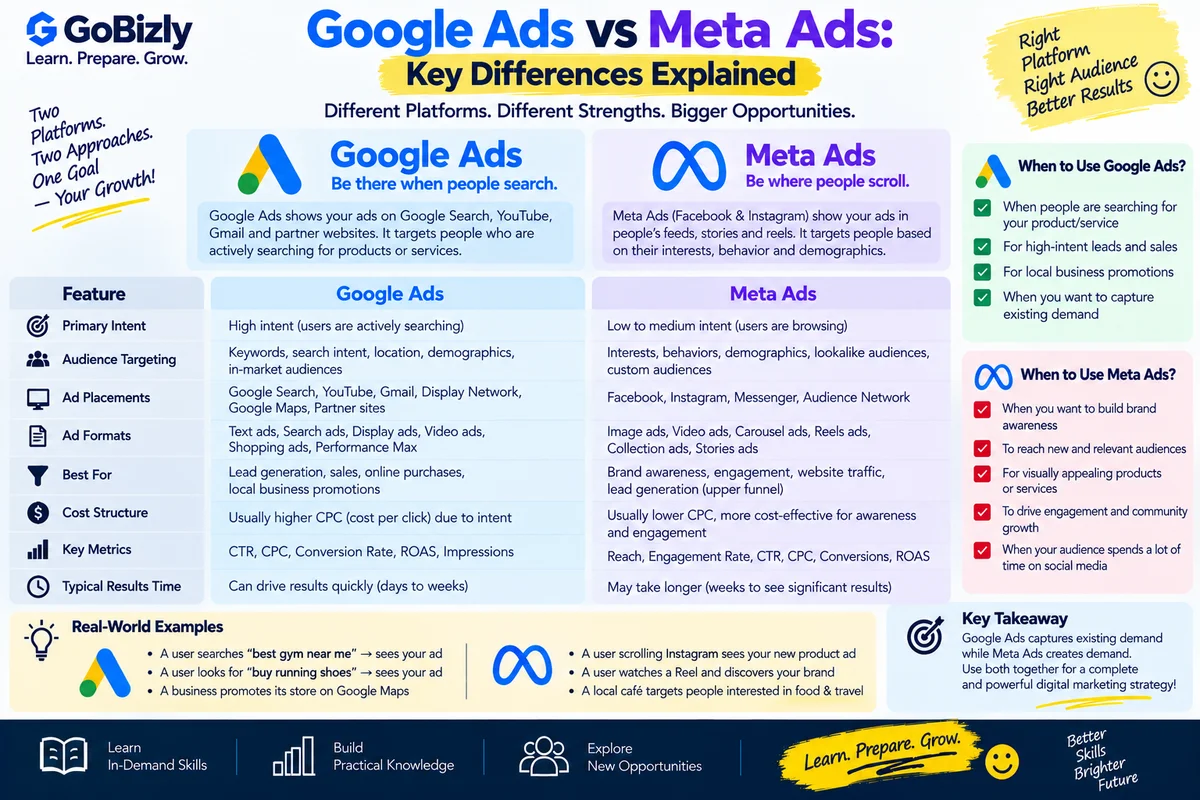
Google Ads and Meta Ads are two major digital advertising platforms, but they operate differently.
One of the biggest differences is the type of user behavior they can capture.
A person searching for a product may already have a specific need.
A person scrolling through social media may not currently be searching for that product.
Understanding this distinction helps marketers choose the appropriate platform and campaign strategy.
1. What Is Google Ads?
Google Ads is Google's advertising platform.
Depending on the campaign type, advertisers can reach users across environments such as:
Google Search
YouTube
Display inventory
Other Google properties and partner environments
Campaign capabilities vary by campaign type.
2. What Is Meta Ads?
Meta Ads is Meta's advertising platform.
It allows advertisers to reach audiences across Meta environments, including:
Facebook
Instagram
Campaign capabilities and placements depend on the campaign setup.
3. Search Intent vs Audience Discovery
One important difference is user intent.
Google Search
A user may actively search:
"best running shoes"
The advertiser can respond to that existing search intent.
Meta
A user may encounter an advertisement while browsing social content.
The platform can use audience and behavioral signals to determine who may be relevant.
This is often described as discovery-based advertising.
4. Targeting
Both platforms provide targeting capabilities, but their approaches differ.
Google Ads
Depending on campaign type, targeting can involve:
Search queries
Keywords
Audiences
Locations
Demographics
Interests
Remarketing
Meta Ads
Targeting can involve:
Demographics
Interests
Behaviors
Custom audiences
Lookalike audiences
Geographic targeting
Available options can change over time.
5. Campaign Objectives
The platforms offer different campaign structures and objectives.
Depending on the platform and current campaign setup, objectives can include:
Traffic
Leads
Sales
Awareness
App-related outcomes
Engagement
Choose an objective based on the actual business goal.
6. Ad Formats
Google Ads can support formats such as:
Search ads
Display ads
Video ads
Shopping-related formats
Meta can support formats such as:
Image ads
Video ads
Carousel ads
Stories/Reels placements
Available formats and placements depend on the current platform configuration.
7. Creative Strategy
Creative requirements can differ significantly.
Google Search
The advertiser often relies heavily on:
Headlines
Descriptions
Keywords
Offers
Landing pages
Meta
Visual creative can play a larger role.
Important elements can include:
Images
Videos
Hooks
Copy
Calls to action
8. Measurement
Both platforms provide performance metrics.
Common metrics include:
Impressions
Clicks
CTR
CPC
Conversions
CPA
Conversion value
The exact reporting structure differs between platforms.
9. Conversion Tracking
Accurate conversion tracking is important for both platforms.
Depending on the setup, tracking can involve:
Website tags
Events
Pixels
Analytics
Server-side solutions
Conversion APIs
Always verify that the measurement setup matches the campaign objective.
10. When Search Intent Matters
Google Search can be particularly useful when people are actively looking for a solution.
For example:
"AC repair near me"
shows stronger immediate intent than someone simply seeing an advertisement while browsing social media.
However, search demand depends on the market and product.
11. When Audience Discovery Matters
Meta can be useful for reaching people based on audience characteristics and interests, even when they aren't actively searching for the product.
This can support:
Brand awareness
Product discovery
Lead generation
Retargeting
The appropriate use depends on the campaign.
12. Budget Allocation
There is no universal rule that one platform should always receive more budget.
Consider:
Audience
Product
Search demand
Creative
Historical performance
Conversion economics
Business objectives
Use campaign data to guide budget decisions.
13. Landing Page Matters on Both Platforms
A strong advertisement cannot compensate for a poor landing page.
Check:
Relevance
Speed
Mobile experience
Message consistency
Call to action
Conversion process
The user should understand what to do next.
14. Don't Compare Platforms Using One KPI
CTR alone doesn't tell the whole story.
For example:
A campaign may generate a high CTR but poor conversion quality.
Evaluate the metrics that matter to the business objective.
15. Attribution Can Be Different
Google and Meta may report conversions differently because each platform has its own measurement and attribution systems.
Therefore, platform-reported conversions should be interpreted carefully.
For important business decisions, compare platform data with your broader analytics and business data.
16. Can You Use Both?
Yes.
Many businesses use multiple advertising channels.
For example:
Meta
→ Generate awareness and audience interest
→ Capture relevant searches and demand
The two platforms can complement each other.
17. A Simple Comparison
Area | Google Ads | Meta Ads |
|---|---|---|
Core environment | Search and other Google properties | Facebook & Instagram ecosystem |
User behavior | Often captures active intent | Often supports audience discovery |
Targeting | Varies by campaign type | Strong audience-based options |
Creative | Search, display, video and more | Strong visual/social formats |
Measurement | Platform conversion reporting | Platform conversion reporting |
Best approach | Depends on objective | Depends on objective |
18. How Beginners Should Learn
Start by understanding:
Campaign structure
↓
Targeting
↓
Ad formats
↓
Bidding
↓
Budget
↓
Conversion tracking
↓
Reporting
Then practice with realistic campaign scenarios.
Google Ads vs Meta Ads Checklist
☐ Understand search intent
☐ Understand audience targeting
☐ Learn campaign objectives
☐ Learn ad formats
☐ Understand bidding
☐ Learn conversion tracking
☐ Understand KPIs
☐ Review landing pages
☐ Understand attribution
☐ Analyze business objectives
☐ Practice campaign scenarios
Conclusion
Google Ads and Meta Ads are not identical platforms.
Google can capture existing search intent, while Meta can be useful for audience discovery and social engagement.
Neither platform should be evaluated in isolation.
The right approach depends on:
Audience + Objective + Product + Creative + Measurement + Economics
Understand these factors before deciding how to allocate advertising resources.
Choose the platform based on the business problem—not simply the platform name.
Learn. Prepare. Grow.