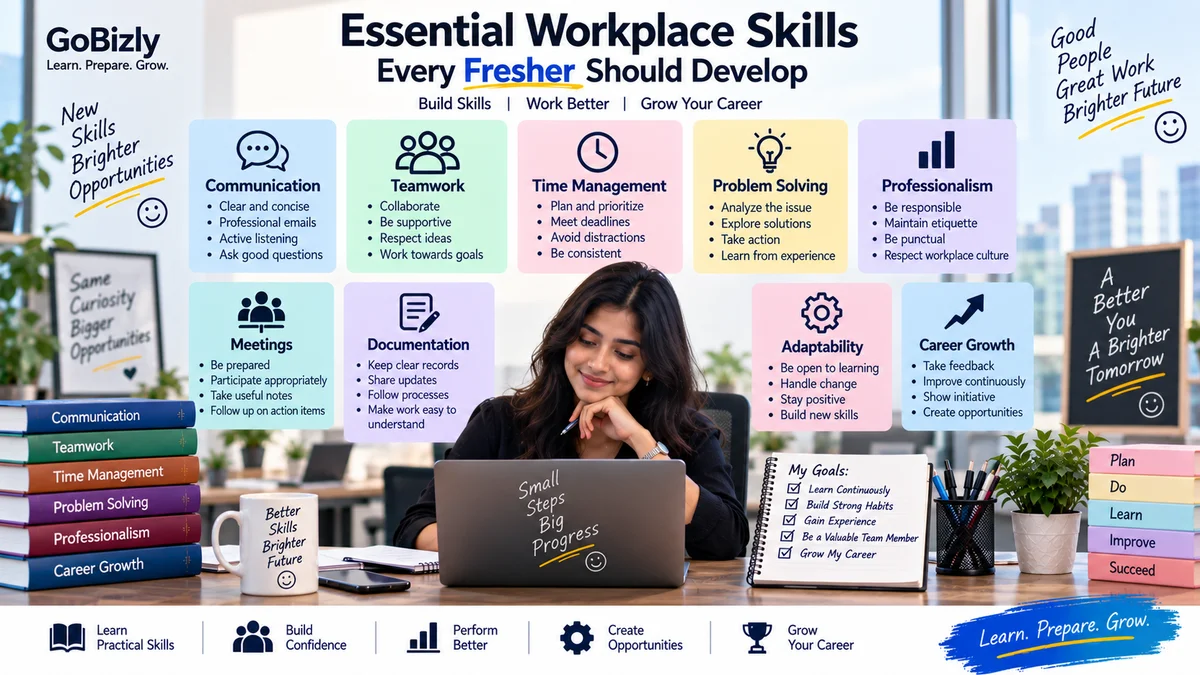
Essential Workplace Skills Every Fresher Should Develop
Essential Workplace Skills Every Fresher Should Develop
Getting your first job is an important milestone, but your learning doesn't stop when you receive the offer.
Moving from college to a professional workplace introduces a completely different environment.
You may need to communicate with managers, collaborate with teammates, attend meetings, manage deadlines, document your work and handle responsibilities independently.
Technical knowledge can help you get a job, but professional skills can help you work effectively once you are there.
The good news is that these skills can be learned and improved through practice.
1. Communicate Clearly
Workplace communication happens through many channels:
Email
Chat
Meetings
Calls
Presentations
Documentation
Reports
Good communication means making your message clear to the person receiving it.
Before sending an important message, ask:
What do I need to communicate?
Who needs this information?
What action is required?
Is there a deadline?
Clear communication reduces unnecessary back-and-forth.
2. Learn Professional Email Writing
Professional emails don't need to be complicated.
A basic structure is:
Subject
Clearly describe the purpose.
Greeting
Use an appropriate professional greeting.
Context
Briefly explain why you're writing.
Request or Information
Clearly state what you need or want to communicate.
Next Step
Mention any action or deadline when relevant.
Closing
End professionally.
For example, instead of:
"Please check this."
You could write:
"Could you please review the attached report and share your feedback by Thursday?"
The second version provides more context and makes the requested action clearer.
3. Learn to Communicate With Your Manager
When communicating with a manager, don't simply report that something is wrong.
Where possible, provide context and explain what you're doing about it.
A useful structure is:
Situation → Impact → Action → Next Step
For example:
"The data upload is currently failing, which is delaying the report. I've checked the source file and identified a formatting issue. I'm correcting it now and expect to complete the upload shortly."
This gives the manager a clearer picture of the situation.
4. Develop Active Listening
Listening is an important professional skill.
During meetings or conversations:
Pay attention
Avoid unnecessary interruptions
Take relevant notes
Ask clarifying questions
Confirm important requirements
If you're unsure about an instruction, don't simply guess.
Ask for clarification.
For example:
"Just to confirm, should I complete the first version today and share it for review?"
A short clarification can prevent a much larger mistake later.
5. Learn How to Ask Good Questions
New employees are expected to learn.
Asking questions is part of that process.
However, try to make your questions specific.
Instead of:
"I don't know how to do this."
Try:
"I've completed the first two steps, but I'm not sure how to configure the final step. Could you guide me on that part?"
This shows what you've already attempted and makes it easier for someone to help you.
6. Manage Your Time
You may eventually have multiple tasks with different priorities.
A simple system can help.
Divide your work into:
Urgent and Important
Handle these first.
Important but Not Urgent
Schedule time for these.
Urgent but Lower Impact
Handle efficiently where possible.
Low Priority
Complete when higher-priority work is under control.
The exact priorities will depend on your role and team.
The important skill is knowing what needs attention first.
7. Understand Deadlines
When someone gives you a deadline, make sure you understand:
What needs to be delivered
When it is due
What format is expected
Who needs it
Whether there are dependencies
If you realize you cannot meet a deadline, communicate early.
Don't wait until the deadline has already passed.
8. Learn to Give Progress Updates
Your manager shouldn't always have to ask:
"What's the status?"
For important tasks, provide updates when appropriate.
A useful update can include:
Completed: What you've finished.
In Progress: What you're currently working on.
Blocker: Anything preventing progress.
Next Step: What you're going to do next.
For example:
Completed: Data collection
In progress: Analysis
Blocker: Waiting for the final dataset
Next step: Complete the report once the dataset is received
This creates visibility without requiring long explanations.
9. Develop Teamwork Skills
Most workplaces require collaboration.
Being a good team member doesn't mean agreeing with everything.
It means:
Sharing information
Helping when appropriate
Respecting different perspectives
Completing your responsibilities
Communicating issues
Giving credit to others
Working toward a shared objective
A team performs better when people understand both their individual responsibilities and the overall goal.
10. Handle Disagreements Professionally
Disagreements are normal in professional environments.
Focus on the issue rather than the person.
Instead of:
"Your approach is wrong."
Try:
"I see the approach differently because of these factors..."
Then explain your reasoning.
If necessary, look for evidence, data or agreed processes that can help resolve the disagreement.
Professional disagreement doesn't have to become personal.
11. Learn Meeting Etiquette
Before a meeting, understand:
Why the meeting is happening
What you need to prepare
Who is attending
Whether you need to provide an update
During the meeting:
Pay attention
Avoid unnecessary interruptions
Keep contributions relevant
Take notes when necessary
After the meeting:
Record important action items
Confirm responsibilities
Track deadlines
Not every meeting requires extensive participation.
Sometimes listening carefully is the most useful contribution.
12. Take Useful Notes
Don't try to write down every word someone says.
Focus on:
Decisions
Tasks
Deadlines
Owners
Important information
Questions
Follow-ups
For example:
Task: Update campaign report
Owner: Praveen
Deadline: Friday
Dependency: Final data from analytics team
Structured notes make follow-up much easier.
13. Develop Problem-Solving Skills
Problems are part of almost every job.
When something goes wrong, avoid immediately asking someone else to fix it.
First try to understand the issue.
Use this framework:
Identify → Investigate → Analyze → Act → Verify
Identify
What exactly is wrong?
Investigate
What changed?
Analyze
What could be causing it?
Act
What solution can you safely try?
Verify
Did the solution actually work?
This approach can be applied to technical, operational and business problems.
14. Learn to Document Your Work
Documentation helps teams understand what was done and why.
Depending on your role, documentation may include:
Process documents
Meeting notes
Reports
Checklists
Project updates
Troubleshooting notes
Handover documents
Good documentation should be:
Clear
Structured
Accurate
Easy to find
Easy for another person to understand
Imagine someone else needs to continue your work tomorrow.
Could they understand what you did?
If yes, your documentation is probably useful.
15. Take Ownership of Your Work
Ownership means being responsible for the work assigned to you.
It doesn't mean solving every problem alone.
It means:
Understanding the requirement
Completing the task
Asking questions when necessary
Communicating blockers
Checking your work
Following through
If you make a mistake, acknowledge it and focus on correcting it.
A professional response is more useful than trying to hide the problem.
16. Pay Attention to Quality
Completing a task quickly isn't always enough.
Before submitting work, perform a basic quality check.
Ask:
☐ Did I complete everything requested?
☐ Are the numbers correct?
☐ Are names and dates accurate?
☐ Did I follow the required format?
☐ Did I check for obvious errors?
☐ Did I save the correct version?
A few minutes of review can prevent avoidable mistakes.
17. Learn Workplace Etiquette
Professional etiquette includes simple behaviors such as:
Being respectful
Being punctual
Responding appropriately
Following workplace policies
Respecting colleagues' time
Maintaining professional communication
Keeping confidential information private
Workplace culture differs between organizations, so observe how your team communicates and adapt appropriately while maintaining professionalism.
18. Learn How to Receive Feedback
Feedback can help you improve.
When someone gives you feedback, listen carefully before becoming defensive.
Ask:
What specifically should I improve?
What would a better approach look like?
Can you give me an example?
Then apply the feedback where appropriate.
You don't have to agree with every piece of feedback, but understanding it can help you decide what to improve.
19. Learn How to Give Feedback
When giving feedback to colleagues, focus on the work rather than attacking the person.
Instead of:
"You did this incorrectly."
Try:
"I noticed this section doesn't match the agreed format. Could we update it before the final submission?"
Good feedback should ideally be:
Specific
Respectful
Relevant
Actionable
20. Build Professional Confidence
Confidence doesn't mean pretending to know everything.
Professional confidence can mean being comfortable saying:
"I know how to do this."
or:
"I'm not familiar with this yet, but I'll learn it."
or:
"I'm not sure. Let me verify and get back to you."
Knowing what you know—and what you don't know—is an important professional skill.
A Simple Workplace Framework
Remember:
COMMUNICATE → PLAN → EXECUTE → CHECK → UPDATE → IMPROVE
Communicate
Understand the requirement.
Plan
Decide how you'll approach the work.
Execute
Complete the task.
Check
Review your work.
Update
Communicate progress or blockers.
Improve
Learn from feedback and experience.
This simple cycle can apply to many professional tasks.
Your First 90 Days at Work
If you're starting your first job, focus on three stages.
First 30 Days — Learn
Understand:
Your role
Your team
Processes
Tools
Communication channels
Expectations
Ask questions and take notes.
Days 31–60 — Contribute
Start taking more ownership.
Focus on:
Completing tasks independently
Improving your understanding
Identifying recurring issues
Applying feedback
Days 61–90 — Improve
Look for opportunities to:
Improve a process
Reduce repetitive work
Document useful knowledge
Take ownership of larger responsibilities
The exact timeline varies by company and role, but the general progression can be useful.
Common Workplace Mistakes Freshers Make
Being Afraid to Ask Questions
Asking thoughtful questions can help you learn faster.
Waiting Until the Deadline to Mention a Problem
Communicate blockers early.
Not Taking Notes
Important instructions can easily be forgotten.
Sending Unclear Messages
Give enough context for the recipient to understand the request.
Ignoring Feedback
Feedback can reveal areas for improvement.
Trying to Do Everything Alone
Collaboration is part of professional work.
Not Reviewing Work
Always perform a basic quality check.
Being Overconfident About What You Know
It's better to verify than confidently provide incorrect information.
Not Communicating Progress
Keep relevant stakeholders informed.
Workplace Skills Checklist
☐ Communicate clearly
☐ Write professional emails
☐ Listen actively
☐ Ask useful questions
☐ Manage priorities
☐ Meet deadlines
☐ Provide progress updates
☐ Work effectively with a team
☐ Handle disagreements professionally
☐ Participate appropriately in meetings
☐ Take structured notes
☐ Solve problems systematically
☐ Document your work
☐ Take ownership
☐ Check your work
☐ Accept feedback
☐ Give constructive feedback
☐ Protect confidential information
☐ Continue learning
Conclusion
Your first job is not just an opportunity to apply what you learned in college.
It's also an opportunity to develop professional habits that can shape your career.
Learn to communicate clearly.
Manage your time.
Ask thoughtful questions.
Take ownership.
Document your work.
Accept feedback.
Solve problems systematically.
And remember that nobody expects a fresher to know everything on day one.
What matters is your willingness to learn, your ability to take responsibility and the way you work with others.
Learn the work. Build good habits. Communicate clearly. Keep improving.
Learn. Prepare. Grow.