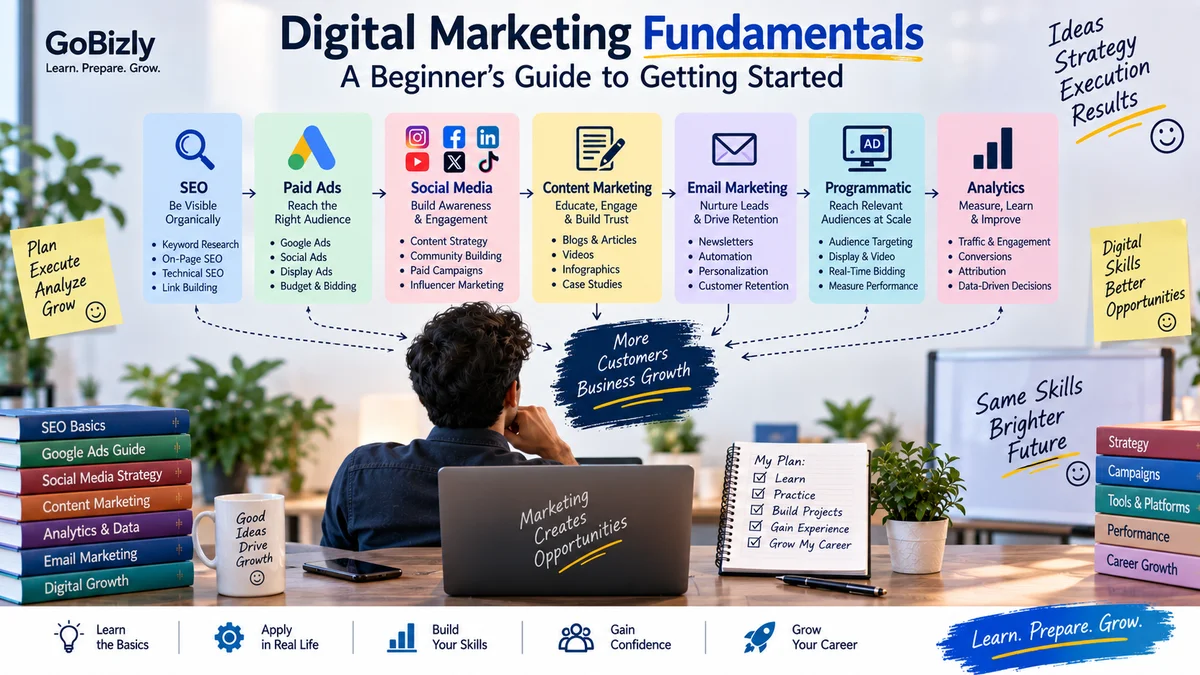
Digital Marketing Fundamentals: A Beginner's Guide to Getting Started
Digital Marketing Fundamentals: A Beginner's Guide to Getting Started
Digital marketing has become an important part of how businesses attract customers, build awareness and generate sales.
But when you're starting out, the field can feel overwhelming.
You may come across terms such as SEO, PPC, social media marketing, content marketing, email marketing, analytics, programmatic advertising and conversion tracking.
What do all these things mean?
More importantly, where should a beginner start?
This guide breaks down the fundamentals of digital marketing and explains how the major areas fit together.
1. What Is Digital Marketing?
Digital marketing is the use of digital channels and technologies to promote products, services, brands or businesses and connect with audiences.
These channels can include:
Search engines
Websites
Social media
Email
Display advertising
Video
Mobile platforms
Online marketplaces
Digital marketing isn't simply about running advertisements.
It can involve the entire customer journey:
Discover → Consider → Visit → Engage → Convert → Retain
Different channels can support different stages of that journey.
2. Understand the Digital Marketing Ecosystem
Digital marketing consists of several connected areas.
Some of the major areas include:
Search Engine Optimization
Improving a website's visibility in organic search results.
Paid Search
Using advertising platforms to show ads when people search for relevant terms.
Social Media Marketing
Using social platforms to build awareness, engagement and relationships.
Content Marketing
Creating useful content to attract and educate an audience.
Email Marketing
Communicating with customers and prospects through email.
Display & Programmatic Advertising
Using display inventory and automated buying systems to reach relevant audiences.
Analytics & Measurement
Understanding what users and campaigns are doing through data.
These areas can operate independently, but they often work together.
3. Start With the Customer
Before choosing a marketing channel, understand the audience.
Ask:
Who are we trying to reach?
What problem are they trying to solve?
What motivates them?
Where do they spend time online?
What information do they need before making a decision?
A marketing strategy should begin with the audience rather than simply choosing a platform.
4. Understand the Marketing Funnel
A basic marketing funnel can help explain how people move from awareness to action.
Awareness
The customer discovers the brand or product.
Channels might include:
Social media
Display advertising
Video
Search
Content
Consideration
The customer begins researching options.
They may:
Visit a website
Read reviews
Compare products
Watch videos
Read articles
Conversion
The customer takes a desired action.
Examples include:
Purchase
Lead submission
Registration
App installation
Booking
Retention
The business works to maintain the customer relationship.
This can involve:
Email
Loyalty programs
Customer support
Remarketing
Useful content
Not every customer follows the same path, but the funnel provides a useful framework for understanding customer journeys.
5. Learn Search Engine Optimization
SEO focuses on improving a website's ability to appear in organic search results.
Important areas include:
On-Page SEO
Content, headings, internal links, titles and other page-level elements.
Technical SEO
Website structure, crawlability, performance and technical accessibility.
Off-Page SEO
External signals such as relevant links and references from other websites.
For beginners, start with:
Search intent
Keyword research
Useful content
Page titles
Headings
Internal linking
Website structure
The objective isn't simply to insert keywords.
The content should genuinely help the person searching.
6. Understand Paid Search
Paid search allows businesses to advertise on search platforms for relevant queries.
A typical process looks like:
User searches → Ad auction occurs → Eligible ad is shown → User clicks → Landing page → Desired action
Important concepts include:
Keywords
Search queries
Ad groups
Campaigns
Bids
Budgets
Ad relevance
Landing pages
Conversions
Platforms such as Google Ads provide tools for managing paid search campaigns.
7. Learn Social Media Marketing
Social media marketing involves using social platforms to communicate with an audience.
Activities can include:
Organic posts
Short-form video
Community engagement
Influencer collaborations
Paid advertising
Content distribution
Different platforms attract different audiences and support different content formats.
Instead of trying to be everywhere, businesses should consider where their target audience is most relevant.
8. Understand Content Marketing
Content marketing focuses on creating and distributing useful content for a specific audience.
Content can include:
Blog articles
Guides
Videos
Infographics
Case studies
Newsletters
Social posts
E-books
Webinars
Good content should have a purpose.
It might:
Answer a question
Explain a problem
Educate a customer
Build awareness
Support a purchase decision
Content works best when it is connected to the audience's actual needs.
9. Learn Display and Programmatic Advertising
Display advertising uses visual advertising formats across websites, apps and other digital environments.
Programmatic advertising uses technology and automated systems to buy and sell digital advertising inventory.
A simplified programmatic process is:
Advertiser → DSP → Ad Exchange/SSP → Publisher → User
A DSP, or Demand-Side Platform, allows advertisers to manage automated media buying.
Programmatic campaigns can involve:
Audience targeting
Contextual targeting
Inventory selection
Bidding
Frequency management
Creative management
Measurement
It is a specialized area, but understanding the basic ecosystem can be useful for digital marketing professionals.
10. Understand Analytics and Measurement
Digital marketing produces large amounts of data.
Analytics helps marketers understand what users and campaigns are doing.
Important questions include:
How many people visited?
Where did they come from?
What did they do?
Did they convert?
Which campaigns contributed to the result?
Common metrics include:
Impressions
Number of times an ad or content item was displayed.
Clicks
Number of times users clicked.
CTR
Click-through rate.
CTR = Clicks ÷ Impressions × 100
Conversion Rate
Percentage of relevant users who completed a desired action.
CPA
Cost per acquisition.
CPA = Cost ÷ Conversions
ROAS
Return on advertising spend.
ROAS = Revenue ÷ Advertising Cost
The correct KPI depends on the campaign objective.
11. Learn Conversion Tracking
Knowing that someone clicked an advertisement is not always enough.
Marketers often need to know what happened after the click.
For example:
Ad → Landing Page → Form → Lead
or:
Ad → Product Page → Cart → Purchase
Conversion tracking helps measure these actions.
Tracking may involve:
Analytics platforms
Advertising platforms
Tag management
Pixels
Events
Conversion tags
Accurate measurement is important because campaign decisions often depend on the data being collected.
12. Understand Landing Pages
A landing page is a page designed to support a specific marketing objective.
A good landing page should make it reasonably clear:
What is being offered
Who it is for
Why it matters
What the visitor should do next
Common conversion actions include:
Buy now
Sign up
Request a quote
Book a consultation
Download a resource
The landing page should be relevant to the advertisement or content that brought the visitor there.
13. Learn Email Marketing
Email remains an important digital communication channel.
Businesses may use email for:
Newsletters
Promotions
Product updates
Customer onboarding
Educational content
Abandoned-cart communication
Customer retention
Important concepts include:
Audience segmentation
Subject lines
Personalization
Open rates
Click rates
Conversion
Unsubscribe rates
The goal isn't simply to send more emails.
The content should be relevant to the recipient.
14. Understand Remarketing
Remarketing allows businesses to reach people who have previously interacted with them, depending on the platform and applicable privacy and targeting rules.
For example, someone might:
Visit a website.
View a product.
Leave without purchasing.
Later see relevant advertising.
Remarketing can be useful for reconnecting with audiences who have already shown interest.
However, marketers should always consider privacy requirements, platform policies and appropriate audience practices.
15. Learn the Difference Between Organic and Paid Marketing
One simple distinction is:
Organic
Traffic or engagement generated without directly paying for each placement.
Examples:
SEO
Organic social media
Content
Paid
Marketing where the advertiser pays for advertising or promotion.
Examples:
Search advertising
Social advertising
Display advertising
Programmatic advertising
Many businesses use both.
Organic and paid strategies can complement each other when they are aligned with the overall marketing objective.
16. Understand Campaign Objectives
Before launching a campaign, define what you want to achieve.
Possible objectives include:
Awareness
Reach and visibility.
Traffic
Bring visitors to a website or destination.
Engagement
Encourage interactions with content.
Leads
Generate potential customer inquiries.
Sales
Drive purchases or revenue.
App Growth
Encourage installations or in-app actions.
Your objective should influence:
Audience
Creative
Platform
Budget
Bidding
Landing page
Measurement
17. Learn the Most Important Marketing KPIs
Don't track every metric simply because a platform provides it.
Choose metrics that connect to your objective.
For example:
Awareness
Reach
Impressions
Frequency
Viewability
Traffic
Clicks
CTR
CPC
Video
Video views
View-through rate
Completion rate
Lead Generation
Leads
Conversion rate
Cost per lead
Sales
Purchases
Revenue
CPA
ROAS
The right KPI depends on what you're trying to accomplish.
18. Understand Attribution at a Basic Level
A customer may interact with several marketing channels before converting.
For example:
Social Media → Search → Website → Email → Purchase
Which channel should receive credit?
That's an attribution question.
Attribution models attempt to distribute conversion credit across customer interactions.
You don't need to master advanced attribution when you're starting.
Begin by understanding that:
The last interaction isn't necessarily the only interaction that influenced a conversion.
19. Learn How Different Channels Work Together
Digital marketing works best when channels aren't treated as completely separate activities.
For example:
SEO
can bring organic traffic.
↓
Content
can educate the visitor.
↓
Paid Search
can capture active demand.
↓
Remarketing
can reconnect with interested users.
↓
can support retention.
↓
Analytics
can help measure performance across the journey.
The exact combination depends on the business and its objectives.
20. Build Practical Skills
Reading about digital marketing is useful, but practical experience is even more valuable.
You can practice through:
Mock campaigns
Case studies
Sample datasets
Personal projects
Website projects
Analytics exercises
Campaign simulations
Content projects
For example, create a fictional business and design a simple marketing plan.
Define:
Business → Audience → Objective → Channel → Message → Budget → KPI
This exercise can help connect different concepts.
A Beginner's Digital Marketing Roadmap
Stage 1 — Fundamentals
Learn:
Marketing concepts
Customer journey
Digital channels
Campaign objectives
↓
Stage 2 — Core Channels
Explore:
SEO
Paid Search
Social Media
Content
Email
↓
Stage 3 — Measurement
Learn:
Analytics
KPIs
Conversion tracking
Attribution basics
↓
Stage 4 — Specialization
Choose an area such as:
Performance Marketing
SEO
Programmatic
Analytics
Social Media
Content
↓
Stage 5 — Practical Experience
Build projects, analyze data and practice real-world scenarios.
Common Digital Marketing Mistakes
Trying to Learn Every Platform
Start with fundamentals before specializing.
Focusing Only on Tools
Understanding the marketing objective is more important than memorizing platform buttons.
Tracking Vanity Metrics
Choose KPIs that relate to your actual objective.
Ignoring Tracking
Without reliable measurement, campaign decisions become harder.
Creating Content Without an Audience
Start by understanding who you're trying to help.
Running Campaigns Without Clear Objectives
Define the desired outcome before choosing tactics.
Learning Without Practicing
Apply concepts through projects and simulations.
Digital Marketing Beginner Checklist
☐ Understand what digital marketing means
☐ Learn the customer journey
☐ Understand SEO
☐ Learn paid search fundamentals
☐ Understand social media marketing
☐ Learn content marketing
☐ Understand display advertising
☐ Learn basic programmatic concepts
☐ Understand analytics
☐ Learn conversion tracking
☐ Understand important KPIs
☐ Learn landing-page fundamentals
☐ Understand email marketing
☐ Learn remarketing basics
☐ Understand organic vs paid marketing
☐ Practice through a project
☐ Choose an area to specialize in
Conclusion
Digital marketing is a broad field, and you don't need to master every channel at once.
Start with the fundamentals.
Understand the customer.
Learn how different channels work.
Understand measurement.
Practice what you learn.
Then choose an area where you want to develop deeper expertise.
Whether you eventually specialize in SEO, paid advertising, analytics, social media, content or programmatic advertising, a strong understanding of the broader digital marketing ecosystem will help you connect the pieces.
Learn the fundamentals. Practice the concepts. Measure what matters. Keep growing.
Learn. Prepare. Grow.