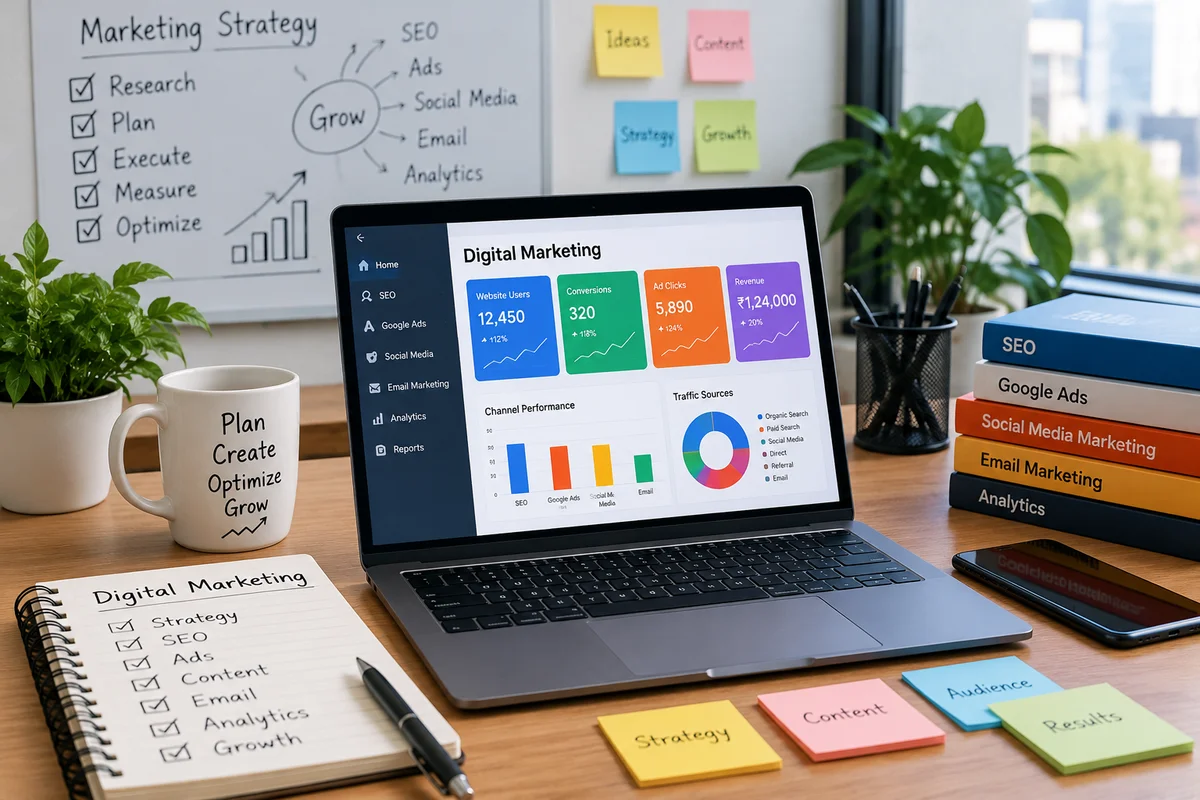
Digital Marketing Channels Cheat Sheet
Digital Marketing Channels Cheat Sheet: Types, Strategies, KPIs & Use Cases
Digital marketing channels are the platforms, tools, and communication methods businesses use to reach audiences, promote products and services, generate leads, and drive sales.
Each channel serves a different purpose. Search engine optimization helps businesses attract organic search traffic, paid advertising provides paid visibility, social media supports discovery and engagement, and email marketing helps businesses communicate with subscribers and customers.
The most effective digital marketing strategy does not necessarily use every available channel. It selects the channels that fit the business objective, audience, budget, resources, and customer journey.
This digital marketing channels cheat sheet explains the major channels, how they work, when to use them, their key performance indicators, and how to combine them into a practical marketing strategy.
1. What Is a Digital Marketing Channel?
A digital marketing channel is a digital medium through which a business communicates with its target audience.
Examples include:
Search engines.
Websites and blogs.
Social media platforms.
Paid search advertising.
Display and video advertising.
Email.
Affiliate websites.
Mobile applications.
Digital audio platforms.
Online marketplaces.
Channels can support different stages of the customer journey, from initial awareness to purchase and retention.
For example, a potential customer might discover a business through a Google search, read a blog article, follow the brand on LinkedIn, subscribe to a newsletter, and eventually purchase a product.
The channels work together to support the journey, even though each interaction may have a different purpose.
2. Owned, Paid and Earned Media
Digital marketing channels can be grouped into three broad categories: owned media, paid media, and earned media.
Owned Media
Owned media includes digital properties and communication assets that a business controls.
Examples:
Business website.
Blog.
Email newsletter.
Mobile application.
Business resource library.
Brand-controlled customer communication channels.
Advantages: Greater control over content, messaging, and the customer experience.
Considerations: Building an audience and generating consistent traffic can take time and resources.
Paid Media
Paid media involves paying for distribution, placement, or advertising exposure.
Examples:
Google Ads.
Paid social advertising.
Programmatic display advertising.
Paid video advertising.
Sponsored placements.
Paid influencer collaborations.
Advantages: Can provide faster access to relevant audiences and more controlled distribution.
Considerations: Requires a budget, ongoing management, and appropriate measurement.
Earned Media
Earned media refers to exposure a business receives through third-party activity rather than purchasing each placement directly.
Examples:
Editorial mentions.
Organic recommendations.
Genuine customer reviews.
Unpaid media coverage.
Organic sharing.
Relevant backlinks earned from other websites.
Advantages: Can support credibility, discovery, and reputation.
Considerations: The business has limited control over whether or when the exposure occurs.
These categories can overlap. For example, a customer testimonial published on a business's website is owned content featuring earned customer feedback.
3. Search Engine Optimization (SEO)
SEO is the practice of improving a website's visibility in organic search results.
It helps businesses attract people searching for information, products, services, or solutions relevant to their offerings.
Main SEO Activities
Keyword research: Understand what people search for and the intent behind their queries.
On-page SEO: Improve page titles, headings, content structure, internal links, and other page-level elements.
Technical SEO: Address crawling, indexing, site architecture, performance, and other technical factors.
Content development: Create useful, accurate, relevant content that satisfies search intent.
Off-page SEO: Earn relevant mentions and links that can support authority and discovery.
When to Use SEO
SEO can be useful when people actively search for information or solutions related to the business and the company can create valuable content or landing pages.
It is especially relevant for educational websites, service businesses, ecommerce stores, and companies seeking sustainable organic discovery.
SEO KPIs
Organic clicks.
Relevant organic traffic.
Search impressions.
Organic conversions.
Qualified organic leads.
Organic revenue, where measurable.
Search visibility indicators.
Rankings and traffic are useful diagnostic measures, but business outcomes should also be considered.
4. Search Engine Marketing and Paid Search
Paid search advertising allows businesses to place advertisements in eligible search results through advertising platforms.
Google Ads is a widely used example.
How Paid Search Works
Advertisers select relevant keywords or other targeting inputs, create advertisements, set budgets and bidding strategies, and direct users to suitable landing pages.
Eligible advertisements participate in an advertising auction. Delivery and placement depend on factors such as bids, ad quality, context, competition, and platform rules.
Common Paid Search Objectives
Generate leads.
Drive purchases.
Increase qualified website traffic.
Promote local services.
Capture high-intent demand.
Support product discovery.
Paid Search KPIs
Impressions.
Clicks.
CTR.
CPC.
Conversion rate.
CPA.
Conversion value.
ROAS.
SEO vs Paid Search
SEO focuses on organic visibility, while paid search uses advertising spend to obtain eligible paid placements.
SEO does not charge a per-click advertising fee for organic clicks, but it requires resources for content, technical work, and ongoing maintenance.
Paid search can generate visibility more quickly when campaigns are eligible and funded, but traffic generally depends on continued advertising activity.
The two channels can complement one another by serving different user needs and search intents.
5. Display and Programmatic Advertising
Display advertising uses visual advertisements across eligible websites, applications, and other digital environments.
Programmatic advertising uses technology to automate the buying and selling of advertising inventory.
Common Display Formats
Static banners.
Animated advertisements.
HTML5 creatives.
Native advertisements.
Responsive display formats.
Other supported visual placements.
Programmatic Advertising
Programmatic campaigns may use demand-side platforms, supply-side platforms, exchanges, audience signals, and automated bidding systems.
Display & Video 360 is one example of a demand-side platform.
When to Use Display and Programmatic
These channels can support:
Brand awareness.
Audience reach.
Retargeting, where eligible.
Product consideration.
Video and visual storytelling.
Selected performance objectives.
Key KPIs
Impressions.
Reach.
Frequency.
CPM.
CTR.
Viewability.
Conversions.
CPA.
ROAS, where relevant.
Important Consideration
High impression volume does not automatically mean a campaign is effective. Evaluate audience relevance, inventory quality, measurement, and the actual campaign objective.
6. Social Media Marketing
Social media marketing uses social platforms to distribute content, build communities, communicate with customers, and promote products or services.
Organic Social Media
Organic activities include posts, videos, stories, discussions, and responses to comments.
Common objectives include brand awareness, education, engagement, and community building.
Paid Social Media
Paid social advertising uses platform advertising tools to distribute content to eligible audiences.
It may support awareness, traffic, lead generation, app promotion, and sales.
Platform Selection
Different platforms serve different audiences and content formats.
Instagram: Visual content, short videos, product discovery, and community engagement.
Facebook: Business pages, communities, local business activity, and paid advertising.
LinkedIn: Professional content, B2B marketing, networking, and recruitment.
YouTube: Tutorials, demonstrations, educational videos, and video advertising.
Pinterest: Visual discovery and inspiration for relevant topics.
X: Timely conversations, industry commentary, and updates.
TikTok: Short-form video and discovery where available and appropriate.
Platform availability and features vary by market and change over time.
Social Media KPIs
Reach.
Impressions.
Engagement.
Engagement rate.
Follower growth.
Link clicks.
Website sessions.
Leads.
Conversions.
Select KPIs according to whether the activity is intended to create awareness, engagement, traffic, or business outcomes.
7. Content Marketing
Content marketing involves creating and distributing useful, relevant content to attract and engage a defined audience.
It can support SEO, social media, email marketing, lead nurturing, and customer education.
Common Content Formats
Blog articles.
In-depth guides.
Cheat sheets.
Checklists.
Videos.
Infographics.
Case studies.
Podcasts.
Webinars.
Educational newsletters.
How Content Marketing Works
A business identifies its audience's questions, creates content that answers those questions, distributes it through relevant channels, and guides interested readers toward suitable next steps.
For example, a website that publishes a beginner's guide to digital marketing may link to related resources, a newsletter subscription, or a relevant service page.
Content Marketing KPIs
Relevant page views.
Organic clicks.
Engaged sessions.
Content downloads.
Newsletter subscriptions.
Returning visitors.
Qualified leads.
Assisted conversions, where measurable.
Content should be evaluated according to its purpose. An educational article may build awareness and trust before a visitor is ready to convert.
8. Email Marketing
Email marketing enables businesses to communicate with eligible subscribers through newsletters, promotional messages, educational content, and automated workflows.
Common Email Campaigns
Welcome sequences.
Newsletters.
Product announcements.
Lead-nurturing sequences.
Promotional campaigns.
Post-purchase communication.
Retention campaigns.
Advantages
Direct communication with subscribers.
Audience segmentation.
Personalization where appropriate.
Automated workflows.
Measurable clicks and conversions.
Important Considerations
Email marketing requires appropriate list management, permission, relevant content, accurate sender information, deliverability controls, and compliance with applicable requirements.
Email KPIs
Delivery rate.
Bounce rate.
Click-through rate.
Conversion rate.
Unsubscribe rate.
Attributed revenue, where measurable.
Open rates should be interpreted cautiously because privacy features and automated image loading can affect measurement.
9. Video Marketing
Video marketing uses video content to educate audiences, demonstrate products, explain services, or communicate a brand message.
Video can be distributed through YouTube, social platforms, websites, email-linked landing pages, and advertising placements.
Common Video Formats
Short-form videos.
Product demonstrations.
Tutorials.
Explainer videos.
Customer interviews.
Webinars.
Brand stories.
Video advertisements.
When to Use Video Marketing
Video can be especially useful when a product or concept is easier to demonstrate visually or when the audience benefits from seeing a process explained.
Video KPIs
Video views, according to platform definitions.
Watch time.
Average view duration.
Completion rate.
Engagement.
Clicks.
Conversions.
A large number of views does not necessarily indicate that viewers understood the message or completed the desired action.
10. Affiliate Marketing
Affiliate marketing is a performance-based arrangement in which affiliates promote a business's products or services and may earn a commission for eligible actions.
Compensation models vary and can include commissions based on sales, leads, or other agreed outcomes.
How Affiliate Marketing Works
A business establishes an affiliate program.
Affiliates receive approved promotional information and tracking methods.
Affiliates promote relevant products or services.
Eligible referrals and actions are tracked.
Commissions are calculated according to the program's terms.
Benefits
Access to external audiences.
Potentially performance-linked costs.
Additional distribution.
Partnerships with relevant publishers or creators.
Considerations
Affiliate quality and brand fit.
Tracking accuracy.
Commission structure.
Fraud prevention.
Disclosure requirements.
Program terms and compliance.
Affiliate KPIs
Referral clicks.
Conversions.
Conversion rate.
Commission cost.
Revenue.
Return on affiliate spend, where defined.
New customer acquisition.
Affiliate marketing works best when partners reach relevant audiences and communicate honestly.
11. Influencer and Creator Marketing
Influencer marketing involves collaborating with people who have an audience and can communicate a brand's message through their content.
Creators may support awareness, education, product demonstrations, community engagement, or sales.
Common Collaboration Types
Sponsored posts.
Product demonstrations.
Reviews.
Tutorials.
Live sessions.
Affiliate partnerships.
Long-term brand collaborations.
Choosing a Creator
Evaluate:
Audience relevance.
Content quality.
Authenticity.
Engagement quality.
Brand suitability.
Previous collaboration performance.
Pricing and deliverables.
Measurement options.
Follower count alone is not a reliable measure of commercial value.
Influencer Marketing KPIs
Reach.
Impressions.
Engagement.
Video views.
Link clicks.
Referral traffic.
Discount-code usage.
Leads.
Sales.
Cost per acquisition.
Paid partnerships and material relationships should be disclosed as required by applicable laws and platform policies.
12. Mobile Marketing and App Marketing
Mobile marketing reaches audiences through mobile devices and related digital experiences.
It may include mobile-friendly websites, app advertising, push notifications, SMS, and other supported channels.
Mobile Website Optimization
Ensure that important pages, forms, menus, and checkout steps work well on mobile devices.
App Marketing
App marketing may focus on installs, registrations, engagement, subscriptions, or purchases.
Push Notifications
Push notifications can deliver relevant updates to users who have enabled notifications and meet the applicable eligibility requirements.
SMS Marketing
SMS can support suitable alerts, offers, and updates where recipients have provided the necessary permission and applicable requirements are met.
Mobile Marketing KPIs
Depending on the channel, useful metrics may include:
Mobile sessions.
App installs.
Cost per install.
Registrations.
Active users.
Retention.
In-app conversions.
Revenue.
Respect notification preferences, consent, and privacy requirements when using mobile communication channels.
13. Online Public Relations and Digital Reputation
Digital PR involves building relationships and earning relevant exposure through online publications, industry websites, and other external channels.
Online reputation management focuses on understanding and responding to public perceptions, customer feedback, and brand mentions.
Common Activities
Media outreach.
Expert commentary.
Newsworthy announcements.
Thought leadership.
Industry partnerships.
Customer review management.
Reputation monitoring.
Potential Benefits
Greater brand visibility.
Relevant referral traffic.
Credibility.
Industry recognition.
Opportunities to earn relevant backlinks.
KPIs
Relevant media mentions.
Referral traffic.
Brand mentions.
Relevant backlinks.
Audience reach estimates.
Qualified leads, where measurable.
The value of a mention depends on its relevance, credibility, audience, and context rather than simply the number of publications involved.
14. Online Marketplaces and E-commerce Channels
Online marketplaces allow businesses to list products on third-party platforms that connect sellers and buyers.
Examples vary by country and product category.
When to Use Marketplaces
Marketplaces may be suitable when a business wants access to existing shopping audiences or needs additional sales channels.
Benefits
Access to established buyer demand.
Product discovery.
Integrated purchasing experiences.
Marketplace-specific promotional opportunities.
Considerations
Marketplace fees.
Competition.
Pricing rules.
Product listing requirements.
Fulfilment obligations.
Customer service.
Limited control over parts of the customer experience.
KPIs
Product views.
Listing conversion rate.
Orders.
Revenue.
Average order value.
Return or cancellation rate.
Marketplace advertising cost.
Profit contribution.
Evaluate marketplace sales after accounting for relevant fees and costs rather than relying only on gross revenue.
15. Choosing the Right Digital Marketing Channels
There is no universal channel mix that works for every business.
The right selection depends on the audience, buying process, budget, product type, competition, resources, and business objectives.
For a New Small Business
Potential priorities include:
A useful website.
Local business visibility where relevant.
Basic SEO.
Organic social content.
Relevant business listings.
Email collection with appropriate permission.
Paid advertising may be added when the business has a clear offer, a suitable landing page, and the ability to measure outcomes.
For a B2B Business
Potential channels include:
SEO and educational content.
LinkedIn.
Email nurturing.
Webinars.
Paid search.
Relevant industry partnerships.
Account-based or programmatic campaigns where appropriate.
B2B purchases may involve longer decision cycles and multiple stakeholders.
For an Ecommerce Business
Potential channels include:
SEO.
Paid search and shopping advertising.
Paid social.
Email marketing.
Creator partnerships.
Affiliate marketing.
Relevant marketplaces.
The channel mix should reflect product economics, audience behavior, and fulfilment capabilities.
For a Local Service Business
Potential channels include:
A well-structured website.
Local SEO.
A business profile on relevant local discovery platforms.
Customer reviews.
Paid search.
Social media.
Permission-based email communication.
Prioritize channels that help nearby customers find the business, understand the service, and make contact.
16. Digital Marketing Channel Comparison
Channel | Main purpose | Typical cost model | Example KPIs |
|---|---|---|---|
SEO | Organic discovery | Time and resources | Organic clicks, qualified leads |
Paid search | Capture search demand | Usually auction-based advertising | CPC, CPA, ROAS |
Display/programmatic | Reach and engage eligible audiences | Often impression-based buying | CPM, reach, frequency, conversions |
Social media | Awareness, community, traffic | Organic effort and/or paid media | Reach, engagement, clicks |
Content marketing | Educate and attract audiences | Content production and distribution | Relevant traffic, leads, engagement |
Email marketing | Communicate with subscribers | Platform and production costs | Clicks, conversions, attributed revenue |
Video marketing | Demonstration and storytelling | Production and/or media costs | Watch time, completion, conversions |
Affiliate marketing | Partner-driven referrals | Often commission-based | Sales, commission cost, acquisition |
Influencer marketing | Creator-led discovery and trust | Fees, products, or agreed compensation | Reach, engagement, sales |
Digital PR | Earned exposure and credibility | Outreach and production resources | Mentions, referrals, relevant links |
Marketplaces | Product discovery and sales | Fees and promotional costs | Orders, revenue, profit contribution |
These are typical patterns rather than universal pricing rules. Actual costs and available KPIs vary by platform and arrangement.
17. How to Build a Digital Marketing Channel Strategy
Step 1: Define the Business Objective
Decide whether the priority is awareness, traffic, leads, purchases, retention, or another outcome.
Step 2: Understand the Audience
Identify the audience's needs, location, preferences, buying behavior, and preferred discovery methods.
Step 3: Map the Customer Journey
Determine how potential customers discover, research, compare, purchase, and continue using the product or service.
Step 4: Select Relevant Channels
Choose channels based on audience fit, objectives, resources, and measurement capabilities.
Step 5: Develop the Content and Offer
Create useful messages, landing pages, advertisements, and other assets that fit the selected channels.
Step 6: Establish Measurement
Define primary KPIs, conversion events, attribution methods, and reporting responsibilities.
Step 7: Allocate the Budget
Assign spending based on business priorities, expected outcomes, and available evidence.
Step 8: Test and Optimize
Monitor results, identify bottlenecks, and make controlled improvements.
Step 9: Review the Channel Mix
Expand, reduce, or adjust investment based on the value each channel contributes and the reliability of the available evidence.
18. Common Digital Marketing Channel Mistakes
Using Every Channel at Once
Spreading limited resources across too many channels can reduce content quality and make optimization difficult.
Choosing Channels Based on Popularity
A popular platform is not necessarily the best way to reach a specific audience.
Measuring Every Channel the Same Way
Each channel has different roles, interaction patterns, and measurement limitations.
Ignoring the Customer Journey
Channels often work together. A visitor may discover a business through one channel and convert through another.
Ignoring Attribution Limitations
Platform-reported conversions do not always represent the incremental conversions caused by advertising.
Failing to Track Results
Without suitable analytics and conversion tracking, it becomes difficult to identify valuable channels.
Abandoning Channels Too Quickly
Some channels, particularly SEO and content marketing, may require time to produce meaningful results.
Continuing Unprofitable Activity
A channel should not receive unlimited investment simply because it has been used for a long time. Evaluate results and business relevance.
19. Digital Marketing Channel Planning Checklist
Strategy
Define the primary business objective.
Identify the target audience.
Map the customer journey.
Select channels that fit the objective.
Define each channel's role.
Execution
Create suitable content and creative assets.
Prepare relevant landing pages.
Assign channel owners.
Set a realistic budget and timeline.
Review privacy and platform requirements.
Measurement
Define primary KPIs.
Validate tracking and attribution.
Standardize metric definitions.
Review channel-specific performance.
Evaluate qualified leads, sales, and other business outcomes.
Optimization
Identify underperforming stages.
Investigate likely causes.
Document changes.
Compare results over suitable periods.
Adjust the channel mix using evidence.
Conclusion
Digital marketing channels give businesses different ways to reach, educate, engage, and convert audiences. SEO, paid advertising, social media, content marketing, email, video, affiliate partnerships, and other channels can all contribute when used for suitable objectives.
The most effective strategy is not necessarily the one with the most channels. It is the one that connects audience needs, relevant content, suitable distribution, reliable measurement, and business outcomes.
Use this cheat sheet when planning a channel mix, evaluating marketing options, developing a digital strategy, or preparing for digital marketing interviews.