Why Integrate Your CRM With Digital Marketing Tools?
Why Integrate Your CRM With Digital Marketing Tools?
Digital marketing can generate thousands of clicks, website visits, leads and conversions.
But there is an important question that often comes after the initial conversion:
What happened to those leads?
A marketing platform may tell you that someone submitted a form.
Analytics may tell you that a visitor came from a particular campaign.
An advertising platform may report a conversion.
But the CRM may contain the information that matters further down the customer journey:
Did the lead become qualified?
Did the sales team contact them?
Did they become an opportunity?
Did they become a customer?
How much revenue did they generate?
This is why integrating a CRM with digital marketing tools can become extremely valuable.
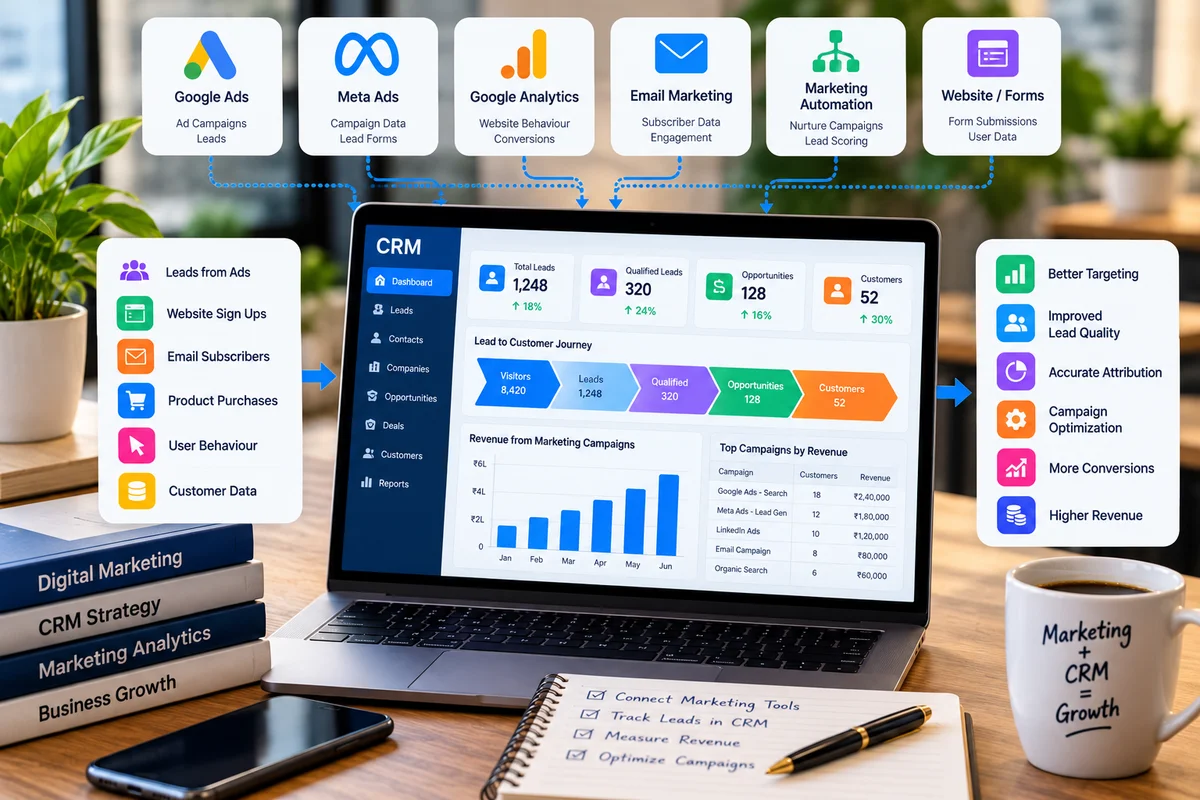
CRM integration connects customer and sales information with marketing data so businesses can better understand the journey from marketing interaction to business outcome.
Instead of looking at marketing and sales as completely separate systems, integration can create a more connected view of the customer journey.
---
## 1. What Is CRM Integration?
CRM integration is the process of connecting a Customer Relationship Management system with other business or marketing platforms so relevant data can move between them.
A CRM typically stores information about:
• Leads
• Contacts
• Companies
• Opportunities
• Sales stages
• Customer interactions
• Sales activities
• Customer status
• Revenue
Digital marketing platforms may contain information about:
• Campaigns
• Impressions
• Clicks
• Website visits
• Ad interactions
• Conversions
• Audiences
• Content engagement
When these systems are connected appropriately, businesses can create a clearer relationship between marketing activity and customer outcomes.
For example:
Advertisement
↓
Website visit
↓
Lead form submission
↓
CRM lead
↓
Qualified lead
↓
Sales opportunity
↓
Customer
↓
Revenue
The CRM can provide visibility into the later stages of this journey.
---
## 2. Why Is CRM Integration Important?
Without integration, marketing and sales data can become fragmented.
Imagine a business generates 1,000 leads from digital advertising.
The advertising platform reports:
1,000 conversions.
The CRM may show:
1,000 leads
200 qualified leads
50 opportunities
15 customers
₹750,000 revenue
Now the business has a much more meaningful picture.
Instead of asking:
"How many leads did marketing generate?"
the business can also ask:
"Which campaigns generated the leads that eventually became customers?"
That distinction can significantly improve marketing decision-making.
---
## 3. Marketing Data vs CRM Data
Marketing platforms and CRMs generally answer different questions.
### Marketing platforms answer questions such as:
• How many people saw the campaign?
• How many clicked?
• Which campaign generated conversions?
• What was the cost per lead?
• Which audience performed better?
### CRM systems answer questions such as:
• Who are the leads?
• Which leads are qualified?
• Which opportunities are active?
• Which leads became customers?
• What is the sales value?
• Where is each opportunity in the sales pipeline?
Neither dataset necessarily provides the complete picture on its own.
Connecting them can help businesses understand what happens across the customer journey.
---
## 4. A Simple Example
Imagine a company runs three advertising campaigns.
### Campaign A
1,000 leads
100 qualified leads
10 customers
### Campaign B
500 leads
150 qualified leads
25 customers
### Campaign C
300 leads
120 qualified leads
30 customers
If the company only looks at lead volume, Campaign A appears to be the best.
But if the objective is customer acquisition, Campaign C may be much more valuable.
This is one of the biggest benefits of connecting marketing data with CRM data.
The business can evaluate not only:
"How many leads did we generate?"
but also:
"What happened to those leads?"
---
# 5. CRM Integration With Google Ads
Google Ads can generate traffic, leads and conversions.
A CRM can provide information about what happens to those leads after the initial conversion.
For example:
Google Ads
↓
Ad click
↓
Landing page
↓
Lead form
↓
CRM
↓
Qualified lead
↓
Customer
When appropriate conversion data can be shared back with advertising systems, advertisers can gain better visibility into downstream outcomes.
This can help businesses move beyond optimizing purely for form submissions.
For example, if one campaign generates many low-quality leads while another generates fewer but better-quality customers, downstream data can help inform optimization decisions.
---
# 6. CRM Integration With Meta Ads
The same principle applies to Meta advertising.
A business may generate leads through Facebook or Instagram.
The initial advertising platform can provide campaign and conversion information.
The CRM can then track:
• Lead status
• Qualification
• Sales activity
• Opportunity stage
• Customer status
• Revenue
Connecting appropriate data between systems can help businesses understand which advertising activity contributes to meaningful business outcomes.
The exact integration method depends on the CRM, advertising platform, lead-generation method and technical setup.
---
# 7. CRM Integration With Google Analytics
Analytics platforms provide valuable information about website and user behavior.
They can help businesses understand:
• Where visitors came from
• Which pages they viewed
• How users interacted with the website
• Which campaigns generated traffic
• Which events or conversions occurred
The CRM provides another layer:
• Lead identity
• Qualification
• Sales stage
• Opportunity
• Customer status
• Revenue
Connecting these datasets where appropriate can help businesses connect website behavior with downstream customer outcomes.
However, organizations must consider privacy, consent and data governance when combining user and customer information.
---
# 8. CRM and Lead Generation Forms
Lead-generation forms are one of the most common places where CRM integration becomes useful.
A basic process may look like:
User sees an advertisement
↓
User clicks
↓
User submits a form
↓
Lead enters CRM
↓
Lead is assigned
↓
Sales or marketing follows up
Without integration, someone may need to manually transfer lead information between systems.
With an appropriate integration, the process can be automated.
The CRM can receive relevant information such as:
• Name
• Phone
• Company
• Campaign source
• Lead type
• Form information
The exact fields available depend on the tools and implementation.
---
# 9. First-Party Customer Data
CRM systems often contain first-party customer information.
First-party data is information a business collects directly through interactions with its customers or prospects.
Examples include:
• Form submissions
• Customer purchases
• Sales interactions
• Account information
• Subscription information
• Customer preferences
• Support interactions
This data can be valuable because it comes directly from the relationship between the business and its audience.
However, using customer data for marketing requires appropriate privacy, consent and data-governance practices.
---
# 10. Audience Segmentation
CRM integration can also support audience segmentation.
Instead of treating every lead as the same, a business can create groups based on relevant information.
For example:
• New leads
• Qualified leads
• Existing customers
• High-value customers
• Previous customers
• Trial users
• Enterprise accounts
• Small-business accounts
These segments can potentially be used to make marketing communications or advertising strategies more relevant.
For example, an existing customer should generally receive different messaging from someone who has never interacted with the business.
---
# 11. Improving Lead Quality Measurement
Lead volume alone can be misleading.
Consider two campaigns.
### Campaign A
1,000 leads
100 qualified leads
10 customers
### Campaign B
500 leads
200 qualified leads
30 customers
Campaign A generated twice as many leads.
But Campaign B generated three times as many customers.
If the CRM is disconnected from marketing data, the marketing team may focus heavily on Campaign A because it produced more leads.
CRM integration can provide additional context.
It allows businesses to examine what happened after the lead was created.
---
# 12. Offline Conversion Tracking
Some businesses complete their conversions offline.
For example:
A person submits an online enquiry.
↓
Sales representative contacts them.
↓
They attend a meeting.
↓
They sign a contract.
The final sale may happen outside the website.
If the business only measures online form submissions, it may never know which marketing campaigns ultimately generated revenue.
Offline conversion measurement can help connect later-stage outcomes back to marketing activity when the necessary identifiers, integrations and consent requirements are properly implemented.
This is particularly useful for:
• B2B businesses
• High-value services
• Enterprise sales
• Real estate
• Education
• Financial services
• Consulting
---
# 13. Closing the Marketing-to-Sales Feedback Loop
One of the biggest benefits of CRM integration is creating a feedback loop.
Without integration:
Marketing
↓
Lead
↓
Unknown outcome
With integration:
Marketing
↓
Lead
↓
Qualified lead
↓
Opportunity
↓
Customer
↓
Revenue
↓
Marketing learns which campaigns produced valuable outcomes
This feedback can help marketing teams make better decisions.
For example, if a particular audience generates many leads but very few customers, the team may reconsider its targeting.
If another audience produces fewer leads but significantly more revenue, it may deserve greater attention.
---
# 14. CRM Integration and Attribution
Attribution is about understanding how different marketing touchpoints contribute to conversions.
Consider a customer journey:
1. Sees a LinkedIn advertisement
2. Visits the website
3. Leaves
4. Searches Google
5. Returns through organic search
6. Downloads a guide
7. Receives an email
8. Talks to sales
9. Becomes a customer
Which marketing activity deserves credit?
There may not be one simple answer.
CRM data can provide important information about what happened after the initial marketing interaction.
When combined with analytics and advertising data appropriately, businesses can develop a more complete view of the customer journey.
---
# 15. CRM Integration and Marketing Automation
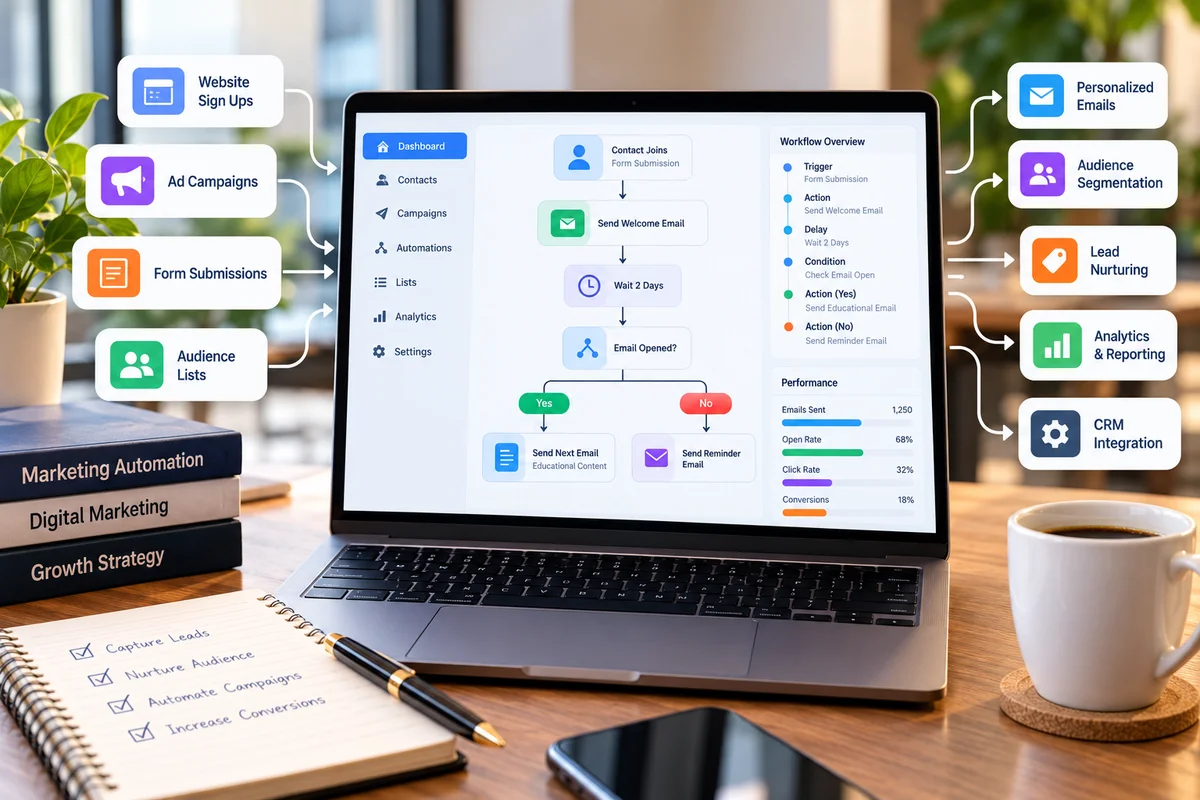
CRM integration and marketing automation often work together.
For example:
Lead submits form
↓
CRM creates lead
↓
Marketing automation starts nurture sequence
↓
Lead interacts with content
↓
Lead score changes
↓
CRM status updates
↓
Sales team receives notification
↓
Opportunity created
This creates a connected process between marketing automation and customer management.
Marketing automation can manage repetitive communication.
The CRM can manage lead and customer information.
Together, they can support a more coordinated customer journey.
---
# 16. CRM Integration With Email Marketing
Email marketing platforms can also benefit from CRM data.
For example, a business may want different email communication for:
• New leads
• Existing customers
• High-value customers
• Inactive contacts
• Qualified opportunities
• Customers who purchased a specific product
CRM information can help define appropriate audiences.
Similarly, email engagement can potentially provide useful signals that can be associated with contact records, depending on the systems being used.
---
# 17. CRM Integration and Personalization
CRM data can support relevant personalization.
For example:
A new prospect may receive educational content.
An existing customer may receive product education.
A high-value customer may receive account-specific communication.
A sales-qualified lead may receive information designed to support a purchasing decision.
The important principle is:
Use customer information to make communication more relevant, not simply to make it more complicated.
---
# 18. CRM Integration for B2B Marketing
CRM integration is particularly valuable for B2B organizations.
B2B customer journeys can involve:
• Multiple decision-makers
• Long sales cycles
• Multiple interactions
• Sales representatives
• Product demonstrations
• Proposals
• Negotiations
• Contracts
A marketing platform may capture the initial interaction.
The CRM can track the sales journey.
Connecting the two can help answer:
• Which campaigns generated opportunities?
• Which sources generated qualified accounts?
• Which content influenced prospects?
• Which campaigns generated revenue?
• How long does it take to convert a lead?
• Which channels produce the best customers?
This can help B2B marketers evaluate marketing beyond lead volume.
---
# 19. CRM Integration for E-Commerce
E-commerce businesses can also benefit from CRM and marketing integrations.
Customer information may include:
• Purchase history
• Product interests
• Order frequency
• Customer value
• Previous interactions
• Customer status
This information can support relevant marketing activities.
For example:
First-time customer
↓
Post-purchase communication
↓
Product education
↓
Related product recommendation
↓
Repeat purchase
The objective is to build a useful customer journey rather than simply send more promotional messages.
---
# 20. Measuring Customer Acquisition Cost
Customer Acquisition Cost, or CAC, measures how much it costs a business to acquire customers.
A simplified formula is:
CAC = Total Customer Acquisition Cost ÷ New Customers
CRM integration can help identify the number of customers generated from marketing activity.
For example:
Marketing and acquisition costs = ₹500,000
New customers = 100
CAC = ₹5,000
But CAC should be interpreted alongside customer value.
A ₹5,000 acquisition cost may be reasonable if customers generate significantly more value over time.
---
# 21. Measuring Customer Lifetime Value
Customer Lifetime Value, or CLV, estimates the value a customer generates over their relationship with a business.
For example:
A customer initially purchases a ₹2,000 product.
Later, they make several additional purchases.
Their total relationship value may eventually become ₹15,000.
If marketing teams only evaluate the first purchase, they may underestimate the value of acquiring that customer.
CRM systems can provide valuable customer-history information that supports this type of analysis.
The exact CLV calculation depends on the business model.
---
# 22. CRM Integration and Campaign Optimization
CRM data can influence marketing optimization.
Imagine two campaigns:
Campaign A:
• 1,000 leads
• 50 qualified leads
• 5 customers
Campaign B:
• 500 leads
• 100 qualified leads
• 20 customers
Campaign B may be more valuable despite generating fewer leads.
This information can influence decisions around:
• Budget allocation
• Audience targeting
• Campaign strategy
• Creative
• Lead-generation methods
• Landing pages
The key is to optimize toward meaningful outcomes rather than simply maximizing volume.
---
# 23. Common CRM Integration Methods
There are several ways systems can be connected.
### Native Integrations
Some platforms provide built-in integrations with popular CRM systems.
These can be relatively straightforward to configure.
### APIs
An API allows different software systems to communicate programmatically.
APIs can support more customized integrations.
### Automation Platforms
Third-party automation platforms can connect systems using predefined workflows.
These can be useful when a direct integration is unavailable or when a business needs a simpler implementation.
### Custom Development
Organizations with complex requirements may build custom integrations.
The appropriate method depends on:
• Data requirements
• Technical resources
• Security requirements
• Platform capabilities
• Budget
• Scale
---
# 24. What Data Should Be Passed Between Systems?
Not every piece of CRM data needs to be shared with every marketing platform.
Relevant information may include:
• Lead identifier
• Campaign source
• Campaign name
• Conversion type
• Lead status
• Qualification status
• Customer status
• Opportunity status
• Conversion value
The exact data should be determined by the business objective and integration requirements.
A useful principle is:
Share the minimum necessary data required to accomplish the intended purpose.
---
# 25. Data Quality Is Critical
CRM integration is only as useful as the data being exchanged.
Common data-quality problems include:
• Duplicate contacts
• Incorrect email addresses
• Missing campaign information
• Inconsistent naming
• Outdated customer status
• Incorrect lead stages
• Missing conversion values
For example, if one system calls a customer status "Closed Won" and another uses "Customer," the systems may require mapping rules.
Before integrating systems, businesses should define how important fields are structured.
---
# 26. Privacy and Consent
CRM integration involves customer and prospect information, so privacy should be considered from the beginning.
Businesses should understand:
• What data is being collected
• Why it is being collected
• Where it is stored
• Which systems receive it
• Who can access it
• How long it is retained
• What consent is required
Organizations should follow applicable privacy laws and their own data-governance policies.
Marketing performance should never come at the expense of responsible handling of customer information.
---
# 27. Common CRM Integration Mistakes
### Mistake 1: Connecting Everything Without a Purpose
More integrations do not automatically create better marketing.
Start with a specific business objective.
### Mistake 2: Ignoring Data Quality
Poor CRM data can create inaccurate reporting.
### Mistake 3: Measuring Only Leads
Lead volume does not necessarily represent business value.
### Mistake 4: Forgetting Sales Outcomes
Marketing should ideally understand what happens after the lead is handed to sales.
### Mistake 5: Overcomplicating the Integration
Start with the most important data flow.
### Mistake 6: Ignoring Privacy
Customer data should be handled responsibly.
### Mistake 7: Not Testing the Data Flow
Always test whether information is transferred accurately.
---
# 28. A Practical CRM Integration Framework
If a business is planning its first CRM integration, a simple framework can help.
### Step 1: Define the business question
For example:
"Which advertising campaigns generate customers?"
### Step 2: Identify the systems
For example:
Google Ads
Website
Analytics
CRM
### Step 3: Define the conversion
Example:
Customer acquired.
### Step 4: Define required data
For example:
Campaign source
Lead ID
Lead status
Customer status
Revenue
### Step 5: Choose the integration method
Native integration, API, automation platform or custom development.
### Step 6: Map the fields
Ensure the same information is represented consistently.
### Step 7: Test
Create test records and verify the data flow.
### Step 8: Monitor
Check whether data continues to transfer correctly.
### Step 9: Build reporting
Connect marketing activity with customer outcomes.
### Step 10: Optimize
Use the resulting insights to improve campaigns.
---
# 29. Example: From Advertisement to Revenue
Consider a simple B2B customer journey.
A person sees a Google advertisement.
↓
Clicks the advertisement.
↓
Visits the website.
↓
Downloads a guide.
↓
Becomes a lead.
↓
Lead enters the CRM.
↓
Marketing automation sends relevant content.
↓
Lead becomes qualified.
↓
Sales contacts the prospect.
↓
Opportunity is created.
↓
Customer signs a contract.
↓
Revenue is recorded.
Now marketing can potentially evaluate the entire journey.
Instead of reporting:
"Campaign generated 100 leads."
the business may be able to understand:
"Campaign generated 100 leads, 25 qualified opportunities and 8 customers worth ₹400,000."
That is a much more useful marketing measurement framework.
---
# 30. CRM Integration Is About Better Decisions
The ultimate purpose of CRM integration is not simply to connect software.
It is to improve decision-making.
Integration can help businesses answer questions such as:
• Which campaigns generate qualified leads?
• Which channels generate customers?
• Which audiences produce higher-value customers?
• Which campaigns generate revenue?
• Where are leads dropping out?
• How long does it take to convert leads?
• Which marketing activities should receive more investment?
These questions are much more valuable than simply asking how many clicks or impressions a campaign generated.
---
# 31. Marketing Technology and the Connected Customer Journey
Modern digital marketing involves many systems.
A simplified technology ecosystem may look like:
Advertising Platforms
↓
Website
↓
Analytics
↓
Lead Capture
↓
Marketing Automation
↓
CRM
↓
Sales
↓
Revenue
Each system can provide a different part of the customer story.
When these systems are connected thoughtfully, businesses can create a more complete picture.
But integration should always be based on a clear purpose.
---
# 32. Final Checklist Before Integrating Your CRM
Before connecting your CRM with digital marketing tools, ask:
□ What business problem are we trying to solve?
□ Which marketing platforms need to be connected?
□ Which CRM fields are required?
□ What counts as a lead?
□ What counts as a qualified lead?
□ What counts as a customer?
□ How will conversion values be recorded?
□ How will campaign sources be captured?
□ How will duplicate records be handled?
□ How will data quality be maintained?
□ What privacy and consent requirements apply?
□ How will the integration be tested?
□ Who will monitor the integration?
□ How will marketing performance be reported?
---
# Conclusion
Integrating your CRM with digital marketing tools can help connect the dots between marketing activity and actual business outcomes.
Marketing platforms can show you:
• Impressions
• Clicks
• Campaigns
• Conversions
• Advertising costs
Your CRM can show you:
• Leads
• Qualified leads
• Opportunities
• Customers
• Sales outcomes
• Revenue
When these systems work together appropriately, businesses can move beyond measuring activity and start understanding business impact.
The most important shift is from:
"How many leads did we generate?"
to:
"What happened to those leads?"
And ultimately:
"Which marketing activities generated valuable customers and revenue?"
That is where CRM integration becomes more than a technical connection.
It becomes a foundation for better marketing measurement, targeting, attribution and decision-making.