Cover Letter for IT Jobs: How to Write One With Examples
# Cover Letter for IT Jobs: How to Write One With Examples
Applying for an IT job can involve more than submitting a resume.
Depending on the company and position, you may also be asked to provide a cover letter.
For many candidates, especially freshers, writing a cover letter can feel confusing.
You may wonder:
What exactly should I write?
Should I repeat my resume?
How long should it be?
Should I mention my technical skills?
What if I have no experience?
Should I write a different cover letter for every company?
What should I write in the opening paragraph?
How do I explain why I want the job?
Should I include salary expectations?
These are common questions.
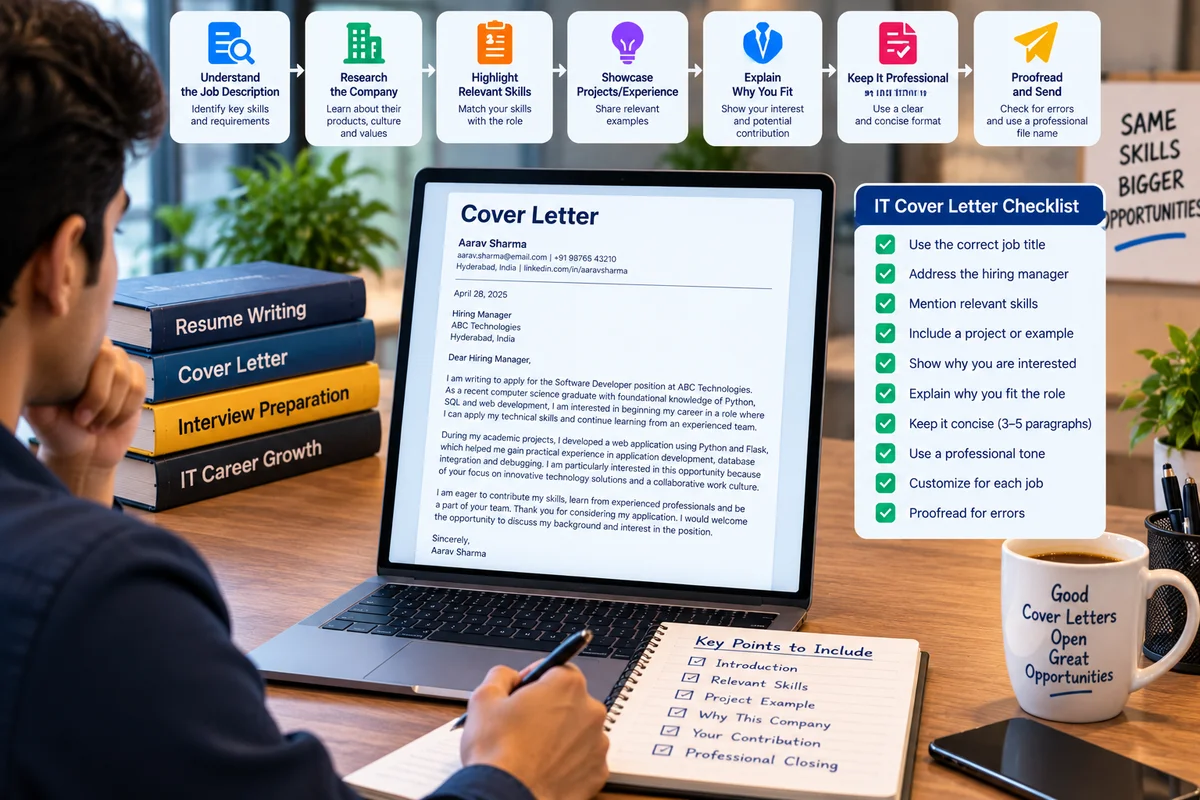
A good cover letter does not need to be complicated.
Its purpose is to introduce you professionally, explain why you are interested in the position, highlight the most relevant parts of your background and encourage the employer to look more closely at your application.
For an IT job, a strong cover letter can also help connect your technical skills, projects, certifications, internship experience or professional experience to the actual requirements of the position.
This guide explains how to write a cover letter for IT jobs, what sections to include, how to customize it for different technology roles and how freshers can create an effective cover letter even without professional experience.
---
# 1. What Is a Cover Letter?
A cover letter is a short professional document submitted with a job application.
It provides additional context about your application.
Your resume answers questions such as:
Who are you?
What have you studied?
What skills do you have?
What experience do you have?
What projects have you completed?
A cover letter can answer:
Why are you applying?
Why are you interested in this specific role?
Which parts of your background are most relevant?
What can you potentially contribute?
Why does the opportunity fit your career direction?
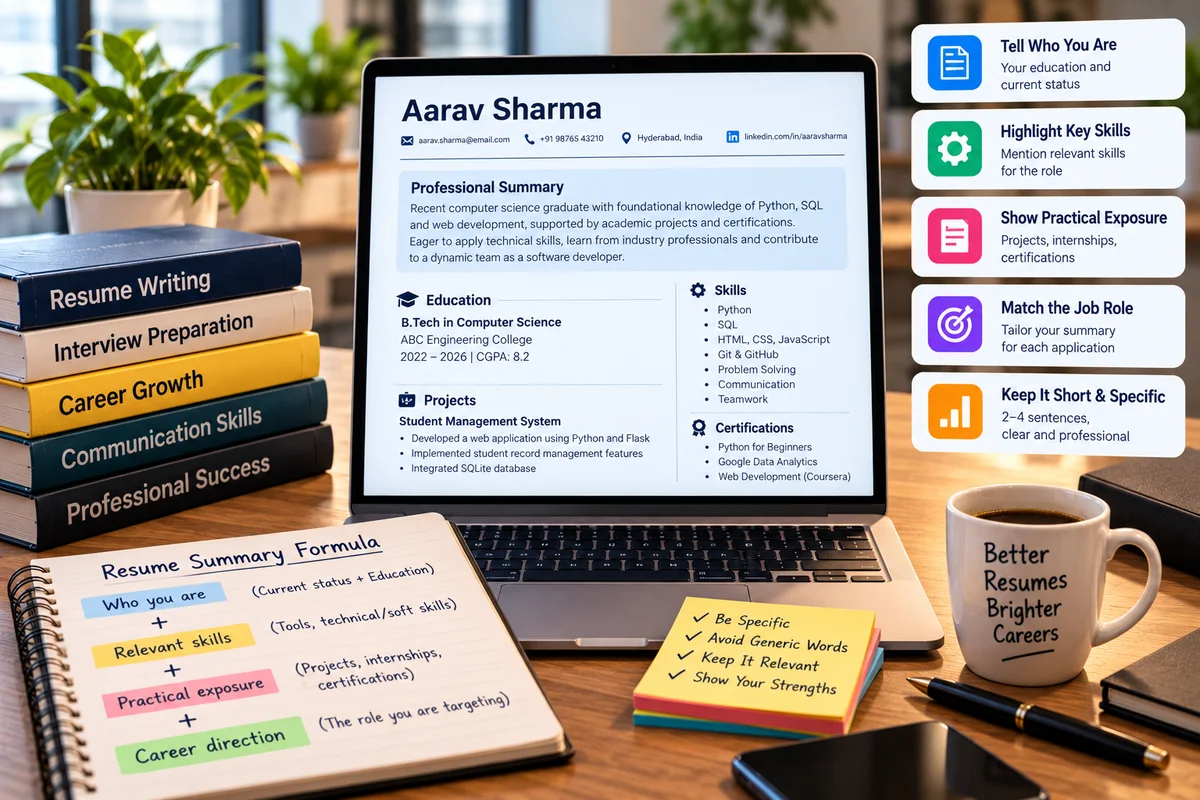
Think of the resume as a structured profile and the cover letter as a short professional explanation.
They should work together.
They should not simply duplicate each other.
---
# 2. Do IT Jobs Always Require a Cover Letter?
No.
Not every IT job requires one.
Some applications specifically request a cover letter.
Some provide an optional field.
Others only ask for a resume.
If a company explicitly requests a cover letter, you should provide one.
If it is optional, the decision depends on the situation.
A cover letter may be especially useful when:
• You are changing careers
• You have limited professional experience
• Your background needs explanation
• You have a relevant project that deserves context
• You are applying directly to a company
• You are particularly interested in the role
• Your experience is not an obvious match
• You are returning after a career break
• The position emphasizes communication
• The application allows meaningful additional information
A cover letter is less useful when it is generic and clearly copied from a template.
Quality matters more than simply submitting one.
---
# 3. What Is the Difference Between a Resume and Cover Letter?
The resume and cover letter have different purposes.
### Resume
A resume is structured and concise.
It usually contains:
• Professional summary
• Skills
• Experience
• Projects
• Education
• Certifications
• Achievements
### Cover letter
A cover letter is written as a professional message.
It usually explains:
• The position you are applying for
• Why you are interested
• Your most relevant qualifications
• A specific project or achievement
• Why you are interested in the company
• How you could contribute
• A professional closing
A resume is generally designed for scanning.
A cover letter is designed for reading.
---
# 4. Should a Cover Letter Repeat Your Resume?
Not word-for-word.
Your cover letter can mention information from your resume, but it should add context.
For example, your resume might say:
“Developed a Python-based student management application.”
Your cover letter can explain:
“During my academic project, I developed a student management application using Python and SQLite. The project gave me practical experience with application logic, database integration and debugging, and strengthened my interest in software development.”
The resume gives the fact.
The cover letter gives the story and relevance.
---
# 5. How Long Should an IT Cover Letter Be?
A practical cover letter is usually around three to five short paragraphs and approximately half a page to one page.
You do not need to write a two-page essay.
A recruiter should be able to understand your application quickly.
A useful structure is:
Paragraph 1:
Why you are writing.
Paragraph 2:
Your relevant skills and experience.
Paragraph 3:
A project, achievement or specific example.
Paragraph 4:
Why the company and role interest you.
Paragraph 5:
Professional closing.
You can combine some sections when appropriate.
The key is relevance.
---
# 6. What Should a Cover Letter Include?
A professional IT cover letter can contain:
1. Your contact information
2. Date
3. Employer or hiring team information
4. Greeting
5. Opening paragraph
6. Relevant qualifications
7. Practical example
8. Why you want the role
9. Closing statement
10. Signature
The exact format can vary depending on the application.
For an online application, a simpler format is often sufficient.
---
# 7. Start With the Correct Job Title
Before writing your cover letter, identify the exact position.
For example:
Software Developer
Junior Software Engineer
Data Analyst
IT Support Specialist
Cloud Engineer
Cybersecurity Analyst
QA Engineer
Business Analyst
Frontend Developer
Backend Developer
DevOps Engineer
Do not write a generic letter addressed to “Any Available Position.”
A specific application looks more intentional.
For example:
“I am writing to apply for the Junior Software Developer position at ABC Technologies.”
This immediately tells the recruiter what you are applying for.
---
# 8. Address the Hiring Manager When Possible
If the hiring manager's name is available, use it.
For example:
Dear Ms. Sharma,
Dear Mr. Rao,
Dear Priya,
Use the level of formality appropriate to the company and context.
If you do not know the person's name, you can use:
Dear Hiring Manager,
or:
Dear Recruitment Team,
Avoid overly informal openings such as:
“Hey”
“Hi guys”
“Hello team!!!”
A cover letter is a professional document.
---
# 9. The Opening Paragraph
Your opening paragraph should answer three questions:
What job are you applying for?
What is your current professional status?
Why are you interested?
For example:
“I am writing to apply for the Junior Software Developer position at ABC Technologies. As a recent computer science graduate with foundational knowledge of Python, SQL and web development, I am interested in the opportunity to apply my technical skills in a professional development environment while continuing to learn from an experienced engineering team.”
This is much stronger than:
“I saw your job advertisement and I am interested in the position.”
---
# 10. Avoid Generic Openings
Weak:
“I am writing this letter to apply for the job advertised on your website.”
This is not wrong, but it provides almost no value.
Better:
“I am excited to apply for the Junior Data Analyst position at ABC Technologies, where I can apply my foundation in SQL, Excel and data visualization to support data-driven business decisions.”
The second version communicates relevance immediately.
---
# 11. Mention Your Most Relevant Skills
Do not list every skill from your resume.
Choose the skills most closely connected to the job.
For example, if the job requires:
Python
SQL
APIs
Git
Problem solving
your cover letter can mention:
“My technical foundation includes Python, SQL, Git and basic API concepts, supported by academic projects involving application development and database integration.”
This is better than:
“I know Python, Java, SQL, Excel, PowerPoint, Canva, Photoshop, AWS, HTML, CSS and many other tools.”
Relevance matters.
---
# 12. Match Skills to the Job Description
Read the job description carefully.
Suppose it says:
“The candidate will support software development, debugging and database-related tasks.”
Your letter can say:
“My academic projects have given me practical exposure to application development, debugging and database integration, particularly through projects using Python and SQL.”
You are not simply repeating the job description.
You are demonstrating alignment.
---
# 13. Demonstrate Instead of Claiming
Avoid unsupported statements such as:
“I am an excellent programmer.”
Instead:
“Through academic and personal projects, I have developed practical experience using Python and SQL and have worked through debugging and database-related challenges.”
The second statement gives evidence.
A good cover letter should answer:
“How do you know this candidate can do what they claim?”
Whenever possible, provide evidence.
---
# 14. Include a Relevant Project
Projects are particularly important for IT freshers.
A project can demonstrate:
• Technical knowledge
• Problem solving
• Application of concepts
• Teamwork
• Debugging
• Documentation
• Learning ability
For example:
“During my final-year project, I developed a web-based student management application using Python, Flask and SQLite. I was responsible for implementing core application functionality and database integration, which helped me develop a stronger understanding of backend development.”
This is far more informative than simply saying:
“I have good technical skills.”
---
# 15. How Freshers Can Write a Cover Letter
Freshers often think:
“I don't have experience, so I have nothing to write.”
That is not true.
You can discuss:
• Education
• Projects
• Internships
• Certifications
• Coursework
• Technical skills
• Personal projects
• Competitions
• Volunteer activities
• Learning initiatives
Your objective is not to pretend you have professional experience.
Your objective is to demonstrate readiness.
---
# 16. Fresher IT Cover Letter Example
Dear Hiring Manager,
I am writing to apply for the Software Developer position at ABC Technologies. I recently completed my degree in computer science and have developed a foundation in Python, SQL, web development and software development concepts. I am interested in starting my career in an environment where I can apply these skills to practical projects and continue learning from experienced professionals.
During my academic work, I developed projects involving Python applications, database integration and basic web development. These projects helped me strengthen my problem-solving skills and gave me practical exposure to writing, testing and debugging code.
I am particularly interested in this opportunity because the role involves software development and provides exposure to real-world technology projects. I believe my technical foundation, willingness to learn and interest in software development would allow me to contribute positively while continuing to grow.
Thank you for considering my application. I would welcome the opportunity to discuss my background and interest in the position.
Sincerely,
[Your Name]
---
# 17. Cover Letter for Software Developer Jobs
A software developer cover letter should emphasize:
• Programming languages
• Development projects
• Problem solving
• Databases
• APIs
• Version control
• Testing
• Debugging
• Relevant frameworks
• Learning ability
Example opening:
“I am writing to apply for the Software Developer position at ABC Technologies. With a foundation in Python, SQL and web development and hands-on experience through academic and personal projects, I am interested in applying my technical knowledge to real-world software development.”
Then provide evidence.
For example:
“One of my recent projects involved developing a web application using Python and Flask with SQLite database integration. This experience helped me understand application architecture, database operations and debugging.”
---
# 18. Cover Letter for Junior Software Engineer
Example:
Dear Hiring Manager,
I am excited to apply for the Junior Software Engineer position at ABC Technologies. As a recent computer science graduate with knowledge of Python, SQL, data structures and web development, I am interested in beginning my professional career in software engineering.
Through academic and personal projects, I have gained practical experience developing applications, working with databases and debugging code. These experiences have strengthened my problem-solving approach and increased my interest in building reliable software.
I am particularly attracted to this position because it offers an opportunity to work with an engineering team while developing practical industry experience. I am comfortable learning new technologies and would welcome the opportunity to contribute while continuing to strengthen my technical skills.
Thank you for your consideration.
Sincerely,
[Your Name]
---
# 19. Cover Letter for Data Analyst Jobs
For a data analyst position, highlight:
• SQL
• Excel
• Python
• Power BI
• Tableau
• Data cleaning
• Data visualization
• Reporting
• Statistical concepts
• Business analysis
Example:
“Recent graduate with foundational knowledge of SQL, Excel and Power BI, I am interested in applying for the Data Analyst position at ABC Technologies. Through academic projects, I have gained practical exposure to data cleaning, analysis and dashboard creation.”
Then explain a relevant project.
For example:
“In one project, I analyzed a sales dataset, cleaned inconsistent records and created a dashboard to highlight sales trends and category performance. This experience strengthened my interest in using data to support business decisions.”
---
# 20. Cover Letter for Data Analyst Freshers
Dear Hiring Manager,
I am writing to apply for the Data Analyst position at ABC Technologies. I recently completed my degree and have developed foundational skills in Excel, SQL, Power BI and data analysis. I am interested in applying these skills in a professional environment where I can contribute to reporting and data-driven decision-making.
As part of my academic and independent learning, I have worked on data analysis projects involving data cleaning, basic analysis and dashboard creation. These projects helped me understand how structured data can be transformed into useful information for decision-making.
I am particularly interested in this opportunity because it combines analytical work with business problem solving. I am eager to continue developing my technical skills while contributing to the team's reporting and analytical requirements.
Thank you for considering my application.
Sincerely,
[Your Name]
---
# 21. Cover Letter for IT Support Jobs
IT support roles often emphasize:
• Troubleshooting
• Operating systems
• Hardware
• Networking
• Customer communication
• Ticket management
• Documentation
• Problem solving
• Patience
• Technical support
Example:
“I am writing to apply for the IT Support Specialist position. With foundational knowledge of computer systems, networking and troubleshooting, along with strong communication skills, I am interested in helping users resolve technical issues efficiently.”
Then provide evidence:
“Through academic and personal technical projects, I have developed experience diagnosing common software and system issues and documenting troubleshooting steps.”
---
# 22. Cover Letter for Help Desk Jobs
Example:
Dear Hiring Manager,
I am interested in applying for the Help Desk Support position at ABC Technologies. I have a strong interest in IT support and a foundation in computer systems, troubleshooting and networking concepts, along with strong communication and problem-solving skills.
During my academic and personal learning, I have worked through common technical issues involving software configuration, system troubleshooting and connectivity. These experiences have taught me the importance of understanding the problem carefully, following a structured troubleshooting process and communicating solutions clearly.
I would welcome the opportunity to develop my technical support skills while helping users resolve issues efficiently.
Thank you for your consideration.
Sincerely,
[Your Name]
---
# 23. Cover Letter for Cybersecurity Jobs
Cybersecurity cover letters can mention:
• Networking
• Security fundamentals
• Threat awareness
• Vulnerability concepts
• Security tools
• Incident response
• Risk management
• Security certifications
• Labs and projects
For a fresher:
“Recent computer science graduate with foundational knowledge of networking, cybersecurity principles and security monitoring, supported by hands-on learning and security-focused projects. I am interested in beginning my career in cybersecurity and developing practical experience in threat detection and security operations.”
Do not claim that you are an experienced cybersecurity professional if you have only completed courses.
---
# 24. Cover Letter for Cloud Jobs
For cloud roles, relevant areas can include:
• AWS
• Microsoft Azure
• Google Cloud
• Virtual machines
• Storage
• Networking
• IAM
• Containers
• Cloud security
• Infrastructure concepts
Example:
“Recent graduate with foundational knowledge of cloud computing, networking and virtual infrastructure, supported by hands-on learning with cloud platforms. I am interested in an entry-level cloud role where I can apply these concepts and continue developing practical cloud engineering skills.”
---
# 25. Cover Letter for DevOps Jobs
For DevOps positions, mention relevant skills such as:
• Linux
• Git
• CI/CD
• Docker
• Kubernetes
• Cloud platforms
• Automation
• Monitoring
• Scripting
Example:
“Recent computer science graduate with foundational knowledge of Linux, Git, scripting and cloud concepts, with hands-on exposure to containerization and basic CI/CD workflows. I am interested in developing a career in DevOps and applying these skills in a professional environment.”
---
# 26. Cover Letter for QA / Software Testing Jobs
Relevant skills include:
• Manual testing
• Test cases
• Bug reporting
• Test planning
• SDLC
• STLC
• Automation
• Selenium
• API testing
• Attention to detail
Example:
“Recent computer science graduate with foundational knowledge of software testing, test case development and defect reporting. Through academic projects, I have developed an understanding of testing workflows and the importance of identifying issues before software reaches users.”
---
# 27. Cover Letter for Frontend Developer Jobs
Highlight:
• HTML
• CSS
• JavaScript
• React
• Responsive design
• UI development
• Browser fundamentals
• Git
Example:
“Recent computer science graduate with hands-on experience building responsive web interfaces using HTML, CSS and JavaScript. Through academic and personal projects, I have developed a strong interest in frontend development and user-focused web experiences.”
---
# 28. Cover Letter for Backend Developer Jobs
Highlight:
• Python
• Java
• Node.js
• APIs
• Databases
• Authentication
• Server-side development
Example:
“Recent computer science graduate with foundational knowledge of Python, SQL, backend development and REST APIs. My academic projects have provided hands-on experience with application logic and database integration, and I am interested in developing my career in backend engineering.”
---
# 29. Cover Letter for Full-Stack Developer Jobs
Do not simply list frontend and backend technologies.
Show that you understand the relationship between them.
Example:
“Recent computer science graduate with foundational experience in frontend development, backend programming and database integration. Through academic projects, I have worked with HTML, CSS, JavaScript, Python and SQL to build basic web applications and develop an understanding of full-stack workflows.”
---
# 30. Cover Letter for Business Analyst Jobs
A business analyst cover letter can emphasize:
• Business analysis
• Requirements gathering
• Documentation
• Stakeholder communication
• Data analysis
• Process improvement
• Excel
• SQL
• Problem solving
Example:
“Recent business graduate with foundational knowledge of business analysis, Excel, data interpretation and process documentation. Through academic projects, I have developed experience analyzing requirements and presenting findings, and I am interested in starting a career in business analysis.”
---
# 31. Cover Letter for Technical Support Jobs
Technical support requires both technical and communication skills.
Your letter can emphasize:
• Troubleshooting
• Customer communication
• Technical documentation
• Problem solving
• Patience
• Ticket handling
Example:
“I am interested in the Technical Support Associate position because it combines my interest in technology with my communication and problem-solving strengths. I have developed foundational knowledge of computer systems and troubleshooting and enjoy breaking technical problems into clear, manageable steps.”
---
# 32. Cover Letter for IT Internships
For internships, focus on:
• Current education
• Relevant coursework
• Projects
• Skills
• Learning ability
• Interest in the industry
Example:
“Dear Hiring Manager,
I am a final-year computer science student interested in applying for the IT internship at ABC Technologies. I have developed foundational knowledge of Python, SQL and web development through coursework and academic projects and am eager to gain practical exposure to professional IT environments.”
Then mention one project and explain why the internship interests you.
---
# 33. Cover Letter for a First IT Job
If this is your first professional IT role, you can openly say that you are starting your career.
For example:
“I am looking for an opportunity to begin my professional career in IT and apply the technical foundation I have developed through education, projects and independent learning.”
This is completely acceptable.
You do not need to disguise your entry-level status.
---
# 34. How to Explain a Lack of Experience
Do not write:
“I don't have any experience.”
Instead, focus on what you do have.
For example:
“While I am at the beginning of my professional career, I have developed practical knowledge through academic projects, technical coursework and independent learning.”
This communicates the same reality more professionally.
---
# 35. Cover Letter for an IT Career Changer
If you are moving from another industry into IT, explain the transition.
Example:
“After several years in customer operations, I developed a growing interest in technology and began structured learning in data analytics. I have since developed practical skills in Excel, SQL and Power BI and completed several independent projects. I am now looking to transition into a data analytics role where I can combine my business understanding with my developing technical skills.”
This provides context.
---
# 36. Cover Letter After a Career Break
If you have a career break, you do not always need to make it the central topic of the cover letter.
If it is relevant, keep the explanation concise.
For example:
“After taking time away from full-time employment due to personal circumstances, I have spent the recent period refreshing my professional skills and completing structured learning in digital marketing and analytics. I am now ready to return to a professional environment and apply this updated knowledge.”
Then focus on the role.
The cover letter should not become a detailed explanation of personal circumstances.
---
# 37. Cover Letter for Returning IT Professionals
Example:
“I am interested in returning to the technology industry after a period away from full-time employment. During this time, I have continued developing my knowledge through structured learning and practical projects, particularly in [technology]. My previous experience in [area], combined with my refreshed skills, has prepared me to contribute effectively while continuing to grow.”
This keeps the focus on readiness.
---
# 38. How to Explain a Career Gap Without Overexplaining
A good structure is:
Reason → Learning/Activity → Current readiness
For example:
“I took time away from full-time work due to personal circumstances. During that period, I focused on refreshing my professional knowledge and completing relevant training. I am now prepared to return to a full-time role and contribute with renewed focus.”
You do not need to provide sensitive personal details.
---
# 39. Why Should You Mention the Company?
A strong cover letter should show that it was written for the company.
You can mention:
• Company products
• Industry
• Technology
• Culture
• Business area
• Specific project
• Role responsibilities
For example:
“I was particularly interested in this opportunity because your team works on cloud-based business applications, an area that aligns closely with the projects I have been exploring.”
That sounds more intentional than:
“Your company is a reputed organization.”
---
# 40. Avoid Empty Compliments
Weak:
“Your company is one of the best companies in the world.”
Why?
It could be sent to almost any company.
Better:
“I am particularly interested in the role because of the opportunity to work on cloud-based applications and develop practical experience with enterprise technology.”
Specificity is more convincing than praise.
---
# 41. How to Research a Company Before Writing
Before preparing the letter, look at:
• Company website
• Careers page
• Job description
• Product pages
• Technology pages
• Recent announcements
• Company LinkedIn page
• Relevant team information
You do not need to research for hours.
You simply need enough context to understand:
What does the company do?
Why does this role matter?
Why am I interested?
---
# 42. Use One Strong Example
You do not need five projects in the cover letter.
One relevant example can be enough.
For example:
“During my final-year project, I developed a Python-based application with database integration. I was responsible for implementing core functionality and troubleshooting issues during testing.”
Then connect it to the role.
This creates a clear story.
---
# 43. Use the STAR Structure When Describing Experience
For a professional or project example, you can use:
Situation
Task
Action
Result
For example:
“During a university project, our team needed to build a small web application within a limited timeframe. I was responsible for the database component, so I designed the database structure, integrated it with the application and tested the main workflows. The project was completed successfully and gave me practical experience with database integration and debugging.”
This is more powerful than simply saying:
“I have project experience.”
---
# 44. Should You Mention Technical Tools?
Yes, when they are relevant.
For example:
Python
SQL
JavaScript
React
AWS
Azure
Power BI
Git
Docker
Selenium
Google Analytics
The key is to connect tools to experience.
Weak:
“I know Python, SQL and Git.”
Better:
“I have used Python and SQL in academic projects and Git for basic version control and project collaboration.”
---
# 45. Do Not List Every Technology
A cover letter is not a skills inventory.
If you list 20 technologies, the important ones disappear.
Select the technologies most relevant to the role.
The resume can contain the broader skills section.
---
# 46. Cover Letter for an IT Job With Certification
Certifications can strengthen a fresher application.
For example:
“I have also completed certifications in [relevant technology], which helped me strengthen my understanding of [specific area].”
Do not make certification names the entire letter.
Certification is supporting evidence, not the complete profile.
---
# 47. Cover Letter for Candidates With a Portfolio
If you have a portfolio, mention it naturally.
For example:
“In addition to my academic projects, I have built a small portfolio of web development projects that demonstrates my practical interest in frontend and backend development.”
If the application allows links, include the portfolio where appropriate.
---
# 48. Cover Letter for GitHub Projects
For technical candidates, GitHub can provide additional evidence.
You can write:
“I have also maintained personal coding projects to strengthen my understanding of software development and version control.”
Do not include a GitHub link just because you have an account.
Make sure the projects are presentable first.
---
# 49. Cover Letter for Freshers With No Projects
If you genuinely have no projects, focus on:
Education
Relevant coursework
Certifications
Technical skills
Academic achievements
Learning initiative
Interest in the role
Example:
“Through my coursework and structured learning, I have developed a foundation in Python, SQL and database concepts. I am now looking for an entry-level opportunity where I can apply this knowledge to practical work and learn from an experienced team.”
You can also begin building a small project to strengthen future applications.
---
# 50. How to Write a Strong Second Paragraph
Your second paragraph should answer:
“What makes you relevant?”
For example:
“My background has given me a foundation in Python, SQL and web development, while academic projects have provided practical exposure to application development and database integration. I have particularly enjoyed solving technical problems and understanding how different components of an application work together.”
This is much stronger than simply listing skills.
---
# 51. How to Write the Company-Fit Paragraph
This paragraph explains why the opportunity interests you.
Example:
“I am particularly interested in this position because it combines software development with opportunities to learn within a collaborative engineering environment. The role's focus on building and maintaining applications aligns with the type of work I want to pursue as I begin my professional career.”
Keep it genuine.
---
# 52. How to Close the Cover Letter
A professional closing can be simple:
“Thank you for considering my application. I would welcome the opportunity to discuss how my skills and interests align with the position.”
Then:
“Sincerely,
[Your Name]”
You do not need an exaggerated closing.
---
# 53. Avoid Overly Emotional Language
Avoid:
“This is my dream company and I would do absolutely anything to get this opportunity.”
Professional applications should remain professional.
Instead:
“I am particularly interested in the opportunity because it aligns with my technical interests and long-term career direction.”
---
# 54. Avoid Begging for the Job
Do not write:
“Please give me a chance.”
Instead:
“I would welcome the opportunity to discuss how my background aligns with the role.”
Confidence and humility can coexist.
---
# 55. Avoid Negative Statements
Do not write:
“I don't have experience, but…”
“I couldn't find another job…”
“My previous company was terrible…”
“My college didn't provide enough opportunities…”
Keep the letter focused on what you can bring.
---
# 56. Do Not Criticize Your Previous Employer
Even if you had a difficult experience, the cover letter is not the place to explain it.
If you are changing jobs, focus on:
• Career growth
• New responsibilities
• Skill development
• Role alignment
For example:
“I am interested in moving into a role that provides greater exposure to data analytics.”
This is better than:
“I want to leave because my previous company had no growth.”
---
# 57. Cover Letter Formatting
Keep the design clean.
Recommended:
• Professional font
• Readable font size
• Clear spacing
• Short paragraphs
• Consistent margins
• Simple formatting
• No excessive graphics
Your cover letter should look like a professional business document.
---
# 58. Should Your Cover Letter Match Your Resume?
Yes.
Use similar:
• Font
• Name styling
• Contact information
• Visual hierarchy
• General formatting
This creates a consistent application package.
The resume and cover letter should look like they belong together.
---
# 59. Save the File Professionally
Avoid:
“coverletterfinalfinal2.pdf”
Use something like:
“Praveen_Kumar_Cover_Letter_Software_Developer.pdf”
or:
“Praveen_Kumar_Cover_Letter_Data_Analyst.pdf”
A professional filename makes your application easier to manage.
---
# 60. Convert to PDF When Appropriate
If the application does not specify another format, PDF is often a practical choice because it preserves formatting.
However, always follow the employer's instructions.
If the company specifically requests a DOCX file, provide DOCX.
If it provides a text field, you may need to paste the content directly.
Follow the application requirements.
---
# 61. Customize the Filename Too
If you apply to multiple roles, use a relevant filename.
For example:
Praveen_Kumar_Software_Developer_Cover_Letter.pdf
Praveen_Kumar_Data_Analyst_Cover_Letter.pdf
This reduces the chance of accidentally submitting the wrong document.
---
# 62. Should You Include Your Address?
It depends on the format and application.
A modern cover letter does not necessarily require your full home address.
You can include:
Name
Phone
City
LinkedIn or portfolio if relevant
Avoid unnecessarily exposing sensitive personal information.
---
# 63. Should You Include LinkedIn?
If your LinkedIn profile is professional and relevant, yes.
Make sure it is:
• Updated
• Consistent with your resume
• Free of obvious errors
• Relevant to the role
Do not include a LinkedIn profile that is incomplete or outdated.
---
# 64. Should You Include a Portfolio?
If relevant, yes.
Especially for:
• Software development
• UI/UX
• Graphic design
• Data analytics
• Content
• Digital marketing
A portfolio can provide evidence that a resume alone cannot.
---
# 65. Cover Letter for IT Freshers: Complete Example
Dear Hiring Manager,
I am writing to apply for the Entry-Level Software Developer position at ABC Technologies. As a recent computer science graduate with foundational knowledge of Python, SQL, JavaScript and web development, I am interested in beginning my professional career in a role where I can apply my technical knowledge and continue developing practical software engineering skills.
During my academic and independent projects, I worked on applications involving database integration, frontend development and basic backend functionality. These projects helped me develop a structured approach to problem solving, debugging and testing. I also gained experience working with Git and learned the importance of writing maintainable and organized code.
I am particularly interested in this position because it provides an opportunity to work with an experienced development team and contribute to real-world software projects. I am comfortable learning new technologies and enjoy understanding technical problems and finding practical solutions.
Thank you for considering my application. I would welcome the opportunity to discuss my skills, projects and interest in the position.
Sincerely,
[Your Name]
---
# 66. Cover Letter for an IT Fresher With Python Skills
Dear Hiring Manager,
I am writing to apply for the Python Developer position at ABC Technologies. I recently completed my computer science degree and have developed a foundation in Python, SQL and software development through academic coursework and practical projects.
One of my key projects involved developing a Python-based application with database integration. Through this project, I gained experience with application logic, data handling, debugging and testing. I also strengthened my understanding of how software components work together to solve practical problems.
I am interested in this opportunity because it would allow me to apply my Python knowledge in a professional environment while learning from experienced developers. I am motivated to develop my technical skills further and contribute consistently to the team.
Thank you for your consideration.
Sincerely,
[Your Name]
---
# 67. Cover Letter for an IT Fresher With SQL Skills
Dear Hiring Manager,
I am interested in the Junior Data Analyst position at ABC Technologies. As a recent graduate with foundational knowledge of SQL, Excel and data visualization, I am eager to begin my career in a role where I can apply analytical skills to real-world business problems.
Through academic projects, I have worked with structured datasets, performed basic data cleaning and used SQL queries to retrieve and analyze information. I have also created basic dashboards to communicate findings more clearly.
I am particularly interested in this position because it combines technical analysis with business decision-making. I would welcome the opportunity to develop my analytical capabilities while contributing to the team's reporting and data requirements.
Thank you for considering my application.
Sincerely,
[Your Name]
---
# 68. Cover Letter for an IT Fresher With Internship Experience
Dear Hiring Manager,
I am writing to apply for the Junior IT Analyst position at ABC Technologies. I recently completed my degree and gained practical exposure to IT operations during my internship, where I supported basic troubleshooting, documentation and internal technical requests.
During the internship, I developed a better understanding of how IT teams diagnose issues, communicate with users and document solutions. I also strengthened my knowledge of computer systems and troubleshooting processes through independent learning.
I am interested in this role because it would allow me to build on my internship experience while developing broader exposure to professional IT operations. I am eager to learn, contribute and grow within an experienced team.
Thank you for your time and consideration.
Sincerely,
[Your Name]
---
# 69. Cover Letter for an Experienced IT Professional
Experienced candidates should focus more on achievements and business impact.
Example:
Dear Hiring Manager,
I am writing to apply for the Senior Software Engineer position at ABC Technologies. With over six years of experience in software development, including extensive work with Python, APIs and relational databases, I have developed and supported applications across multiple business environments.
In my current role, I have contributed to backend application development, API integration and production troubleshooting. I have also worked closely with cross-functional teams to translate requirements into technical solutions and improve application reliability.
I am particularly interested in this opportunity because of the team's focus on scalable technology solutions. I believe my technical experience and collaborative approach would allow me to contribute effectively while taking on broader engineering responsibilities.
Thank you for considering my application.
Sincerely,
[Your Name]
---
# 70. Experienced Candidates Should Focus on Results
Instead of:
“I worked on software development.”
Use:
“Developed and maintained backend services that supported key business workflows.”
Instead of:
“I worked with databases.”
Use:
“Optimized database queries and improved application response times for high-volume workflows.”
The more experienced you are, the more important outcomes become.
---
# 71. Use Numbers When They Are Genuine
Numbers can make achievements more concrete.
For example:
“Reduced manual reporting time by approximately 30% by automating recurring data preparation.”
“Supported a team handling more than 500 monthly support requests.”
“Improved page load performance by 20%.”
Only use numbers you can genuinely support.
Do not invent metrics to make the cover letter sound impressive.
---
# 72. Cover Letter for a Remote IT Job
For remote roles, you can mention:
• Remote collaboration
• Communication
• Documentation
• Time management
• Digital collaboration tools
Example:
“I am comfortable working in collaborative digital environments and have experience using communication and project management tools to coordinate work and maintain clear documentation.”
Only mention tools you actually know.
---
# 73. Cover Letter for a Hybrid IT Job
You can focus on adaptability:
“I am comfortable working in collaborative environments and adapting between independent and team-based work. I value clear communication, documentation and accountability, particularly when coordinating work across different teams.”
---
# 74. Cover Letter for a Startup
Startups may value:
• Adaptability
• Ownership
• Learning speed
• Problem solving
• Flexibility
Example:
“I am particularly interested in the opportunity because startup environments provide exposure to a broad range of responsibilities and encourage practical problem solving. I enjoy learning new technologies and taking ownership of tasks from understanding requirements through implementation and testing.”
Only use this if it genuinely reflects you.
---
# 75. Cover Letter for a Large IT Company
Large organizations may emphasize:
• Process
• Collaboration
• Scale
• Structured learning
• Quality
• Teamwork
Example:
“I am interested in joining an organization where I can develop my technical skills through structured projects, collaborate with experienced professionals and contribute to technology solutions operating at scale.”
Again, customize it to the company.
---
# 76. Cover Letter for a Product Company
Focus on:
• Product thinking
• Users
• Quality
• Problem solving
• Technology
Example:
“I am particularly interested in product-focused development because it connects technical decisions with real user needs. My project experience has strengthened my interest in building practical solutions that are reliable and easy to use.”
---
# 77. Cover Letter for an IT Services Company
Focus on:
• Client requirements
• Adaptability
• Multiple technologies
• Communication
• Delivery
Example:
“I am interested in the opportunity to work across different technology projects and develop experience solving client and business requirements through technology solutions.”
---
# 78. Common Cover Letter Mistakes
### Mistake 1: Sending the same letter everywhere
A generic letter shows little interest.
### Mistake 2: Repeating the entire resume
The cover letter should add context.
### Mistake 3: Making unsupported claims
Avoid exaggeration.
### Mistake 4: Writing too much
Recruiters do not need your entire career history.
### Mistake 5: Using generic compliments
“Your company is excellent” provides little value.
### Mistake 6: Focusing only on what you want
Explain what you can contribute too.
### Mistake 7: Ignoring the job description
Your letter should reflect the actual role.
### Mistake 8: Using poor formatting
Keep it clean and readable.
### Mistake 9: Spelling the company name incorrectly
Always proofread.
### Mistake 10: Sending the wrong cover letter
Check the company and role before submitting.
---
# 79. The Wrong Company Name Problem
This is a surprisingly damaging mistake.
Imagine applying to:
Company A
but your cover letter says:
“I am excited to join Company B.”
This can immediately make your application look copied.
Before submitting, check:
□ Company name
□ Job title
□ Hiring manager
□ Technology names
□ Project references
□ Filename
□ Contact information
This takes less than a minute.
---
# 80. Don't Overuse “I”
A cover letter naturally contains “I,” but every sentence should not begin with it.
Weak:
“I have knowledge of Python.”
“I have worked on projects.”
“I have completed certifications.”
“I am interested in the role.”
Better:
“My technical foundation includes Python and SQL.”
“Academic projects have provided practical exposure to application development.”
“Relevant certifications have strengthened my understanding of…”
“I am particularly interested in the role because…”
Varying sentence structure makes the letter easier to read.
---
# 81. Use Active Language
Weak:
“I was given the responsibility of developing…”
Better:
“I developed…”
Weak:
“I was involved in testing…”
Better:
“I tested…”
Weak:
“I was responsible for preparing reports…”
Better:
“I prepared performance reports…”
Active language is clearer and more confident.
---
# 82. Proofread Your Cover Letter
Before sending it, check:
Grammar
Spelling
Company name
Job title
Technology names
Dates
Contact information
Filename
Formatting
Email address
LinkedIn URL
A single mistake can be avoided with a final review.
---
# 83. Read It From the Recruiter's Perspective
After writing your letter, ask:
If I had never met this person, what would I understand about them?
Can I identify the role they want?
Can I identify their strongest relevant skills?
Can I see evidence?
Do I understand why they want the role?
Does the letter feel customized?
Would I want to read their resume after this?
If the answer is yes, the cover letter is doing its job.
---
# 84. A Five-Minute Cover Letter Customization Method
If you already have a base cover letter, you can customize it quickly.
### Minute 1
Read the job title.
### Minute 2
Identify the top three requirements.
### Minute 3
Choose your strongest matching skills or project.
### Minute 4
Customize the company-interest paragraph.
### Minute 5
Proofread the company name, job title and filename.
This is much better than submitting the same generic letter everywhere.
---
# 85. Cover Letter Template for Freshers
Dear [Hiring Manager],
I am writing to apply for the [Job Title] position at [Company Name]. I am a recent [Degree] graduate with foundational knowledge of [Skill 1], [Skill 2] and [Skill 3], and I am interested in beginning my career in [Career Area].
Through [academic projects/internship/personal projects], I have gained practical exposure to [relevant area]. In particular, [brief project/example] helped me develop [relevant skills or understanding].
I am particularly interested in this opportunity because [specific reason related to company or role]. I am eager to apply my current skills, learn from experienced professionals and contribute to the team.
Thank you for considering my application. I would welcome the opportunity to discuss my background and interest in the position.
Sincerely,
[Your Name]
---
# 86. Cover Letter Template for Experienced Candidates
Dear [Hiring Manager],
I am writing to apply for the [Job Title] position at [Company Name]. With [X years] of experience in [area], I have developed strong expertise in [Skill 1], [Skill 2] and [Skill 3], with experience supporting [type of work/business outcome].
In my current/previous role at [Company], I [specific achievement or responsibility]. This experience strengthened my ability to [relevant capability] and contributed to [result, where appropriate].
I am particularly interested in this opportunity because [specific company/role reason]. I believe my experience in [relevant area] would allow me to contribute effectively while taking on new responsibilities.
Thank you for your consideration. I would welcome the opportunity to discuss my experience and suitability for the position.
Sincerely,
[Your Name]
---
# 87. Cover Letter Template for Career Changers
Dear [Hiring Manager],
I am writing to apply for the [Job Title] position at [Company Name]. After building experience in [previous field], I developed a strong interest in [new field] and have since completed structured learning and practical projects focused on [relevant skills].
Through this transition, I have developed knowledge of [skills] and applied them through [project/certification/practical work]. My previous experience in [transferable skill] also provides a foundation that I believe is relevant to this position.
I am particularly interested in this opportunity because [specific reason]. I am eager to bring my transferable experience and newly developed technical skills into a professional environment.
Thank you for considering my application.
Sincerely,
[Your Name]
---
# 88. Cover Letter Template for Candidates With a Career Break
Dear [Hiring Manager],
I am writing to apply for the [Job Title] position at [Company Name]. I have previous experience in [area] and have recently focused on refreshing and expanding my skills in [relevant skills] through structured learning and practical development.
During this period, I strengthened my knowledge of [specific tools/technologies] and completed [relevant learning/projects]. I am now ready to return to a professional environment and apply this updated knowledge alongside my previous experience.
I am particularly interested in this opportunity because [role-specific reason]. I would welcome the opportunity to contribute to the team and continue developing professionally.
Thank you for your consideration.
Sincerely,
[Your Name]
---
# 89. Should You Mention Your Career Gap If It Is Not Asked?
Not necessarily.
If your resume already explains the gap clearly, the cover letter can focus on your qualifications.
If the gap materially affects the application or your recent learning is relevant, a short explanation can help.
The important thing is not to let the entire cover letter become a discussion of the gap.
Your current skills and readiness should remain central.
---
# 90. Cover Letter vs Email Application
Sometimes an employer asks you to email your resume.
In that situation, you can use the email body as a short introduction instead of attaching a separate cover letter, unless the employer specifically requests one.
For example:
Subject:
Application for Junior Data Analyst – Praveen Kumar
Email:
Dear Hiring Manager,
I am writing to apply for the Junior Data Analyst position. I have attached my resume for your consideration. I have foundational knowledge of SQL, Excel and Power BI, along with academic project experience in data analysis and dashboard creation.
I would welcome the opportunity to discuss my background and interest in the role.
Thank you for your consideration.
Regards,
Praveen Kumar
[Phone]
[Email]
Keep the email concise.
---
# 91. Cover Letter for LinkedIn Applications
If an application allows a message rather than a formal cover letter, you can shorten the approach.
For example:
“Hello [Name], I’m interested in the [Role] opportunity at [Company]. I have a background in [area] with experience/knowledge in [two or three relevant skills]. I was particularly interested in the role because [specific reason]. I’d be happy to share my resume and discuss the opportunity.”
Do not send a long paragraph through a short messaging field.
---
# 92. Should You Use AI to Write Your Cover Letter?
AI can help with:
• Structure
• Grammar
• Brainstorming
• Customization
• Clarity
• Editing
But you should review the final result carefully.
Do not submit a letter containing:
• Skills you do not have
• Fake achievements
• Incorrect company information
• Generic claims
• Artificial language
The final cover letter should sound like you.
AI should support your writing, not replace your judgment.
---
# 93. How to Make an AI-Generated Cover Letter Sound Human
After generating a draft:
Remove unnecessary adjectives.
Replace complicated phrases with normal language.
Add one genuine project example.
Mention the actual job title.
Mention a real reason you are interested.
Remove claims you cannot support.
Read it aloud.
If it sounds like a corporate advertisement rather than a person applying for a job, simplify it.
---
# 94. Cover Letter Quality Checklist
Before submitting, check:
□ Correct company name
□ Correct job title
□ Correct hiring manager
□ Relevant skills
□ Relevant project or experience
□ Clear reason for applying
□ Company-specific information
□ Professional tone
□ Concise paragraphs
□ No unsupported claims
□ No spelling mistakes
□ No grammar mistakes
□ Correct contact details
□ Correct filename
□ PDF or required format
□ Resume and cover letter are consistent
---
# 95. A Simple Cover Letter Formula to Remember
When you are unsure what to write, remember:
WHY THIS ROLE
+
WHY ME
+
WHY THIS COMPANY
+
WHAT I CAN CONTRIBUTE
+
PROFESSIONAL CLOSE
For example:
WHY THIS ROLE:
“I am interested in the Junior Data Analyst position because it aligns with my interest in data and business analysis.”
WHY ME:
“I have foundational knowledge of SQL, Excel and Power BI, supported by academic projects.”
WHY THIS COMPANY:
“I am particularly interested in the company's work in data-driven business solutions.”
WHAT I CAN CONTRIBUTE:
“I can bring analytical thinking, willingness to learn and practical project experience.”
PROFESSIONAL CLOSE:
“I would welcome the opportunity to discuss my background.”
This simple framework can help you write a cover letter for almost any IT role.
---
# 96. Final Example: Strong IT Fresher Cover Letter
Dear Hiring Manager,
I am writing to apply for the IT Associate position at ABC Technologies. I recently completed my degree in computer science and have developed foundational knowledge of Python, SQL, computer systems and web technologies. I am interested in beginning my professional career in an environment where I can apply these skills, solve practical problems and continue learning.
Through academic and personal projects, I have gained practical exposure to application development, databases and troubleshooting. One of my projects involved developing a Python-based application with database integration, where I worked on application functionality, data handling and testing. This experience strengthened my problem-solving approach and increased my interest in working with technology in a professional environment.
I am particularly interested in ABC Technologies because of the opportunity to work with an experienced team and gain exposure to real-world technology projects. I am comfortable learning new tools and processes and would bring a strong willingness to learn, attention to detail and a practical approach to problem solving.
Thank you for considering my application. I would welcome the opportunity to discuss my background and how my skills could contribute to the team.
Sincerely,
[Your Name]
---
# 97. Final Thoughts
A cover letter does not need to be complicated.
It does not need to repeat your entire resume.
It does not need to contain dozens of technical keywords.
And it does not need to make you sound like someone with ten years of experience when you are applying for your first job.
A strong IT cover letter should simply make the connection between:
Your background.
Your skills.
Your practical experience.
The job requirements.
Your interest in the company.
And the value you could potentially bring.
For freshers, projects, coursework, certifications and independent learning can provide useful evidence.
For experienced professionals, achievements, responsibilities and measurable results can make the letter stronger.
For career changers, transferable skills and a clear reason for the transition can provide context.
For professionals returning after a career break, recent learning and current readiness can demonstrate that they are prepared to re-enter the workplace.
The most important rule is relevance.
Do not write one generic cover letter and send it to every company.
Read the job description.
Understand what the employer needs.
Identify your strongest matching skills.
Choose one or two relevant examples.
Explain why the opportunity interests you.
Then write clearly and professionally.
Your cover letter is not supposed to guarantee an interview.
Its job is to make your application more understandable, relevant and memorable.
Keep it specific.
Keep it honest.
Keep it concise.
And make sure it supports the story told by your resume.
Learn. Prepare. Grow.