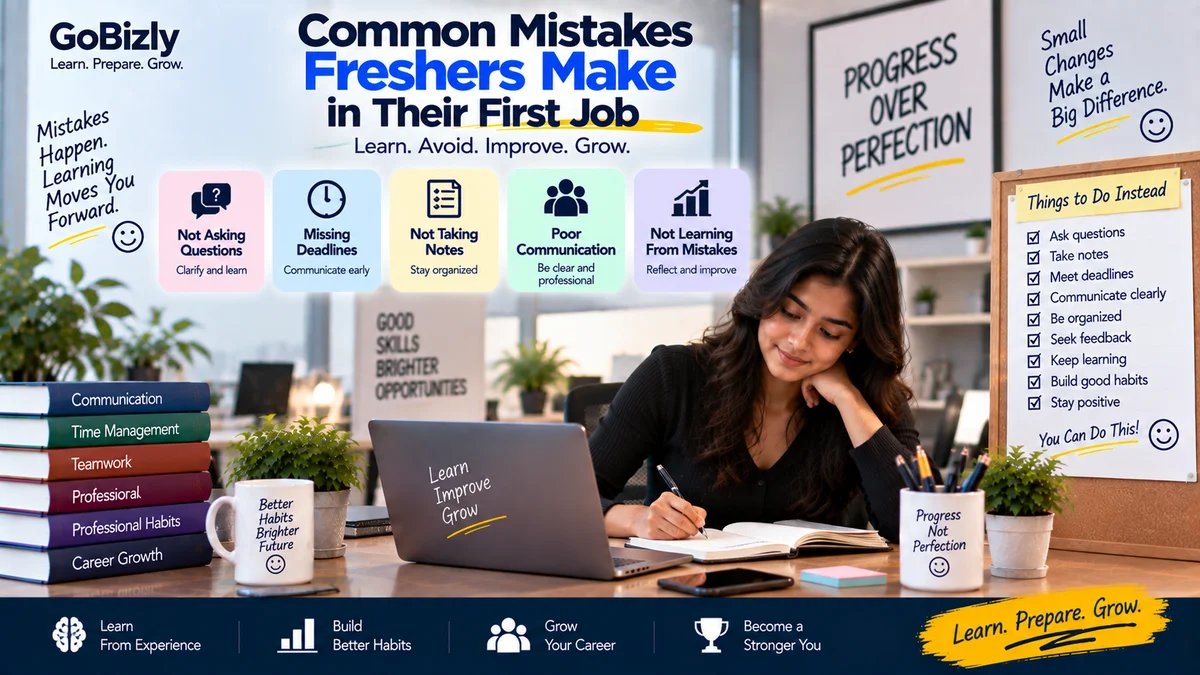
Common Mistakes Freshers Make in Their First Job
Common Mistakes Freshers Make in Their First Job
Starting your first job comes with a learning curve.
You are not only learning your actual role.
You may also be learning:
How meetings work
How to communicate with managers
How deadlines are handled
How teams collaborate
How work is documented
How feedback is given
Making mistakes is part of learning.
The goal is not to avoid every mistake.
The goal is to recognize common problems early and learn from them.
1. Being Afraid to Ask Questions
Some freshers avoid asking questions because they worry about appearing inexperienced.
But staying confused can create larger problems later.
Before asking:
Read the available information.
Try the task yourself.
Identify the exact point you're unsure about.
Ask a clear question.
2. Pretending to Understand
Saying "yes" when you don't understand an instruction can cause problems.
If something isn't clear, clarify it.
You can say:
"I want to make sure I understood the requirement correctly. Should the final output include X and Y?"
A short clarification can prevent significant rework.
3. Missing Deadlines Without Communicating
Unexpected problems happen.
The bigger issue is allowing a deadline to pass without communicating.
If you're blocked, tell the appropriate person early.
Explain:
What you've completed
What's blocking you
What you need
Expected next step
4. Not Taking Notes
You may receive a lot of information during your first few weeks.
Don't rely entirely on memory.
Record:
Processes
Instructions
Important terms
Feedback
Questions
This can also reduce repeated questions.
5. Focusing Only on Your Task
Understanding your task is important.
Understanding the broader process is also useful.
Ask:
Who uses my work?
Why is this task important?
What happens next?
This can help you understand the business context.
6. Being Unorganized
Poor organization can lead to:
Missed deadlines
Lost files
Forgotten tasks
Repeated work
Use a simple system for:
Tasks
Calendar
Files
Notes
Follow-ups
It doesn't need to be complicated.
7. Trying to Learn Everything at Once
Your organization may have dozens of tools and processes.
You don't need to master everything immediately.
Prioritize the tools and knowledge directly relevant to your role.
Then expand gradually.
8. Taking Feedback Personally
Feedback can sometimes feel uncomfortable.
Try separating:
Feedback about the work
from
Feedback about you as a person
Ask what you should change and apply it.
9. Not Checking Your Work
Before submitting something, review it.
Check:
Accuracy
Formatting
Numbers
Spelling
Required fields
Instructions
A short review can catch avoidable errors.
10. Being Too Quiet
You don't need to speak in every meeting.
But if you have a relevant question, update or idea, contribute appropriately.
Professional communication isn't about speaking the most.
It's about adding useful information.
11. Speaking Without Understanding
The opposite problem is also possible.
Don't feel pressured to contribute simply to be noticed.
Listen first.
Understand the topic.
Then provide a relevant response.
12. Comparing Yourself Constantly
Other employees may have:
More experience
Different backgrounds
Different responsibilities
Different skills
Use colleagues as sources of learning rather than measuring your entire career against them.
13. Ignoring Professional Communication
Messages like:
"Send this."
may not be appropriate in many workplace situations.
Instead:
"Could you please share the latest report when you have a chance?"
Communication should be clear and respectful.
14. Not Following Up
If someone gives you an action item, track it.
If you are waiting for information, follow up appropriately.
Don't assume that people will remember every pending item.
15. Avoiding Responsibility
When something goes wrong, don't immediately look for someone else to blame.
Understand:
What happened
What you could have done differently
How to prevent it
If someone else contributed to the issue, communicate the facts professionally.
16. Not Understanding Priorities
Not every task has the same urgency.
Ask when priorities are unclear.
For example:
"I have these three tasks. Which one should I prioritize for today's deadline?"
This is better than guessing.
17. Expecting Immediate Promotion
Career progression varies by organization and role.
Focus first on:
Learning
Delivering quality work
Building skills
Taking responsibility
Understanding your role
Your early career is a time to build foundations.
18. Ignoring Networking
Networking doesn't mean asking everyone for favors.
Build professional relationships through:
Collaboration
Learning
Industry events
Professional communities
LinkedIn
Internal interactions
Be genuine and respectful.
19. Not Keeping Evidence of Your Work
You may forget what you accomplished months later.
Keep a simple record of:
Projects
Contributions
Skills learned
Feedback
Results
This can help during performance discussions and future job searches.
20. Not Learning From Mistakes
The biggest problem isn't necessarily making a mistake.
It is repeating the same mistake without changing your process.
After an error, ask:
What happened?
Why?
What should I change?
How will I prevent it next time?
First Job Mistake Checklist
☐ Don't avoid necessary questions
☐ Clarify unclear instructions
☐ Communicate delays early
☐ Take notes
☐ Understand the bigger process
☐ Stay organized
☐ Prioritize learning
☐ Accept feedback
☐ Review your work
☐ Communicate professionally
☐ Track follow-ups
☐ Understand priorities
☐ Take responsibility
☐ Record achievements
☐ Learn from mistakes
Conclusion
Your first job is a learning experience.
You will make mistakes.
You may misunderstand instructions.
You may need to ask many questions.
You may receive feedback that changes how you work.
That's normal.
What matters is how you respond.
Learn quickly.
Communicate clearly.
Stay organized.
Accept feedback.
Take responsibility.
And gradually build the habits that help you become a dependable professional.
Your first job is not just about doing tasks. It's about learning how to work.
Learn. Prepare. Grow.