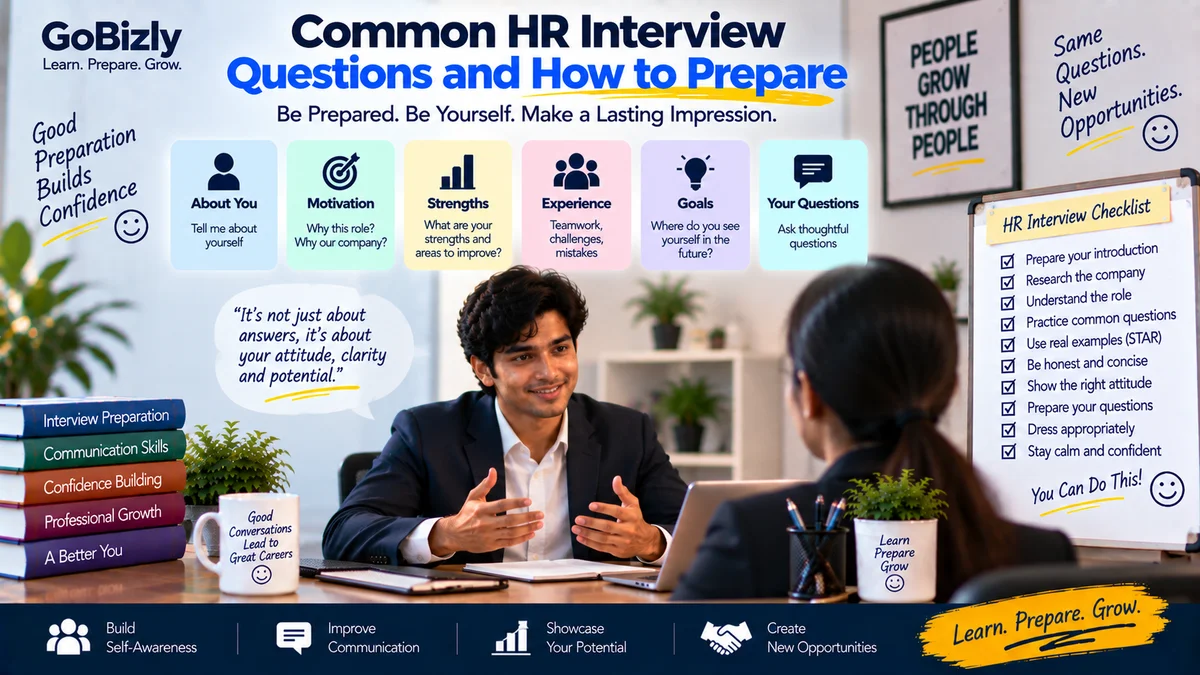
Common HR Interview Questions and How to Prepare
Common HR Interview Questions and How to Prepare
HR interviews often focus on more than technical knowledge.
Depending on the role and organization, you may be asked about:
Your background
Communication
Motivation
Teamwork
Problem solving
Career goals
Workplace situations
Strengths and development areas
You don't need to memorize answers to every possible question.
Instead, prepare your experiences, examples and key points.
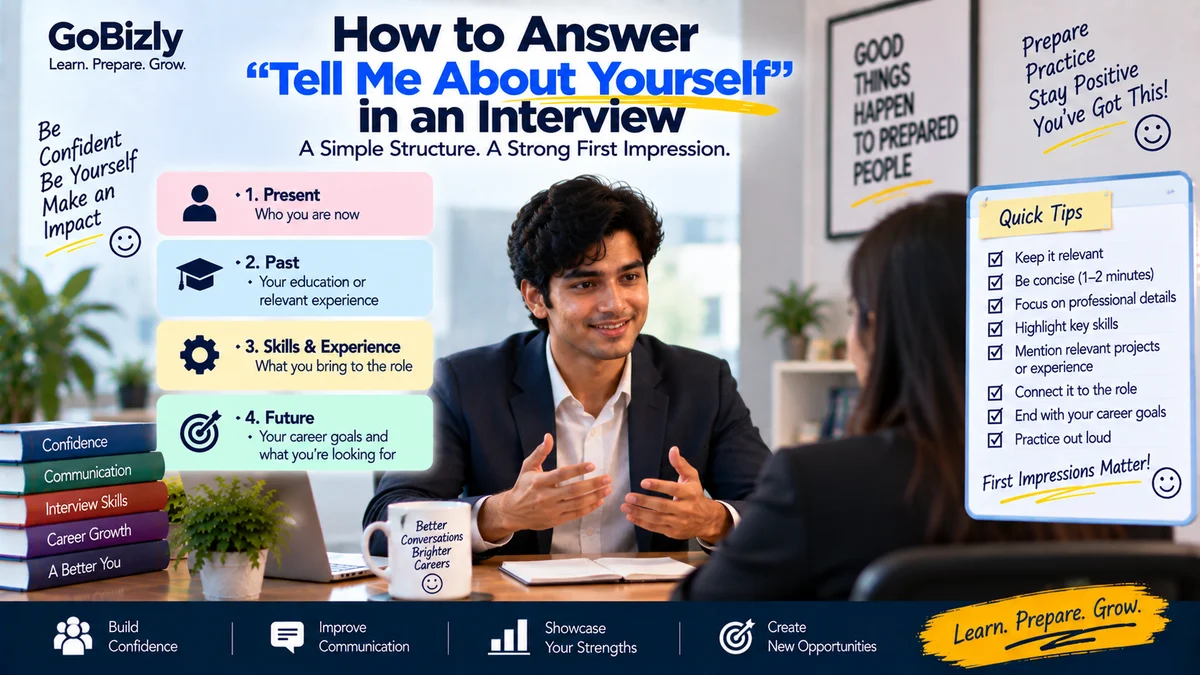
1. Tell Me About Yourself
This is often used as an opening question.
Use:
Present → Background → Relevant skills → Career direction
Keep the answer professional and relevant.
2. Why Do You Want This Role?
Connect the role with:
Your interests
Relevant skills
Experience
Learning goals
Avoid giving an answer based only on salary or convenience.
3. Why Do You Want to Work With Us?
Research the organization before answering.
You might discuss:
The company's industry
The role
Products or services
Learning opportunities
How your skills relate to the position
Keep the answer based on information you genuinely know.
4. What Are Your Strengths?
Choose strengths relevant to the role.
Examples:
Communication
Analytical thinking
Organization
Problem solving
Learning ability
Attention to detail
Support the strength with an example where possible.
5. What Would You Like to Improve?
Choose a genuine development area.
Then explain:
What you're working on → What you're doing → How you're improving
Avoid giving a weakness that is simply disguised as a strength.
6. Where Do You See Yourself Developing?
You don't need to predict your entire career.
Discuss:
Skills you want to build
Responsibilities you want to take on
Areas you want to develop
Keep your answer realistic and relevant to the role.
7. Tell Me About a Challenge You Faced
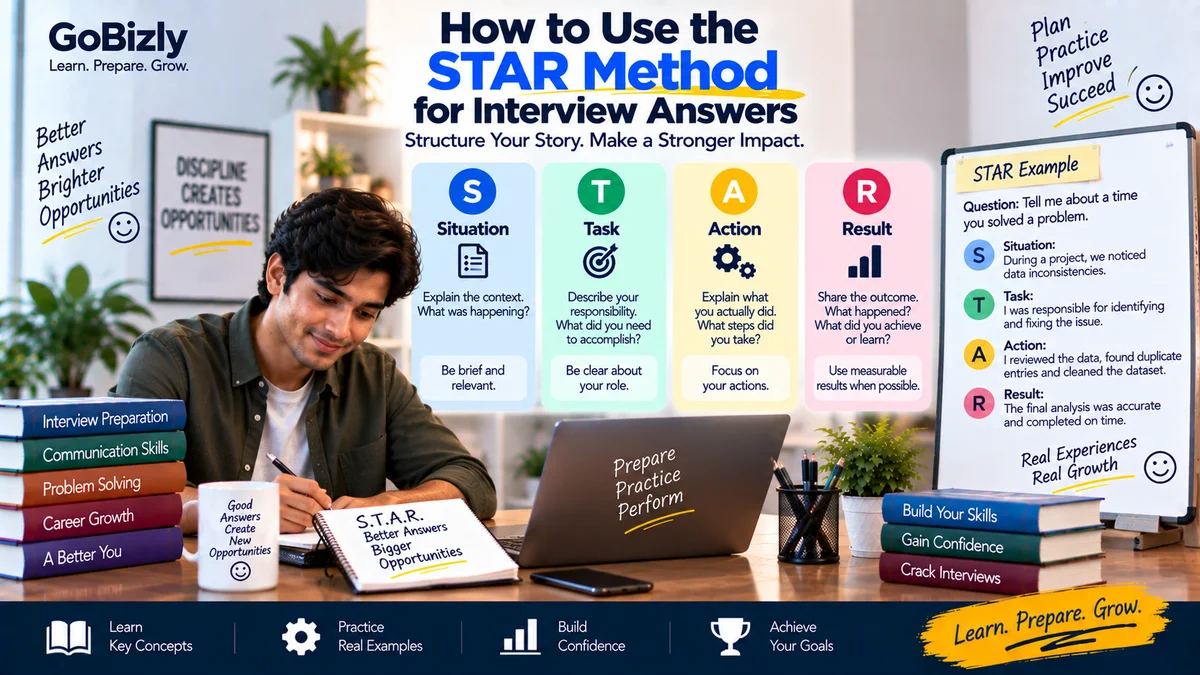
Use STAR:
Situation → Task → Action → Result
Choose a genuine example.
Focus on what you did.
8. Tell Me About a Mistake
Don't claim you've never made a mistake.
Choose an example where:
Something went wrong
You recognized it
You took action
You learned from it
Focus on improvement rather than blame.
9. Tell Me About a Time You Worked in a Team
Explain:
Situation
Your responsibility
Your contribution
How you communicated
Result
Avoid describing only what the entire team did.
10. How Do You Handle Pressure?
Avoid simply saying:
"I work well under pressure."
Explain your approach.
For example:
"When I have multiple deadlines, I first identify which tasks are most urgent, break larger tasks into smaller steps and communicate early if I identify a potential delay."
Use an actual example where possible.
11. How Do You Prioritize Tasks?
A simple approach is:
Urgency → Importance → Deadline → Dependencies
If priorities are unclear, ask for clarification.
12. How Do You Handle Disagreements?
Focus on:
Listening
Understanding the issue
Discussing facts
Finding common ground
Agreeing on the next step
Avoid blaming the other person.
13. Why Should We Hire You?
Connect:
Your skills + relevant experience + role requirements
For a fresher, this might include:
Education
Projects
Relevant skills
Learning ability
Communication
Avoid making claims you cannot support.
14. What Motivates You?
Your answer can relate to:
Learning
Solving problems
Building skills
Working toward goals
Taking responsibility
Give a genuine answer.
15. Are You Comfortable Learning New Tools?
If the role requires unfamiliar tools, explain how you approach learning.
For example:
"I usually start with the fundamentals, review documentation or structured learning resources and then practice by working on small tasks."
16. How Do You Handle Feedback?
A useful answer should show that you can:
Listen
Understand
Apply feedback
Review improvement
Give a genuine example when possible.
17. Why Did You Leave Your Previous Role?
If you're experienced, keep the answer factual and professional.
Avoid unnecessary criticism of previous employers or colleagues.
Focus on your career direction and what you're looking for next.
18. Explain a Career Gap
Keep it:
Honest → Concise → Relevant → Forward-looking
You can explain the reason and then discuss what you did during the period and your current career direction.
19. Do You Have Any Questions for Us?
Prepare a few questions.
Examples:
What would the first few months in this role look like?
What skills are most important for success?
How is performance evaluated?
What type of projects does the team work on?
Choose questions relevant to the role.
20. Don't Memorize Every Answer
Preparation should help you communicate naturally.
Create key points.
Prepare examples.
Practice speaking.
Then adapt your answer to the actual question.
HR Interview Preparation Checklist
☐ Self-introduction
☐ Why this role
☐ Why this organization
☐ Strengths
☐ Development areas
☐ Career goals
☐ Teamwork example
☐ Problem-solving example
☐ Challenge example
☐ Mistake example
☐ Pressure and prioritization
☐ Feedback
☐ Career gap if relevant
☐ Questions for interviewer
☐ Practice aloud
Conclusion
HR interviews are not simply a test of whether you can memorize standard answers.
They are an opportunity to explain your background, experiences, communication style and approach to workplace situations.
Prepare examples.
Understand your resume.
Research the role.
Practice speaking.
And answer honestly.
Don't memorize the interview. Prepare for the conversation.
Learn. Prepare. Grow.