Business Basics: Concepts Every Beginner Should Understand
Business Basics: Concepts Every Beginner Should Understand
Whether you are a student, fresher, aspiring entrepreneur or professional, understanding basic business concepts can help you make better decisions at work and communicate more effectively.
You don't need an MBA to understand how a business works.
Start by understanding how businesses create value, serve customers, generate revenue and manage resources.
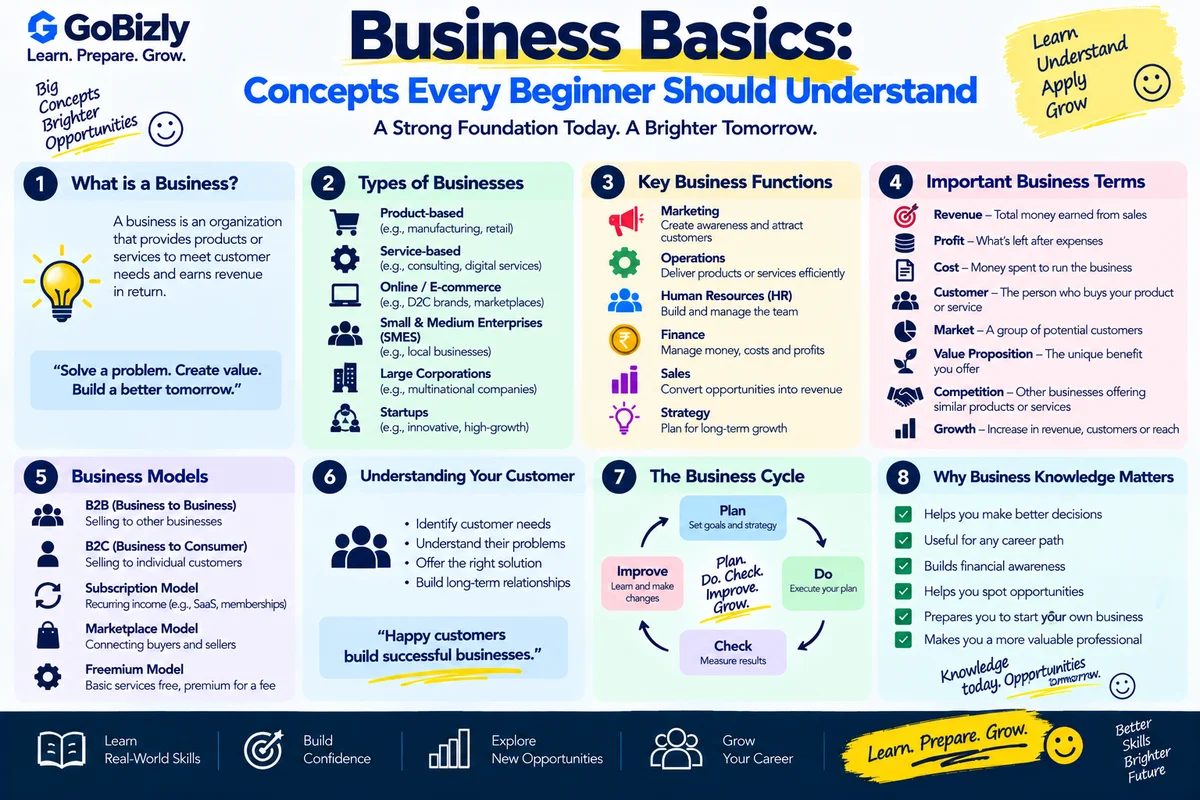
1. What Is a Business?
A business provides products or services that solve problems or satisfy customer needs.
A simple business model can be understood through four questions:
What problem are we solving?
Who are we solving it for?
How do we deliver the solution?
How does the business generate revenue?
2. Customers
Customers are the people or organizations that purchase or use a product or service.
Understanding customers involves identifying:
Their needs
Their problems
Their preferences
Their buying behavior
Their expectations
A business that understands its customers can make more informed decisions about products, pricing and marketing.
3. Value Proposition
A value proposition explains why a customer should choose a particular product or service.
For example:
"A simple online learning platform that helps students prepare for job interviews."
A strong value proposition communicates the problem being addressed and the value being offered.
4. Products and Services
Businesses generally provide either products, services or a combination of both.
Products
Physical or digital items customers can purchase.
Examples:
Software
Books
Electronics
Digital guides
Services
Activities or expertise provided to customers.
Examples:
Consulting
Marketing services
Training
Design
5. Revenue
Revenue is the income generated from business activities.
For example:
If a business sells 100 products at ₹500 each:
Revenue = 100 × ₹500 = ₹50,000
Revenue is not the same as profit.
6. Costs
Businesses incur costs while operating.
Examples include:
Salaries
Rent
Technology
Marketing
Software
Production
Logistics
Understanding costs is important when determining pricing and profitability.
7. Profit
A simplified formula is:
Profit = Revenue − Costs
A business can generate substantial revenue while still having low or negative profit if its costs are high.
8. Marketing
Marketing helps businesses communicate their value to potential customers.
It can include:
Advertising
Content marketing
SEO
Social media
Email marketing
Events
Partnerships
Marketing isn't simply advertising.
It includes understanding customers and communicating the value of an offering.
9. Sales
Sales focuses on converting potential customers into customers.
A simplified process can include:
Lead → Qualification → Conversation → Proposal → Decision → Purchase
The exact process varies by business.
10. Operations
Operations are the activities required to deliver products or services.
This could include:
Production
Customer support
Logistics
Technology
Quality control
Order processing
Marketing may bring customers into the business, while operations help deliver what was promised.
11. Competition
Businesses operate within competitive environments.
Competitors may offer:
Similar products
Alternative solutions
Different pricing
Different customer experiences
Understanding competition can help businesses identify opportunities and risks.
12. Business Strategy
Strategy involves deciding where the business should focus and how it will create value.
Important questions include:
Who is our target customer?
What problem are we solving?
What makes our offering different?
Which channels will we use?
What resources do we need?
How will we measure progress?
13. Key Business Metrics
Different businesses use different KPIs.
Examples include:
Revenue
Profit
Customer acquisition cost
Customer retention
Conversion rate
Average order value
Customer lifetime value
The right metrics depend on the business model.
14. Why Business Functions Work Together
A business isn't made up of isolated departments.
For example:
Marketing generates awareness.
↓
Sales converts opportunities.
↓
Operations delivers the product or service.
↓
Customer Support helps customers after purchase.
↓
Finance tracks financial performance.
These functions need to work together.
15. Learn Business Through Examples
One of the easiest ways to understand business concepts is to analyze real or hypothetical businesses.
Ask:
Who is the customer?
What problem does the business solve?
What does it sell?
How does it make money?
What are its major costs?
Who are its competitors?
How does it attract customers?
Business Basics Checklist
☐ Understand customers
☐ Define the value proposition
☐ Understand products and services
☐ Learn revenue and costs
☐ Understand profit
☐ Learn marketing fundamentals
☐ Understand sales
☐ Learn basic operations
☐ Analyze competition
☐ Understand business strategy
☐ Identify important KPIs
Conclusion
Business becomes easier to understand when you break it into its core components.
Start with the customer.
Understand the value being provided.
Then learn how marketing, sales, operations and finance work together to create a sustainable business.
Understand the fundamentals before moving into advanced business concepts.
Learn. Prepare. Grow.