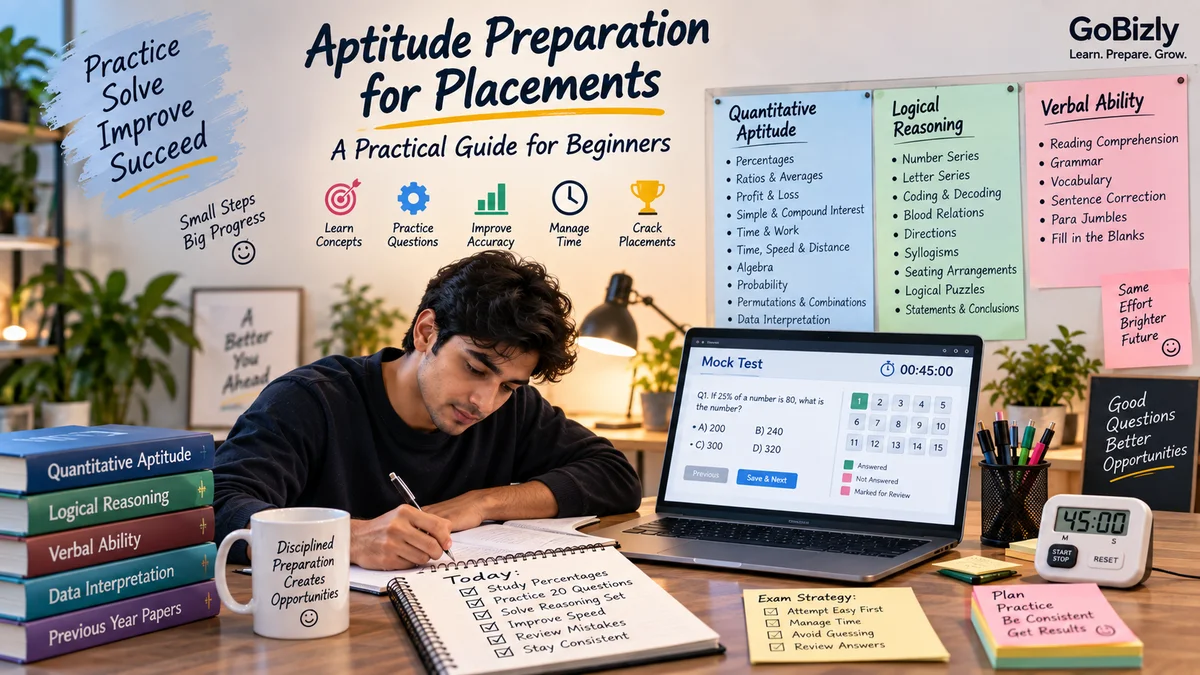
Aptitude Preparation for Placements: A Practical Guide for Beginners
Aptitude Preparation for Placements: A Practical Guide for Beginners
Aptitude tests are a common part of recruitment and placement processes, particularly for students and freshers.
For many candidates, the challenge isn't necessarily that the questions are extremely difficult.
The bigger challenge can be time pressure, unfamiliar question patterns and lack of consistent practice.
The good news is that aptitude is a skill you can develop.
You don't need to spend several hours every day solving random questions. A structured approach can help you understand the concepts, identify weak areas and gradually improve your speed and accuracy.
This guide explains how to approach aptitude preparation effectively.
1. Understand What an Aptitude Test Is
An aptitude test generally evaluates skills such as:
Numerical ability
Logical reasoning
Problem solving
Verbal ability
Data interpretation
Pattern recognition
The exact sections and difficulty vary between companies and recruitment processes.
Some assessments may focus heavily on quantitative questions, while others may include reasoning, English or role-specific assessments.
Before preparing, understand the type of test you're likely to take.
2. Identify the Main Areas
Aptitude preparation can generally be divided into three broad areas:
Quantitative Aptitude
Focuses on numbers and mathematical problem solving.
Common topics include:
Percentages
Ratios
Averages
Profit and loss
Simple and compound interest
Time and work
Time, speed and distance
Number systems
Algebra
Probability
Permutations and combinations
Data interpretation
Logical Reasoning
Tests your ability to identify patterns and relationships.
Common topics include:
Number series
Letter series
Coding and decoding
Blood relations
Directions
Syllogisms
Logical puzzles
Seating arrangements
Statements and conclusions
Verbal Ability
Tests language comprehension and usage.
Common areas include:
Reading comprehension
Grammar
Vocabulary
Sentence correction
Para jumbles
Fill-in-the-blanks
The exact topics depend on the assessment.
3. Don't Try to Learn Everything at Once
A common mistake is opening a large list of aptitude topics and trying to study everything simultaneously.
Instead, create a structured sequence.
For example:
Week 1: Percentages, ratios and averages
Week 2: Profit and loss, interest and basic arithmetic
Week 3: Time and work, speed and distance
Week 4: Logical reasoning and verbal ability
Then review and practice.
Breaking preparation into smaller sections makes it easier to measure progress.
4. Start With the Fundamentals
Before worrying about speed, understand the underlying concepts.
For example, if you're learning percentages, understand:
What percentage means
Percentage increase
Percentage decrease
Converting fractions to percentages
Comparing percentages
Applying percentages to real problems
Once the concept is clear, practice different question types.
The sequence should generally be:
Concept → Example → Practice → Review
5. Learn Common Shortcuts Carefully
Aptitude tests often involve time pressure.
Shortcuts can help when used correctly.
For example, knowing common percentage equivalents can save time:
50% = 1/2
25% = 1/4
20% = 1/5
10% = 1/10
5% = 1/20
Similarly, understanding multiplication patterns, fractions and basic mathematical relationships can improve speed.
However, don't memorize shortcuts without understanding the underlying concept.
A shortcut is useful only when you know when it applies.
6. Focus on Accuracy Before Speed
When beginning preparation, don't worry too much about completing questions quickly.
First aim to solve them correctly.
A useful progression is:
Accuracy → Consistency → Speed
If you repeatedly make mistakes because you're rushing, increasing your speed won't solve the underlying problem.
Once your accuracy improves, gradually introduce time limits.
7. Practice With a Timer
After understanding a topic, introduce timed practice.
For example:
10 questions → 15 minutes
Then gradually reduce the time as your confidence improves.
Timed practice helps you understand:
How quickly you solve questions
Which topics take longer
Where you make mistakes
Whether you spend too much time on difficult questions
The goal isn't simply to solve questions quickly.
It's to use your available time effectively.
8. Learn When to Move On
One difficult question can consume several minutes.
That can affect your performance on easier questions later.
During timed tests, learn to recognize when a question is taking too long.
A useful approach is:
Read → Estimate → Attempt → Move on if necessary
If you don't see a reasonable path to the solution, consider moving to the next question if the test format allows it.
You can return later when appropriate.
9. Keep a Mistake Log
One of the most useful aptitude preparation techniques is maintaining a record of your mistakes.
Create a simple table:
Question | Topic | Mistake | Correct Approach |
|---|---|---|---|
Q1 | Percentages | Formula error | Review percentage change |
Q2 | Ratio | Calculation error | Practice ratios |
Q3 | Reasoning | Misread pattern | Review series |
Over time, patterns will appear.
You may discover that you're repeatedly making mistakes in:
Calculations
Reading questions
Formulas
Logical interpretation
Time management
Fixing repeated mistakes can be more useful than simply solving more questions.
10. Practice Quantitative Aptitude Systematically
Start with foundational topics.
A possible sequence is:
Level 1 — Fundamentals
Number systems
Fractions
Decimals
Percentages
Ratios
Averages
Level 2 — Applications
Profit and loss
Simple interest
Compound interest
Time and work
Time and distance
Level 3 — Advanced Practice
Probability
Permutations
Combinations
Advanced data interpretation
The order can be adjusted depending on the assessment you're preparing for.
11. Practice Logical Reasoning
Logical reasoning improves with exposure to different question patterns.
Practice areas such as:
Number series
Letter series
Coding and decoding
Directions
Blood relations
Syllogisms
Seating arrangements
Logical puzzles
When solving reasoning questions, don't immediately search for the answer.
First ask:
What pattern or relationship is the question testing?
Learning to recognize patterns is an important part of reasoning practice.
12. Improve Verbal Ability
Aptitude preparation isn't only mathematics.
For verbal sections, practice:
Reading
Read articles and short passages regularly.
Vocabulary
Learn words in context rather than memorizing isolated lists.
Grammar
Review common grammatical structures.
Sentence Correction
Understand why a sentence is incorrect.
Reading Comprehension
Practice identifying:
Main idea
Supporting points
Author's position
Inferences
Relevant details
Regular reading can support several of these skills simultaneously.
13. Learn Data Interpretation
Data interpretation questions may present information through:
Tables
Bar charts
Line graphs
Pie charts
Mixed data
Don't immediately start calculating.
First understand:
What information is provided?
What is the question asking?
Which data is actually relevant?
Sometimes the biggest time saver is identifying which information you don't need.
14. Use Practice Tests
Practice tests help you understand how your preparation translates into performance.
After completing a test, don't look only at your score.
Review:
Correct Answers
Why were you able to solve them?
Incorrect Answers
What went wrong?
Unattempted Questions
Did you run out of time?
Time-Consuming Questions
Which topics took too long?
The review process can be as valuable as taking the test itself.
15. Analyze Your Performance
After several practice tests, create a simple performance tracker.
Test | Score | Accuracy | Time Used | Weak Areas |
|---|---|---|---|---|
Test 1 | 62% | 70% | 45 min | Ratios |
Test 2 | 68% | 75% | 44 min | Reasoning |
Test 3 | 74% | 82% | 42 min | Data Interpretation |
The exact metrics will depend on the test format.
The objective is to identify trends rather than focus on one individual score.
16. Don't Ignore Time Management
Aptitude tests often involve completing many questions within a limited period.
Develop a strategy.
For example:
First Pass
Solve questions you can answer confidently.
Second Pass
Return to questions requiring more calculation or thought.
Final Review
Check unanswered questions where the test rules allow it.
Your exact approach should depend on whether the assessment has negative marking, section-specific time limits or other restrictions.
17. Understand Negative Marking
If a test has negative marking, guessing strategy becomes important.
Before starting the assessment, understand:
Marks for correct answers
Penalty for incorrect answers
Whether unanswered questions receive zero
Whether you can return to previous questions
Don't assume every test follows the same rules.
Read the instructions carefully.
18. Prepare According to the Company
Different companies can use different assessment formats.
If you know the company you're preparing for, research the available information about its recruitment assessment.
Understand:
Test sections
Approximate duration
Question types
Difficulty level
Negative marking
Number of rounds
Then adjust your preparation accordingly.
19. Build a Daily Practice Routine
You don't necessarily need several hours of practice every day.
For example:
15 minutes
Review one concept.
20 minutes
Solve practice questions.
10 minutes
Review mistakes.
10 minutes
Practice reasoning or verbal ability.
That's approximately 55 minutes.
You can increase or decrease the time based on your schedule.
Consistency is more important than occasionally completing a very long session.
A 30-Day Aptitude Preparation Plan
Week 1 — Foundation
Focus on:
Percentages
Ratios
Averages
Number systems
Basic reasoning
Week 2 — Applications
Practice:
Profit and loss
Interest
Time and work
Speed and distance
Logical reasoning
Week 3 — Mixed Practice
Combine:
Quantitative aptitude
Reasoning
Verbal ability
Data interpretation
Start introducing timed tests.
Week 4 — Assessment Practice
Focus on:
Full-length practice tests
Time management
Mistake analysis
Weak areas
Revision
Common Aptitude Preparation Mistakes
Trying to memorize everything
Understanding concepts is more useful than memorizing solutions.
Practicing only easy questions
Gradually expose yourself to different difficulty levels.
Ignoring mistakes
Review mistakes instead of immediately moving to the next question.
Focusing only on speed
Accuracy should come first.
Solving questions without timing
Timed practice is important for test readiness.
Avoiding weak topics
Weak areas often require more deliberate practice.
Taking mock tests without reviewing them
The review process helps identify what needs improvement.
Aptitude Preparation Checklist
☐ Understand the test format
☐ Identify the main topics
☐ Build your fundamentals
☐ Practice quantitative aptitude
☐ Practice logical reasoning
☐ Practice verbal ability
☐ Practice data interpretation
☐ Maintain a mistake log
☐ Practice with a timer
☐ Take mock tests
☐ Review your performance
☐ Identify weak areas
☐ Revise important concepts
☐ Practice under realistic test conditions
Conclusion
Aptitude preparation is not about solving the maximum number of questions.
It is about understanding concepts, practicing consistently, improving accuracy and learning how to manage time under pressure.
Start with the fundamentals.
Practice one topic at a time.
Record your mistakes.
Use timed exercises.
Take practice tests.
Then use your results to identify what you need to improve.
With a structured approach, aptitude preparation becomes much more manageable.
Learn the concept. Practice the skill. Review the mistake. Improve the result.
Learn. Prepare. Grow.