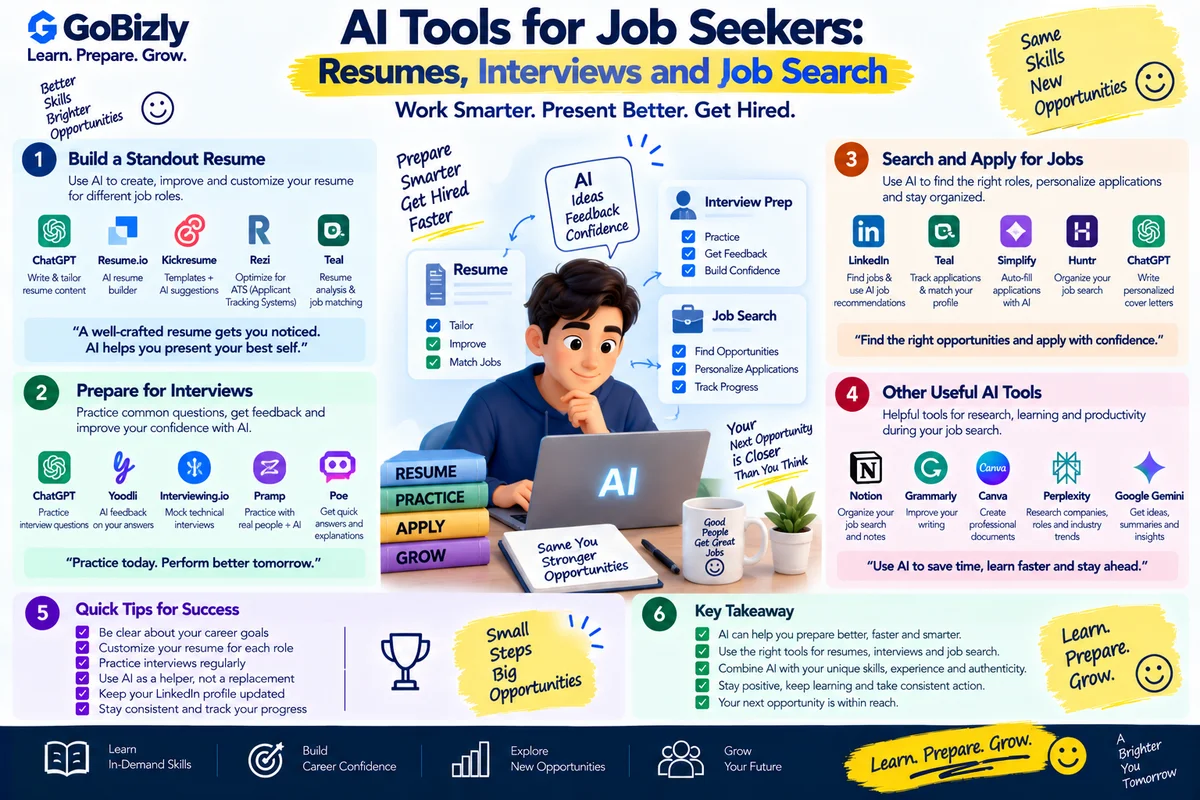
AI Tools for Job Seekers: Resumes, Interviews and Job Search
AI Tools for Job Seekers: Resumes, Interviews and Job Search
AI can support several parts of a job search.
It can help you analyze job descriptions, improve the clarity of your resume, practice interviews and organize your applications.
But your experience, achievements and career decisions should remain your own.
AI should assist the process rather than fabricate your professional background.
1. Analyze a Job Description
A job description can contain many requirements.
AI can help organize them into categories such as:
Required skills
Preferred skills
Responsibilities
Tools
Experience
Qualifications
This can help you understand what the employer is looking for.
2. Identify Resume Gaps
You can compare your existing resume with a job description.
Ask AI to identify:
Matching skills
Missing keywords
Relevant experience
Areas that need clarification
Don't add a skill simply because it appears in the job description.
Only include skills you genuinely possess.
3. Improve Resume Wording
AI can help make resume statements clearer.
For example:
Basic:
Managed digital marketing campaigns.
A stronger version might clarify the actual responsibility:
Managed digital marketing campaigns across defined channels, coordinating campaign setup, monitoring and performance reporting.
The statement should remain truthful to your actual experience.
4. Quantify Achievements Carefully
Numbers can make accomplishments easier to understand.
Examples might include:
Campaign volume
Budget managed
Process improvements
Time saved
Conversion improvements
Never invent numbers simply to make a resume appear stronger.
5. Tailor Your Resume
A general resume may not highlight everything relevant to a particular role.
AI can help identify which genuine experiences are most relevant.
A useful process is:
Job Description
↓
Relevant Requirements
↓
Your Existing Experience
↓
Relevant Resume Content
↓
Final Human Review
6. Practice "Tell Me About Yourself"
AI can act as an interview practice partner.
You can provide:
Education
Experience
Skills
Target role
Then ask it to help structure a concise introduction.
Your final answer should sound natural rather than memorized.
7. Practice Technical Interviews
Ask AI to generate questions based on a target role.
For example:
"Act as an interviewer for a digital marketing analyst role. Ask me one technical question at a time and wait for my answer."
This can help identify knowledge gaps.
8. Practice HR Interviews
AI can simulate questions such as:
Tell me about yourself.
Why do you want this role?
What are your strengths?
Describe a challenge you faced.
Why should we hire you?
Practice answering in your own words.
9. Use AI for Scenario Questions
Ask AI to provide realistic workplace situations.
For example:
"Give me a campaign troubleshooting scenario and ask me to explain how I would investigate it."
This can be especially useful for roles involving practical problem-solving.
10. Improve Professional Emails
AI can help draft:
Recruiter responses
Follow-up emails
Interview confirmations
Thank-you messages
Networking messages
Always review the message before sending it.
11. Organize Your Job Search
A simple tracker can include:
Company | Role | Date Applied | Status | Follow-up |
|---|
AI can help create or improve a tracking structure.
12. Prepare for Recruiter Conversations
AI can help you practice concise responses about:
Current situation
Experience
Skills
Notice period
Location
Role preferences
Keep factual information accurate.
13. Research Career Options
AI can help compare different career paths by organizing:
Required skills
Common responsibilities
Learning areas
Potential progression
For current job-market information, verify details using current job listings and reliable sources.
14. What AI Should Not Do
Avoid using AI to:
Invent experience
Fabricate achievements
Create fake certifications
Misrepresent employment history
Claim skills you don't have
Generate fake references
A polished resume is useful only when it accurately represents you.
15. Protect Your Information
Be careful when entering information into AI tools.
Avoid sharing unnecessary:
Passwords
Financial information
Government identification numbers
Confidential employer information
Private customer information
Use anonymized examples whenever possible.
16. A Practical AI Job Search Workflow
Find a suitable role
↓
Analyze the job description
↓
Identify relevant genuine experience
↓
Tailor your resume
↓
Prepare interview questions
↓
Practice answers
↓
Research the company
↓
Apply
↓
Track the application
↓
Follow up appropriately
Job Search AI Checklist
☐ Analyze job descriptions
☐ Identify relevant skills
☐ Improve resume wording
☐ Tailor genuine experience
☐ Practice introductions
☐ Practice technical questions
☐ Practice HR questions
☐ Practice scenarios
☐ Draft professional messages
☐ Track applications
☐ Verify important information
☐ Protect personal data
Conclusion
AI can make job preparation more structured and interactive.
Use it to analyze, practice, organize and improve.
But your resume should represent your actual experience, and your interview answers should reflect your own knowledge and experiences.
Use AI as a career assistant—not as a substitute for authenticity.
Learn. Prepare. Grow.