AI Basics: What Is Artificial Intelligence and How Does It Work?
AI Basics: What Is Artificial Intelligence and How Does It Work?
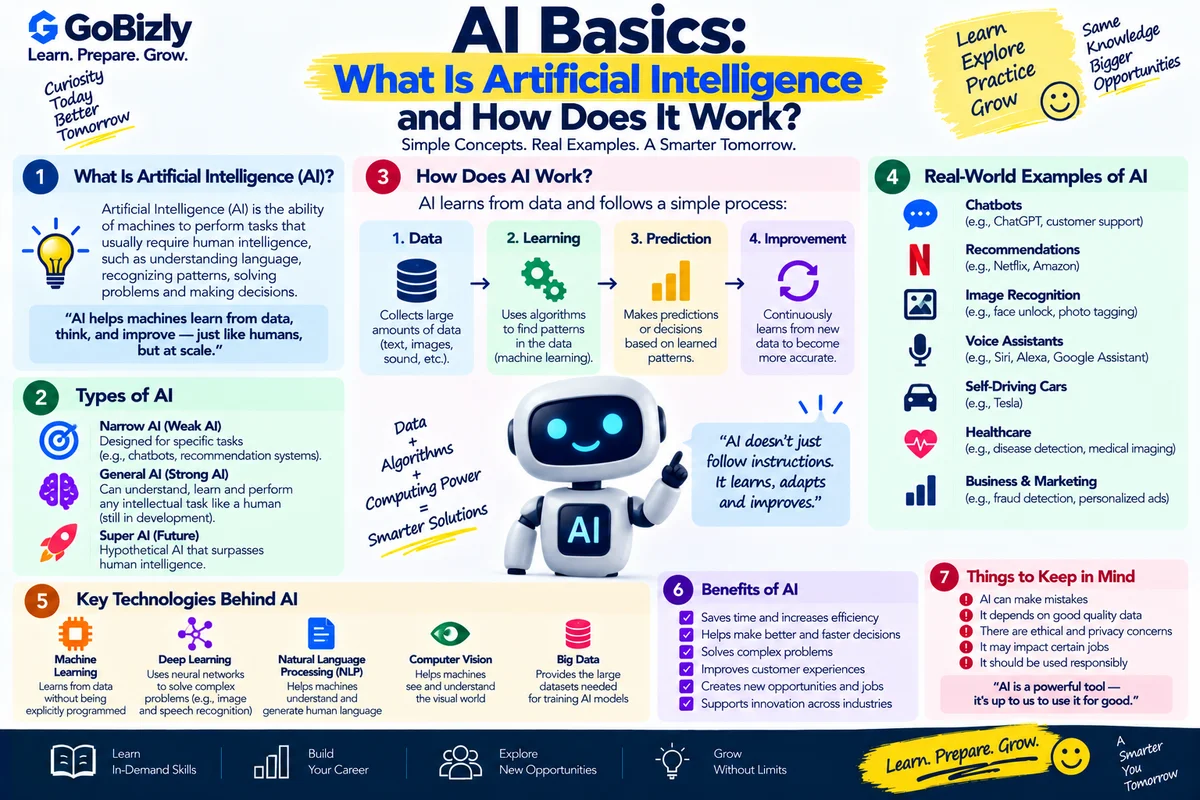
Artificial Intelligence, commonly called AI, refers to technologies that enable computers to perform tasks that traditionally require human-like capabilities such as recognizing patterns, understanding language, making predictions and generating content.
AI is now used across education, business, healthcare, marketing, software development, customer service and many other areas.
For beginners, the important thing is to understand what AI actually does, how different AI technologies relate to each other and where its limitations exist.
1. What Is Artificial Intelligence?
Artificial intelligence is a broad field of computing focused on creating systems that can perform tasks associated with intelligent behavior.
Examples include:
Understanding language
Recognizing images
Predicting outcomes
Recommending content
Detecting patterns
Generating text
Generating images
Supporting decision-making
AI doesn't necessarily mean that a computer thinks exactly like a human.
Different AI systems are designed for different tasks.
2. What Is Machine Learning?
Machine Learning (ML) is a major area within AI.
Instead of explicitly programming every possible rule, machine-learning systems can learn patterns from data.
For example, a system can be trained using examples to identify patterns associated with different categories.
The model can then use what it learned to make predictions or classifications on new data.
3. What Is Generative AI?
Generative AI refers to AI systems capable of generating new content based on learned patterns.
Depending on the system, generated content can include:
Text
Images
Audio
Video
Code
Generative AI has made AI tools much more accessible to everyday users.
4. What Are Large Language Models?
A Large Language Model (LLM) is a type of AI model designed to process and generate language.
LLMs can perform tasks such as:
Answering questions
Summarizing information
Rewriting text
Generating ideas
Explaining concepts
Drafting content
Assisting with code
The quality of an answer depends on the model, the prompt, available context and the task.
5. How Does Generative AI Produce an Answer?
A simplified process looks like:
User input
↓
AI processes the instructions and context
↓
Model generates an output
↓
User reviews the result
The underlying technology is significantly more complex, but this simplified model is useful for beginners.
6. What Are AI Models?
An AI model is a trained computational system that can perform particular tasks.
Different models may specialize in:
Language
Images
Speech
Recommendations
Prediction
Classification
Models can also be integrated into larger applications.
7. AI in Everyday Life
You may already use AI without realizing it.
Examples include:
Search recommendations
Spam detection
Navigation
Content recommendations
Voice assistants
Translation
Fraud detection
Personalized feeds
AI isn't limited to chatbots.
8. AI in the Workplace
Businesses can use AI for activities such as:
Customer support
Data analysis
Content creation
Document processing
Research assistance
Software development
Marketing
Forecasting
The appropriate use depends on the task and the organization's requirements.
9. AI and Automation Are Not the Same
Automation follows predefined workflows or rules.
AI can use learned patterns or models to perform tasks that may require more flexible interpretation.
For example:
Automation
→ If a customer submits a form, send a predefined email.
AI
→ Analyze a customer message and generate a response based on its content.
AI and automation can also be combined.
10. Benefits of AI
AI can help with:
Speed
Productivity
Pattern recognition
Content generation
Research assistance
Repetitive tasks
Personalization
However, benefits depend on implementation and the quality of the information provided.
11. Limitations of AI
AI systems can produce incorrect or misleading outputs.
Potential issues include:
Inaccurate information
Missing context
Outdated information
Bias
Incorrect assumptions
Overconfident answers
Therefore, important information should be reviewed before being used.
12. Why Human Judgment Still Matters
AI can assist with tasks, but users still need to:
Define the objective
Provide context
Evaluate outputs
Check important facts
Make decisions
Take responsibility for the final result
The strongest approach is often human judgment supported by AI.
13. AI Skills Worth Learning
Beginners can start with:
AI fundamentals
Prompt writing
Fact-checking
AI-assisted research
Data privacy
Workflow automation
Responsible AI usage
You don't need to become an AI engineer to benefit from AI tools.
14. A Simple AI Learning Path
Understand AI
↓
Learn Generative AI
↓
Practice Prompting
↓
Use AI for Real Tasks
↓
Verify Outputs
↓
Build AI-Assisted Workflows
↓
Learn Advanced Tools
AI Basics Checklist
☐ Understand AI
☐ Learn machine learning basics
☐ Understand generative AI
☐ Learn what LLMs are
☐ Explore everyday AI applications
☐ Understand AI vs automation
☐ Learn AI limitations
☐ Practice prompting
☐ Verify important information
☐ Protect sensitive information
Conclusion
AI is a broad technology area rather than a single tool.
Start by understanding the basic concepts, then explore how AI can support your studies, career and everyday work.
The most useful AI skill isn't simply knowing how to generate an answer.
It is knowing what to ask, how to evaluate the response and how to apply it responsibly.
Learn. Prepare. Grow.